

Report Overview
The Global AI in Spine Surgery Market size is expected to be worth around US$ 6.6 Billion by 2035 from US$ 1.2 Billion in 2025, growing at a CAGR of 18.5% during the forecast period 2026-2035. In 2025, North America led the market, achieving over 52.6% share with a revenue of US$ 0.7 Billion.
Increasing adoption of robotic-assisted and image-guided technologies accelerates the AI in Spine Surgery market as orthopedic and neurosurgeons require intelligent systems that enhance precision, reduce complications, and improve outcomes in complex spinal procedures.
Surgeons increasingly utilize AI-powered robotic platforms during pedicle screw placement in spinal fusion surgeries, where algorithms automatically segment vertebral anatomy from preoperative CT scans and provide real-time trajectory guidance to achieve optimal screw positioning and minimize breach risks.
Multiple new FDA 510(k) clearances for AI surgical guidance platforms in 2025 is driving the market. The U.S. Food and Drug Administration granted 510(k) clearance to Proprio’s Paradigm platform in April 2025 for real-time intraoperative 3D measurements during spine procedures. Additional clearances followed for Surgical Theater’s SyncAR Spine in October 2025, integrating AI-powered extended reality with existing navigation systems. Carlsmed received clearance for its Aprevo cervical fusion platform in December 2025, combining AI-driven planning with patient-specific implants. The 2025 regulatory milestones validate substantial equivalence while introducing advanced guidance features. Surgeons gain tools for dynamic trajectory optimization and implant positioning. The clearances align with increasing demand for precision in complex spinal reconstructions. Facilities benefit from streamlined workflows and reduced manual adjustments. The development stimulates adoption in academic and community settings alike. Early implementations demonstrate consistent performance gains in screw accuracy. Overall, these clearances accelerate clinical integration of AI guidance technologies in spine surgery practice. North America is leading the AI in Spine Surgery Market North America accounted for 52.6% of the AI in spine surgery market in 2025 as hospitals and surgical centers rapidly integrated artificial intelligence with robotic-assisted systems and advanced imaging technologies to improve surgical precision and patient outcomes. Spine surgeons across the United States increasingly rely on AI-enabled navigation systems that analyze preoperative imaging and assist in accurate implant placement and alignment during complex procedures. According to the American Academy of Orthopaedic Surgeons, more than 500000 spinal fusion procedures are performed annually in the United States, reflecting a high procedural volume that drives demand for advanced surgical technologies. Growing prevalence of degenerative spine disorders, spinal injuries, and age-related musculoskeletal conditions has further increased the need for precision-guided surgical interventions. Healthcare providers are adopting AI-driven analytics that support intraoperative decision-making and reduce complication rates. Integration of robotic-assisted platforms with AI algorithms has enhanced surgical accuracy and workflow efficiency in operating rooms. Academic medical centers and research institutions are collaborating with technology companies to develop predictive models that improve surgical planning and postoperative outcomes. Surgeons are also receiving specialized training in AI-assisted surgical techniques, which is accelerating clinical adoption. These developments collectively supported strong growth of intelligent spine surgery technologies across North America in 2025. The Asia Pacific region is expected to experience the highest CAGR during the forecast period Asia Pacific is expected to experience strong expansion during the forecast period as healthcare systems modernize and adopt advanced surgical technologies to address rising spinal disorder cases. Countries such as China, Japan, South Korea, and India are investing in artificial intelligence, robotics, and digital health infrastructure to improve surgical outcomes and healthcare efficiency. The World Health Organization reported that musculoskeletal conditions affect more than 1.7 billion people globally, highlighting the significant burden of spine-related disorders and the need for advanced treatment solutions. Hospitals across the region are expanding access to minimally invasive and robot-assisted spine procedures supported by intelligent surgical planning tools. Governments are promoting digital health initiatives that encourage integration of AI technologies into surgical care pathways. Medical technology companies are collaborating with regional hospitals to introduce advanced navigation systems and robotic platforms tailored for spine surgery. Universities and research institutions are strengthening programs in biomedical engineering and surgical robotics to support innovation in this field. Growing awareness among patients regarding advanced surgical options is also encouraging adoption of technology-driven procedures. These developments are expected to accelerate the use of intelligent spine surgery technologies across Asia Pacific in the coming years. North America Europe Asia Pacific Middle East & Africa Latin America Key participants in the AI in Spine Surgery Market expand growth by integrating artificial intelligence with robotic-assisted surgical systems, advanced imaging platforms, and real-time navigation tools that enhance precision in spinal procedures. Companies collaborate with hospitals and surgical centers to deploy AI-driven planning software that supports accurate implant placement and improves intraoperative decision-making. They also invest in data analytics platforms and machine learning models that analyze surgical outcomes to refine techniques and reduce complications. Medtronic plc represents a prominent participant in the AI in Spine Surgery Market and operates as a global medical technology company headquartered in Ireland that develops spinal implants, surgical robotics, and digital surgery solutions. The company focuses on combining robotics, navigation, and AI-powered insights to improve surgical accuracy and patient recovery outcomes. Industry competitors continue to introduce intelligent surgical platforms, strengthen clinical partnerships, and expand technology ecosystems to accelerate adoption of advanced spine surgery solutions.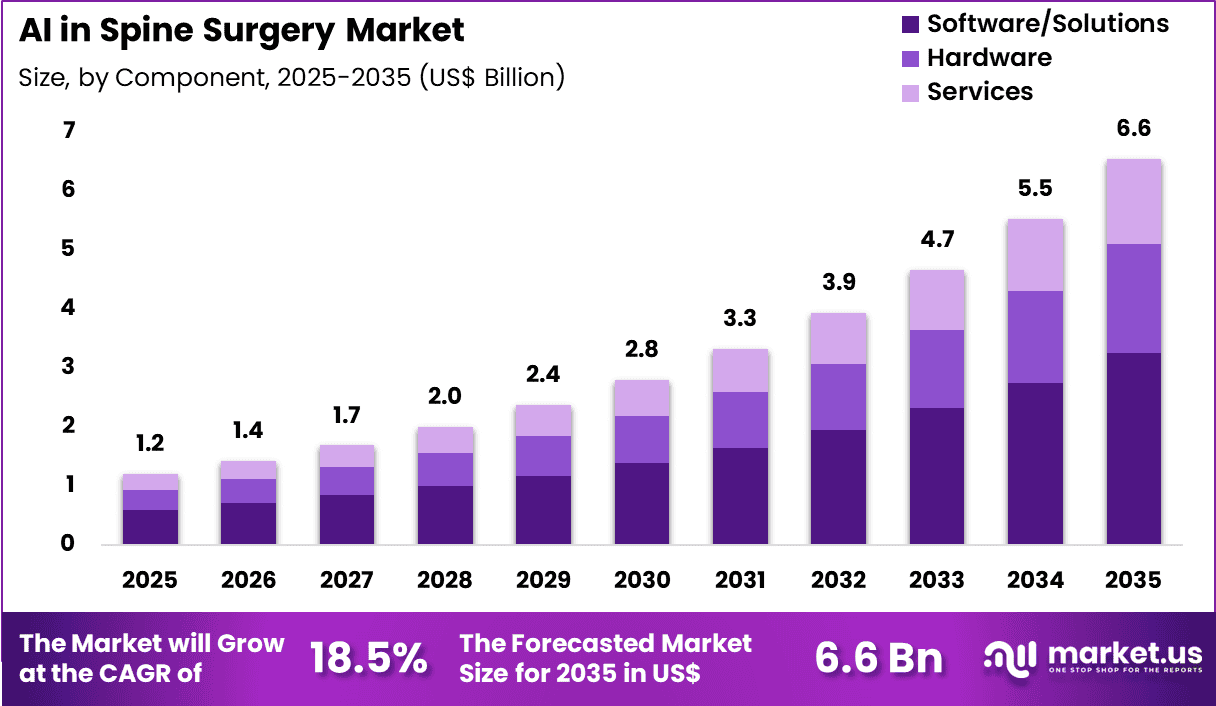
Latest Trends
Regional Analysis

Key Regions and Countries
Key Players Analysis
Top Key Players
Recent Developments