

Report Overview
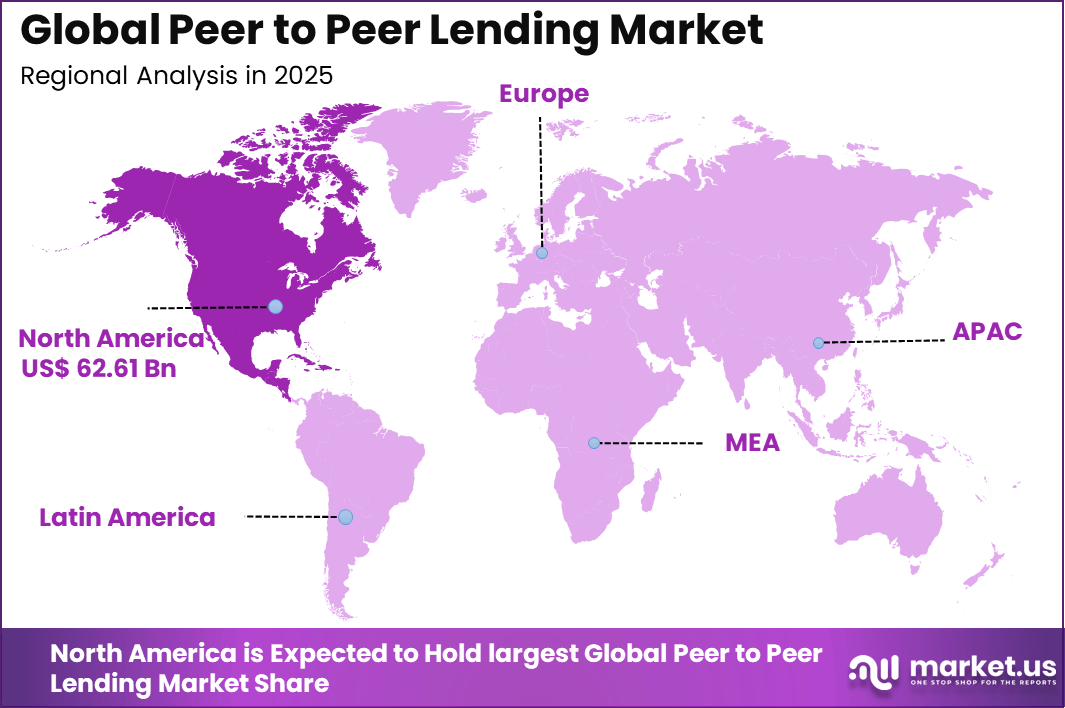
The Global Peer to Peer Lending Market size is expected to be worth around USD 2,768.92 billion by 2035, from USD 180.45 billion in 2025, growing at a CAGR of 31.4% during the forecast period from 2025 to 2035. North America held a dominant market position, capturing more than a34.7% share, holding USD 62.61 billion in revenue.
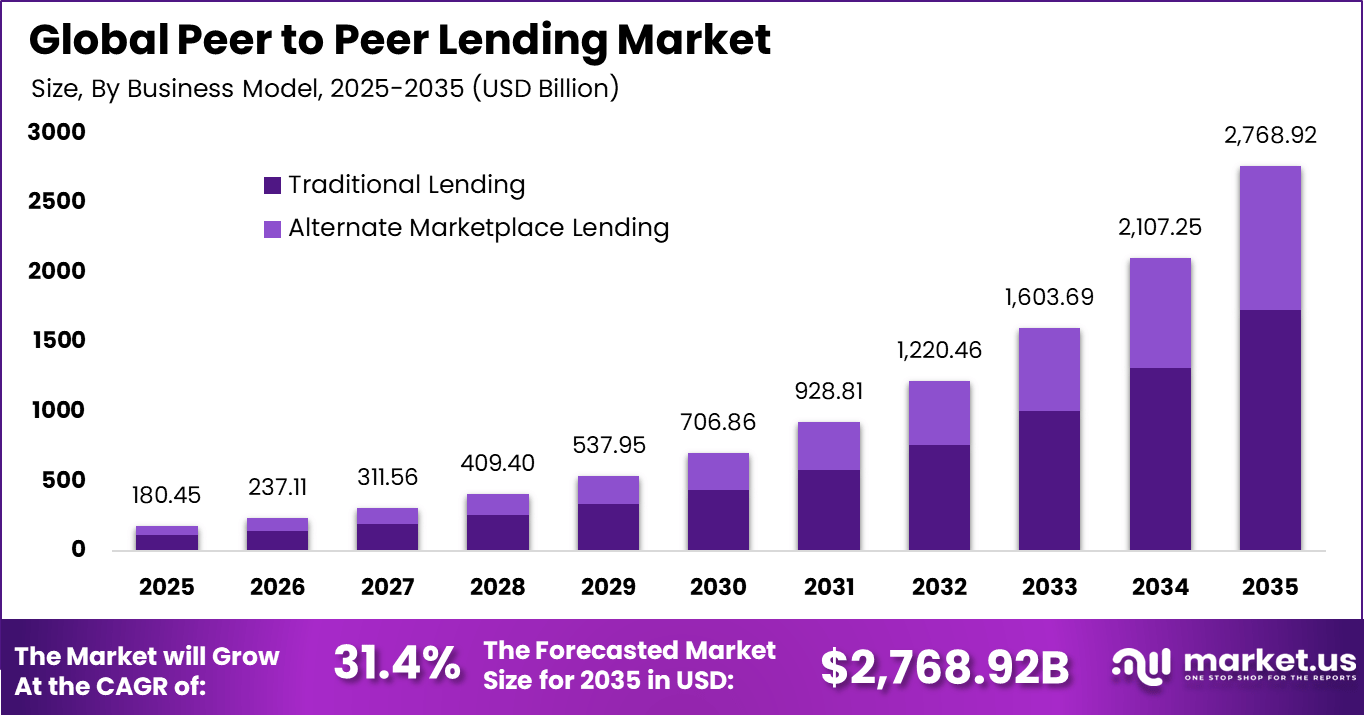
The peer to peer lending market refers to platforms that connect individual and institutional lenders directly with borrowers through digital intermediaries. These platforms facilitate unsecured and secured loans for personal, business, and consumer financing without the traditional banking intermediation. Lending decisions are supported by digital credit assessment tools that evaluate borrower risk and assign interest rates accordingly.
The market has expanded as both borrowers and lenders seek alternatives to conventional financial institutions. Growth in this market has been influenced by advancements in internet connectivity and fintech innovation that support secure, real time transactions. Peer to peer platforms provide streamlined application processes and faster access to funds compared with traditional loan channels. Investors are attracted by potential returns that may exceed savings and money market alternatives.
For instance, in April 2025, Prosper Funding LLC locked in a hefty $500 million forward flow pact led by Fortress Investment Group and Edge Focus, supercharging personal loans for debt refi and big buys. It’s a lifeline for borrowers ditching high-rate cards, proving Prosper’s staying power in matching lenders with solid returns amid economic ups and downs.
Key Takeaway
- Traditional lending models led the global P2P lending landscape with a 62.6% share, as platforms continued to mirror conventional loan structures that borrowers and investors already understand and trust.
- Consumer loans accounted for 42.2%, reflecting sustained demand for personal financing used for debt consolidation, medical expenses, and lifestyle needs.
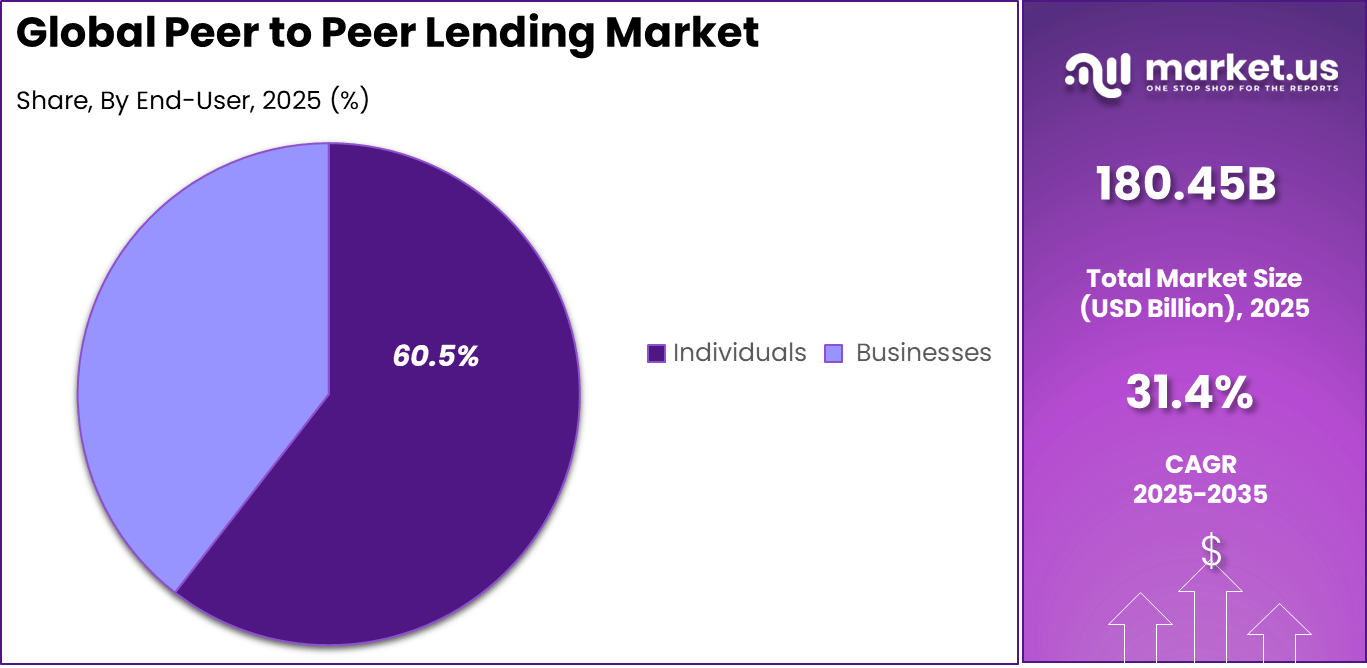
- Individual participants dominated the market with a 60.5% share, underlining the strong role of retail borrowers and investors in driving platform activity and liquidity.
- Medium-term loans (1–5 years) represented the largest maturity category at 57.4%, offering a balance between manageable repayment periods for borrowers and attractive yield profiles for investors.
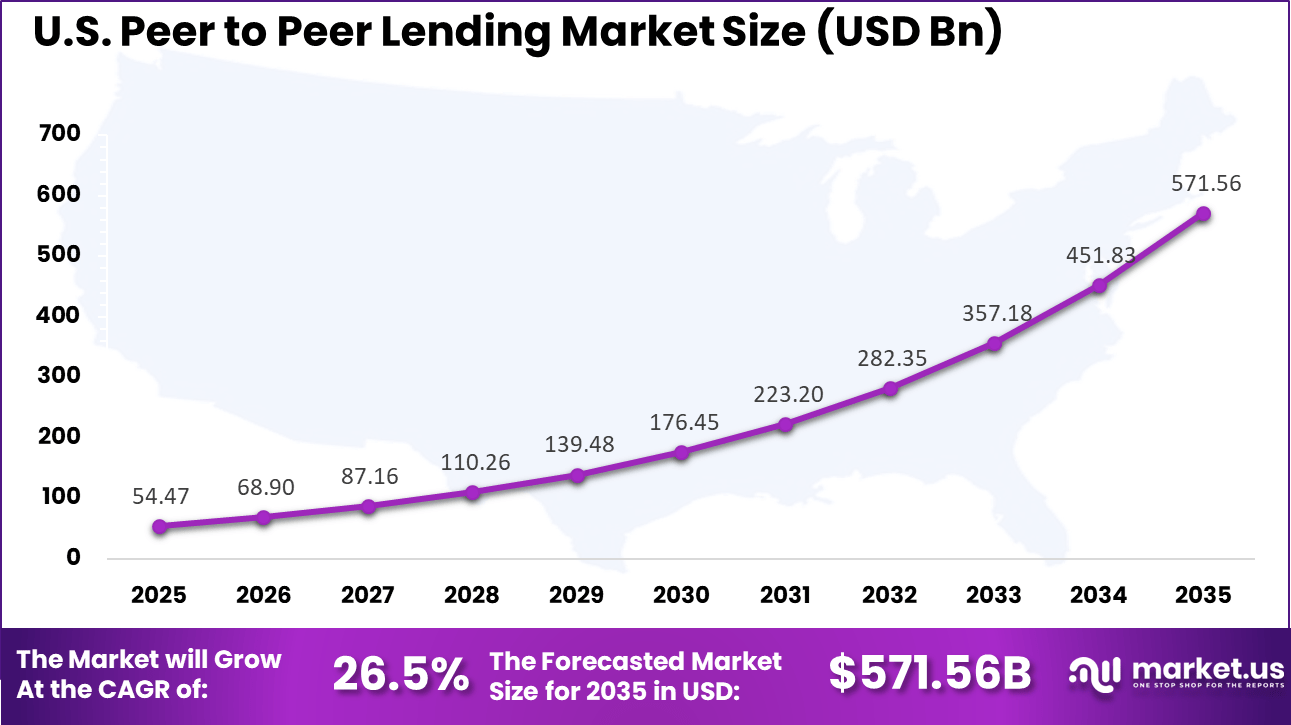
- The U.S. market reached USD 54.47 billion in 2025 and is expanding at a strong 26.5% CAGR, supported by high digital adoption, alternative credit demand, and a mature fintech ecosystem.
- North America held over a 34.7% share of the global market, driven by regulatory clarity, widespread fintech usage, and growing acceptance of non-bank lending channels.
Key Statistics
Sector-Specific Insights (2024–2025)
- Consumer lending remains the largest loan category, accounting for about 55% of total P2P lending volume in 2025, supported by demand for quick, unsecured credit.
- Business lending follows with roughly 35%, as small businesses increasingly use P2P platforms for working capital and short-term financing needs.
- Individual investors are expected to generate 51.8% of total market revenue in 2025, highlighting the strong role of retail participation in platform liquidity.
- Mobile-first borrowing is now standard, with nearly 80% of borrowers accessing P2P loans through mobile applications.
- Investor returns typically range between 5% and 12% annually, offering higher yield potential compared with traditional savings products.
Risk and Performance Indicators
- Default rates averaged around 4.5% globally in 2023, although platform-level risk varies widely. Some P2P portfolios report default levels exceeding 10%, compared with traditional bank delinquency rates near 1.44%.
- Borrower overleveraging is a key risk factor, with repayment of existing bank debt responsible for about 33% of loan defaults across platforms.
- AI-driven credit assessment is becoming standard, with more than 60% of platforms using AI-based scoring models by 2025, reducing default risk by an estimated 15% through better borrower profiling and risk segmentation.
Drivers Impact Analysis
| Driver Category | Key Driver Description | Estimated Impact on CAGR (%) | Geographic Relevance | Impact Timeline |
|---|---|---|---|---|
| Digital lending adoption | Shift toward online credit platforms | ~8.6% | North America, Europe | Short Term |
| Credit access gap | Underserved borrowers seeking alternatives | ~7.2% | Global | Short to Mid Term |
| Faster loan processing | Automation reducing approval timelines | ~6.3% | Global | Short Term |
| Investor yield demand | Search for higher returns than deposits | ~5.4% | North America, Asia Pacific | Mid Term |
| Platform risk analytics | Improved borrower screening accuracy | ~3.9% | Global | Long Term |
Risk Impact Analysis
| Risk Category | Risk Description | Estimated Negative Impact on CAGR (%) | Geographic Exposure | Risk Timeline |
|---|---|---|---|---|
| Credit default risk | Higher borrower risk during downturns | ~6.2% | Global | Short Term |
| Regulatory tightening | Licensing and compliance constraints | ~5.1% | North America, Europe | Mid Term |
| Platform trust issues | Fraud and data breaches | ~4.3% | Global | Short Term |
| Liquidity risk | Limited secondary market depth | ~3.1% | Global | Mid Term |
| Interest rate volatility | Changing borrowing demand | ~2.4% | Global | Long Term |
Restraint Impact Analysis
| Restraint Factor | Restraint Description | Impact on Market Expansion (%) | Most Affected Regions | Duration of Impact |
|---|---|---|---|---|
| Regulatory uncertainty | Fragmented lending rules | ~6.7% | Global | Mid Term |
| Investor risk perception | Concerns over loan recoverability | ~5.4% | Global | Short to Mid Term |
| Platform concentration | Dependence on few major platforms | ~4.2% | North America | Long Term |
| Limited borrower education | Misunderstanding loan terms | ~3.6% | Emerging Markets | Short Term |
| Capital availability swings | Sensitivity to market cycles | ~2.9% | Global | Mid Term |
U.S. Peer to Peer Lending Market Size
The United States reached USD 54.47 Billion with a CAGR of 26.5%, reflecting rapid expansion. Growth is driven by rising borrower participation. Investors seek alternative income sources. Platform innovation continues. Market momentum remains strong.
For instance, in December 2025, Avant LLC surpassed 2 million customers on its data-driven platform, serving middle-income Americans with personal loans, credit cards, and financial tools. Since 2012, Avant has connected over 4.3 million unique customers to $12.5 billion in loans and 2.8 million credit cards using its AI-powered CreditOS engine. This milestone reinforces U.S. dominance in peer-to-peer lending through innovative fintech solutions.
North America accounts for 34.7%, supported by strong digital finance adoption. The region has high internet penetration and financial literacy. Peer to peer platforms are widely accepted. Regulatory frameworks support platform growth. The region remains influential.
For instance, in November 2025, LendingClub Corporation expanded into the $500 billion home improvement financing market via a distribution partnership and technology acquisition from Mosaic. The San Francisco-based P2P leader’s strategic move accelerates growth in consumer lending, showcasing U.S. firms’ agility in capturing new segments and driving North America’s P2P lending supremacy.
Business Model Analysis
In 2025, Traditional lending accounts for 62.6%, showing its strong position within peer to peer platforms. This model follows structured processes for borrower assessment and loan approval. Investors prefer predictable lending frameworks with defined risk controls. Platforms using traditional models focus on transparency and consistency. This approach builds trust among participants.
The dominance of traditional lending is driven by familiarity and regulatory alignment. Borrowers understand repayment terms more easily. Investors benefit from clearer risk evaluation. Standardized processes improve operational efficiency. This sustains long-term adoption of traditional models.
For Instance, in April 2025, Prosper Funding LLC announced a $500 million forward flow agreement with Fortress and Edge Focus. This deal lets Prosper buy more unsecured personal loans from its traditional platform. It helps lenders reach more borrowers seeking debt refinance or home fixes. The move boosts direct matching in the core model.
Loan Type Analysis
In 2025, the Consumer loans represent 42.2%, making them the leading loan category. These loans support personal expenses such as education, healthcare, and household needs. Borrowers value faster access to funds through digital platforms. Simpler application processes increase demand. Consumer lending remains central to platform activity.
Growth in consumer loans is driven by unmet credit needs. Many individuals seek alternatives to traditional banks. Peer to peer platforms offer flexible options. Competitive interest rates attract borrowers. This supports continued expansion of consumer lending.
For instance, in March 2025, LendingClub Corporation shut its retail P2P side. Shift eyes to institutional backers for consumer loan growth. Platforms still push personal funds through direct channels. Borrowers have options for home or debt needs.
End-User Analysis
In 2025, The Individuals account for 60.5%, highlighting their primary role as borrowers. Personal users rely on peer to peer platforms for accessible financing. Digital interfaces simplify loan applications. Faster approval improves user experience. Individual participation drives transaction volume.
Adoption among individuals is driven by convenience and speed. Users prefer online processes over branch visits. Platforms provide clear loan terms. Repayment tracking improves financial planning. This sustains strong individual engagement.
For Instance, in March 2025, Social Finance Inc. targeted individuals with new personal finance tools. SoFi boosted peer matches for debt relief and goals among everyday users. The move taps the large individual base seeking bank alternatives.
Repayment Term Analysis
In 2025, the Medium-term loans account for 57.4%, making them the preferred repayment option. These loans balance affordability and repayment flexibility. Borrowers manage payments without long-term commitment. Investors benefit from steady returns. Medium durations reduce default risk.
Preference for medium-term loans is driven by financial stability. Borrowers align repayment with income cycles. Platforms structure terms to support sustainability. Predictable cash flows attract lenders. This keeps medium-term loans dominant.
For Instance, in December 2024, RateSetter expanded 1-5 year loans for steady payouts. Lenders set rates fitting medium spans matching borrower plans. Platform sees uptick in holds for reliable medium commitments.
Investor Type Impact Matrix
| Investor Type | Adoption Level | Contribution to Market Growth (%) | Key Motivation | Investment Behavior |
|---|---|---|---|---|
| Individual lenders | Very High | ~44% | Higher yield potential | Portfolio diversification |
| Institutional investors | High | ~28% | Scalable credit exposure | Structured investments |
| High net worth individuals | Moderate to High | ~15% | Yield enhancement | Selective allocation |
| Asset managers | Moderate | ~9% | Alternative income products | Fund based exposure |
| Retail platforms | Low to Moderate | ~4% | User acquisition | Incentive driven |
Technology Enablement Analysis
| Technology Layer | Enablement Role | Impact on Market Growth (%) | Adoption Status |
|---|---|---|---|
| Digital lending platforms | Core loan origination and servicing | ~9.1% | Mature |
| AI based credit scoring | Risk assessment automation | ~7.4% | Growing |
| Open banking integration | Access to borrower financial data | ~5.6% | Growing |
| Cloud infrastructure | Platform scalability | ~4.8% | Mature |
| Blockchain settlement | Transparency and traceability | ~2.5% | Developing |
Emerging Trends
In the peer to peer lending market, a key trend is the integration of digital underwriting technologies that assess borrower creditworthiness using non-traditional data sources. Instead of relying solely on historical credit scores, platforms are increasingly analysing alternative indicators such as transaction history, mobile usage behaviour, and real-time financial activity. This broader view of borrower profiles can improve access to credit for individuals and small enterprises that might otherwise be excluded by conventional scoring models.
Another emerging trend is the expansion of automated loan servicing and workflow processes. Many peer to peer platforms are deploying automated systems for loan origination, disbursement, collections, and investor reporting. These systems reduce manual intervention, accelerate processing times, and enhance transparency for both borrowers and lenders. Automated servicing also supports scalability as lending activity grows across multiple segments.
Growth Factors
A principal growth factor in the peer to peer lending market is the growing demand for accessible credit solutions outside traditional banking channels. Individuals and small businesses often seek alternatives to conventional lenders due to stringent eligibility requirements or lengthy approval timelines. Peer to peer platforms can offer more flexible access to funds, which attracts borrowers who need quick or tailored financing.
Another important factor supporting growth is the increasing investor interest in diversified lending opportunities. Peer to peer platforms allow individual and institutional lenders to allocate capital across a range of loan types and risk profiles. This diversification potential can appeal to investors seeking predictable returns outside traditional fixed income or equity markets.
Opportunity
A strong opportunity exists in the expansion of niche lending verticals such as education loans, healthcare financing, small business growth credit, and sustainable initiatives. Platforms that develop specialised lending products aligned with specific use cases can differentiate their offerings and attract both targeted borrower segments and aligned investor communities.
Another opportunity lies in deepening integration with financial ecosystems and partner networks. By collaborating with banks, payment processors, credit bureaus, and fintech service providers, peer to peer platforms can enhance onboarding, risk evaluation, and capital flows. These partnerships can support broader adoption and enable more seamless financing experiences.
Challenge
One of the main challenges for the peer to peer lending market is ensuring platform credibility and transparency. Borrowers and lenders alike must trust that pricing, risk disclosures, and servicing practices are fair and accurate. Platforms must provide clear reporting, robust governance, and independent audit mechanisms to maintain confidence and encourage participation.
Another challenge involves complying with diverse regulatory regimes across regions. Peer to peer platforms often operate across multiple jurisdictions with varying requirements for licensing, investor protection, and consumer disclosure. Navigating this regulatory mosaic requires dedicated compliance efforts and ongoing engagement with authorities to ensure lawful operations.
Key Market Segments
By Business Model
- Traditional Lending
- Direct Lender-to-Borrower
- Alternate Marketplace Lending
- Platform-Facilitated Lending
- Hybrid Lending (involving institutional investors)
By Loan Type
- Consumer Loans
- Debt Consolidation
- Home Renovation
- Medical Expenses
- Family Expenses
- Other Personal Needs
- Small Business Loans
- Working Capital
- Equipment Financing
- Expansion Loans
- Real Estate Loans
- Commercial
- Residential
- Student Loans
By End-User
- Individuals
- Prime Borrowers
- Near-Prime Borrowers
- Subprime Borrowers
- Businesses
- Small and Medium Enterprises (SMEs)
- Startups
By Repayment Term
- Short-term Loans (up to 12 months)
- Medium-term Loans (1-5 years)
- Long-term Loans
Key Regions and Countries
- North America
- US
- Canada
- Europe
- Germany
- France
- The UK
- Spain
- Italy
- Russia
- Netherlands
- Rest of Europe
- Asia Pacific
- China
- Japan
- South Korea
- India
- Australia
- Singapore
- Thailand
- Vietnam
- Rest of APAC
- Latin America
- Brazil
- Mexico
- Rest of Latin America
- Middle East & Africa
- South Africa
- Saudi Arabia
- UAE
- Rest of MEA
Key Players Analysis
LendingClub Corporation, Prosper Funding LLC, and Zopa Bank Limited are key players in the peer to peer lending market, enabling direct lending between individuals through digital platforms. Their models focus on faster loan approvals, transparent pricing, and data driven credit assessment. These platforms reduce reliance on traditional banking channels. Growing demand for flexible personal and SME financing continues to support their strong market position.
Funding Circle, Social Finance Inc., Avant LLC, and RateSetter strengthen the market by targeting underserved borrowers and small businesses. Their platforms use alternative data and risk based pricing to improve credit access. These companies emphasize borrower experience and investor returns. Rising acceptance of digital lending models supports wider adoption.
Kabbage Inc., LendingTree LLC, and OnDeck expand the landscape with lending marketplaces and short term credit solutions. Their offerings support comparison shopping, working capital needs, and rapid funding. These players focus on automation and scalability. Continued growth in fintech adoption is driving steady expansion of the peer to peer lending market.
Top Key Players in the Market
- Avant LLC
- Zopa Bank Limited
- Funding Circle
- Social Finance Inc.
- Kabbage Inc.
- RateSetter
- Lending Club Corporation
- Prosper Funding LLC
- LendingTree LLC
- OnDeck
- Others
Recent Developments
- In December 2025, Avant secured a strategic growth investment from Court Square Capital Partners and Pamlico Capital, fueling expansion in lending products for underserved consumers. This move builds on their track record of facilitating $8 billion in loans since 2012, solidifying their role in accessible credit markets.
- In November 2025, Lending Club Corporation expanded into $500 billion home improvement financing via the Wisetack partnership and Mosaic tech acquisition. After buying Cushion AI in April, this positions LendingClub to grab bigger slices of consumer debt markets.
- In January 2025, LenDenClub, a well known peer to peer lending platform, announced the launch of a new daily earning loan product. This offering allows lenders to earn interest on a daily basis along with scheduled principal repayments. Investors are provided with flexible options, with loan tenures starting from nine months. The product was designed to attract users seeking predictable returns and shorter investment commitments.
- In July 2025, Funding Circle marked a strong comeback after a period of restructuring. The UK based platform extended significantly higher credit in the first half of 2025 compared to the previous year. This improvement supported a return to profitability following its exit from the U.S. market. The recovery highlighted stronger lending performance and improved financial discipline within the platform.