

Report Overview
The Global AI In Precision Medicine Market size is expected to be worth around USD 24.4 Billion by 2033, from USD 2.4 Billion in 2023, growing at a CAGR of 26.1% during the forecast period from 2024 to 2033.
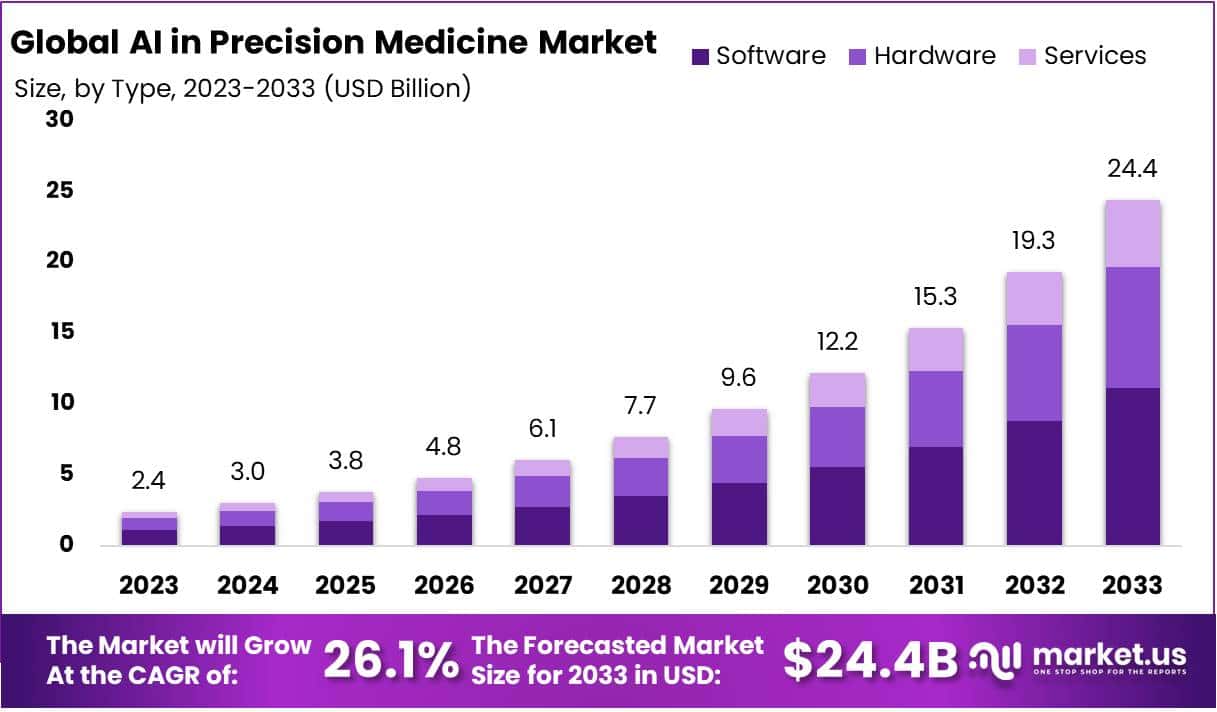
The utilization of an individual’s genomic data to tailor personalized medicine, commonly known as artificial intelligence in precision medicine, is reshaping the landscape of healthcare. This innovative approach leverages deep learning, a core component of artificial intelligence, to craft individualized treatment plans. It integrates diverse data sources such as electronic health records, genomic profiles, insurance details, diagnostic images, and data from wearable devices.
The integration of data analytics and machine learning in personalized medicine has revolutionized the field, enhancing the accuracy of disease diagnosis, treatment selection, and prognosis prediction. AI algorithms excel in detecting subtle patterns and correlations in health data that may elude human experts, streamlining complex medical decision-making processes.
The market for AI in precision medicine is experiencing robust growth, driven by supportive government policies, an increase in chronic disease prevalence, and growing public awareness of the benefits of AI-driven treatments. Strategic collaborations among key industry players have further expanded the market’s scope.
For example, the World Health Organization reported that chronic obstructive pulmonary disease, a leading cause of death globally, accounted for 3.23 million deaths in 2019, predominantly affecting individuals over 70 in lower-income countries. Additionally, a notable collaboration between Enlitic and GE Healthcare aims to enhance efficiency for PACS users by standardizing data through the use of Enlitic Curie.
Key Takeaways
- AI-based software solutions have shown significant potential in diagnosing diseases, contributing to the recent growth of the software segment.
- The deep learning segment holds a notable market share of 36.2%, as revealed by a technology analysis.
- The oncology segment’s widespread adoption of AI-driven solutions highlights the role of AI in treating various cancer types, which is expanding the market.
- The rising elderly population often faces serious diseases, underscoring the need for AI-based solutions to improve patient outcomes.
- Concerns over data security could impede the growth of the AI in precision medicine market.
Component Analysis
AI-Based Software Solutions Propel Market Growth in 2023
In 2023, the AI in precision medicine market is segmented into hardware, software, and services. AI-based software solutions, known for their precise diagnostics and insightful analysis of medical reports, have significantly bolstered the software segment, capturing a notable market share of 45.6%. These solutions are increasingly adopted by healthcare providers and research institutions, contributing to their prominence in various healthcare applications.
This includes reducing dosage errors, assisting in robotic surgeries, detecting fraud, enhancing telemedicine, and strengthening cybersecurity. The growth in this segment is further supported by strategic collaborations, such as GE Healthcare’s partnerships with 12 Sigma Technologies, Bio-mind, Yizhun Medical, and Shukun Technology in China, aimed at developing the Edison AI platform and facilitating digital transformation.
Technology Analysis
Accelerated Diagnostic Procedures Through Deep Learning Algorithms
The market for AI in precision medicine is divided into several technology segments, including Machine Learning, Querying Method, Deep Learning, Context Aware Processing, and Natural Language Processing. In 2023, the Deep Learning segment commands a significant market share of 36.2%, highlighting its dominance over other segments.
This prominence is largely due to the sophisticated capabilities of deep learning platforms, such as enhanced processing power and automated task performance. Deep learning algorithms facilitate the integration and modeling of varied patient data across different modalities and timelines, leading to improved predictive accuracy and tailored treatment recommendations.
Conversely, Natural Language Processing is projected to grow at the fastest compound annual growth rate (CAGR) of 37.4%. This growth is attributed to its critical role in expediting decision-making processes in healthcare settings, thereby enabling physicians to focus on value-added treatments.
Therapeutic Area Analysis
The precision medicine market, particularly in the field of oncology, has achieved significant advancements, driven by the integration of artificial intelligence (AI). In 2023, the oncology segment dominated the market with a substantial share of 47.6%. This prominence is primarily due to AI’s role in enhancing the accuracy of cancer diagnoses and improving patient outcomes. The surge in global cancer cases, coupled with advancements in healthcare infrastructure, further propels this market segment.
- According to the World Health Organization, cancer was responsible for approximately 10.3 million deaths worldwide in 2020.
In addition to oncology, the neurology segment is expected to see robust growth, with a projected compound annual growth rate (CAGR) of 34.8% during the forecast period. This growth is attributed to the increasing prevalence of neurological disorders such as epilepsy, dementia, Alzheimer’s disease, and migraines, which continue to drive the demand for AI in precision medicine.

Key Market Segments
By Component
- Hardware
- Software
- Services
By Technology
- Machine Learning
- Querying Method
- Deep Learning
- Context Aware Processing
- Natural Language Processing
By Therapeutic Area
- Oncology
- Neurology
- Cardiology
- Respiratory
- Others
Market Drivers
Technological Advancements Propel AI in Precision Medicine Market
The AI in precision medicine market is experiencing robust growth driven by technological advancements. The integration of AI-based computational tools and extensive human genome databases has significantly enhanced the scope of precision medicines. Furthermore, strategic partnerships and collaborations among key players are crucial in advancing cancer biology and developing precision medicine solutions.
- For instance, a significant partnership between GE Healthcare (US) and Minerva Imaging (Denmark) aims to advance precision medicine developments in oncology treatments, thereby boosting the market’s growth during the forecast period.
AI Adoption Boosted by Growing Geriatric Population
The integration of AI in precision medicine is expanding significantly, driven by the increasing elderly population. This demographic shift is predicted to enhance market growth, as older adults face higher health risks compared to younger individuals. Here’s how the rise in the geriatric population is expected to propel the adoption of AI technologies:
- According to the World Health Organization’s 2022 report, by 2030, one in seven people globally will be over 60 years old. Furthermore, the number of individuals aged 60 and above is projected to double by 2050, reaching approximately 2.3 billion.
- A projection by the National Library of Medicine suggests a 99.5% increase in the number of Americans with at least one chronic condition, from 71.522 million in 2020 to 142.66 million by 2050.
This data underscores the crucial role of AI in addressing the complexities of healthcare for an aging global population.
Market Restraints
Impact of Data Breaches on AI Adoption in Precision Medicine
Data security issues significantly restrict the growth of the AI-driven precision medicine market. Artificial intelligence handles a vast amount of sensitive patient data, including insurance IDs, medical records, and social security numbers. Consequently, this sector faces substantial challenges due to unauthorized access, misuse, and data breaches, which impede the adoption of AI in precision medicine and slow market expansion.
For example, a data breach at OneTouch Point in July 2022 affected approximately 2,651,396 individuals.
Opportunities
AI as a Catalyst for Growth in Precision Medicine
Artificial intelligence (AI) significantly enhances precision medicine, transforming how we understand, diagnose, and treat diseases. This technology leverages vast medical data to extract patterns, correlations, and insights through advanced deep learning and machine learning techniques.
AI’s integration into research streamlines and sharpens data analysis, facilitating advancements in disease understanding, drug development, and personalized treatments. Additionally, the market experiences a boost from increasing collaborations and partnerships, which significantly propel AI sales in precision medicine.
These developments present promising opportunities for market expansion in the upcoming years. For instance, Intel’s collaboration with the Perelman School of Medicine at the University of Pennsylvania aims to develop an AI model that helps identify brain cancer.
Impact of macroeconomic factors
One of the significant macroeconomic factor influencing the market spread is rising inflation affecting the prices of AI solutions, consumer purchasing power, and cost of regulatory compliance. The rising inflation affects the pricing of AI driven solutions, making the companies to adjust their pricing to conceal heightening operational costs.
This limits the patients and healthcare providers’ access towards advanced healthcare technologies. Consumers and healthcare professionals find it more difficult to afford such expensive AI driven precision medicine solutions, slowing down the adoption rate particularly in the regions where patients have limited accessibility for insurance coverage for highly improved medical treatments.
Latest Trends
Several advancements in AI in precision medicine results into the growth of the market. Some of these include:
Integration of Multi Omics Data
A better understanding regarding disease mechanism and improvements in patient’s outcomes is as a result of integrating various omics disciplines such as transcriptomic, metabolomics, genomics and proteomics. The integration and analysis of multi-omics data promises the advances in precision medicine.
Personalized treatment plans
Large datasets of patient information such as lifestyle factors, medical history, and genetic data are being extensively analyzed aided by AI algorithms, leading to the optimization of treatment efficiency and reducing side effects.
Regional Analysis
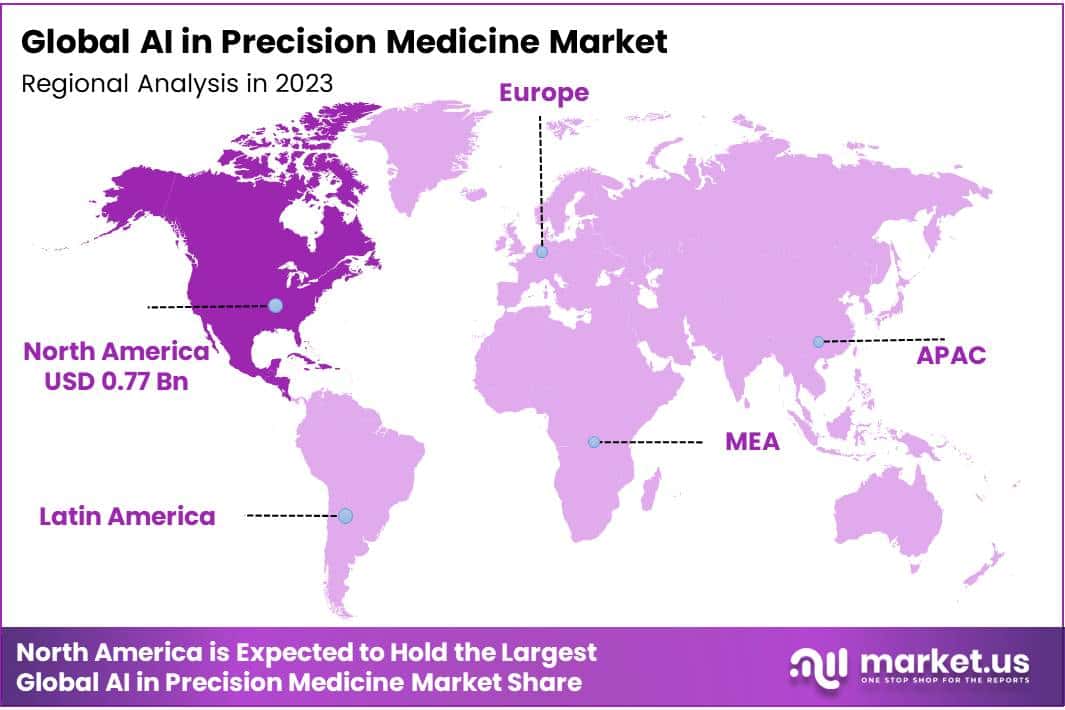
North America to witness significant growth during the forecast period
North America has established a commendable market presence compared to other regions, largely due to the strategic presence of key players such as Mead Johnson and Company and Abbott Laboratories. In 2023, the region achieved a significant market share of 32.4%. This success is further bolstered by numerous collaborations among market stakeholders.
Additionally, the region benefits from a global increase in the elderly population, sedentary lifestyles, and the expansion of health-related digital information datasets, which enhance the development of advanced medications and improve treatment outcomes. Key developments include:
According to estimates from a US-based intergovernmental organization in May 2023, chronic diseases like cardiovascular diseases, diabetes, cancer, and respiratory illnesses are projected to account for 86% of the 90 million deaths anticipated by 2050.
Certara, Inc. has initiated a two-year partnership with Memorial Sloan Kettering Cancer Center to develop a bio-simulation platform for CAR-T cell treatment, demonstrating the region’s commitment to advancing healthcare solutions.
By Region and Countries
- North America
- The US
- Canada
- Europe
- Germany
- France
- The UK
- Spain
- Italy
- Russia & CIS
- Rest of Europe
- APAC
- China
- Japan
- South Korea
- India
- ASEAN
- Rest of APAC
- Latin America
- Brazil
- Mexico
- Rest of Latin America
- Middle East & Africa
- GCC
- South Africa
- UAE
- Rest of MEA
Key Players Analysis
Several leading companies are actively advancing AI in precision medicine, including Novo Nordisk, GE Healthcare, Alphabet Inc., Sanofi, and Tempus. These companies are deploying multiple strategies to enhance their market presence.
Key tactics include launching new products, entering into contractual agreements, making substantial investments, and pursuing mergers and acquisitions. Collaborations with other organizations are also a crucial part of their expansion strategy. Offering cost-effective products is particularly effective in capturing attention and sustaining growth in a competitive market environment.
Moreover, gaining product approvals from regulatory authorities significantly broadens market access. For instance, the Personalized Medicine Coalition reported that in 2022, the US Food and Drug Administration approved 12 personalized medicines, representing between 26% and 34% of all new therapeutic molecular entities approved that year.
Key market players
- Intel Corporation
- NVIDIA Corporation
- Microsoft Corporation
- AtraZeneca
- Atomwise Inc
- Insilico Medicines
- Modernizing machine Inc.
- BioXcel Therapeutics, Inc.
- Enlitic Inc.
- Zephyr AI
Recent Developments
- In March 2024: Microsoft expanded its collaboration with NVIDIA to accelerate healthcare and life sciences innovation through advanced cloud, AI, and accelerated computing capabilities. This partnership focuses on enhancing clinical research, drug discovery, and care delivery by leveraging NVIDIA’s BioNeMo on Azure, a generative AI platform that speeds up AI model development for drug discovery.
- In June 2023: Insilico Medicine has made significant advancements using generative AI for drug discovery. They developed a drug candidate to treat idiopathic pulmonary fibrosis, which is now entering Phase 2 clinical trials. This development was achieved using Insilico’s generative AI to identify drug targets and design novel drug candidates, significantly reducing the cost and time traditionally required for such processes.