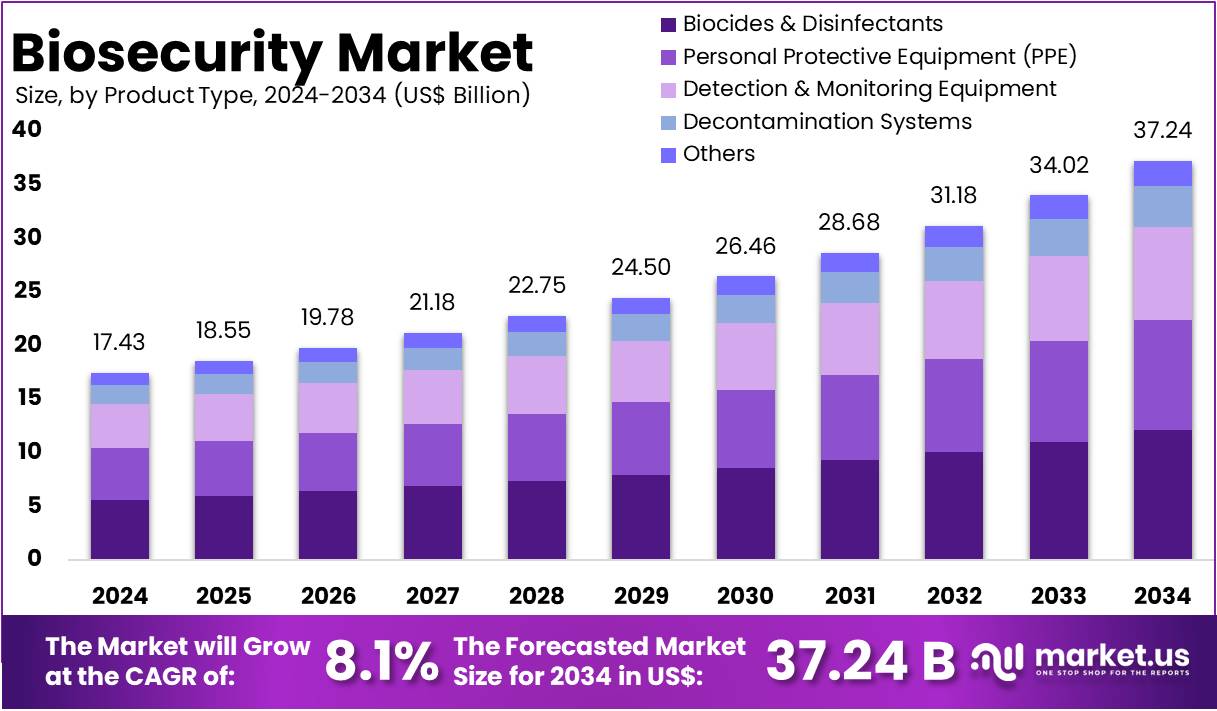
The Biosecurity Market size is expected to be worth around US$ 37.24 billion by 2034 from US$ 17.43 billion in 2024, growing at a CAGR of 8.1% during the forecast period 2025 to 2034. North America held a dominant market position, capturing more than a 38.4% share and holds US$ 6.69 Billion market value for the year.
The market encompasses solutions, technologies, and services aimed at preventing, detecting, and managing risks to human, animal, and plant health, as well as protecting the environment from biological threats.
Biosecurity is a strategic and integrated approach that includes policy frameworks, regulatory compliance, surveillance, diagnostics, laboratory testing, decontamination, and risk management practices. It addresses challenges such as the introduction of transboundary diseases, invasive species, contamination of food and feed, and the spread of zoonotic pathogens. With globalization, increased international trade, and rising cross-border movement of people, animals, and agricultural products, the risk of disease outbreaks and biosecurity hazards has grown significantly, fueling market demand.
Regulatory pressure from frameworks such as the World Health Organization (WHO) International Health Regulations, SPS Agreement, and national biosecurity standards encourages the adoption of harmonized, risk-based control measures. Additionally, the rising use of infection-prevention products, rapid molecular diagnostics, decontamination solutions, and advanced surveillance platforms across healthcare, agriculture, and food industries is boosting market growth. Increasing private-sector demand for supply chain resilience and food safety assurance further supports the expansion of biosecurity solutions. Examples include AI-enabled outbreak prediction platforms, point-of-care diagnostic devices, and centralized biosecurity hubs such as FAO’s IPFSAPH and WHO’s INFOSAN.
Biosecurity Market, Global Analysis, 2020-2024 (US$ Billion)
The Asia Pacific region is expected to experience the highest CAGR during the forecast period
The Asia-Pacific region is experiencing rapid growth in the biosecurity market, driven by expanding agriculture, high population density, frequent zoonotic outbreaks, and increasing awareness of food safety. Countries like China, Japan, South Korea, and Australia are investing heavily in laboratory networks, rapid diagnostics, and surveillance systems to manage risks from livestock diseases, plant pests, and human pathogens. For example, China’s response to African Swine Fever and avian influenza outbreaks has included nationwide farm biosecurity programs, rapid molecular diagnostic deployment, and strengthened traceability systems.
India and Southeast Asian nations such as Thailand, Vietnam, and Indonesia are adopting AI-based outbreak forecasting, integrated pest management, and IoT-enabled farm monitoring to address the challenges of large-scale livestock farming and cross-border disease spread. The COVID-19 pandemic further accelerated investments in public health laboratories, PPE, and disinfection solutions. Australia’s biosecurity framework emphasizes strict border controls, surveillance of invasive species, and rapid response mechanisms, reflecting high preparedness for transboundary threats.
Key Regions and Countries
North America
US
Canada
Europe
Germany
France
The UK
Spain
Italy
Russia
Netherland
Rest of Europe
Asia Pacific
China
Japan
South Korea
India
Australia
New Zealand
Singapore
Thailand
Vietnam
Rest of APAC
Latin America
Brazil
Mexico
Rest of Latin America
Middle East & Africa
South Africa
Saudi Arabia
UAE
Rest of MEA
Key Players Analysis
The global biosecurity market is highly competitive and fragmented, featuring a mix of large industrial players, specialized technology providers, and innovative startups. Industry leaders like 3M and Thermo Fisher Scientific dominate key segments such as PPE and diagnostic instruments by leveraging large-scale manufacturing, global supply chains, and strong customer networks. Their ability to rapidly scale production during crises gives them a clear competitive edge.
Pharmaceutical companies contribute through cutting-edge biological innovation, with technologies like mRNA enabling the rapid development of countermeasures and creating high entry barriers through significant R&D investments and intellectual property portfolios. Meanwhile, agile tech-focused firms such as Ginkgo Bioworks are reshaping the market with AI-driven biosurveillance platforms and predictive analytics, shifting the industry’s focus from reactive measures to proactive prevention. Competition increasingly revolves around speed of innovation, data integration, and the delivery of comprehensive end-to-end solutions rather than just product quality or cost.
Top Key Players in the Biosecurity Market
BASF SE
Thermo Fisher Scientific Inc.
3M Company
DuPont de Nemours, Inc.
Ecolab Inc.
Lonza Group Ltd.
Agilent Technologies, Inc.
EnviroTech Services, Inc.
Johns Hopkins Applied Physics Laboratory
Vetoquinol S.A.
Merck & Co., Inc.
Ginkgo Bioworks Holdings, Inc.
Biochem Pharma
Oxitec Ltd.
Bio-Rad Laboratories, Inc.
Recent Developments
In August 2025: The USDA’s APHIS is partnering with Merck Animal Health to enhance swine disease traceability through a five-year, $20 million initiative providing free RFID ear tags. Shipped directly to producers, these tags speed traceability, reduce outbreak impacts, and strengthen biosecurity, trade, and industry resilience, with allocations based on herd size and premises registration.
In May 2025: Agilent Technologies inaugurated its first India Solution Centre at its LEED Platinum-certified facility in Manesar, Haryana. Spanning 12,500 sq. ft., the centre will deliver end-to-end scientific workflows, proof-of-concept demonstrations, and customized solutions for healthcare, life sciences, diagnostics, and applied markets. Key focus areas include GLP-1 analysis, PFAS detection, and testing for emerging food and environmental contaminants.
In March 2025: Enviro Tech, an Arxada company, has made a significant advancement in combating Avian Influenza with the U.S. Environmental Protection Agency’s (EPA) approval for PeraGuard AH (EPA Reg. No. 63838-32). This label amendment allows PeraGuard AH to make claims against Avian Influenza and other animal viruses on surfaces. This development positions PeraGuard AH as an essential solution in addressing the ongoing Avian Influenza crisis, which has severely impacted poultry operations across the United States.
In May 2024: Steen-Hansen, a leader in antifouling and aquaculture coatings, and Ecolab, a global sustainability and water solutions provider, announced a collaboration to strengthen aquaculture biosecurity through the NetCare Program. This initiative focuses on enhancing fish welfare, reducing pathogen cross-contamination, and improving farm productivity with sustainable practices. The program integrates specialized training, strict hygiene protocols, and measurable net disinfection results. By combining Ecolab’s aquaculture-approved products with Steen-Hansen’s NetCare certification framework, the partnership aims to combat biofouling, safeguard fish health, and ensure long-term sustainability in aquaculture—a sector critical for meeting global food demand and preserving ocean biodiversity.