Report Overview
In 2022, the Global contrast media market Size was valued at USD 4.9 billion and is expected to reach USD 6.9 billion in 2032. This market is estimated to register a CAGR of 3.5% between 2023 and 2032.
Diagnostic imaging tests such as ultrasound, X-rays, and modern imaging equipment like CT scans & MRI, are becoming more prevalent due to the rising number of complex comorbidities and chronic illnesses.
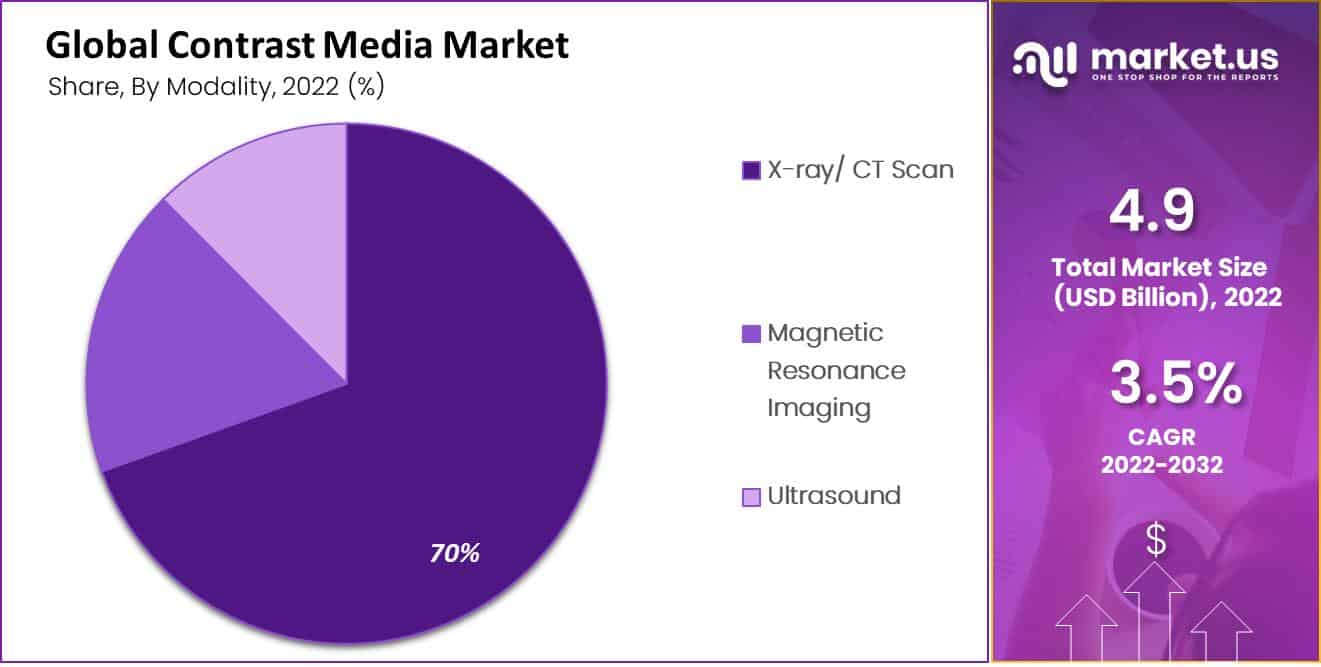
Barium and iodine contrast substances are provided or injected into the body and block X-rays, preventing the rays from going through. When the body temporarily contains barium- or iodinated-based contrast agents, this causes images of the organs, blood vessels, and other tissues to change. The global usage of X-rays and CT for a variety of disorders is expected to drive market expansion.
By Application Analysis
The Neurological Disorder Segment is the Most Lucrative Segment in the Application Analysis of the Contrast Media Market.
In 2022, the neurological disorder segment accounted for around 29.45% of the market. The diagnosis and treatment of the CNS for neurological disorders encourage the use of MRI contrast agents because they provide better pictures of neural structures than CT. Contrast agents based on gadolinium are used to observe inflammatory, neoplastic, and demyelinated lesions. Over the forecast period, the segment for cardiovascular disorders is expected to expand at the fastest rate. The most often utilized technique for imaging the cardiovascular system in both adult and pediatric patients is contrast-enhanced ultrasound imaging of the cardiovascular system, also known as echocardiography.
By Route of Administration Analysis
The Intravascular Route Segment Accounted for the Largest Market Share in Contrast Media Market
The market share for the intravascular route segment is going to be the greatest throughout the forecast period, and it is also anticipated to rise at the highest CAGR. The oral, intravascular, rectal, and other modes of administration make up the market segments for contrast media and contrast agents. The market category for intravascular routes is anticipated to dominate while growing at the fastest rate. One of the key drivers driving the expansion of the intravascular segment is the widespread implementation of injectable contrast media in the majority of modern imaging modalities, such as CT and MRI scanning.
By End-User Analysis
The Hospitals segment is expected to dominate the end-user analysis of the Contrast Media Market.
Hospitals are the largest segment in terms of revenue in the contrast media market, owing to the high volume of imaging procedures performed in these facilities. Diagnostic imaging centres are anticipated to have the fastest growth rate in the coming years due to the increasing demand for diagnostic imaging services and the rising trend of outsourcing imaging services to specialized centres.
Key Market Segments
Based on Type
- Iodinated Contrast Media
- Gadolinium-based Contrast Media
- Microbubble Contrast Media
- Barium-based Contrast Media
- Other Types
Based on Modality
- X-ray/ CT Scan
- Magnetic Resonance Imaging
- Ultrasound
Based on Application
- Neurological Disorders
- Cardiovascular
- Gastrointestinal Disorders
- Cancer
- Nephrological Disorders
- Musculoskeletal Disorders
- Other Applications
Based on Route of Administration
- Oral
- Rectal
- Intravascular
- Other Route of Administration
Based on End-User
- Hospitals
- Clinic & Ambulatory Surgery Centers
- Diagnostic Imaging Centers
- Other End-Users
Growth Opportunity
Development of more secure and more efficient contrast agents: There is an excellent opportunity to create safer and more efficient contrast agents that are better targeted to certain organs and tissues and have fewer negative effects. This may result in a rise in demand for contrast media, especially in developing economies.
Growing demand in emerging nations: The contrast media industry has an enormous chance of opportunity because of the rising demand for healthcare services in emerging markets. Companies that can create affordable and useful contrast agents that satisfy the requirements of these markets are likely going to see high demand.
Latest Trends
- Increasing use of non-ionic contrast agents: Non-ionic contrast agents are becoming increasingly popular due to their lower risk of adverse reactions. Particularly in high-risk patient populations.
- Iodinated contrast agents are the most widely used contrast agents, particularly in CT imaging, which is driving up demand for them. There is a growing demand for iodinated contrast agents owing to their affordable and wide availability.
Regional Analysis
The contrast media market was led by North America in 2022 with a share of approximately 44.44%. This is anticipated to change as a result of numerous strategic activities done by main firms to target particular patient populations in these regions. Bayer and GE Healthcare are significant industry participants.
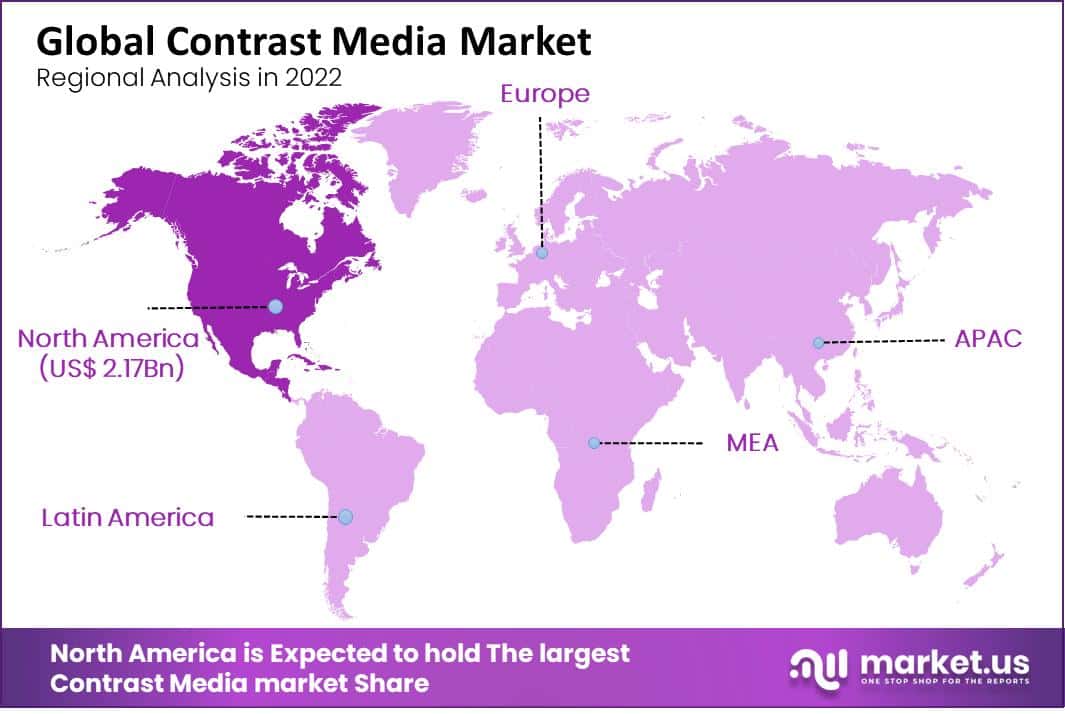
The existence of well-known medical facilities, easy access to cutting-edge technology, and increasing demand for diagnostic procedures owing to disease management and disease screening programs in these regions are all expected to lead to a rise in inpatient examinations. The number of operations could be reduced, however, as a result of the health care reforms that enforce standards for proper utilization and prevent unnecessary procedures. The global contrast media market in Europe and APAC region is likely to expand at a significant CAGR.
Key Regions and Countries
- North America
- The US
- Canada
- Mexico
- Western Europe
- Germany
- France
- The UK
- Spain
- Italy
- Portugal
- Ireland
- Austria
- Switzerland
- Benelux
- Nordic
- Rest of Western Europe
- Eastern Europe
- Russia
- Poland
- The Czech Republic
- Greece
- Rest of Eastern Europe
- APAC
- China
- Japan
- South Korea
- India
- Australia & New Zealand
- Indonesia
- Malaysia
- Philippines
- Singapore
- Thailand
- Vietnam
- Rest of APAC
- Latin America
- Brazil
- Colombia
- Chile
- Argentina
- Costa Rica
- Rest of Latin America
- Middle East & Africa
- Algeria
- Egypt
- Israel
- Kuwait
- Nigeria
- Saudi Arabia
- South Africa
- Turkey
- United Arab Emirates
- Rest of MEA
Key Players Analysis
To enhance their position in the contrast media market, key companies are implementing tactics including collaborations, acquisitions, and mergers as well as the development of new products. To expand their market share and client base globally, major businesses are engaging in mergers and acquisitions. The previously announced GE Healthcare acquisition of BK Medical, for instance, was completed in December 2021. Real-time surgical viewing, a rapidly expanding and relatively new field, is now included in GE Healthcare’s pre- and post-operative ultrasound capabilities.
Key Players
- Bayer AG
- Medtronic plc.
- GE Healthcare LLC
- Guerbet
- Lantheus Medical Imaging, Inc.
- Bracco Diagnostic, Inc.
- Nano Therapeutics Pvt. Ltd.
- Trivitron Healthcare
- CMC Contrast AB
- IMAX Diagnostic Imaging
- Other Key Players
Recent Developments
- GE Healthcare Pharma Limited acquired the ownership of Daiichi Sankyo’s four diagnostic agents in Japan, in 2020
- Bracco Imaging SpA get approval from the US FDA for its product ProHance, which is an MRI contrast agent for use in neonates and pediatric patients under two years of age, in 2020
- Gadavist, a gadolinium-based contrast agent used in cardiac MRI to diagnose coronary artery disease, achieved approval in 2019 from the FDA for Bayer AG.