

Market Overview
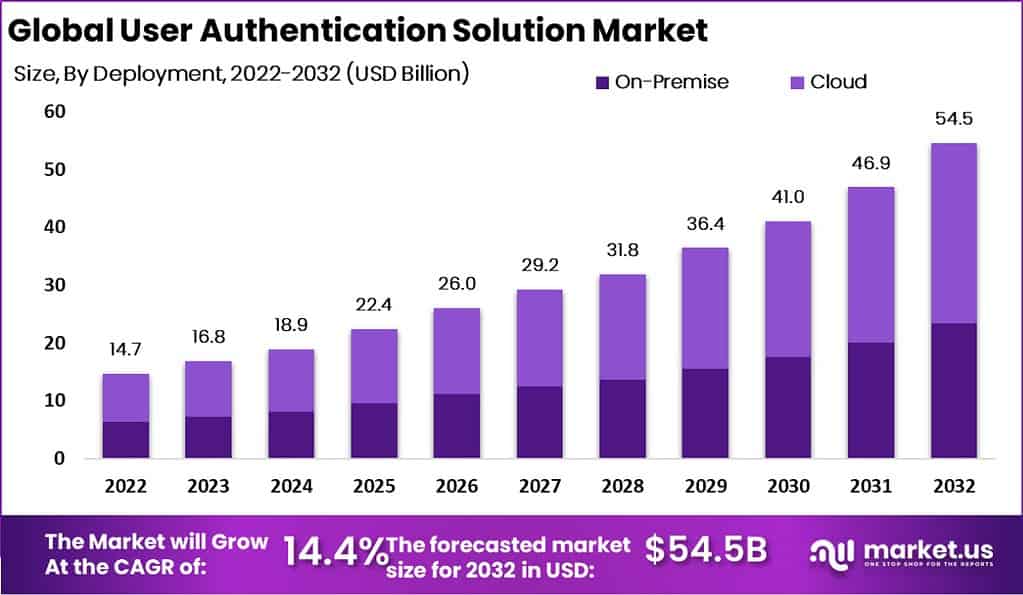
The user authentication solution market is a rapidly growing market, driven by the increasing demand for security and compliance in the digital age. The user authentication solution market size is expected to grow from USD 14.7 billion in 2022 to USD 54.5 billion by 2032, at a CAGR of 14.4%. The growth of the market is being driven by the increasing demand for security and compliance in the digital age.
User authentication solutions are expected to play a larger role in shaping the future of cybersecurity. As cyber threats continue to evolve, these solutions will need to adapt and innovate to stay ahead of potential risks. Additionally, user authentication will play a crucial role in enabling secure access to emerging technologies, such as the Internet of Things (IoT), blockchain, and artificial intelligence.
Rising Demands
The increasing adoption of digital technologies across sectors, such as finance, healthcare, e-commerce, and government, has significantly raised the demand for user authentication solutions. Traditional username and password-based authentication methods have proven vulnerable to cyber threats, leading to a growing interest in more robust and sophisticated authentication approaches. Additionally, the growing popularity of remote work and mobile access has further emphasized the need for secure identity verification methods.
Increasing Uses
User authentication solutions are being employed across various applications and platforms. In the financial sector, these solutions are used for secure online banking, mobile payments, and fraud prevention. In healthcare, user authentication ensures data privacy and prevents unauthorized access to electronic health records. E-commerce platforms utilize authentication measures to protect customer accounts and personal information. Moreover, government agencies use authentication solutions to safeguard sensitive data and citizen information.
Rising Popularity
The rising popularity of user authentication solutions can be attributed to the growing awareness of cybersecurity threats and the need for robust data protection. Organizations and individuals alike are increasingly recognizing the importance of secure access control to safeguard sensitive information. Biometric authentication methods, such as fingerprint and facial recognition, have gained considerable traction due to their accuracy and ease of use. As a result, vendors offering user authentication solutions are witnessing an upsurge in demand for their products and services.
Top 5 Trends Propelling Sales
- Biometric Authentication Dominance: Biometric authentication methods, such as fingerprint recognition, facial recognition, and voice recognition, are gaining traction as they provide a high level of security and ease of use.
- Mobile-based Authentication: With the widespread use of smartphones, mobile-based authentication methods, like one-time passwords (OTPs) and push notifications, are becoming increasingly popular for their convenience and accessibility.
- Multi-factor Authentication (MFA): MFA, which combines two or more authentication factors, such as passwords, biometrics, and tokens, is becoming a standard practice to enhance security and thwart unauthorized access attempts.
- Adoption of Artificial Intelligence (AI): AI-powered user authentication solutions are gaining prominence as they can detect and prevent suspicious activities in real-time, providing an added layer of security.
- Cloud-based Solutions: The adoption of cloud-based user authentication solutions is increasing due to their scalability, cost-effectiveness, and ease of integration with existing systems.
Drivers
- Rising Cybersecurity Concerns: The increasing frequency and sophistication of cyberattacks have compelled organizations to invest in robust user authentication solutions to safeguard their digital assets and sensitive information.
- Regulatory Compliance: Stringent data protection regulations, such as GDPR (General Data Protection Regulation) and HIPAA (Health Insurance Portability and Accountability Act), mandate the implementation of secure authentication methods to ensure data privacy and prevent data breaches.
- Digital Transformation: The ongoing digital transformation across industries necessitates the adoption of secure authentication measures to support seamless and safe access to digital services.
- Growing Mobile and Cloud Adoption: The widespread use of mobile devices and cloud-based services has accelerated the demand for authentication solutions that cater to these platforms.
Restraints
- High Initial Costs: The implementation of user authentication solutions can involve significant upfront costs, particularly for large enterprises, which may pose a challenge for some organizations.
- User Resistance: Introducing new authentication methods or additional steps in the login process can sometimes face resistance from users who may perceive them as inconvenient or time-consuming.
- Integration Challenges: Integrating user authentication solutions with existing IT infrastructure and legacy systems may pose technical challenges for some organizations.
Opportunities
- Emerging Markets: The rapid digitization in emerging economies presents substantial opportunities for user authentication solution providers to expand their market reach.
- IoT Security: As the IoT ecosystem continues to grow, there will be an increasing need for secure authentication methods to protect connected devices and networks.
- Advanced Biometrics: Advancements in biometric technologies, such as palm vein recognition and behavioral biometrics, offer opportunities for innovative and secure authentication methods.
Challenges
- Cybersecurity Threats Evolution: As cyber threats evolve, user authentication solutions will need to continually update and enhance their security features to counter new attack vectors.
- Data Privacy Concerns: The collection and storage of biometric data raise privacy concerns, and user authentication solution providers must address these issues to gain user trust.
- Interoperability Issues: Ensuring seamless interoperability between different authentication methods and systems can be challenging.
Regional Analysis
North America is currently the largest market for user authentication solutions, driven by its mature cybersecurity infrastructure and the presence of several key market players. Additionally, the Asia-Pacific region is experiencing rapid growth in this market due to the increasing adoption of digital technologies and the rising number of cyber threats in the region. Emerging economies in Asia-Pacific, such as China and India, are contributing significantly to the market’s growth as they undergo digital transformation across various sectors.
Key Regions and Countries
- North America
- The US
- Canada
- Mexico
- Western Europe
- Germany
- France
- The UK
- Spain
- Italy
- Portugal
- Ireland
- Austria
- Switzerland
- Benelux
- Nordic
- Rest of Western Europe
- Eastern Europe
- Russia
- Poland
- The Czech Republic
- Greece
- Rest of Eastern Europe
- APAC
- China
- Japan
- South Korea
- India
- Australia & New Zealand
- Indonesia
- Malaysia
- Philippines
- Singapore
- Thailand
- Vietnam
- Rest of APAC
- Latin America
- Brazil
- Colombia
- Chile
- Argentina
- Costa Rica
- Rest of Latin America
- Middle East & Africa
- Algeria
- Egypt
- Israel
- Kuwait
- Nigeria
- Saudi Arabia
- South Africa
- Turkey
- United Arab Emirates
- Rest of MEA
Top Key Players
Some of the companies that are profiled in this report are:
- Computer Sciences Corporation
- CA Technologies
- Germalto
- SecureAuth
- VASCO Data Security International
- SecurEnvoy
Market Segmentation
By Type
- Single Factor Authentication
- Two Factor Authentication
- Multi-Factor Authentication
By Component
- Hardware
- Software
- Services
By Organization Size
- SMEs
- Large Enterprises
By Deployment
- On-Premise
- Cloud
By Application
- BFSI
- IT and Telecomm
- Healthcare
- Automotive
- Government
- Defense and Surveillance
- Consumer Electronics
- Energy
- Education
- Manufacturing
- Retail
- Others