

Woodworking Equipment Market
Woodworking Equipment MarketSize, Share, Growth Analysis By Type (Saw, Lathe, Planer, Grinding Machines, Others), By Operating Type (Electrical, Mechanical), By Application (Furniture, Construction), By Region and Companies - Industry Segment Outlook, Market Assessment, Competition Scenario, Statistics, Trends and Forecast 2026-2035
- Published date: Jun 2026
- Report ID: 187783
- Number of Pages: 260
- Format:
- Overview
- Table of Contents
- Major Market Players
 ntracts alongside hardware sales create recurring revenue streams that insulate them from the cyclical nature of machine procurement budgets.
A 2025 CNC routing best-practice guide indicates that using high-precision servo drives and properly tuned acceleration settings on CNC routers can reduce dimensional errors by 30 to 50% compared with legacy stepper systems, particularly on curved furniture components. This precision improvement matters most in premium furniture and architectural millwork segments, where dimensional tolerance directly determines product acceptance rates and rework costs. Early movers who upgrade servo drive specifications gain a quality differentiation that is quantifiable to buyers.
Type Analysis
Saw dominates with 31.5% due to universal use in primary wood cutting.
In 2025, Saw held a dominant market position in the By Type segment of the Woodworking Equipment Market, with a 31.5% share. Saw machines serve as the entry point for nearly all wood processing workflows, from rough timber breakdown to panel cutting. Buyers across furniture, flooring, and construction applications require saw equipment before any downstream processing begins, making it structurally indispensable across all end markets.
Lathe machines address the turned-component segment of wood manufacturing, producing spindles, chair legs, and decorative profiles. Demand tracks closely with furniture production volumes and custom interior woodwork. Buyers upgrading from manual lathes to CNC-controlled versions gain dimensional repeatability, which directly reduces rework rates and material scrap in high-volume production environments.
Planer equipment handles surface preparation and thickness calibration for solid timber and engineered boards. Construction-grade lumber processing facilities use planers at high throughput volumes. As builders demand more consistent dimensional tolerances for prefabricated structures, planer technology with automated feed adjustment becomes a procurement priority for large-scale wood processing plants.
Grinding Machines in woodworking focus on tool maintenance and finishing operations. Operators use them to restore cutting edges on saw blades, router bits, and planer knives. Facilities that invest in in-house grinding reduce tooling replacement costs and machine downtime, creating a secondary demand layer that grows alongside total installed machinery capacity.
Others in the type segment include mortisers, tenoners, dowel borers, and band saws used for specialized joinery and panel processing tasks. These machines serve niche production requirements in custom cabinetry, stair manufacturing, and architectural millwork. Vendors that bundle niche equipment with core machine lines capture broader share within individual facility budgets.
Operating Type Analysis
Electrical dominates with 74.8% due to precision control and automation compatibility.
In 2025, Electrical held a dominant market position in the By Operating Type segment of the Woodworking Equipment Market, with a 74.8% share. Electrical machines integrate directly with CNC controllers, programmable logic systems, and digital monitoring platforms. This compatibility with automation infrastructure makes electrical operation the standard choice for any facility pursuing reduced labor dependency or higher output consistency across production shifts.
Mechanical operating systems retain a presence in entry-level and small-trade applications where capital budgets are limited. Operators in developing markets and low-volume custom shops still purchase mechanically driven equipment for its lower upfront cost and simpler maintenance requirements. However, this segment faces structural pressure as entry-level CNC prices fall and access to technical training improves across emerging economies.
Application Analysis
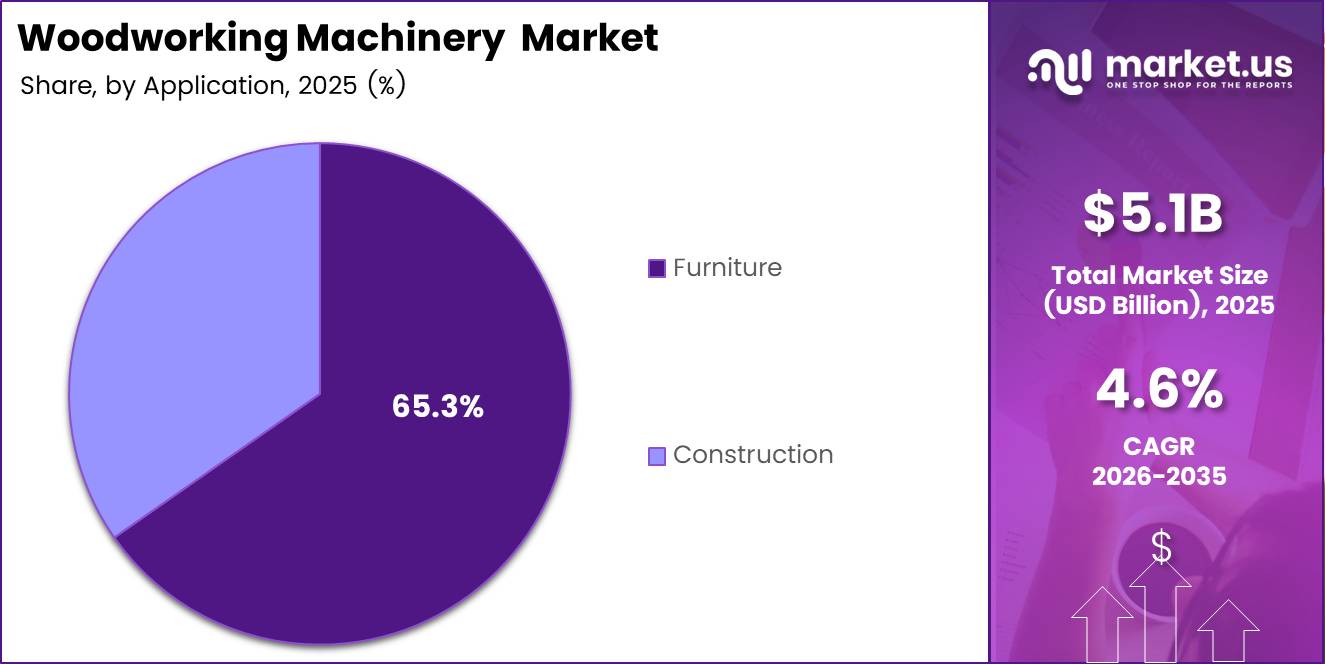
Furniture dominates with 65.3% due to high-volume precision processing requirements.
In 2025, Furniture held a dominant market position in the By Application segment of the Woodworking Equipment Market, with a 65.3% share. Furniture manufacturers require consistent cut quality, tight tolerances, and high throughput across panel boards, solid wood frames, and veneered components. This combination of volume and precision requirements sustains capital investment in advanced woodworking equipment at a higher rate than any other application category.
Construction applications cover structural framing, roof truss assembly, floor system production, and exterior cladding. Residential and commercial building activity directly governs equipment demand in this segment. Contractors and prefabricated building manufacturers investing in automated cutting and joinery systems reduce on-site labor exposure and improve structural consistency, creating a clear productivity case for capital equipment investment.
Key Market Segments
By Type
- Saw
- Lathe
- Planer
- Grinding Machines
- Others
By Operating Type
- Electrical
- Mechanical
By Application
- Furniture
- Construction
Regional Analysis
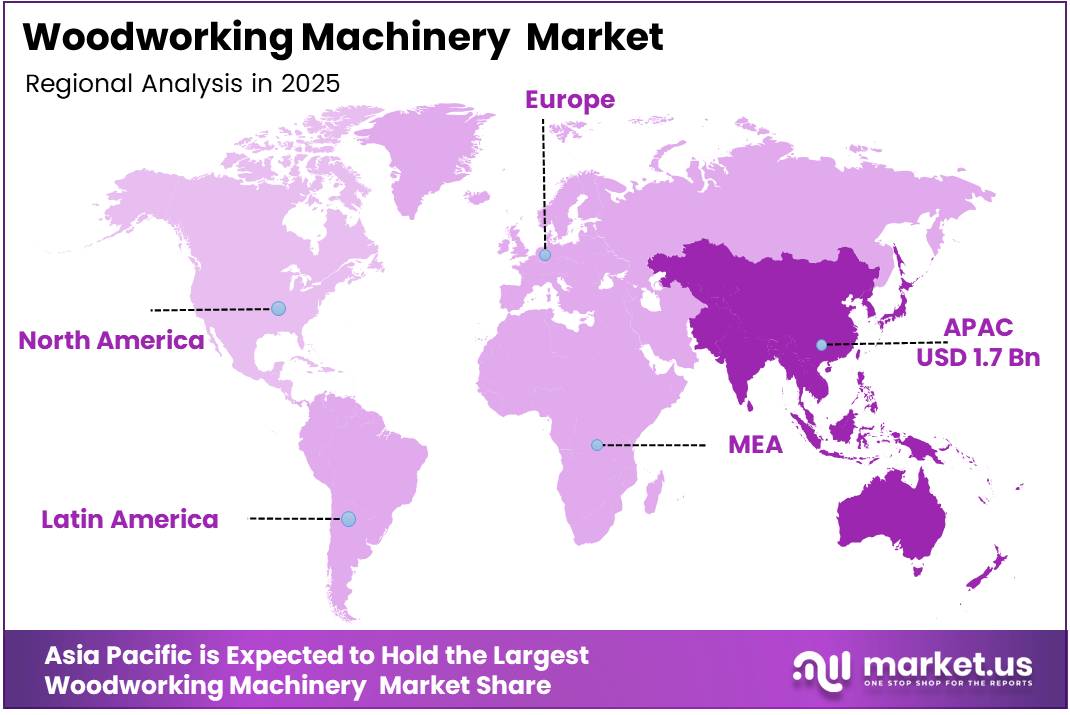
Asia Pacific Dominates the Woodworking Equipment Market with a Market Share of 34.20%, Valued at USD 1.7 Billion
Asia Pacific holds the largest regional position in the Woodworking Equipment market, driven by China’s scale in furniture exports and India’s expanding residential construction activity. Both countries operate large-volume wood processing facilities that require continuous equipment investment. Government-backed manufacturing modernization programs in the region accelerate the transition from semi-manual to CNC-integrated production systems across furniture and construction supply chains.
North America represents a mature but capital-active market, where residential renovation cycles and commercial construction activity sustain replacement demand for woodworking equipment. The region’s emphasis on labor productivity and precision output supports adoption of multi-axis CNC systems and smart monitoring platforms. Vendors that position equipment around total cost of ownership metrics, rather than unit price, find stronger traction with North American buyers.
Europe combines high regulatory standards on energy consumption and raw material sourcing with a strong tradition of precision wood processing equipment manufacturing. German and Italian machinery producers maintain technological leadership, while buyers across the continent face compliance requirements that favor modern equipment with lower energy draw and reduced waste generation. This regulatory environment filters older equipment out of the market at a faster rate than in less regulated regions.
Latin America presents a mixed demand environment where Brazil and Mexico lead activity in furniture manufacturing and construction. Both countries hold growing domestic consumer markets that require expanded wood product output. However, currency volatility and import-dependent machinery supply chains increase total procurement costs for buyers, creating a preference for longer equipment lifecycles and deferred upgrade cycles compared with North American and European markets.
Middle East and Africa show concentrated demand in GCC construction markets and South African furniture manufacturing. Large-scale infrastructure and real estate development programs in Saudi Arabia and the UAE create sustained requirements for structural timber processing. As local value-added manufacturing policies push downstream wood processing into the region, demand for entry-level to mid-range Woodworking Equipment is expected to build from a low base.
Key Regions and Countries
North America
- US
- Canada
Europe
- Germany
- France
- The UK
- Spain
- Italy
- Rest of Europe
Asia Pacific
- China
- Japan
- South Korea
- India
- Australia
- Rest of APAC
Latin America
- Brazil
- Mexico
- Rest of Latin America
Middle East and Africa
- GCC
- South Africa
- Rest of MEA
Key Company Insights
Homag Group operates as the market’s broadest-platform supplier, covering individual trade machines through to fully networked production lines. This end-to-end capability allows Homag to embed itself across a customer’s entire equipment lifecycle, from first purchase through upgrades and service contracts. However, their scale also creates organizational complexity that nimbler specialists can exploit in narrowly defined product categories.
SCM Group reinforced its automation position at LIGNA 2025 through its Tecno Logica subsidiary, which launched the RO-TEC X6 multi-station robotic platform combining drilling, milling, edge-banding, and assembly functions. This integrated system targets furniture manufacturers seeking full-line automation under a single vendor relationship. Buyers who adopt this platform reduce integration risk but accept single-vendor dependency across their core production process.
Felder Group serves the trade and small-to-medium enterprise segment with modular machines that deliver CNC-adjacent precision at accessible price points. This positioning captures buyers who cannot justify enterprise-scale capital expenditure but require output quality above what purely mechanical equipment delivers. The risk in this strategy is margin compression if Chinese-manufactured entry-level CNC equipment continues to fall in price and improve in reliability.
Martin Woodworking Machines competes in the premium manual and semi-automated segment, targeting craftsmen and specialist workshops where build quality and longevity take precedence over throughput volume. This buyer segment shows lower price sensitivity but also lower replacement frequency, which limits revenue per customer over time. Martin’s advantage lies in its brand loyalty within high-skill workshop communities where peer recommendation drives purchasing decisions.
Key Players
- Homag Group
- SCM Group
- Felder Group
- Martin Woodworking Machines
- Weinig Group
- MiniMax
- Powermatic
- Robland
- Biesse Group
- Grizzly Industrial
- Altendorf Group
Recent Developments
- January 2024 – WEINIG Group announced the presentation of approximately 30 new machines, technologies, and product innovations at HOLZ-HANDWERK 2024, covering solid wood and wood-based material processing applications.
- June 2025 – SCM Group subsidiary Tecno Logica launched the RO-TEC X6 automated machining and edge-banding system at LIGNA 2025, integrating drilling, milling, assembly, and edge-banding functions into a multi-station robotic production platform.
- June 2025 – Tecno Logica (SCM Group) introduced a new automation concept for furniture manufacturing that combines smart monitoring, logistics integration, and real-time production control within the RO-TEC X6 platform.