

MRI Contrast Agents Market
MRI Contrast Agents Market By Type (Extracellular Agents, Blood Pool Agents, Organ-Specific Agents) By Application (Neurology, Oncology, Cardiology, Musculoskeletal, Gastroenterology, Others) By Route of Administration (Intravenous, Oral, Intrathecal) By End User (Hospitals, Diagnostic Imaging Centers, Ambulatory Surgical Centers, Others), By Region and Companies - Industry Segment Outlook, Market Assessment, Competition Scenario, Statistics, Trends and Forecast 2026-2035
- Published date: May 2026
- Report ID: 185633
- Number of Pages: 380
- Format:
- Overview
- Table of Contents
- Major Market Players
Quick Navigation
- Report Overview
- Key Takeaways
- Type Analysis
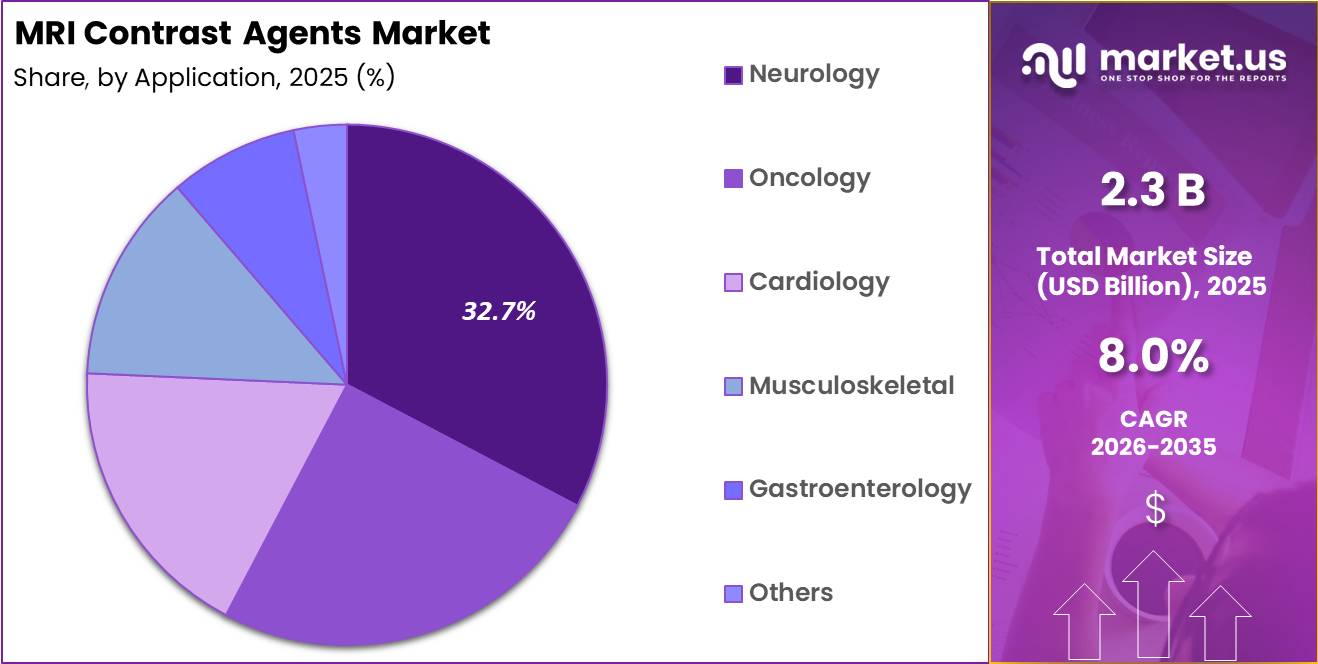
- Application Analysis
- Route of Administration Analysis
- End User Analysis
- Key Market Segments
- Driving Factors
- Trending Factors
- Restraining Factors
- Opportunity
- Regional Analysis
- Key Players Analysis
- Recent Developments
- Report Scope
Report Overview
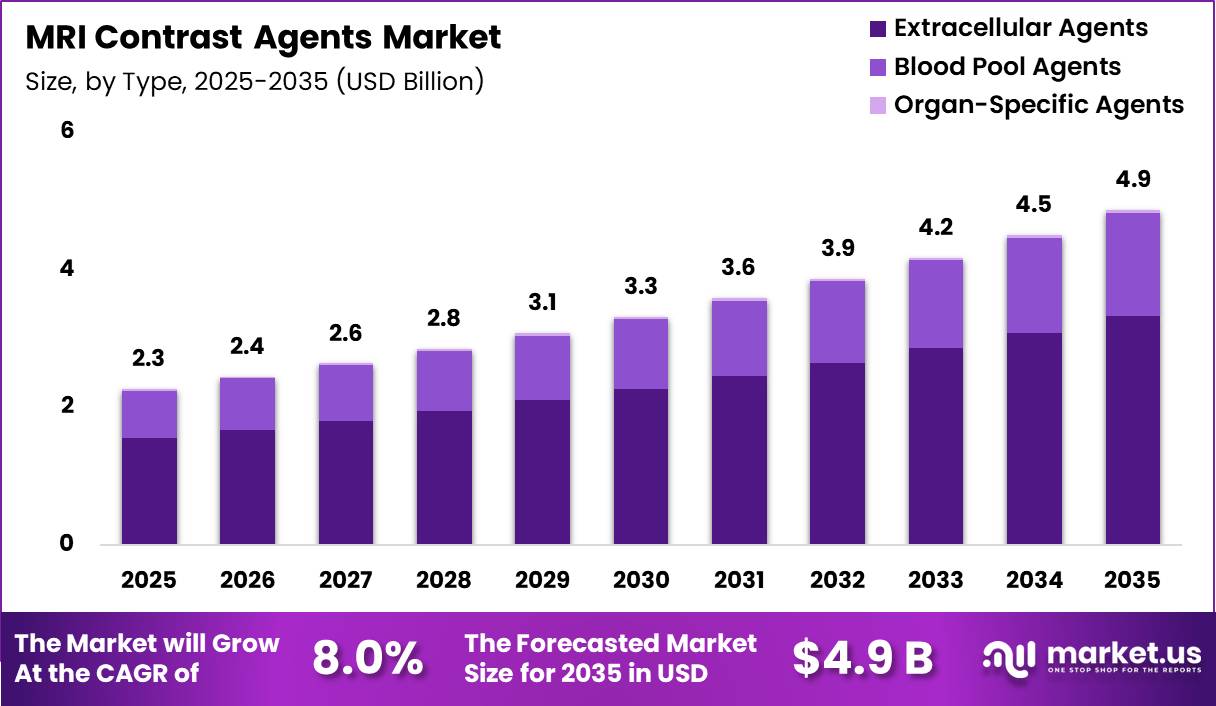
Global MRI Contrast Agents Market size is expected to be worth around US$ 4.9 Billion by 2035 from US$ 2.3 Billion in 2025, growing at a CAGR of 7.61% during the forecast period from 2026 to 2035. In 2025, North America led the market, achieving over 8.0% share with a revenue of US$ 1.13 Billion.
The MRI contrast agents market is demonstrating strong growth potential, driven by advancements in diagnostic imaging and increasing disease burden. These agents are widely utilized to enhance visualization of tumors, aneurysms, and tissue abnormalities, improving diagnostic accuracy in neurological, oncological, and cardiovascular conditions.
 A major driver for MRI contrast agents is the rising use of MRI for cancer, cardiovascular and neurological imaging as populations age and chronic disease prevalence increases worldwide. The OECD reports MRI exam rates above 140 per 1,000 population in countries like the United States and Japan, compared with fewer than 10 per 1,000 in some emerging systems, indicating substantial headroom for growth as access expands.
WHO estimates that noncommunicable diseases already account for about 74% of global deaths, increasing demand for high-resolution diagnostic imaging to guide treatment. In the United States, Medicare Part B imaging spending has repeatedly highlighted MRI and CT as key modalities in outpatient care, with millions of contrast-enhanced scans billed annually.
As clinical guidelines increasingly recommend MRI for early detection of multiple sclerosis, liver lesions and cardiac function, contrast-enhanced protocols become standard, reinforcing consistent demand for gadolinium-based and alternative agents within hospital and independent imaging networks.
Trending Factors
Shift Toward Safer Macrocyclic and Non-Gadolinium Agents
A dominant trend in the MRI contrast agents space is the shift from older linear gadolinium-based contrast agents (GBCAs) to macrocyclic and emerging non-gadolinium agents due to safety concerns about gadolinium retention.Since 2017, the European Medicines Agency has recommended restricting several linear GBCAs and suspending some marketing authorizations, while supporting macrocyclic agents because of their greater kinetic and thermodynamic stability. The EMA emphasized that although no clinical harm from brain gadolinium deposition has been demonstrated, precautionary measures were needed, prompting hospitals to convert formularies toward macrocyclic products.
The U.S. FDA has issued multiple Drug Safety Communications on gadolinium retention and now requires class-wide warnings, medication guides and patient-specific risk assessment, encouraging lower doses and safer formulations.
These regulatory signals have catalyzed R&D into manganese-based, iron-based and other non-gadolinium contrast systems, with numerous academic publications over the last decade outlining nanoparticle and targeted agents optimized for molecular and organ-specific MRI applications.
Restraining Factors
Regulatory Scrutiny, Safety Warnings and Liability
Regulatory scrutiny and safety-related actions constitute a key restraint on the MRI contrast agents market. In the United States, Congress passed legislation in 2022 requiring the FDA to regulate all contrast agents as drugs, regardless of mechanism, aligning them with stringent pharmaceutical quality, clinical evidence and pharmacovigilance standards.The FDA has issued class warnings on gadolinium retention and mandated patient medication guides, adding documentation and counseling workload for radiology departments and potentially limiting use in lower-risk indications.
In Europe, EMA decisions restricting or suspending multiple linear gadolinium agents have effectively removed some products from clinical practice, squeezing portfolio breadth for manufacturers and forcing substitution to specific macrocyclic brands.
These actions increase post-marketing study obligations, risk-management plans and long-term safety monitoring, raising development and compliance costs that can exceed hundreds of millions of dollars over a product life cycle. Combined with medico-legal concerns, this environment can slow adoption of novel agents and deter smaller entrants.
Opportunity
Supply Chain, Innovation and Emerging Markets
There is a significant opportunity in strengthening contrast-agent supply chains and expanding access in emerging markets while advancing safer chemistries. The U.S. government’s 100-day supply chain review highlighted vulnerabilities in pharmaceutical and imaging-related inputs, pointing out that India imports nearly 70% of its active pharmaceutical ingredients from China, creating concentration risk.Diversifying production of key drug components, including contrast media ingredients, through on-shore and near-shore manufacturing and modular production platforms is a stated policy priority that can open incentives, grants and public–private partnerships for producers.
At the same time, global imaging volumes are growing as low- and middle-income countries invest in MRI scanners under WHO and national cancer-control and noncommunicable-disease programs, where baseline MRI utilization may still be below 10 exams per 1,000 population.
Vendors that develop low-dose, macrocyclic or non-gadolinium agents with robust supply security can align with these policies and capture fast-growing procedural volumes in these under-penetrated regions.
Regional Analysis
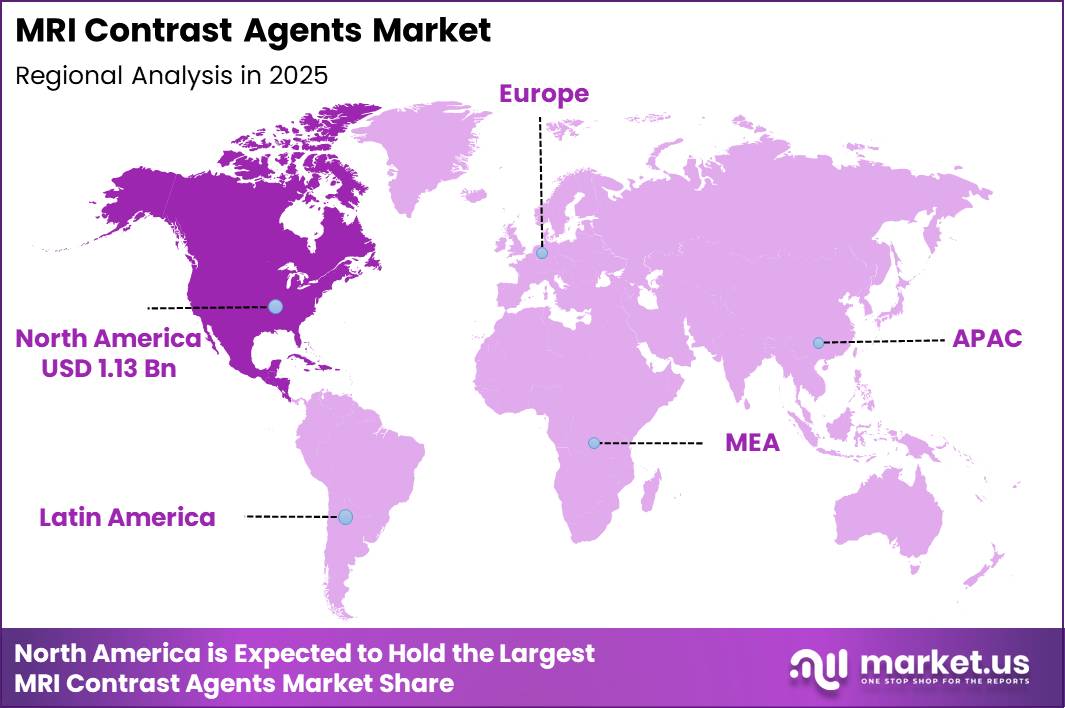
North America maintained a leading position in the MRI contrast agents market in 2025, accounting for over 8.0% share and generating approximately US$ 1.13 billion in revenue. This dominance can be attributed to the well-established healthcare infrastructure, high adoption of advanced diagnostic imaging technologies, and strong presence of key market players.
The increasing prevalence of chronic diseases, including neurological disorders and cancer, has significantly contributed to the demand for MRI procedures across the region.
In Europe, steady market growth has been observed, supported by rising healthcare expenditure, favorable reimbursement frameworks, and expanding research activities in imaging technologies. Countries such as Germany, France, and the UK have demonstrated consistent demand due to early adoption of innovative diagnostic solutions.
The Asia-Pacific region is emerging as a high-growth market, driven by improving healthcare infrastructure, increasing patient awareness, and growing investments in medical imaging facilities. Rapid urbanization and a rising burden of lifestyle-related diseases are further accelerating market expansion in countries like China, India, and Japan.
Meanwhile, Latin America and the Middle East & Africa are experiencing gradual growth, supported by improving access to healthcare services and increasing government initiatives aimed at strengthening diagnostic capabilities. However, limited infrastructure and cost constraints may continue to restrain market penetration in these regions.
Key Regions and Countries
North America
- The US
- Canada
Europe
- Germany
- France
- The U.K.
- Italy
- Spain
- Russia & CIS
- Rest of Europe
Asia Pacific
- China
- India
- Japan
- South Korea
- ASEAN
- Australia & New Zealand
- Rest of Asia Pacific
Middle East & Africa
- GCC
- South Africa
- Rest of Middle East & Africa
Latin America
- Brazil
- Mexico
- Rest of Latin America
Key Players Analysis
The MRI contrast agents market is characterized by a highly consolidated competitive landscape, where a limited number of multinational players account for a significant share of global revenue.
Leading companies such as Bayer AG, GE HealthCare, Bracco Imaging S.p.A., and Guerbet Group collectively dominate the market, supported by strong product portfolios and extensive global distribution networks.
These firms account for a substantial proportion of market share, with the top players controlling over 70% of the global market, indicating high entry barriers and strong brand positioning.
Innovation and product differentiation are central to competitive strategies. Market leaders are heavily investing in research and development to introduce advanced gadolinium-based and macrocyclic agents with improved safety profiles and reduced toxicity risks.
For instance, Bayer AG continues to expand its portfolio through clinical advancements, while GE HealthCare leverages integrated imaging solutions combining contrast agents with AI-enabled diagnostics.
Mid-sized and emerging players, including Lantheus Medical Imaging and regional manufacturers in Asia-Pacific, are focusing on niche applications and cost-effective solutions to strengthen their market presence.
Strategic initiatives such as regulatory approvals, partnerships, and geographic expansion into emerging markets are widely adopted to sustain growth. Overall, the competitive environment remains innovation-driven, with safety, efficacy, and regulatory compliance acting as key differentiators.
Market Key Players
- Bayer AG
- Bracco Imaging S.p.A.
- GE Healthcare
- Guerbet Group
- Lantheus Medical Imaging Inc.
- Daiichi Sankyo Company Limited
- Fujifilm Holdings Corporation
- Nano Therapeutics Pvt. Ltd.
- Ixico plc
- Jodas Expoim Pvt. Ltd.
- Spago Nanomedical AB
- CMIC Holdings Co., Ltd.
- Taejoon Pharm Co., Ltd.
- Unijules Life Sciences Ltd.
- Trivitron Healthcare
- Others
Recent Developments
- Bayer AG: By March 2026, at ECR 2026, Bayer released additional subgroup data (abdominal, CNS, and MR angiography) confirming that gadoquatrane can reduce gadolinium dose by up to 60 percent while maintaining image quality, and confirmed that regulatory filings are already under review in the US, EU, Japan, and China.
- Bracco Imaging S.p.A.: In March 2025, Bracco Imaging completed the acquisition of NanoPET Pharma GmbH, expanding its portfolio of specialized contrast agents for molecular and preclinical imaging and strengthening its precision-medicine-oriented pipeline.
- GE HealthCare: In April 2026, GE HealthCare announced that the first patient was dosed in the international Phase 2/3 LUMINA trial evaluating mangaciclanol, a manganese-based MRI contrast agent designed as a potential alternative to standard gadolinium agents.
- Lantheus Medical Imaging Inc.: In February 2025, Lantheus reported successful Phase 3 data for a novel manganese-based MRI contrast agent, positioned as an alternative for patients where gadolinium use is problematic and as a response to environmental concerns around gadolinium discharge.

