

Oral Microbiome Products Market
Oral Microbiome Products Market By Product Type (Probiotics, Prebiotics, Synbiotics, Postbiotics, Oral Microbiome Test Kits) By Formulation (Chewable Tablets, Lozenges, Mouthwashes, Toothpaste, Powders, Others) By Distribution Channel (Hospital Pharmacies, Retail Pharmacies, Online Pharmacies, Dental Clinics, Supermarkets and Hypermarkets) By End User (Adults, Children, Geriatric Population), By Region, and Key Companies - Industry Segment Outlook, Market Assessment, Competition Scenario, Trends and Forecast 2026-2035
- Published date: May 2026
- Report ID: 185643
- Number of Pages: 240
- Format:
- Overview
- Table of Contents
- Major Market Players
Quick Navigation
- Report Overview
- Key Takeaways
- Product Type Analysis
- Formulation Analysis
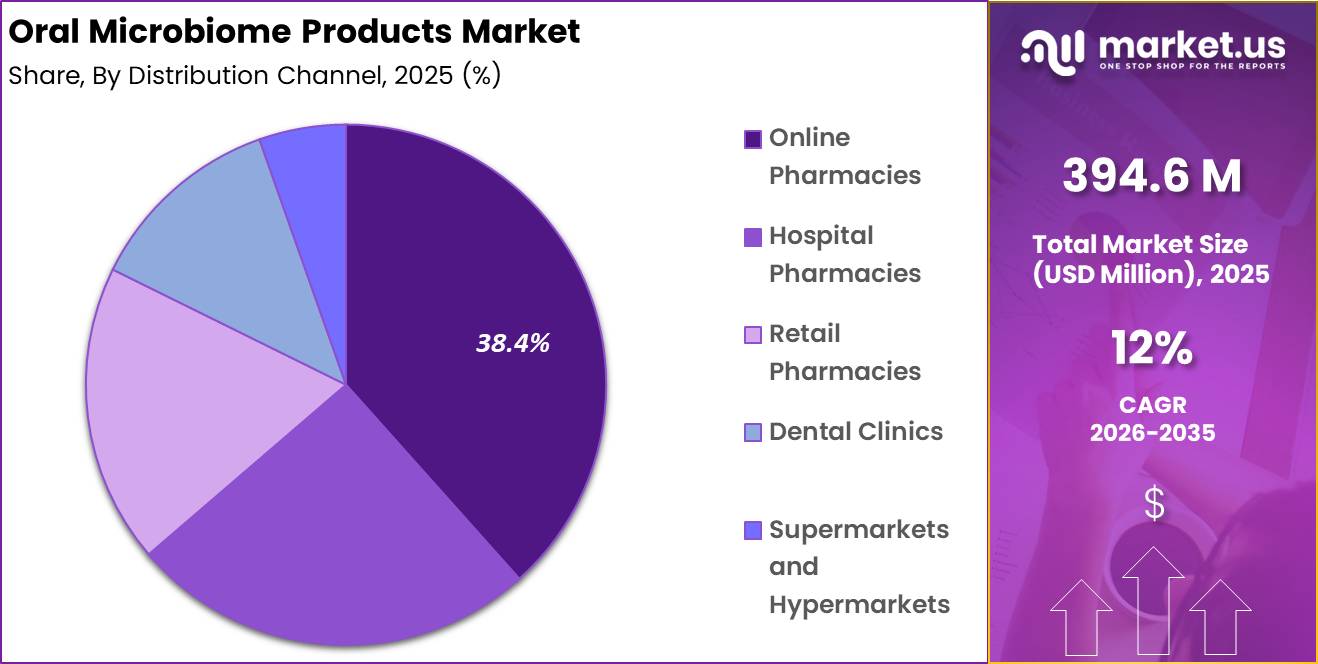
- Distribution Channel Analysis
- End User Analysis
- Key Market Segments
- Driving Factors
- Trending Factors
- Restraining Factors
- Opportunity
- Regional Analysis
- Key Players Analysis
- Recent Developments
- Report Scope
Report Overview
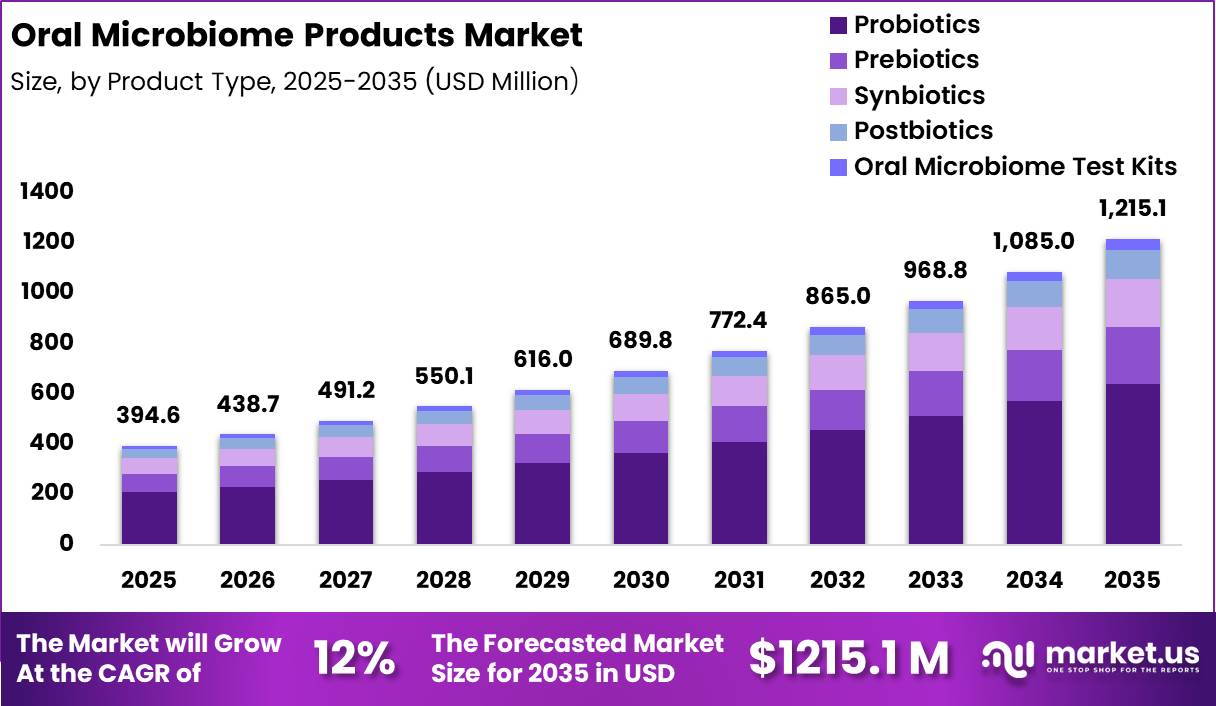
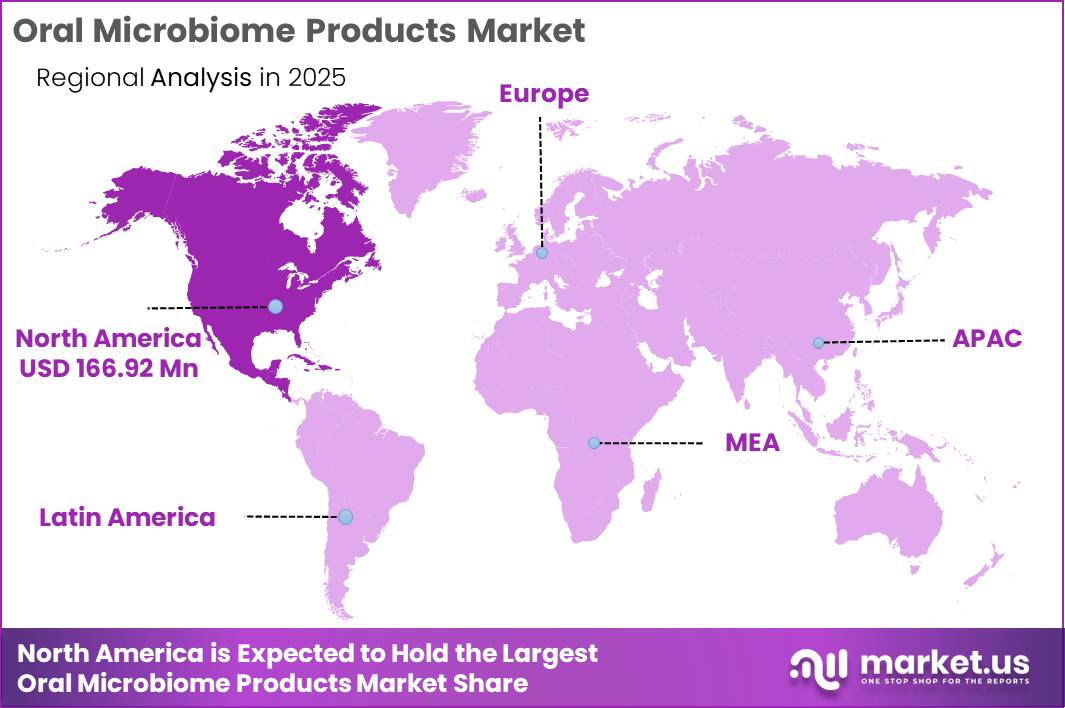
Global Oral Microbiome Products Market size is expected to be worth around US$ 1215.1 Million by 2035 from US$ 394.6 Million in 2025, growing at a CAGR of 12% during the forecast period from 2026 to 2035. In 2025, North America led the market, achieving over 42.30% share with a revenue of US$ 166.92 Million.
The oral microbiome products market represents a specialized segment within preventive oral healthcare, focusing on maintaining the balance of microbial populations in the oral cavity. These products include oral probiotics, prebiotics, microbiome-friendly toothpaste, and therapeutic formulations designed to prevent dental disorders such as caries, periodontitis, and halitosis.
 A key driver for oral microbiome products is the high global prevalence of oral diseases and their links to systemic illness. The WHO estimates that oral diseases affect around 3.5 billion people worldwide, with untreated dental caries in permanent teeth being the most common condition globally.
Dysbiosis of the oral microbiome is strongly associated with caries, periodontitis and endodontic infections, and is increasingly connected to cardiovascular disease, diabetes and adverse pregnancy outcomes.
NIH-supported work notes that the oral cavity hosts one of the body’s most diverse microbiomes, with hundreds of bacterial taxa forming complex biofilms on multiple surfaces, meaning even small compositional shifts can influence disease risk.
As payers and health systems confront the economic burden of oral disease—oral conditions are among the top ten causes of years lived with disability globally—interest in preventive, microbiome-modulating products (probiotic lozenges, microbiome-friendly toothpaste and mouthwashes) is accelerating, especially in high-income and rapidly urbanizing countries.
Trending Factors
Preventive and personalized oral care
A prominent trend is the shift from symptomatic treatment towards preventive and personalized oral care built around microbiome science. The U.S. NIH’s NIDCR Oral Microbiome and Polymicrobial Diseases Program explicitly funds translational research on microbiome-based prevention, diagnosis and treatment, signaling growing institutional focus.At the same time, academic and government-funded studies increasingly document associations between oral microbiota composition and systemic conditions such as depression, metabolic disease and neuroinflammation, encouraging earlier, microbiome-targeted interventions.
For example, recent work has linked oral dysbiosis to chronic stress–related behavioral changes, while other studies connect periodontal pathogens to Alzheimer’s disease and diabetes pathophysiology. This is stimulating development of products positioned for caries and gingivitis prevention, halitosis control, and adjunctive support in high-risk groups (e.g., people with diabetes or immunosuppression).
Commercially, this translates into microbiome-friendly toothpastes, low-aggression mouthrinses, probiotic lozenges and at-home microbiome testing kits bundled with tailored regimens, particularly in North America, Europe and advanced Asian markets.
Restraining Factors
Evidence gaps and regulatory uncertainty
A major restraint for oral microbiome products is limited long-term clinical evidence and heterogeneous regulation. NIH reviews emphasize that, although more than 700 bacterial species can inhabit the oral cavity, causal links between manipulating specific taxa and durable clinical endpoints (such as reduced caries incidence over 3–5 years) remain incompletely proven.This evidence gap makes regulators cautious about therapeutic or disease-reduction claims. The U.S. FDA, for instance, has approved only a small number of live biotherapeutic microbiome products overall; Vowst, cleared in 2023–2024 as the first orally administered fecal microbiota product to prevent recurrent Clostridioides difficile infection, illustrates how stringent evidentiary standards are for microbiome interventions.
However, most oral microbiome cosmetics, toothpastes and supplements are regulated under less specific frameworks, leading to variability in labeling, strain documentation and claim language across regions. This patchwork raises compliance costs, slows cross-border launches and can erode clinician trust, dampening recommendation rates despite rising consumer curiosity.
Opportunity
Public health focus on prevention
There is substantial opportunity where public health policy emphasizes cost-effective oral disease prevention. WHO’s 2022 global oral health status report underscores that treating oral conditions already costs countries, on average, around 5% of total health expenditure and 20% of out-of-pocket health spending, making prevention economically attractive.Meanwhile, NIDCR and other NIH institutes collectively invested more than USD 500 million annually in dental, oral and craniofacial research in recent years, with oral microbiome and polymicrobial disease explicitly prioritized.
Governments are also integrating oral health into noncommunicable disease strategies; for example, many countries now include periodontal screening within diabetes or pregnancy programs, creating channels where microbiome-supportive products can be positioned as adjunctive care.
As regulatory agencies gain experience from early microbiome therapeutics like Vowst, clearer guidance on probiotics, prebiotics and postbiotics is likely to emerge, enabling evidence-backed claims and reimbursement pilots. Companies aligning with public campaigns and generating robust clinical data can leverage these shifts to expand penetration beyond niche, self-pay segments.
Regional Analysis
North America has been identified as the leading regional market for oral microbiome products in 2025, accounting for over 42.30% of the global share and generating revenue of approximately US$ 166.92 million. This dominance can be attributed to the region’s advanced healthcare infrastructure, strong consumer awareness regarding oral health, and the widespread adoption of preventive healthcare solutions.
The presence of key market players, along with continuous investments in research and development, has further strengthened product innovation and commercialization in this region.
Europe is observed to hold the second-largest share, supported by increasing demand for natural and probiotic-based oral care solutions. Regulatory support for microbiome-based products and a growing aging population have contributed to steady market expansion.
The Asia-Pacific region is projected to witness the fastest growth during the forecast period. Rising disposable income, expanding urban populations, and increasing awareness of oral hygiene are key growth drivers. Countries such as China, India, and Japan are experiencing heightened demand due to improving healthcare access and shifting consumer preferences toward preventive care.
Meanwhile, Latin America and the Middle East & Africa are emerging markets, where growth is being driven by improving healthcare infrastructure and gradual increases in consumer awareness, although market penetration remains comparatively lower.
Key Regions and Countries
North America
- The US
- Canada
Europe
- Germany
- France
- The U.K.
- Italy
- Spain
- Russia & CIS
- Rest of Europe
Asia Pacific
- China
- India
- Japan
- South Korea
- ASEAN
- Australia & New Zealand
- Rest of Asia Pacific
Middle East & Africa
- GCC
- South Africa
- Rest of Middle East & Africa
Latin America
- Brazil
- Mexico
- Rest of Latin America
Key Players Analysis
The oral microbiome products market is characterized by a moderately fragmented competitive landscape, where a combination of multinational oral care companies, probiotic specialists, and niche innovators operate across consumer and clinical segments. Tier-1 players collectively account for nearly 57% of market share, indicating partial consolidation with strong competitive intensity.
Large FMCG and healthcare companies such as Unilever, Procter & Gamble, Colgate-Palmolive, Johnson & Johnson, and GlaxoSmithKline (GSK) leverage established distribution networks, brand equity, and dental professional engagement to scale microbiome-based offerings globally. Their strategic advantage lies in rapid commercialization, regulatory compliance, and mass-market penetration.
Specialized probiotic companies including BioGaia, BLIS Technologies, and ProBiora Health focus on clinically validated strains and targeted formulations. These players emphasize R&D investments, proprietary microbial strains, and evidence-based claims, which are critical differentiation factors in this market.
Ingredient and biotechnology firms such as Lallemand Health Solutions, Chr. Hansen (Novonesis), and Novozymes play a foundational role by supplying high-quality probiotic strains and enabling product innovation across brands.
Additionally, emerging and niche brands like Oragenics, OralBiome, Revitin, and NatureWise are expanding through direct-to-consumer channels and specialized formulations targeting gum health, halitosis, and preventive care.
Overall, competitive positioning is increasingly driven by strain specificity, clinical validation, and regulatory-compliant claims, while partnerships and innovation pipelines are shaping long-term market leadership.
Market Key Players
- Procter & Gamble Co.
- Johnson & Johnson
- Colgate-Palmolive Company
- Koninklijke Philips N.V.
- Church & Dwight Co., Inc.
- Sunstar Group
- OraVital Inc.
- BioGaia AB
- Lallemand Inc.
- DMG Dental
- I.M.S. S.r.l.
- Dentistar Group
- Apac Biotech
- TCI Co., Ltd.
- NOW Health Group, Inc.
- Others
Recent Developments
- Procter & Gamble Co.(January, 2025): The company strengthened its premium oral care portfolio through innovation-led pricing strategy, introducing upgraded electric toothbrush technologies and advanced toothpaste formulations, aimed at driving higher consumer adoption in preventive oral health segments.
- Colgate-Palmolive Company (March, 2025): Expansion in microbiome-friendly oral care formulations was observed, with increased focus on natural and probiotic-based toothpaste lines aligned with growing demand for chemical-free oral health solutions.
- Johnson & Johnson (April, 2025): The company continued restructuring its consumer health segment (Kenvue spin-off impact), enabling sharper focus on specialized oral care and microbiome-supportive products within its portfolio.
- Procter & Gamble Co.(April, 2025): Strategic emphasis was placed on premium oral care devices such as high-end electric toothbrushes under its Oral-B brand to offset macroeconomic pressures and enhance value-driven offerings
- Sunstar Group (June, 2025): The company expanded its GUM oral care range with microbiome-balancing solutions targeting gum health and periodontal disease prevention, reflecting increasing clinical positioning of oral probiotics.

