

Endoscope Reprocessing Market
Endoscope Reprocessing Market By Product Type (Automatic Endoscope Reprocessors, Endoscope Tracking Systems, Consumables and Detergents, Others) By Application (Disinfection, Sterilization) By End User (Hospitals, Ambulatory Surgical Centers, Specialty Clinics, Others), Region and Companies – Industry Segment Outlook, Market Assessment, Competition Scenario, Trends and Forecast 2026-2035
- Published date: May 2026
- Report ID: 185779
- Number of Pages: 206
- Format:
- Overview
- Table of Contents
- Major Market Players
Quick Navigation
- Report Overview
- Key Takeaways
- Product Type Analysis
- Application Analysis
- End User Analysis
- Key Market Segments
- Driving Factors
- Trending Factors
- Restraining Factors
- Opportunity
- Regional Analysis
- Key Players Analysis
- Market Key Players
- Recent Developments
- Report Scope
Report Overview
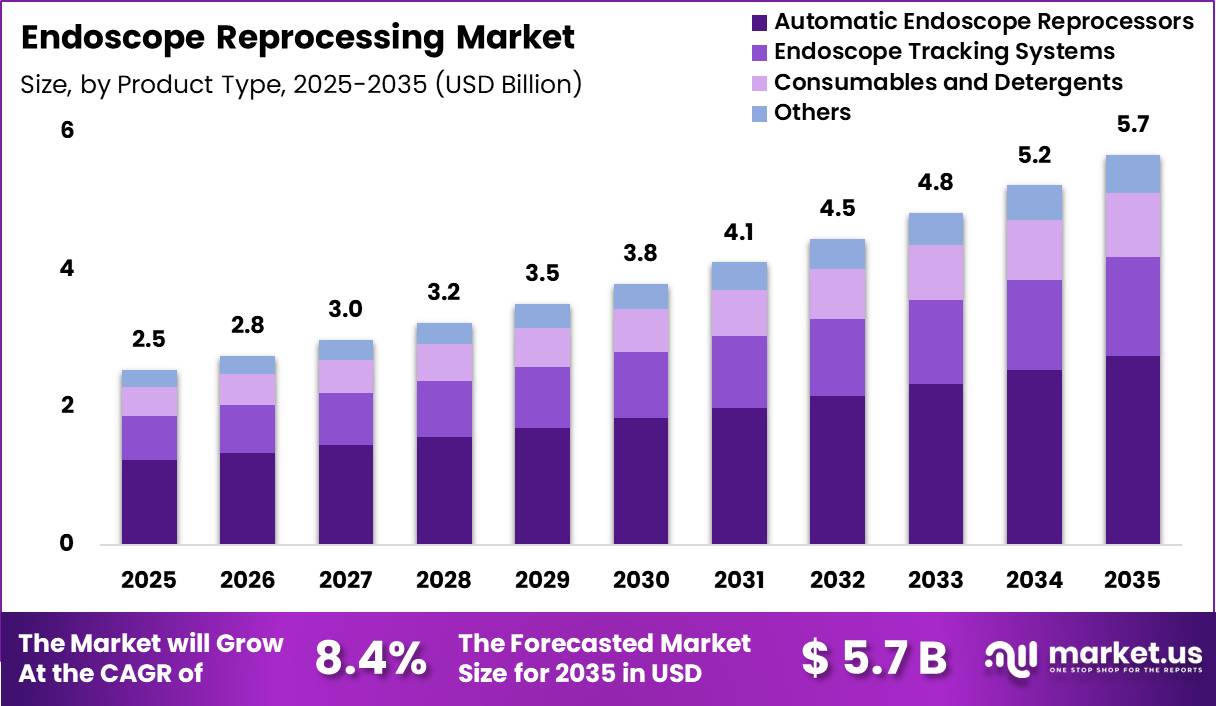
Global Endoscope Reprocessing Market size is expected to be worth around US$ 5.7 Billion by 2035 from US$ 2.5 Billion in 2025, growing at a CAGR of 8.4% during the forecast period from 2026 to 2035. In 2025, North America led the market, achieving over 38.2% share with a revenue of US$ 0.65 Billion.
The Endoscope reprocessing market is gaining strategic importance within the global healthcare industry due to the rising volume of minimally invasive diagnostic and therapeutic procedures and the increasing emphasis on infection prevention in hospitals and ambulatory surgical centers.
 A key driver for the endoscope reprocessing market is the rapid growth in endoscopic procedure volumes combined with documented infection risks from contaminated scopes. In Finland alone, upper gastrointestinal endoscopies reached an annual rate of 9.30 procedures per 1,000 inhabitants, increasing by 2.6% per year over the study period, indicating sustained growth in demand for safe reprocessing solutions.
Flexible gastrointestinal and bronchoscopic endoscopes have been implicated in nosocomial outbreaks; in one U.S. hospital, Pseudomonas aeruginosa colonization or infection occurred in 6.7% of 240 ERCP patients and 8.9% of 1,109 other upper GI endoscopy patients due to reprocessing failures.
CDC guidance stresses that every flexible endoscope must undergo meticulous cleaning and high-level disinfection or sterilization between patients, directly stimulating investment in standardized, automated reprocessing platforms. Together, rising procedure volumes and quantified outbreak data are pushing hospitals and regulators to prioritize robust endoscope reprocessing workflows and technologies.
Trending Factors
Shift to Automation, Surveillance, and Safer Designs
A prominent trend in endoscope reprocessing is the move toward automated systems, enhanced surveillance, and redesigned scopes that reduce contamination risk. The U.S. FDA’s post-market duodenoscope sampling showed high-concern organism contamination rates of 4–6% for older fixed-endcap models, compared with only 1.1% for a newer design, driving interest in devices that are easier to reprocess and in disposable components.FDA safety communications from 2015 onward explicitly recommend supplemental measures such as microbiological culturing, repeat high-level disinfection, and in some settings sterilization, encouraging facilities to adopt automated, trackable reprocessing protocols.
At the same time, infection-control literature describes multi-step reprocessing workflows (pre-cleaning, leak testing, cleaning, high-level disinfection, drying, storage), highlighting cleaning as the most vulnerable step and pushing demand for automated washers, drying cabinets, and real-time quality checks. These regulatory and clinical pressures are normalizing automation, data logging, and human-factors-tested instructions as standard features in reprocessing suites.
Restraining Factors
Persistent Contamination, Complexity, and Cost
Persistent contamination rates, process complexity, and cost pressures act as major restraints on the endoscope reprocessing market. Despite adherence to guidelines, FDA analyses still found contamination with high-concern organisms in up to 6% of sampled older-generation duodenoscopes, indicating that even validated protocols may not fully eliminate risk.Historical CDC investigations documented outbreaks where 6.7% of ERCP patients and 8.9% of upper GI endoscopy patients acquired Pseudomonas aeruginosa due to failures in automated reprocessors, underscoring vulnerability to human error, design flaws, and equipment malfunction.
Reprocessing is also labor-intensive, requiring multiple sequential steps and specialized staff; this complexity increases training needs and operational costs, particularly for smaller hospitals.
Furthermore, regulatory expectations for microbiologic surveillance, enhanced drying, and documentation increase capital and consumable expenditures, which can limit adoption of advanced automated systems in low- and middle-income settings where budget constraints remain acute.
Opportunity
Single-Use, Emerging Markets, and Capacity Gaps
There is significant opportunity for growth in safer technologies, emerging regions, and capacity expansion to meet rising endoscopy demand. FDA now explicitly supports transition to fully disposable duodenoscopes or those with disposable endcaps, creating space for vendors of single-use scopes, compatible reprocessing chemicals, and hybrid workflows that reduce residual contamination risk from complex elevator mechanisms.Systematic reviews show overall bronchoscope contamination rates near 8.7%, and a U.S. Senate investigation linked at least 250 life-threatening infections worldwide to endoscopes between 2012 and 2015, quantifying the potential benefits of safer designs and adjunct reprocessing innovations.
At the same time, device manufacturers highlight large gaps in endoscopy capacity; for example, Japan has about 282 endoscopists per million people versus roughly 72 per million in India, implying substantial latent demand for diagnostic and therapeutic endoscopy infrastructure and associated reprocessing equipment in emerging markets. Vendors that combine robust infection control with cost-efficient solutions can capture this growth.
Regional Analysis
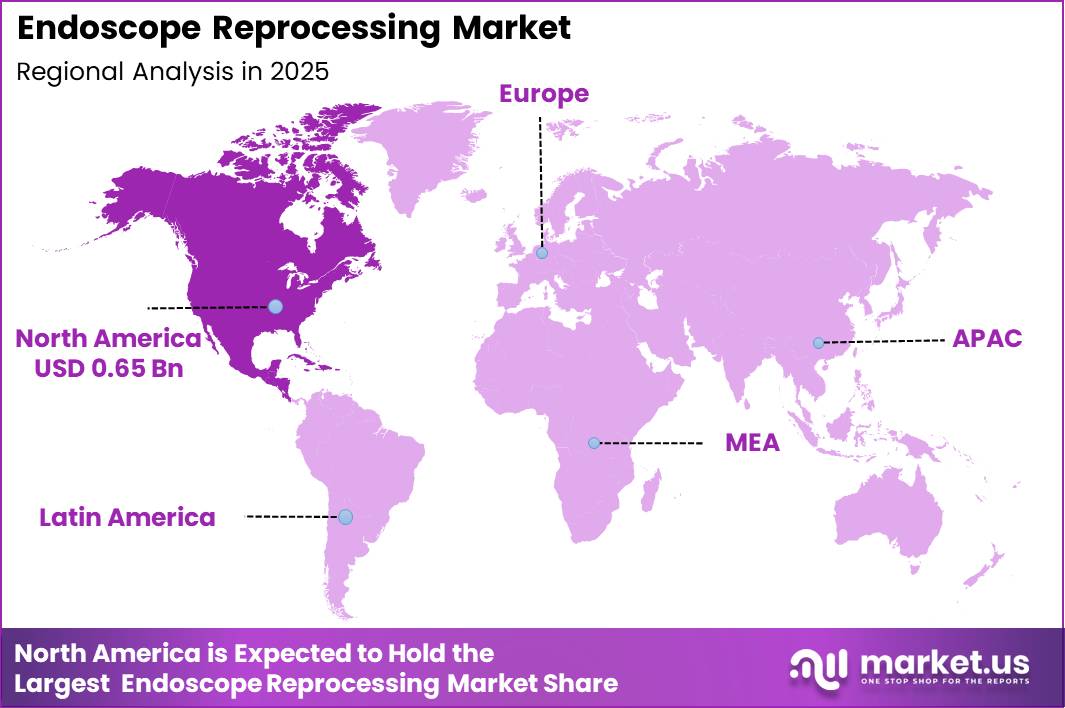
North America dominated the endoscope reprocessing market in 2025, accounting for more than 38.2% of the global market share and generating approximately US$ 0.65 billion in revenue. The regional market growth is primarily supported by the high volume of endoscopic procedures, advanced healthcare infrastructure, and stringent infection prevention regulations across the United States and Canada.
The strong presence of leading healthcare facilities and increasing investments in automated endoscope reprocessors (AERs), drying cabinets, and contamination surveillance systems further contribute to regional expansion.
Europe represented the second-largest regional market due to strict sterilization guidelines implemented by healthcare authorities and rising awareness regarding healthcare-associated infections (HAIs). Countries such as Germany, France, and the United Kingdom are increasingly adopting automated cleaning technologies to improve patient safety and regulatory compliance.
The Asia Pacific region is projected to witness the fastest growth during the forecast period owing to expanding healthcare infrastructure, rising hospital admissions, and increasing adoption of minimally invasive procedures in China, India, and Japan. Growing healthcare expenditure and improving infection control standards are expected to support market growth across emerging economies.
Key Regions and Countries
North America
- The US
- Canada
Europe
- Germany
- France
- The U.K.
- Italy
- Spain
- Russia & CIS
- Rest of Europe
Asia Pacific
- China
- India
- Japan
- South Korea
- ASEAN
- Australia & New Zealand
- Rest of Asia Pacific
Middle East & Africa
- GCC
- South Africa
- Rest of Middle East & Africa
Latin America
- Brazil
- Mexico
- Rest of Latin America
Key Players Analysis
The endoscope reprocessing market is characterized by the presence of several established medical device and infection prevention companies focused on product innovation, automation, and regulatory compliance.
Key players such as Olympus Corporation, STERIS plc, Getinge AB, Cantel Medical Corp., and Advanced Sterilization Products maintain strong market positions through extensive product portfolios and global distribution networks. These companies are actively investing in automated endoscope reprocessors (AERs), drying cabinets, detergents, and tracking systems to improve workflow efficiency and reduce contamination risks.
Strategic initiatives such as mergers, acquisitions, and partnerships are widely adopted to strengthen technological capabilities and geographic presence. For instance, STERIS plc expanded its infection prevention portfolio through the acquisition of Cantel Medical, enhancing its position in the endoscope reprocessing segment.
In addition, manufacturers are emphasizing compliance with stringent guidelines issued by regulatory authorities such as the FDA and CDC, which has accelerated the adoption of high-level disinfection systems and advanced monitoring solutions.
Furthermore, increasing healthcare-associated infection concerns and the growing number of minimally invasive procedures are encouraging companies to develop cost-effective, automated, and user-friendly reprocessing technologies. Continuous innovation and rising hospital investments are expected to intensify competition within the global market.
Market Key Players
- Cantel Medical Corporation
- Olympus Corporation
- STERIS plc
- Getinge Group
- Wassenburg Medical B.V.
- ASP
- Belimed Group
- Custom Ultrasonics, Inc.
- ARC Group
- Shinva Medical Instrument Co., Ltd.
- Borer Chemie AG
- Soluscope SAS
- Endo-Technik GmbH
- Steelco S.p.A.
- Hoya Group
- Others
Recent Developments
- Olympus Corporation (May 2025 ): Olympus launched the ScopeLocker Air endoscope drying cabinet, designed to improve infection prevention by providing continuous airflow through internal channels and around the scope to support guideline‑compliant drying and storage. This move strengthens Olympus’s value proposition beyond visualization, into the “last meter” of safe endoscope turnaround in high‑volume endoscopy units.
- Wassenburg Medical B.V.(April 2026): Wassenburg announced its relocation to a new “future‑proof” headquarters and production facility in Elst, the Netherlands, with the move effective in 2026. The expansion supports higher manufacturing capacity and a broader international footprint for its portfolio across pre‑cleaning, cleaning and disinfection, drying, storage, transport, and traceability of flexible endoscopes.
 A key driver for the endoscope reprocessing market is the rapid growth in endoscopic procedure volumes combined with documented infection risks from contaminated scopes. In Finland alone, upper gastrointestinal endoscopies reached an annual rate of 9.30 procedures per 1,000 inhabitants, increasing by 2.6% per year over the study period, indicating sustained growth in demand for safe reprocessing solutions.