

Medical Equipment Cooling Market
Medical Equipment Cooling Market By Product Type (Liquid-based Cooling, Air-based Cooling), By Compressor Type (Reciprocating Compressors, Scroll Compressors, Screw Compressors, Centrifugal Compressors), By Application (Medical Devices, Cold Storage and Testing, Dehumidification, Analytical and Laboratory Equipment, Others), By End User (Hospitals, Diagnostic Laboratories, Ambulatory Surgical Centers, Specialty Clinics, Others), Region and Companies – Industry Segment Outlook, Market Assessment, Competition Scenario, Trends and Forecast 2026-2035
- Published date: May 2026
- Report ID: 185823
- Number of Pages: 216
- Format:
- Overview
- Table of Contents
- Major Market Players
Quick Navigation
- Report Overview
- Key Takeaways
- Product Type Analysis
- Compressor Type Analysis
- Application Analysis
- End User Analysis
- Key Market Segments
- Driving Factors
- Trending Factors
- Restraining Factors
- Opportunity
- Regional Analysis
- Key Players Analysis
- Recent Developments
- Report Scope
Report Overview
Global Medical Equipment Cooling Market size is expected to be worth around US$ 454.5 Million by 2035 from US$ 307.2 Million in 2025, growing at a CAGR of 4.0% during the forecast period from 2026 to 2035. In 2025, North America led the market, achieving over 33.2% share with a revenue of US$ 102.0 Million.
Medical cooling equipment plays a critical role in maintaining the operational efficiency, safety, and longevity of advanced healthcare systems such as MRI scanners, CT scanners, X-ray machines, PET scanners, laboratory analyzers, and radiation therapy equipment.
These systems generate substantial amounts of heat during diagnostic and therapeutic procedures due to high-power electronic components, superconducting magnets, radiofrequency systems, and imaging processors. As a result, specialized cooling technologies including chillers, compressors, heat exchangers, air conditioning systems, and cryogenic cooling units are increasingly being integrated into healthcare infrastructure.
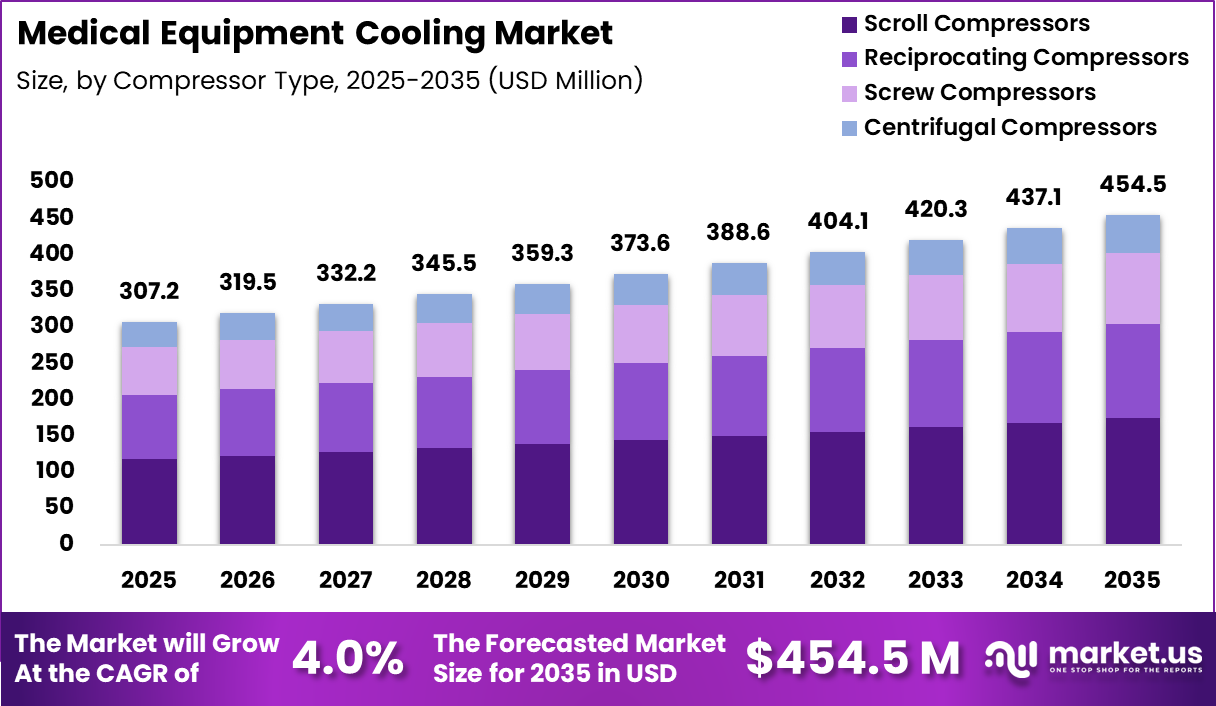 Growing demand for advanced diagnostic imaging is a key driver for medical equipment cooling systems. OECD data show that use of CT, MRI and PET exams exceeds 370 exams per 1,000 population in countries such as Luxembourg, Korea and Austria, and CT exam volumes more than doubled in Korea between 2013 and 2023, sharply increasing thermal loads in imaging suites.
At the same time, chronic diseases such as cardiovascular disease affected an estimated 523 million people and caused about 19 million deaths globally in 2020, driving sustained investment in imaging, radiotherapy and laboratory equipment that must operate within tight temperature tolerances.
Hospitals already exhibit industrial-like energy intensity of around 780 kWh per square metre annually in critical operating theatre blocks, illustrating how heat-dense medical processes are. Together, higher scan volumes, expanding scanner fleets and chronic disease programs are structurally lifting demand for reliable liquid and air-based cooling solutions in hospitals and diagnostic centres.
Trending Factors
Energy-efficient, low-carbon hospital cooling
A major trend in the medical equipment cooling market is the shift toward energy-efficient and climate-aligned solutions within hospitals’ broader decarbonisation strategies.Large hospitals and inpatient facilities in the United States already consume more than 600–700 kWh per square metre annually, with a representative block of specialised operating theatres reaching about 780 kWh per square metre per year, higher than many hyperscale data centres and underscoring the urgency of efficiency gains in cooling-intensive areas.
Global analyses of hospital cooling indicate that space-cooling related emissions in healthcare can reach 40–80 million tonnes of CO2 equivalent per year under certain scenarios, pushing health systems to adopt higher-performance chillers, heat exchangers and control systems to cut energy use and emissions.
This is accelerating adoption of variable-speed compressors, advanced heat pumps and liquid-based cooling that can reduce electrical demand while maintaining strict thermal stability for CT, MRI and radiotherapy equipment, often integrated with distributed energy systems in hospitals.
Restraining Factors
High capital costs and energy burden
High upfront and operating costs form a significant restraint on wider deployment of advanced medical equipment cooling, especially in resource-constrained health systems.Evidence from hospital energy studies shows that critical zones such as operating theatres can drive electricity intensities close to 780 kWh per square metre annually, locking hospitals into large, continuous cooling loads that can be difficult to finance and manage, particularly where tariffs are high.
In many low- and middle-income countries, chronic diseases already account for around 80% of the global chronic-disease burden, yet health budgets are constrained, so capital-intensive infrastructure like high-capacity chillers and redundant cooling loops compete with essential clinical spending.
Even in high-income OECD systems, rising volumes of CT and MRI exams, which more than doubled in some countries between 2013 and 2023, add to peak energy demand and can require electrical and mechanical upgrades that smaller facilities cannot easily afford. These financial and energy-intensity pressures slow replacement of older, less efficient cooling equipment.
Opportunity
Expanding imaging capacity and infrastructure
The expansion of diagnostic and treatment infrastructure worldwide creates a substantial opportunity for medical equipment cooling providers. OECD data show rapid growth in CT and MRI exam volumes, with CT exams rising by more than 50% in Australia and Latvia and more than doubling in Korea between 2013 and 2023, while MRI exams more than doubled in Korea and Latvia and increased around 70% in France, implying sustained investment in scanner fleets that require robust cooling capacity per room.Japan already operates over 57 MRI units per million inhabitants, and several other OECD countries exceed 35 units per million, indicating a large installed base that will periodically upgrade both scanners and thermal management systems.
At the same time, the global cost of chronic disease is projected to reach 47 trillion dollars by 2030, motivating governments and health systems to scale early diagnosis and high-throughput imaging programs supported by reliable, energy-efficient cooling infrastructure. This opens opportunities for modular, retrofit-friendly and low-carbon cooling technologies tailored to hospitals and imaging centres.
Regional Analysis
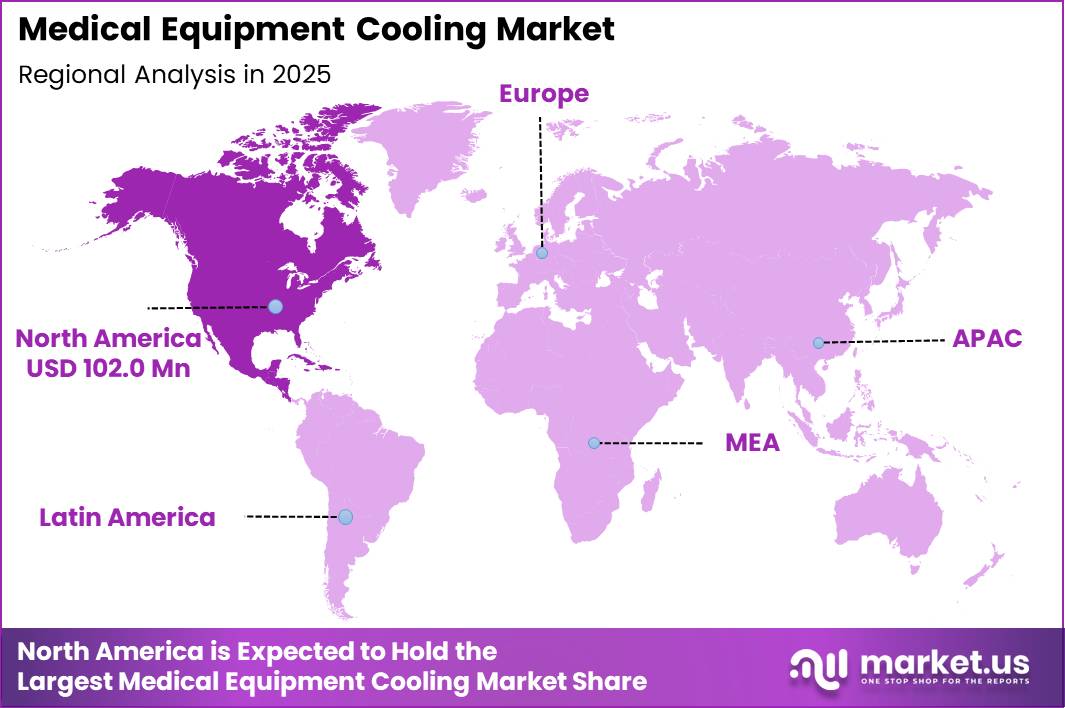
In 2025, North America dominated the Medical Equipment Cooling Market, accounting for over 33.2% of the global market share and generating revenue of approximately US$ 102.0 million. The regional market growth is primarily driven by the strong presence of advanced healthcare infrastructure, increasing adoption of technologically advanced medical devices, and rising investments in healthcare modernization across the United States and Canada.
The growing utilization of diagnostic imaging systems, laser-based surgical equipment, and high-performance medical electronics has significantly increased the demand for efficient cooling solutions in healthcare facilities.
Furthermore, the region benefits from the presence of leading medical device manufacturers and continuous technological innovations in cooling systems designed for sensitive medical equipment.
The increasing focus on patient safety, equipment reliability, and energy-efficient healthcare operations is further supporting market expansion. Regulatory standards related to device performance and temperature management have also encouraged healthcare providers to adopt advanced cooling technologies.
In addition, the rising prevalence of chronic diseases and the growing number of diagnostic procedures are contributing to higher installations of medical equipment requiring thermal management systems.
Favorable reimbursement policies, increasing healthcare expenditure, and rapid integration of AI-enabled and portable medical devices are expected to sustain North America’s leading position in the Medical Equipment Cooling Market during the forecast period.
Key Regions and Countries
North America
- The US
- Canada
Europe
- Germany
- France
- The U.K.
- Italy
- Spain
- Russia & CIS
- Rest of Europe
Asia Pacific
- China
- India
- Japan
- South Korea
- ASEAN
- Australia & New Zealand
- Rest of Asia Pacific
Middle East & Africa
- GCC
- South Africa
- Rest of Middle East & Africa
Latin America
- Brazil
- Mexico
- Rest of Latin America
Key Players Analysis
The Medical Equipment Cooling Market is characterized by the presence of several global and regional players focusing on technological innovation, product efficiency, and strategic collaborations to strengthen their market position.
Key companies operating in the market include Boyd Corporation, KKT Chillers Inc., Pfannenberg Group, Lytron Inc., Advanced Cooling Technologies, Inc., and Mekra Lang GmbH & Co. KG. These companies are actively investing in advanced liquid cooling systems, thermoelectric cooling technologies, and compact heat management solutions to meet the increasing demand for reliable and high-performance medical devices.
Market participants are emphasizing research and development activities to improve cooling efficiency and reduce equipment downtime in imaging systems, diagnostic devices, and surgical equipment.
Strategic partnerships with healthcare equipment manufacturers are also being adopted to expand product portfolios and enhance global distribution networks. In addition, the growing adoption of minimally invasive procedures and high-powered diagnostic systems is encouraging companies to develop customized and energy-efficient cooling solutions.
Furthermore, leading players are focusing on geographical expansion across emerging economies in Asia-Pacific and Latin America, where healthcare infrastructure development and medical equipment investments are increasing significantly. Competitive rivalry in the market remains moderate to high due to continuous technological advancements and product differentiation strategies.
Market Key Players
- Daikin Industries, Ltd.
- Glen Dimplex Group
- Copeland LP
- Ingersoll Rand Inc.
- Atlas Copco AB
- GE HealthCare Technologies Inc.
- Siemens Healthineers AG
- Koninklijke Philips N.V.
- Laird Thermal Systems, Inc.
- Motivair Corporation
- Boyd Corporation (Lytron)
- KKT chillers
- Filtrine Manufacturing Company
- General Air Products, Inc.
- Thermal Care, Inc.
- Others
Recent Developments
- January, 2025 – GE HealthCare confirmed an investment of $135 million to expand its manufacturing site in Carrigtwohill, Cork, aimed at addressing growing demand for imaging equipment used in MRI applications. This expansion reflects the increasing thermal management requirements as diagnostic imaging systems become more sophisticated and energy-intensive.
- March, 2026 – Daikin India launched its 2026 product portfolio featuring major advancements in energy efficiency and smart cooling technologies. The new lineup includes an upgraded range of Room Air Conditioners aligned with BEE 2026 Star Rating standards and the introduction of the AI-enabled VRV Alpha series, marking significant progress in intelligent climate control for commercial and luxury residential segments.
- April, 2025 – Siemens Healthineers and Tower Health entered into a 10-year partnership to enhance Tower Health’s radiology, cardiology, and oncology departments using Siemens Healthineers equipment, including computed tomography and magnetic resonance imaging systems. This collaboration underscores the critical role of advanced cooling infrastructure in supporting next-generation imaging technologies.
- November, 2025 – GE HealthCare, Philips, and Siemens Healthineers showcased AI-forward imaging innovations at RSNA 2025 in Chicago. Philips unveiled the industry’s first 3 Tesla MRI scanner with a sealed helium system (BlueSeal Horizon), building on its track record of over 2,000 installations of 1.5 Tesla BlueSeal systems that have collectively saved more than 6 million liters of liquid helium since 2018, demonstrating significant advancements in cooling efficiency and sustainability.
 Growing demand for advanced diagnostic imaging is a key driver for medical equipment cooling systems. OECD data show that use of CT, MRI and PET exams exceeds 370 exams per 1,000 population in countries such as Luxembourg, Korea and Austria, and CT exam volumes more than doubled in Korea between 2013 and 2023, sharply increasing thermal loads in imaging suites.