

Postpartum Hemorrhage Management Devices Market
Postpartum Hemorrhage Management Devices MarketBy Product Type (Intrauterine Balloon Tamponade, Uterine Compression Devices, Resuscitators, Vacuum-Induced Hemorrhage Control Systems, Intrauterine Vacuum Devices, Others) By Application (Vaginal Delivery, Cesarean Section, Termination of Pregnancy, Others) By End-User (Hospitals, Ambulatory Surgical Centers, Maternity and Fertility Clinics, Others), Region and Companies – Industry Segment Outlook, Market Assessment, Competition Scenario, Trends and Forecast 2026-2035
- Published date: May 2026
- Report ID: 185854
- Number of Pages: 255
- Format:
- Overview
- Table of Contents
- Major Market Players
Quick Navigation
- Report Overview
- Key Takeaways
- Product Type Analysis
- Application Analysis
- End-User Analysis
- Key Market Segments
- Driving Factors
- Trending Factors
- Restraining Factors
- Opportunity
- Regional Analysis
- Key Players Analysis
- Recent Developments
- Report Scope
Report Overview
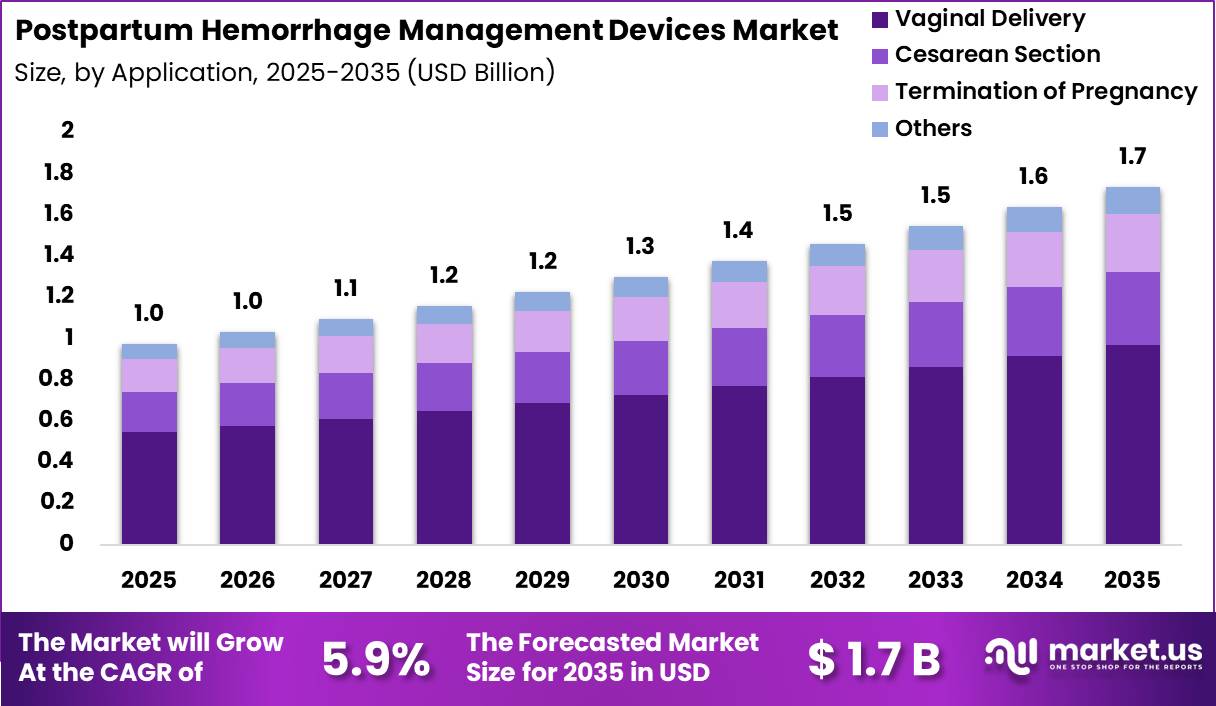
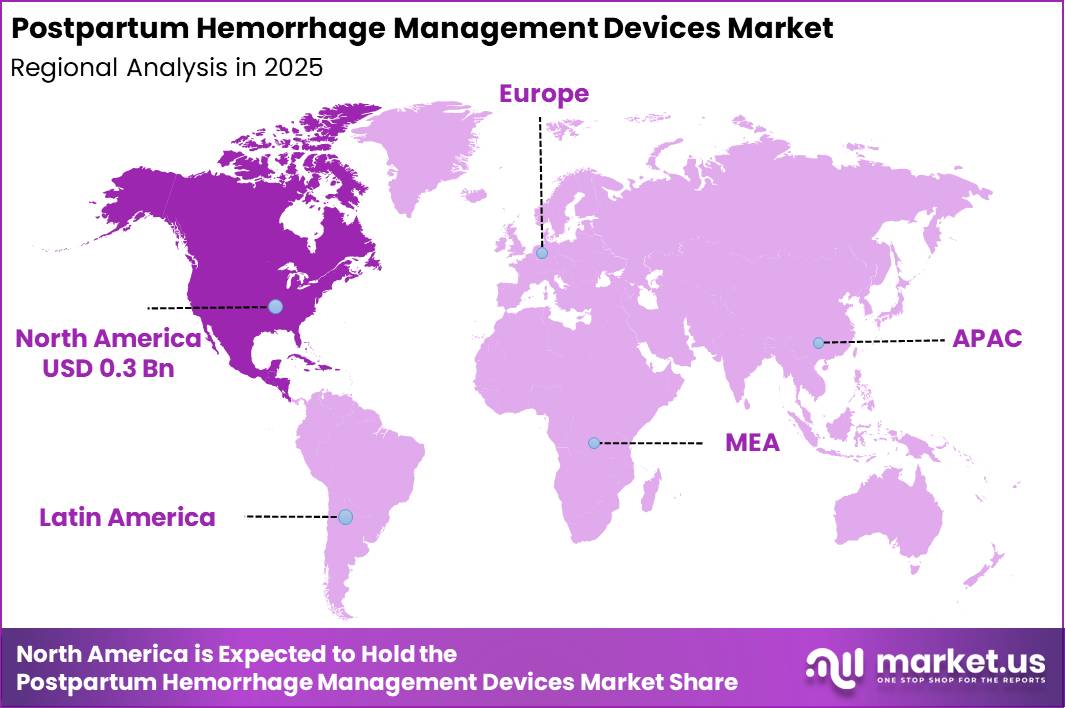
Global Postpartum Hemorrhage Management Devices Market size is expected to be worth around US$ 1.7 Billion by 2035 from US$ 1.0 Billion in 2025, growing at a CAGR of 5.9% during the forecast period from 2026 to 2035. In 2025, North America led the market, achieving over 34.4% share with a revenue of US$ 0.3 Billion.
The global Postpartum Hemorrhage Management Devices Market is witnessing significant growth due to the increasing burden of postpartum hemorrhage (PPH), which remains one of the leading causes of maternal mortality worldwide.
Postpartum hemorrhage, commonly defined as blood loss of 500 mL or more within 24 hours after childbirth, has become a major public health concern, particularly in low- and middle-income countries where access to emergency obstetric care remains limited. According to the World Health Organization (WHO), nearly 14 million women experience PPH annually, resulting in approximately 70,000 maternal deaths each year globally.
 Opportunity
Opportunity
Expanding healthcare infrastructure in emerging markets presents substantial opportunities for Postpartum Hemorrhage Management Devices adoption. India’s National Health Mission supports states through annual Programme Implementation Plans to reduce maternal mortality, with institutional births reaching 100% in Kerala, Goa, Lakshadweep, Puducherry, and Tamil Nadu.
The proportion of pregnant women receiving antenatal care in the first trimester increased from 59% in 2015-16 to 70% in 2019-21, while women receiving four or more ANC visits rose from 51% to 59% nationally. WHO’s global action plan emphasizes uterine balloon tamponade device deployment at primary health center levels with trained medical officers present. India’s Extended PMSMA strategy launched in January 2022 provides financial incentivization for high-risk pregnancy tracking until safe delivery.
The government recommendation for blood storage units within maternity wings of high-volume tertiary care facilities creates infrastructure demand. Cost-effective uterine balloon tamponade alternatives like condom catheters offer affordable solutions for resource-limited settings. India’s commitment to UN Sustainable Development Goal targets for MMR at 70 per 100,000 live births by 2030 drives investment.
Regional Analysis
North America dominated the global Postpartum Hemorrhage Management Devices Market in 2025, accounting for over 34.4% of the total market share and generating revenue of approximately US$ 0.3 billion. The regional market growth is primarily driven by the increasing prevalence of postpartum hemorrhage cases, rising maternal healthcare expenditure, and the strong presence of advanced healthcare infrastructure across the United States and Canada.
The adoption of technologically advanced hemorrhage management devices, including uterine balloon tamponade systems and non-pneumatic anti-shock garments, has increased significantly due to growing awareness regarding maternal mortality prevention and emergency obstetric care.
Furthermore, supportive government initiatives and favorable reimbursement frameworks have contributed to the widespread utilization of postpartum hemorrhage management devices in hospitals and maternity care centers. The presence of major market players, coupled with continuous investments in research and development activities, has further accelerated product innovation and market penetration in the region.
In addition, the increasing number of institutional deliveries and the availability of skilled healthcare professionals are supporting market expansion. Rising emphasis on early diagnosis and rapid intervention for obstetric complications is also expected to strengthen demand for postpartum hemorrhage management devices across North America during the forecast period.
Key Regions and Countries
North America
- The US
- Canada
Europe
- Germany
- France
- The U.K.
- Italy
- Spain
- Russia & CIS
- Rest of Europe
Asia Pacific
- China
- India
- Japan
- South Korea
- ASEAN
- Australia & New Zealand
- Rest of Asia Pacific
Middle East & Africa
- GCC
- South Africa
- Rest of Middle East & Africa
Latin America
- Brazil
- Mexico
- Rest of Latin America
Key Players Analysis
The Postpartum Hemorrhage Management Devices Market is characterized by intense competition among global medical device manufacturers focusing on product innovation, strategic collaborations, and geographic expansion.
Major companies operating in the market include Becton, Dickinson and Company, Cook Medical, Teleflex Incorporated, Utah Medical Products, Inc., and Organon & Co.. These players are actively investing in advanced postpartum hemorrhage management technologies, particularly uterine balloon tamponade systems and vacuum-induced hemorrhage control devices, to strengthen their market presence.
Becton, Dickinson and Company holds a leading market position due to its extensive women’s health portfolio, strong global distribution network, and continuous investments in research and development. The company has strengthened its market position through acquisitions and innovative product launches targeting rapid hemorrhage control solutions.
Cook Medical is recognized for its focus on emergency obstetric care products and customized hemorrhage management kits designed for hospital settings. Meanwhile, Teleflex Incorporated emphasizes minimally invasive and clinically efficient solutions to improve maternal healthcare outcomes.
In addition, emerging companies and regional manufacturers are increasingly entering the market with cost-effective products, particularly for low-resource healthcare settings. Strategic partnerships with healthcare organizations, government maternal health programs, and expanding presence in emerging economies are expected to remain key competitive strategies among market participants during the forecast period.
Market Key Players
- Medtronic plc
- Becton, Dickinson and Company
- Teleflex Incorporated
- CooperSurgical, Inc.
- Cook Medical, LLC
- Utah Medical Products, Inc.
- Clinical Innovations, LLC
- Integra LifeSciences Holdings Corporation
- Inpress Technologies, Inc.
- Dornier MedTech GmbH
- Olympus Corporation
- Karl Storz SE & Co. KG
- Ethicon, Inc. (Johnson & Johnson)
- Zinpro Corporation
- Cryo-Cell International, Inc.
- Others
Recent Developments
- Utah Medical Products, Inc. (February 2025): Utah Medical Products reported expanded adoption of its Bakri postpartum balloon in high-risk obstetric centers as updated PPH protocols in North America and Europe elevated uterine tamponade balloons to front-line therapy, reinforcing the company’s positioning in guideline-driven PPH management pathways.
- Becton, Dickinson and Company (BD) (March 2025): BD strengthened its role in postpartum hemorrhage treatment by emphasizing uterine balloon tamponade and related surgical instruments within its broader women’s health portfolio, supported by rising global PPH incidence and growing hospital demand for standardized device kits that integrate seamlessly into emergency obstetric care workflows.
- Medtronic plc (April 2025): Medtronic leveraged its maternal health footprint by aligning advanced monitoring and surgical technologies with postpartum hemorrhage management bundles, as hospitals prioritized comprehensive obstetric solutions that combine rapid detection, minimally invasive intervention, and post-procedure monitoring to reduce maternal morbidity.
- Cook Medical LLC (May 2025): Cook Medical continued to expand access to its obstetric and gynecologic surgical instruments used in refractory PPH cases, with hospitals in developed markets consolidating purchasing contracts around vendors that can support both conservative and procedural interventions within a single postpartum hemorrhage device portfolio.
 Opportunity