

Gaucher Disease Drugs Market
Gaucher Disease Drugs Market By Drug Type (Enzyme Replacement Therapy (ERT), Substrate Reduction Therapy (SRT), Chaperone Therapy, Others) By Route of Administration (Intravenous, Oral, Others) By End User (Hospitals, Specialty Clinics, Homecare Settings, Others), Region and Companies – Industry Segment Outlook, Market Assessment, Competition Scenario, Trends and Forecast 2026-2035
- Published date: June 2026
- Report ID: 187415
- Number of Pages: 203
- Format:
- Overview
- Table of Contents
- Major Market Players
Quick Navigation
- Report Overview
- Key Takeaways
- Drug Type Analysis
- Route of Administration Analysis
- End User Analysis
- Key Market Segments
- Driving Factors
- Trending Factors
- Restraining Factors
- Opportunity
- Regional Analysis
- Key Players Analysis
- Recent Developments
- Report Scope
Report Overview
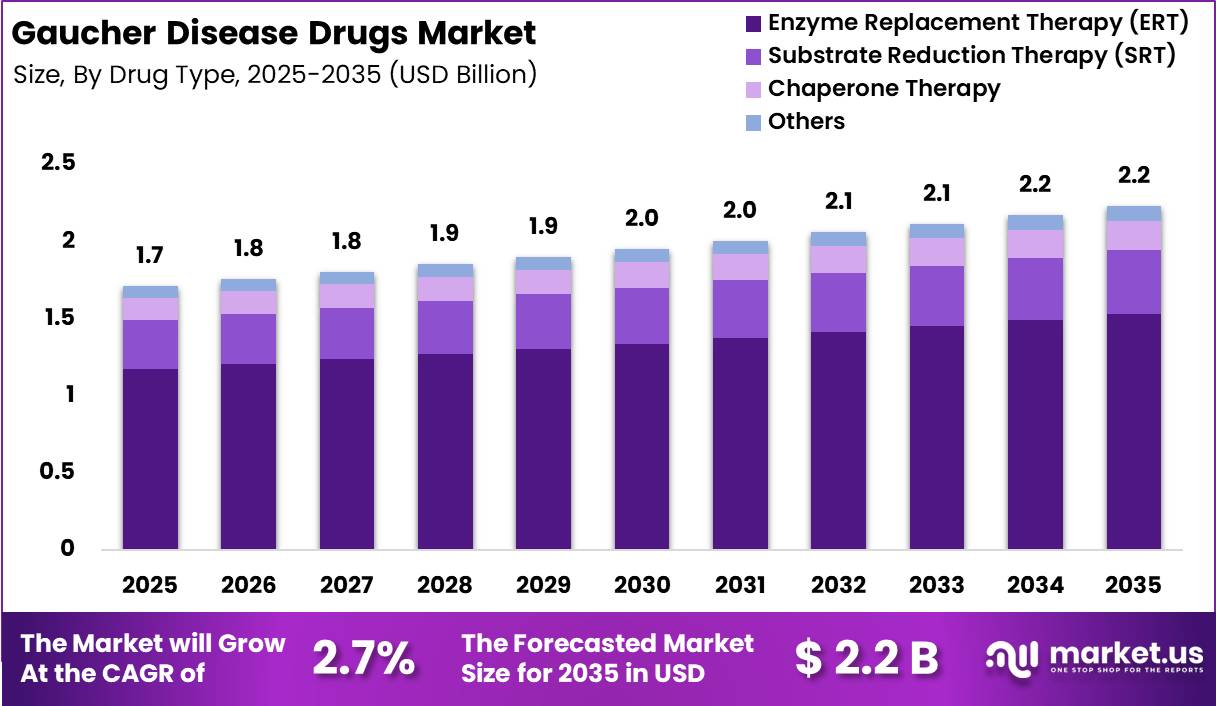
Global Gaucher Disease Drugs Market size is expected to be worth around US$ 2.2 Billion by 2035 from US$ 1.7 Billion in 2025, growing at a CAGR of 2.7% during the forecast period from 2026 to 2035. In 2025, North America led the market, achieving over 48.6% share with a revenue of US$ 0.8 Billion.
The Gaucher Disease Drugs Market represents a specialized segment of the rare disease therapeutics industry, focused on the treatment and long-term management of Gaucher disease (GD), a rare inherited lysosomal storage disorder caused by mutations in the GBA gene.
The condition results in a deficiency of the enzyme glucocerebrosidase, leading to the accumulation of glucocerebroside within macrophages and causing progressive damage to the spleen, liver, bone marrow, and skeletal system. According to a systematic review published by the U.S. National Library of Medicine, the global birth prevalence of Gaucher disease is estimated at approximately 1.5 cases per 100,000 live births, while the overall prevalence is around 0.9 cases per 100,000 population.
 The growth of the Gaucher Disease Drugs Market is being driven by increasing diagnosis rates and broader adoption of disease-specific therapies. Advancements in newborn screening programs, genetic testing technologies, and physician awareness have improved the identification of patients at earlier stages of disease progression. Earlier diagnosis enables timely therapeutic intervention, which contributes to better disease management and improved clinical outcomes.
The growing availability of specialized treatment centers and rare disease management programs has further increased patient access to approved therapies. In addition, expanding healthcare coverage for rare diseases across developed markets has supported higher treatment uptake. As more patients receive confirmed diagnoses and initiate long-term therapy, demand for Gaucher disease treatments continues to increase, supporting market expansion.
Trending Factors
Growing Preference for Oral Therapies and Personalized Treatment Approaches
A key trend shaping the market is the increasing preference for oral treatment options and personalized therapeutic strategies. Oral therapies offer greater convenience compared to intravenous treatment administration and can reduce the burden associated with frequent hospital or infusion-center visits. This shift is contributing to improved patient adherence and treatment satisfaction.At the same time, advances in molecular diagnostics and genetic profiling are supporting more individualized treatment decisions. Healthcare providers are increasingly incorporating patient-specific genetic and metabolic information into therapy selection, reflecting the broader movement toward precision medicine in rare disease management. Continued research into targeted therapies and advanced treatment modalities is expected to further transform the treatment landscape.
Restraining Factors
High Cost of Long-Term Treatment and Limited Patient Pool
The market faces significant challenges due to the high cost associated with lifelong treatment and the relatively small patient population. Advanced biologic therapies require complex manufacturing processes and ongoing administration, resulting in substantial treatment expenses. These costs create financial pressures for healthcare systems and can limit treatment accessibility, particularly in low- and middle-income countries where reimbursement frameworks for rare diseases remain underdeveloped.The rarity of Gaucher disease also restricts the commercial potential of new therapies, reducing economies of scale and increasing development costs for pharmaceutical manufacturers. Furthermore, delayed diagnosis resulting from non-specific symptoms can postpone treatment initiation and limit overall market penetration.
Opportunity
Advancements in Gene Therapy and Rare Disease Funding Initiatives
Significant opportunities are emerging from the advancement of gene therapy technologies and increasing governmental support for rare disease research. Growing investment in genetic engineering, cell-based therapies, and advanced drug development platforms is accelerating the development of disease-modifying and potentially curative treatment approaches.In parallel, orphan drug incentives, research grants, and accelerated regulatory pathways are encouraging greater participation from biotechnology and pharmaceutical companies. Expansion of newborn screening programs, genetic counseling services, and rare disease awareness initiatives is also expected to improve early diagnosis rates and patient identification. These developments are creating favorable conditions for innovation and long-term market growth, particularly as next-generation therapies progress through clinical development and commercialization.
Regional Analysis
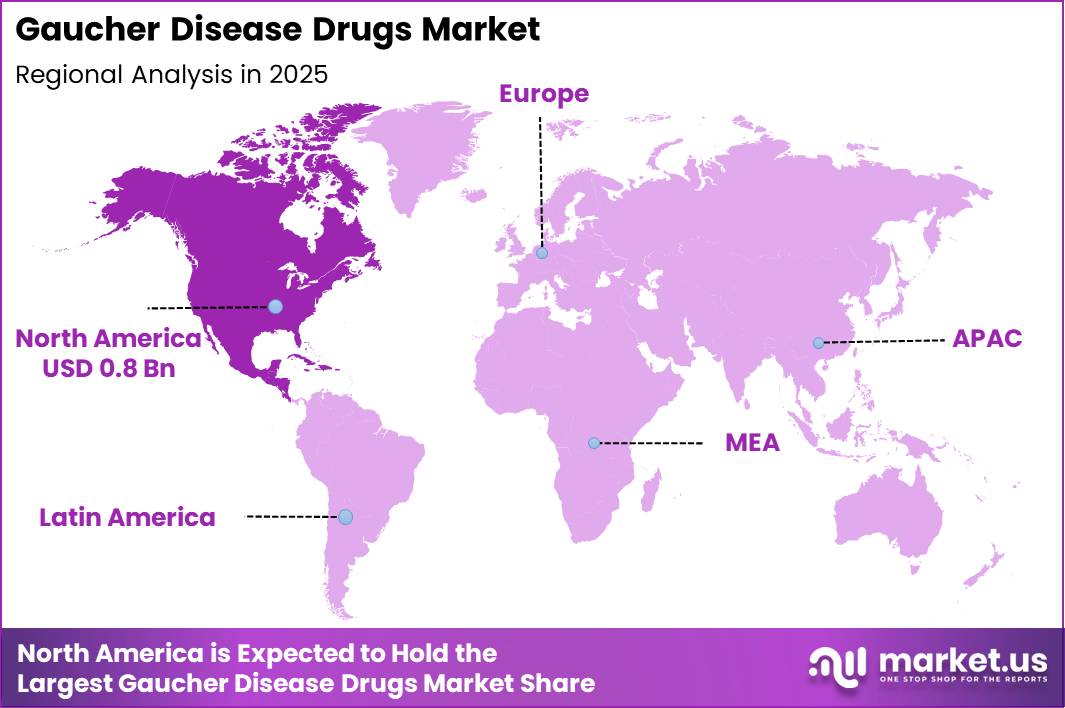
North America dominated the Gaucher Disease Drugs Market in 2025, accounting for more than 48.6% of the global market share and generating revenue of approximately US$ 0.8 billion. The region’s leadership can be attributed to its advanced healthcare infrastructure, strong presence of leading pharmaceutical companies, and widespread availability of innovative therapies for rare diseases.
Favorable reimbursement policies, high healthcare expenditure, and increasing awareness regarding early diagnosis and treatment of Gaucher disease have further supported market growth across the United States and Canada.
The United States represented the largest contributor within the region, driven by a well-established rare disease treatment ecosystem and significant investments in research and development. The availability of enzyme replacement therapies (ERTs) and substrate reduction therapies (SRTs), coupled with strong regulatory support for orphan drugs, has enhanced patient access to effective treatment options. In addition, the presence of specialized treatment centers and genetic screening programs has improved disease detection rates, contributing to sustained demand for Gaucher disease drugs.
Canada also contributed to regional growth through expanding healthcare coverage and increasing adoption of advanced biologic therapies. Furthermore, ongoing clinical research activities, collaborations between pharmaceutical companies and healthcare institutions, and the introduction of next-generation therapies are expected to strengthen North America’s position throughout the forecast period. The region is anticipated to maintain its market dominance due to continuous innovation and a supportive regulatory environment for rare disease treatments.
Key Regions and Countries
North America
- The US
- Canada
Europe
- Germany
- France
- The U.K.
- Italy
- Spain
- Russia & CIS
- Rest of Europe
Asia Pacific
- China
- India
- Japan
- South Korea
- ASEAN
- Australia & New Zealand
- Rest of Asia Pacific
Middle East & Africa
- GCC
- South Africa
- Rest of Middle East & Africa
Latin America
- Brazil
- Mexico
- Rest of Latin America
Key Players Analysis
The Gaucher Disease Drugs Market is characterized by the presence of several leading pharmaceutical companies focused on enzyme replacement therapies (ERTs) and substrate reduction therapies (SRTs). Key players include Sanofi, Takeda Pharmaceutical Company, and Johnson & Johnson through its rare disease portfolio. Sanofi maintains a strong market position with its established ERT products and extensive global distribution network.
Takeda continues to strengthen its presence through innovative treatment offerings and ongoing research initiatives. Market participants are increasingly investing in advanced therapies, including gene therapy and next-generation treatment approaches, to improve patient outcomes and expand their product portfolios.
Strategic collaborations, regulatory approvals, and geographic expansion remain key competitive strategies. The market is moderately consolidated, with high entry barriers due to complex drug development processes, stringent regulatory requirements, and the limited patient population associated with this rare genetic disorder.
Market Key Players
- Sanofi S.A.
- Takeda Pharmaceutical Company Limited
- Pfizer Inc.
- Johnson & Johnson (Janssen)
- Protalix BioTherapeutics, Inc.
- Amicus Therapeutics, Inc.
- Centogene N.V.
- Chiesi Farmaceutici S.p.A.
- BioMarin Pharmaceutical Inc.
- Shire plc (Takeda)
- Roche Holding AG
- Merck & Co., Inc.
- Novo Nordisk A/S
- Others
Recent Developments
- December 2025 – BioMarin Pharmaceutical Inc. announced a definitive agreement to acquire Amicus Therapeutics for approximately $4.8 billion. The transaction was designed to strengthen BioMarin’s rare disease portfolio and expand its presence in lysosomal storage disorders. Although Amicus is primarily focused on Fabry and Pompe diseases, the acquisition reflects increasing consolidation within the rare disease therapeutics landscape, which also includes Gaucher disease.
- October 2025 – Takeda Pharmaceutical Company Limited entered into a strategic partnership with Innovent Biologics. The collaboration, valued at up to $11.4 billion, was established to develop and commercialize innovative biologic assets. The agreement underscored Takeda’s broader strategy of enhancing its rare disease and specialty medicine pipeline through external innovation and global partnerships.
- Throughout 2025–2026 – Protalix BioTherapeutics continued expanding the commercial presence of ELELYSO® (taliglucerase alfa), a plant cell-expressed enzyme replacement therapy for Gaucher disease. The company maintained its focus on increasing treatment accessibility and strengthening its position in the global Gaucher disease market through ongoing commercialization initiatives and lifecycle management activities.