

Report Overview
Global Engineering Services Outsourcing Market size is expected to be worth around USD 91.9 Billion by 2035 from USD 29.2 Billion in 2025, growing at a CAGR of 12.2% during the forecast period 2026 to 2035.
Engineering services outsourcing (ESO) covers the delegation of core technical functions including product design, system integration, testing, and prototyping to external specialist providers. Companies across automotive, aerospace, semiconductors, and healthcare sectors use ESO to access deep engineering expertise without building permanent in-house capacity. The market now spans onshore, nearshore, and offshore delivery models.
Medical device engineering outsourcing benefits from regulatory complexity that most mid-tier device companies cannot manage internally. FDA and CE certification pathways require validation engineering, design history file management, and risk analysis documentation that specialist providers deliver faster and at lower cost than internal teams. This creates high-retention outsourcing relationships with recurring revenue characteristics, making healthcare ESO one of the highest-margin application segments.
According to microsourcing, engineering teams pursue offshoring when they can realize labor cost differentials of 40–70% compared with onshore rates. For renewable energy and medical device programs, where engineering labor constitutes a major share of project cost, this differential translates directly into project feasibility decisions. Programs that are borderline viable onshore become commercially attractive when offshore ESO delivery is factored into the cost model.
Emerging Trends
Generative AI Integration and Cloud-Based Engineering Platforms Are Redefining How Outsourced Engineering Work Is Delivered and Priced
Generative AI tools are now embedded into product design, testing, and engineering documentation workflows at leading ESO providers. AI-assisted code generation, design verification, and simulation acceleration are compressing delivery timelines while expanding the scope of work a given engineering team can execute. Providers that integrate these tools successfully into production workflows gain a structural speed and cost advantage over those still relying on manual engineering processes.
Cloud-based collaborative engineering environments and Product Lifecycle Management platforms are replacing legacy on-premises toolchains. This shift enables real-time collaboration between client engineering teams and offshore providers, reducing the coordination friction that historically limited the complexity of work that could be safely outsourced. Model-Based Systems Engineering adoption further supports this, standardizing how requirements, architecture, and verification evidence are shared across distributed teams.
According to ISG, HCM SaaS fees in outsourced environments are 28% lower over the last five years and 25% lower over the last three years to 2025. This pattern of compressing per-unit technology costs in mature outsourcing relationships is directly applicable to engineering services environments. Buyers who lock in long-term ESO partnerships now benefit from declining unit costs as provider productivity improves and AI tooling amortizes across growing delivery volumes.
Regional Analysis
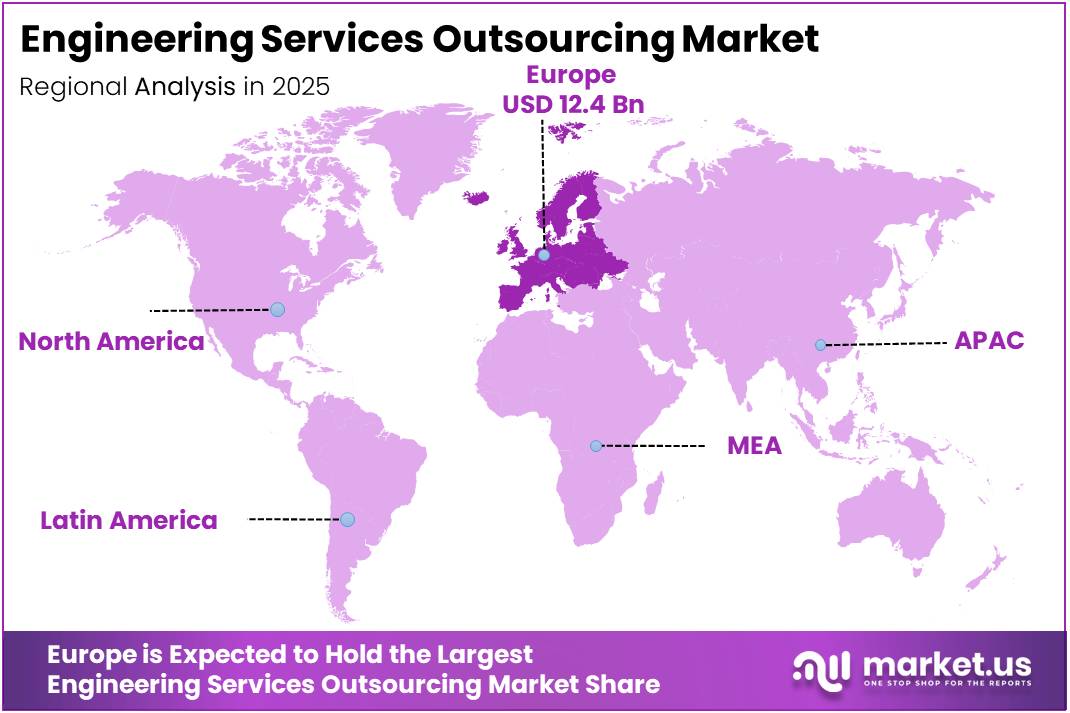
Europe Dominates the Engineering Services Outsourcing Market with a Market Share of 42.70%, Valued at USD 12.4 Billion
Europe holds the largest share of the global ESO market at 42.70%, valued at USD 12.4 Billion in 2025. Germany’s automotive and mechanical engineering ecosystem, France’s aerospace cluster, and the UK’s defense and energy sectors generate persistent outsourcing demand that European providers and offshore delivery centers serve in parallel. Stringent product liability and safety regulations in these industries create complex engineering documentation requirements that specialist outsourcing partners manage on behalf of OEMs.
North America Engineering Services Outsourcing Market Trends
North America represents the second largest ESO consumption region, anchored by the US defense, semiconductor, and healthcare sectors. Federal investment in domestic chip manufacturing through the CHIPS Act and expanded defense procurement budgets are generating multi-year engineering program workloads. US buyers combine onshore providers for classified and compliance-sensitive work with offshore providers for non-sensitive design and validation tasks, creating hybrid delivery models that optimize cost and control simultaneously.
Asia Pacific Engineering Services Outsourcing Market Trends
Asia Pacific functions as both a major ESO consumption region and the world’s largest delivery base. India generates the majority of offshore ESO revenue, with a talent pool of accredited engineers across software, systems, and mechanical disciplines. China, South Korea, and Japan drive regional ESO demand through their consumer electronics, semiconductor, and automotive manufacturing ecosystems. Intra-regional outsourcing between high-cost Japanese and Korean manufacturers and lower-cost Indian and Southeast Asian providers is an accelerating structural pattern.
Latin America Engineering Services Outsourcing Market Trends
Latin America is growing as a nearshore ESO destination for North American buyers seeking time-zone alignment and Spanish-language capability alongside cost reduction. Brazil and Mexico host growing engineering delivery centers serving US automotive, industrial, and energy clients. Nearshore delivery reduces collaboration overhead compared with offshore models, making it attractive for programs requiring iterative design reviews and close client interaction throughout the engineering lifecycle.
Middle East and Africa Engineering Services Outsourcing Market Trends
The Middle East is generating new ESO demand through infrastructure megaprojects, energy transition programs, and defense modernization investments across Saudi Arabia, the UAE, and Qatar. GCC governments are funding large-scale engineering programs in smart cities, hydrogen infrastructure, and grid electrification. These programs require engineering specializations that local workforces cannot supply at scale, creating sustained import demand for offshore and nearshore ESO providers with relevant domain credentials.
Key Regions and Countries
North America
- US
- Canada
Europe
- Germany
- France
- The UK
- Spain
- Italy
- Rest of Europe
Asia Pacific
- China
- Japan
- South Korea
- India
- Australia
- Rest of APAC
Latin America
- Brazil
- Mexico
- Rest of Latin America
Middle East & Africa
- GCC
- South Africa
- Rest of MEA
Key Company Insights
AKKA Technologies positions itself as a pure-play engineering and technology services provider with deep roots in European automotive and aerospace accounts. The firm’s concentration in high-value design and validation work for German and French OEMs gives it a defensible revenue base tied to long product development programs. However, its European focus creates exposure to regional slowdowns in automotive capital investment, particularly as OEMs rationalize engineering spend during EV transition periods.
Alten Group operates a broad multi-vertical ESO model spanning automotive, aerospace, defense, and life sciences clients across Europe and internationally. Its geographic diversification reduces single-sector revenue concentration, but the firm competes in a fragmented talent market where retaining specialized engineers across multiple domains simultaneously is operationally demanding. Alten’s scale enables competitive pricing on volume contracts, but differentiation on technical depth remains a persistent challenge in commoditizing service lines.
Capgemini Engineering deploys the broadest market positioning among ESO providers, combining management consulting heritage with engineering delivery scale. In June 2024 and July 2024, Capgemini completed two targeted acquisitions in Australia and Germany to strengthen product engineering and automotive systems capabilities. This acquisition pace signals a deliberate strategy to close capability gaps through inorganic means, targeting verticals where organic talent development would take too long given client demand timelines.
Entelect focuses on software engineering and digital product development outsourcing, primarily serving technology-driven clients in financial services and retail. Its positioning in software-defined engineering differentiates it from hardware-centric ESO providers. As industrial and manufacturing clients increase software content in physical products, Entelect’s core competencies become increasingly relevant outside its traditional sector base. The firm’s ability to scale into embedded software and digital twin services will determine its addressable market expansion rate.
Key Players
- AKKA Technologies
- Alten Group
- Capgemini Engineering
- Entelect
- HCL Technologies Limited
- Emerson Electric Co
- Infosys Limited
- Tata Elxsi
- Tata Consultancy Services Limited
- Tech Mahindra Limited
- Wipro Limited
Recent Developments
- August 2025 – VVDN Technologies acquired GGS Engineering Services, adding mechanical design, simulation, virtual manufacturing, and engineering analysis capabilities across automotive, aerospace, and medical technology sectors.
- September 2025 – Wipro agreed to acquire Harman’s Digital Transformation Solutions business for USD 375 million, significantly expanding its Engineering R&D, device engineering, and digital engineering capabilities.
- March 2025 – Quest Global acquired Alpha-Numero Technology Solutions, a semiconductor and FPGA engineering specialist, strengthening mission-critical engineering, aerospace, and semiconductor design services.
- May 2026 – Cyient acquired Tao Digital Solutions for approximately USD 218 million, enhancing its AI-native data engineering, digital engineering, and lifecycle engineering service portfolio.
- May 2026 – L&T Technology Services opened an Engineering Intelligence Centre of Excellence in Munich, Germany, focused on AI-led product engineering and software-defined mobility solutions for global ESO customers.