

Report Overview
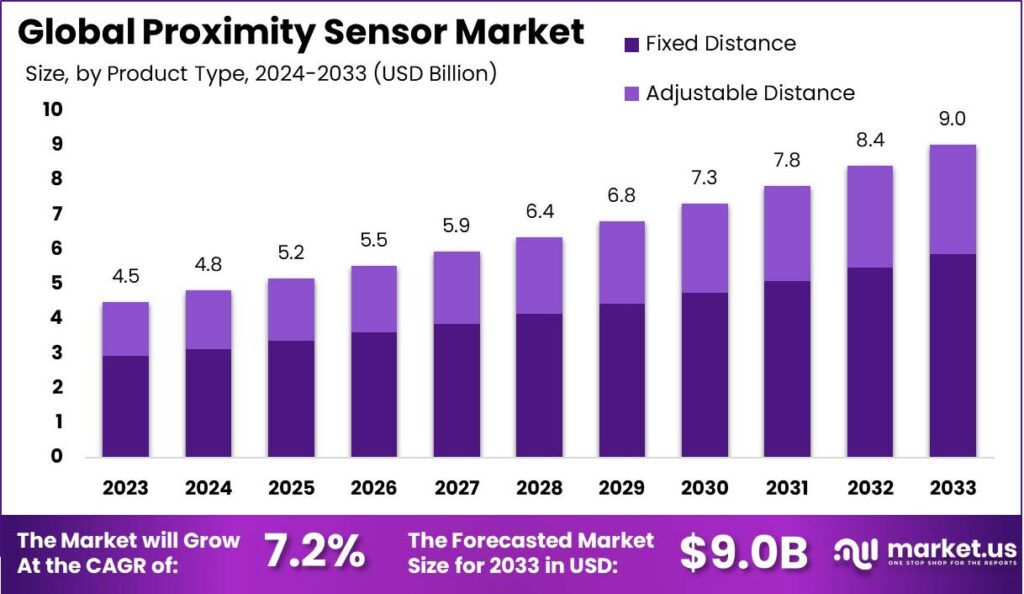
The Global Proximity Sensor Market size is expected to be worth around USD 9.0 Billion By 2033, from USD 4.5 Billion in 2023, growing at a CAGR of 7.20% during the forecast period from 2024 to 2033. In 2023, North America dominated the proximity sensor market, accounting for over 35.8% of the market share, with revenues reaching USD 1.6 billion.
A proximity sensor is a device that can detect the presence of nearby objects without any physical contact. It typically works by emitting an electromagnetic field or a beam of radiation (like infrared) and detecting changes in the field or return signal. These sensors are versatile, functioning across air, liquids, and solids, which makes them indispensable in diverse applications ranging from industrial automation to mobile devices.
The proximity sensor market is experiencing robust growth due to their critical role in modern technology and automation. These sensors are extensively used in various sectors including manufacturing, automotive, consumer electronics, and healthcare. Their ability to improve operational efficiency and safety in equipment and processes aligns with the rising demand for automation and more intelligent systems across industries.
The primary driving forces behind the expanding proximity sensor market include the increasing adoption of automation across various industries, the miniaturization and enhanced capabilities of electronic devices, and the growing emphasis on safety and efficient processes. The rise of the Internet of Things (IoT) and smart manufacturing technologies also significantly contribute to the demand, as these sensors are integral in enabling effective communication and operations within smart systems.
The demand for proximity sensors is largely driven by their application in automotive, manufacturing, and consumer electronics, where they contribute to safety mechanisms, power saving features, and user-friendly interfaces. Their ability to operate under a wide range of temperatures and environmental conditions broadens their applicability in harsh or challenging operational settings.
Opportunities in the proximity sensor market are tied closely with technological advancements and the integration of sensors in emerging technologies such as autonomous vehicles, robotics, and smart infrastructure. The development of more sophisticated, reliable, and cost-effective sensors is expected to open new applications and markets, potentially increasing the deployment of these sensors in everyday devices.
For instance, In June 2024, Elliptic Labs unveiled its AI-powered Virtual Proximity Sensor, INNER BEAUTY, which has been integrated into HONOR’s Magic V Flip smartphone. This innovative technology, already deployed in over 500 million devices worldwide, enables precise proximity sensing without the need for traditional physical sensors. By leveraging advanced AI algorithms, INNER BEAUTY enhances user interaction, offering a seamless experience that adapts to the user’s environment.
Technological innovations in proximity sensors focus on enhancing their accuracy, range, and the ability to detect a wider array of materials. Improvements in miniaturization, energy efficiency, and the integration of sensors with wireless technology are pivotal. The trend towards building smarter and interconnected devices provides a significant impetus for advancements in this technology.
Key Takeaways
- The Global Proximity Sensor Market is projected to reach USD 9.0 billion by 2033, growing from USD 4.5 billion in 2023, at a CAGR of 7.20% from 2024 to 2033.
- In 2023, the Fixed Distance segment led the market, holding more than 65.1% of the share.
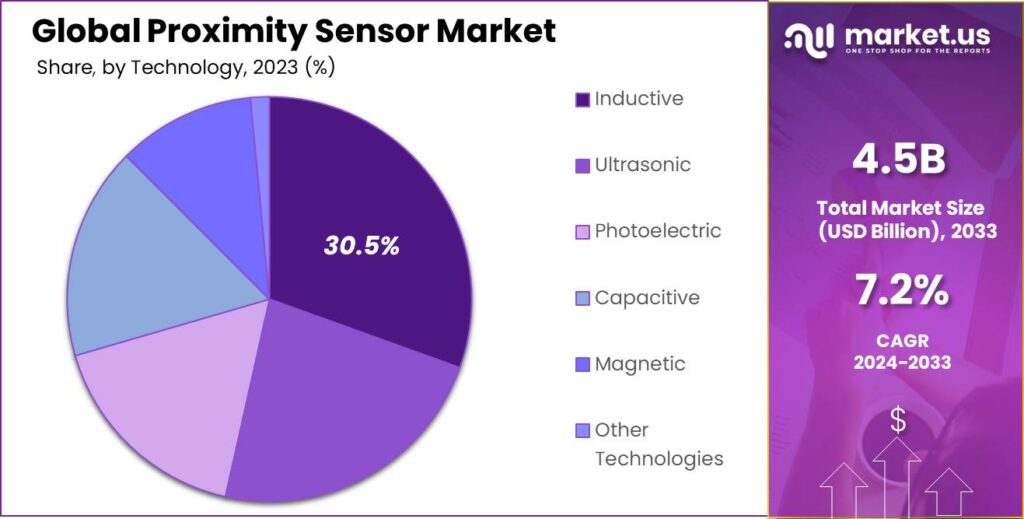
- The Inductive segment captured more than 30.5% of the market share in 2023, maintaining a dominant position.
- The Automotive segment also led the market with a share of over 28.4% in 2023.
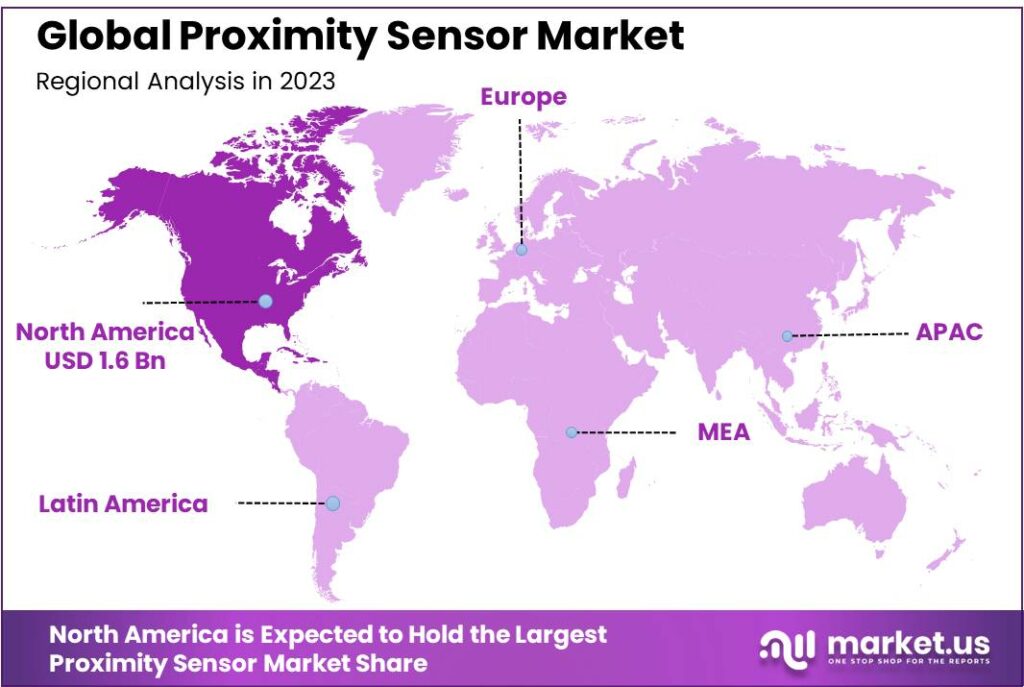
- North America dominated the proximity sensor market in 2023, with a share of over 35.8% and revenues reaching USD 1.6 billion.
Product Type Analysis
In 2023, the Fixed Distance segment held a dominant market position within the proximity sensor market, capturing more than a 65.1% share. This significant market share can be primarily attributed to the simplicity and cost-effectiveness of fixed distance sensors, making them highly desirable for a wide range of applications.
These sensors are preferred in environments where the target distance remains constant or within predictable limits, such as in assembly lines and automation equipment. Their reliability and ease of integration into existing systems without the need for calibration or adjustment have fostered widespread adoption across industries.
The robustness and low maintenance of fixed-distance proximity sensors drive their market leadership. Less affected by background interference than adjustable sensors, they provide stable performance. In industries like manufacturing and automotive, their accuracy and ease of setup make them essential for precision and reliability.
Economically, fixed-distance proximity sensors are more cost-effective than adjustable ones due to their streamlined production process. This pricing advantage is vital in cost-sensitive markets, including economies and industries with tight budgets, where efficiency is key.
Technology Analysis
In 2023, the Inductive segment held a dominant position in the proximity sensor market, capturing more than a 30.5% share. This technology’s leading status can be attributed to its robustness and reliability in detecting metallic objects without physical contact.
Inductive sensors are highly favored in industrial settings for their ability to operate effectively in harsh environments, where factors such as dust, moisture, and extreme temperatures might impair other types of sensors. Their durability and low maintenance requirements make them an optimal choice for manufacturing, automotive, and aerospace applications, where precision and reliability are paramount.
Ultrasonic sensors, known for their ability to detect objects irrespective of material, color, or transparency, also represent a significant share of the market. These sensors are particularly useful in applications requiring precise measurements over longer distances, such as in automotive park assist systems and industrial automation.
The Photoelectric segment, using light beams to detect objects, is widely used in packaging and logistics for its speed and precision. Ideal for assembly lines and material handling, these sensors excel in detecting small objects, working with non-metallic materials, and performing under varying lighting conditions, making them essential for high-efficiency operations.
End-Use Industry Analysis
In 2023, the Automotive segment held a dominant position in the proximity sensor market, capturing more than a 28.4% share. This prominence can be attributed to the increasing integration of automation and safety features in vehicles, which heavily rely on accurate and reliable sensor technology.
Proximity sensors in this sector are crucial for functions such as parking assistance, collision avoidance systems, and adaptive cruise control. The growing consumer demand for these advanced vehicle features has significantly driven the adoption of proximity sensors in the automotive industry.
The enhanced focus on vehicle safety standards globally has also contributed to the leadership of the Automotive segment in the proximity sensor market. Regulatory bodies across various countries have been tightening vehicle safety regulations, compelling manufacturers to incorporate advanced sensor-based technologies.
Furthermore, the evolution of autonomous vehicles is another pivotal factor propelling the growth of the proximity sensor market within the automotive sector. As car manufacturers and technology companies push forward in developing self-driving vehicles, the need for sophisticated sensing technologies, including proximity sensors, becomes more critical.
Key Market Segments
By Product Type
- Fixed Distance
- Adjustable Distance
By Technology
- Inductive
- Ultrasonic
- Photoelectric
- Capacitive
- Magnetic
- Other Technologies
By End-Use Industry
- Aerospace and Defense
- Consumer Electronics
- Automotive
- Food and Beverages
- Other End-Use Industries
Driver
Integration of Proximity Sensors in Consumer Electronics
The increasing incorporation of proximity sensors into consumer electronics significantly propels market growth. These sensors enhance user experience and device functionality by enabling features such as touchless control, gesture recognition, and energy efficiency.
In smartphones, for instance, proximity sensors detect user proximity during calls, automatically turning off the display to prevent accidental touches and save battery life. Similarly, in wearable devices, they facilitate intuitive interactions, contributing to the seamless operation of smart technologies.
The expanding consumer electronics market, driven by the demand for advanced and user-friendly devices, continues to bolster the adoption of proximity sensors across various applications.
Restraint
Technological Limitations in Challenging Environments
Proximity sensors face performance challenges in extreme environmental conditions, which can impede their widespread adoption. Factors such as high temperatures, strong electromagnetic interference, and exposure to dust or moisture can affect sensor accuracy and reliability.
For example, in industrial settings with high electromagnetic fields, inductive proximity sensors may experience reduced sensitivity, leading to false readings or failures. These technological limitations necessitate ongoing research and development to enhance sensor robustness and ensure consistent performance across diverse and demanding environments.
Opportunity
Expansion in Industrial Automation
The growing trend toward industrial automation presents a significant opportunity for the proximity sensor market. As industries strive to enhance efficiency, safety, and productivity, the demand for reliable non-contact sensing technologies increases.
Proximity sensors play a crucial role in automation systems by detecting object presence, position, and movement, thereby facilitating process control and quality assurance. The integration of proximity sensors in automated assembly lines, robotic systems, and quality control mechanisms underscores their importance in modern manufacturing processes.
Challenge
Competition from Alternative Sensing Technologies
The proximity sensor market faces challenges from alternative sensing technologies that offer similar or enhanced functionalities. Technologies such as ultrasonic, infrared, and laser sensors provide varying advantages in terms of range, accuracy, and application suitability.
For instance, ultrasonic sensors, which use sound waves for detection, are effective in applications requiring long-range detection and are less affected by environmental factors like dust or lighting conditions. This competition necessitates continuous innovation and differentiation among proximity sensor manufacturers to maintain market relevance and address specific application requirements effectively.
Emerging Trends
A notable trend is the integration of Artificial Intelligence (AI) and the Internet of Things (IoT) into proximity sensing technology. This integration enables sensors to self-adjust based on environmental conditions and provide predictive maintenance alerts, enhancing efficiency and reducing downtime.
In the automotive sector, proximity sensors are increasingly utilized for touch-free user interfaces, including infotainment systems, keyless entry, and interior lighting control. This adoption enhances user experience and vehicle safety.
The consumer electronics industry also sees a rise in proximity sensor applications. Devices such as smartphones and tablets use these sensors to detect user proximity, enabling features like automatic screen dimming during calls, thereby improving user convenience and device efficiency.
Furthermore, advancements in sensor technology have led to the development of Time-of-Flight (ToF) sensors, which offer high-performance proximity and ranging capabilities. These sensors are instrumental in enabling 3D sensing for everyday products, contributing to more interactive and responsive user interfaces.
Business Benefits
One key benefit is the enhancement of operational efficiency. By automating tasks such as object detection and position sensing, these sensors reduce the need for manual intervention, leading to increased throughput and streamlined processes.
Safety is another critical area where proximity sensors contribute significantly. In industrial settings, they detect the presence of operators near hazardous machinery, triggering safety protocols like emergency stops. This proactive approach helps prevent accidents and ensures a safer working environment.
Implementing proximity sensors also leads to reduced downtime. By monitoring machine components in real-time, these sensors can detect anomalies such as overheating or misalignment. Early detection allows maintenance teams to address issues before they escalate, minimizing unplanned downtime and extending machinery lifespan.
Moreover, proximity sensors contribute to improved product quality. By ensuring precise object detection and positioning, they help maintain consistency in production processes, leading to higher-quality outputs and increased customer satisfaction.
Regional Analysis
In 2023, North America held a dominant position in the proximity sensor market, capturing more than a 35.8% share with revenues reaching USD 1.6 billion. This leadership can be primarily attributed to the region’s robust industrial base and the rapid adoption of advanced technologies in manufacturing, automotive, and consumer electronics sectors.
North America’s commitment to incorporating automation and IoT across various industries has significantly driven the demand for proximity sensors. The presence of leading technology companies and automotive manufacturers who continually innovate and integrate these sensors into their products has also bolstered market growth.
Europe follows closely, benefiting from its strong automotive sector and stringent safety regulations which mandate the use of advanced sensor technologies. European manufacturers are integrating proximity sensors not only in automotive applications but also in industrial automation to enhance efficiency and safety.
The Asia-Pacific (APAC) region is witnessing the fastest growth in the proximity sensor market, driven by expanding manufacturing sectors and increasing investments in automation technologies in countries such as China, Japan, and South Korea. The rise in consumer electronics production, where proximity sensors are extensively used, contributes to the high growth rate in this region.
Latin America and the Middle East and Africa (MEA), while holding smaller shares in the global market, are expected to show promising growth. Economic developments and industrialization in these regions are leading to increased adoption of modern technologies, including proximity sensors.
Key Regions and Countries
- North America
- US
- Canada
- Europe
- Germany
- France
- The UK
- Spain
- Italy
- Rest of Europe
- Asia Pacific
- China
- Japan
- South Korea
- India
- Australia
- Singapore
- Rest of Asia Pacific
- Latin America
- Brazil
- Mexico
- Rest of Latin America
- Middle East & Africa
- South Africa
- Saudi Arabia
- UAE
- Rest of MEA
Key Player Analysis
In the proximity sensor market, OMRON Corporation stands out as a leading player. OMRON has established a strong reputation for innovation and quality, specializing in a wide range of sensors, including inductive, photoelectric, and capacitive types. Their products are renowned for their durability and precision, making them a favorite among industries.
Panasonic Corporation is another key competitor in the proximity sensor market. Known for their technological prowess and extensive product lineup, Panasonic sensors are integral to various applications, from consumer electronics to industrial automation. Their sensors are particularly noted for their compact design and energy efficiency, which align with the global push towards sustainability and reduced energy consumption.
Schneider Electric SE is renowned for its comprehensive approach to industrial automation and energy management. Their proximity sensors are critical components in smart factory setups and energy management systems, helping industries achieve greater efficiency and sustainability.
Top Key Players in the Market
- OMRON Corporation
- Panasonic Corporation
- Schneider Electric SE
- SICK AG
- Balluff GmbH
- Pepperl+Fuchs
- Hans Turck GmbH & Co. KG
- Honeywell International Inc.
- ifm electronic gmbh
- Rockwell Automation Inc.
- Other Key Players
Top Opportunities Awaiting for Players
The proximity sensor market is poised for substantial growth, driven by several key opportunities that market players can leverage.
- Automation and Robotics: As industries increasingly adopt automation to enhance efficiency, productivity, and safety, the demand for proximity sensors is expected to surge. These sensors are integral in automation for precise object detection and measurement without physical contact, facilitating smooth operations in various applications, including robotics.
- Advancements in Consumer Electronics: The burgeoning consumer electronics market, especially in the development of smartphones and wearable technologies, presents a significant opportunity. Innovations such as high-resolution Time-of-Flight sensors with advanced 3D depth imaging for smart devices are driving the demand for proximity sensors in this sector.
- Automotive Industry: The automotive sector continues to be a major growth area, particularly with the rise of autonomous vehicles. Proximity sensors are crucial for enhancing vehicle functionalities, including parking assistance, collision avoidance systems, and adaptive cruise control, making them indispensable as the industry moves towards more automated solutions.
- Internet of Things (IoT) and Smart Infrastructure: The integration of proximity sensors with IoT devices offers vast opportunities for remote monitoring and control, contributing to the development of smart cities and infrastructures. This integration facilitates enhanced accuracy and operational capabilities in various applications, from smart homes to industrial automation.
- Healthcare Applications: The healthcare sector provides a growing market for proximity sensors, especially in biomedicine and patient monitoring systems. Sensors play a crucial role in developing new healthcare technologies that require reliable and precise monitoring and detection capabilities.
Recent Developments
- In January 2024, Vishay Intertechnology’s Optoelectronics group has launched a new integrated proximity sensor to enhance efficiency in consumer devices. It will enable automatic screen wake-up and turn-off on smartphones and smartwatches, and detect the use of TWS earphones, VR/AR headsets, and smart glasses.
- In February 2024, SICK launched the W10 photoelectric proximity sensor, featuring an intuitive touchscreen interface and IO-Link functionality. This sensor is designed for versatile object detection across various industrial applications.
- In December 2024, Elliptic Labs, the global leader in AI Virtual Smart Sensors™, has signed a software license agreement with a major smartphone manufacturer. This partnership will enable the use of Elliptic Labs’ AI-powered Virtual Proximity Sensor™, INNER BEAUTY®, in the customer’s upcoming smartphone models, further expanding its presence in over 500 million devices worldwide.