

Report Overview
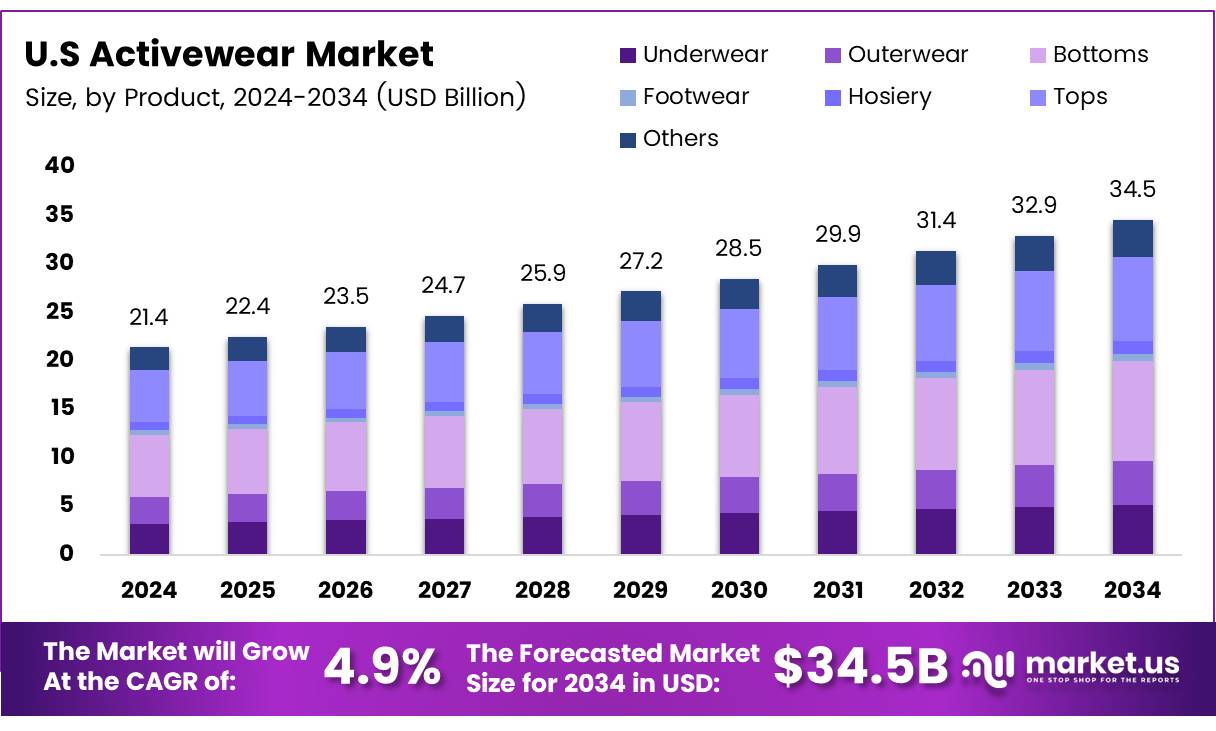
The U.S Activewear Market size is expected to be worth around USD 34.6 Billion by 2034, from USD 21.4 Billion in 2024, growing at a CAGR of 4.9% during the forecast period from 2025 to 2034.
The U.S. activewear market is a rapidly expanding sector within the broader sportswear industry, driven by shifting consumer preferences toward fitness, health, and an active lifestyle. As of recent years, activewear has transitioned from being purely athletic apparel to an everyday fashion statement, with consumers seeking both style and functionality in their clothing.
Activewear now includes performance-driven designs in categories such as workout clothes, athleisure, and outdoor gear, catering to an increasingly health-conscious population. The market is characterized by strong demand from various demographics, including fitness enthusiasts, casual athletes, and those seeking comfort in daily wear. Notably, global brands such as Nike, Adidas, and Puma dominate the U.S. activewear market, boasting high brand awareness levels, with Nike leading at 96%, according to Statista.
Growth in the U.S. activewear market is not only driven by the rise in fitness culture but also by broader lifestyle changes. Consumers are placing more value on clothes that blend performance features with everyday comfort. According to the 2023 Cotton Incorporated Lifestyle Monitor™ Survey, 67% of U.S. consumers are at least somewhat likely to prioritize performance features when purchasing activewear, including tops, pants, and shorts.
Additionally, the market is supported by the continued popularity of outdoor activities, as reflected in a 2.3% growth in outdoor recreation participation in 2022, bringing the participant base to a record 168.1 million individuals or 55% of the U.S. population aged 6 and older, according to Outdoor Recreation.
Government investments and policies have also fueled this growth, with initiatives focusing on promoting public health, encouraging physical activity, and providing infrastructure for outdoor recreation, further enhancing demand for activewear.
Government investments in physical activity and outdoor recreation have created opportunities for the activewear market to flourish. Increased participation in outdoor activities, including hiking, cycling, and running, has raised the need for specialized activewear products.
Furthermore, regulations supporting environmental sustainability are encouraging brands to invest in eco-friendly fabrics and manufacturing processes. This regulatory push has opened doors for innovation in sustainable activewear, catering to environmentally conscious consumers.
Moreover, the outdoor recreation sector’s steady growth offers a robust opportunity for companies to diversify their offerings and meet the evolving preferences of consumers who prioritize both performance and style in their activewear choices. Brands that embrace these trends will be well-positioned to capitalize on the growing demand for high-performance, sustainable activewear in the U.S.
Key Takeaways
- The U.S. Activewear Market is projected to reach USD 21.4 Billion by 2034, down from USD 34.6 Billion in 2024.
- U.S. Activewear Market growth is expected at a CAGR of 4.9% from 2025 to 2034.
- Bottoms category (leggings, shorts, joggers) dominated the product type segment with 27.1% share in 2024.
- The men’s segment led the market with 43.9% share in 2024, driven by the rise in fitness and athleisure trends.
Product Type Analysis
Bottoms Lead U.S. Activewear Market with 27.1% Share in 2024
In 2024, Bottoms held a dominant position in the By Product Type segment of the U.S. activewear market, capturing a notable 27.1% share. This category includes products such as leggings, shorts, and joggers, which have become essential staples in the daily wardrobe for both fitness enthusiasts and casual wearers.
The rising demand for versatile, comfortable, and performance-oriented attire has driven significant growth in this segment. Consumer preference for athleisure, combined with the increasing focus on health and wellness, has bolstered the popularity of Bottoms as a key product category.
The U.S Activewear Market, By Product Type, 2020-2024 (USD Million)
Key Market Segments
Product Type
- Underwear
- Sports Bra
- Others
- Outerwear
- Bottoms
- Footwear
- Hosiery
- Tops
- Others
End-User
- Men
- Women
- Kids
Drivers
Rising Health Consciousness and Fitness Participation Propel Activewear Demand
The U.S. activewear market is experiencing strong growth, driven by several key factors. First, a growing awareness of health and fitness among consumers has led to increased participation in physical activities such as running, yoga, and gym workouts.
This shift towards healthier lifestyles directly boosts demand for activewear, as people look for clothing that can keep up with their active routines. Additionally, the rise of athleisure has transformed activewear from gym-only attire to a mainstream fashion choice.
Consumers now wear activewear for daily activities, from casual outings to work-from-home setups, making it a versatile wardrobe staple. The demand for comfort and convenience also plays a crucial role in this trend. Activewear offers flexibility, breathability, and ease of movement, making it suitable for both exercise and everyday wear.
Lastly, technological advancements in fabrics, such as moisture-wicking, UV protection, and anti-odor technologies, have enhanced the performance and comfort of activewear. These innovations appeal to consumers seeking functional yet stylish clothing. Together, these factors are creating a robust environment for the continued expansion of the U.S. activewear market.
Restraints
High Competition and Price Sensitivity in the U.S. Activewear Market
The U.S. activewear market faces significant challenges due to intense competition among a growing number of brands. With numerous players in the space, from established giants to emerging labels, it becomes increasingly difficult for any single brand to differentiate itself.
Consumers, often seeking the best value, are also highly price-sensitive, pushing them toward more affordable options. This pressure forces brands to balance quality with pricing, sometimes leading to lower-quality products to maintain competitive pricing.
As a result, it becomes challenging for premium activewear brands to maintain market share without attracting price-conscious shoppers. Moreover, the rise of fast-fashion brands offering stylish yet affordable activewear further intensifies this competition.
In this environment, brands must innovate not only in terms of product offerings but also in terms of their marketing strategies and customer engagement. As a result, pricing strategies and brand differentiation will remain key for long-term success in this crowded market.
Growth Factors
Customization and Personalization Offer New Opportunities for Activewear Brands
The U.S. activewear market is experiencing significant growth, driven by the increasing demand for personalized and customized products. Offering custom-fit or personalized designs—such as choosing colors, patterns, or even tailoring for specific body types—can help brands tap into a more niche yet loyal customer base. Consumers are increasingly looking for products that reflect their individuality and cater to their unique preferences, creating a growing market for such custom offerings.
Additionally, innovations in fabric technologies play a crucial role in driving market expansion. Activewear brands that focus on creating high-performance fabrics with better breathability, durability, and sustainability have a competitive edge. This trend appeals to environmentally conscious consumers, as well as those seeking enhanced comfort during physical activities.
Corporate wellness programs are another promising avenue for growth, where brands can form partnerships with companies to provide branded activewear for employees, aligning with the growing trend of workplace health initiatives.
Furthermore, the rise of virtual and home fitness routines offers a unique opportunity for activewear brands to design and market products specifically for at-home workouts. With the growing popularity of online fitness classes, activewear that caters to activities like yoga, pilates, or home workouts could attract new customers seeking comfortable yet functional apparel. All of these factors point to a dynamic and evolving market with a wealth of growth opportunities for activewear brands.
Emerging Trends
Sustainable and Ethical Manufacturing Gaining Momentum in Activewear
The U.S. activewear market is rapidly evolving with sustainability and ethical production becoming key drivers of growth. Consumers are increasingly seeking brands that prioritize eco-friendly materials and sustainable practices, such as using recycled fabrics or reducing carbon emissions in production. This shift is motivating activewear brands to adopt eco-conscious methods, from utilizing organic cotton to sourcing recycled polyester, ensuring that their products appeal to environmentally aware shoppers.
Alongside sustainability, technology integration in activewear is also on the rise. Smart fabrics that track fitness data, such as garments with embedded sensors, are gaining popularity among fitness enthusiasts who want to combine fashion with function. Furthermore, the market is embracing more inclusive and diverse clothing options, with gender-neutral designs gaining traction among consumers.
These designs cater to a broader audience, reflecting the changing cultural landscape that values inclusivity. As brands continue to innovate with both eco-friendly fabrics and tech-driven features, they are aligning themselves with the preferences of modern consumers who prioritize sustainability, technology, and inclusivity in their purchases. The U.S. activewear market is now defined not only by performance but by how well brands respond to these evolving consumer expectations.
Key Players Analysis
In 2024, the U.S. activewear market remains highly competitive, with several key players shaping industry trends and driving growth. Nike continues to maintain a dominant position, leveraging its strong brand recognition, innovative product offerings, and expansive retail footprint. The company’s focus on sustainability and customization, particularly through the Nike By You initiative, positions it to capture a growing segment of environmentally-conscious consumers.
Adidas AG and PUMA SE are also strong contenders, capitalizing on their robust global presence and aligning with the rising demand for athleisure products. Adidas, in particular, is focused on integrating technology into its apparel, such as through partnerships with Parley for the Oceans to produce sustainable products. PUMA’s strength lies in its collaborations with high-profile celebrities, which enhance its visibility in the activewear sector.
VF Corporation, which owns leading brands such as The North Face and Vans, is diversifying its portfolio to meet consumer demand for both outdoor and performance-oriented activewear. Skechers U.S.A., Inc. continues to benefit from its reputation for comfort, while The Columbia Sportswear Company taps into the increasing interest in outdoor fitness apparel.
Under Armour is undergoing a transition period, rebranding and refocusing on its core strengths in performance apparel. Its ability to pivot towards direct-to-consumer channels and expand internationally will be key to its recovery.
Lastly, ASICS Corporation, Hanesbrands Inc., and PVH Corp. are well-positioned to leverage their expertise in textiles and established distribution networks to capture market share, particularly in value-driven activewear segments.
Top Key Players in the Market
- Nike
- Adidas AG
- PUMA SE
- VF Corporation
- Skechers U.S.A., Inc.
- The Columbia Sportswear Company
- Under Armour, Inc. (Transition Period)
- ASICS Corporation
- Hanesbrands Inc.
- PVH Corp.
- Other Key Players
Recent Developments
- In November 2024, Vuori announced a strategic $825 million investment round, led by General Atlantic and Stripes, aimed at scaling its operations and expanding its global footprint. The funding is expected to accelerate product innovation and enhance Vuori’s presence in key markets.
- In July 2024, Tala, the activewear brand founded by influencer Grace Beverley, successfully raised $6.5 million through an 18-slide pitch deck. This capital injection will help Tala broaden its product offerings and fuel its next phase of growth within the sustainable fashion space.
- In May 2024, activewear brand Tala secured a £5 million investment to support its ambitious plans for a US market launch. The funding will enable the brand to expand its operations and establish a strong presence across North America.