

Report Overview
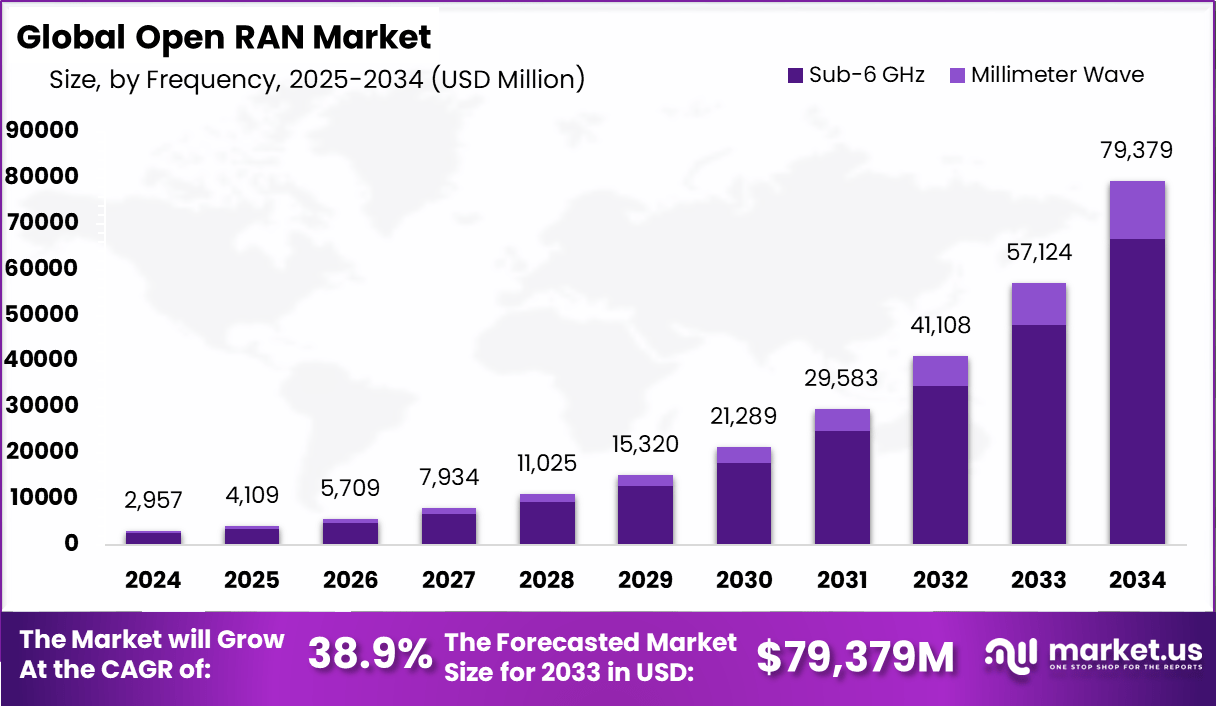
The Global Open RAN Market size is expected to be worth around USD 79,379 Million By 2034, from USD 2,957 Million in 2024, growing at a CAGR of 38.9% during the forecast period from 2025 to 2034. North America dominated a 34.6% market share in 2024 and held USD 1,024.3 Million in revenue from the Open Ran Market.
The market for Open RAN is experiencing significant growth, propelled by its promise to reduce costs and increase system flexibility. With the backing of major telecom operators and the active involvement of a broad array of equipment vendors, the Open RAN ecosystem is rapidly expanding. This market evolution is driven by both technological advancements and strategic partnerships among key industry players, making Open RAN a viable alternative to traditional RAN solutions.
The main drivers of Open RAN adoption include the need for greater network flexibility, reduced vendor lock-in, and lower capital and operational expenditures. These factors are crucial as operators seek more customizable and cost-effective solutions in the face of evolving consumer demands and the ongoing rollout of 5G networks.
Technological advancements such as virtualization, standardized interfaces, and intelligent network management tools are central to the increasing adoption of Open RAN. These technologies enable easier integration of components from multiple vendors, creating a more competitive and innovative market landscape.
Operators are turning to Open RAN primarily to escape the constraints of single-vendor ecosystems, which can stifle innovation and drive up costs. By adopting Open RAN, operators can leverage the best technologies available from a broader supplier base, leading to improved network performance and cost efficiency.
The demand for Open RAN is expected to surge as operators seek to expand 5G networks across varied geographical and market segments. The ability of Open RAN to support diverse network demands and configurations, from dense urban areas to remote locations, is a significant factor driving its adoption.
The UK government’s allocation of £88 million ($109 million) to 19 projects underscores a robust commitment to demonstrating Open RAN’s capabilities in enhancing mobile services nationwide. This initiative is part of a broader strategy to encourage innovation and interoperability within the telecom sector.
Simultaneously, the US has also shown a strong commitment through the National Telecommunications and Information Administration (NTIA), which has earmarked up to $420 million for the development of Open RAN networks. This substantial investment is indicative of a strategic shift towards more open, secure, and competitive wireless network infrastructures.
Additionally, a previous grant of $42 million to a consortium led by telecom giants AT&T and Verizon focuses on enhancing Open RAN interoperability, network performance, and security, further validating the critical role of Open RAN in the future of telecommunications.
Adopting Open RAN can lead to significant business benefits, including lower costs, enhanced service capabilities, and greater operational flexibility. These advantages help telecom operators better respond to market changes and consumer needs.
Key Takeaways
- The Global Open RAN Market is poised for significant growth, projected to reach a value of USD 79,379 Million by 2034, up from USD 2,957 Million in 2024. This surge represents a robust compound annual growth rate (CAGR) of 38.9% over the ten-year forecast period from 2024 to 2033.
- In the components category, Hardware was the standout in 2023, securing a majority with 51.8% of the market share. This indicates strong demand and deployment of physical infrastructure essential for Open RAN systems.
- Focusing on network types, 4G Networks were predominant in 2023, holding 59.25% of the market. Despite the growing push towards 5G, 4G remains crucial, serving as the backbone for many existing Open RAN deployments.
- When we look at the Open RAN units, the Radio Unit took the lead, capturing over 42.35% of the market in 2023. Radio units are critical as they handle radio frequency signals and are key to the functionality of Open RAN architectures.
- In terms of frequency bands, Sub-6 GHz dominated the scene with a commanding 84.2% market share in 2023. This frequency band is widely used due to its balance between coverage and speed, making it highly favorable for Open RAN setups.
- Geographically, North America led the global market with a significant 34.64% share, translating to revenues of USD 1,024.3 Million in 2024. This region’s leadership underscores its advanced technological infrastructure and early adoption of Open RAN systems.
Analysts’ Viewpoint
The shift towards Open RAN is opening substantial investment opportunities in areas such as RAN component manufacturing, network integration services, and software development for network management and automation solutions. Investors are particularly interested in startups and technology firms that are at the forefront of Open RAN technology and innovation.
Regulatory changes, technological advancements, and shifting market demands are the top impacting factors for the Open RAN market. Regulatory support for open networking standards can accelerate adoption, while continuous technological evolution is necessary to address the growing complexity of network management and security challenges.
The regulatory environment for Open RAN is evolving, with an increasing number of global telecommunications standards organizations and government bodies endorsing open networking principles. This regulatory shift is aimed at fostering innovation and competition in the telecommunications equipment market, which supports the broader deployment and acceptance of Open RAN solutions.
Component Analysis
In 2024, Hardware held a dominant market position in the By Component segment of the Open RAN Market, capturing more than a 51.80% share. The hardware segment’s prominence is primarily driven by the escalating demand for advanced network infrastructure, which enables improved connectivity and faster data transfer rates.
This surge is particularly fueled by the global push towards 5G deployment, where Open RAN hardware plays a crucial role in facilitating flexible and scalable network solutions. Following Hardware, the Software segment accounted for a significant portion of the market. This segment is gaining traction due to the increasing need for software-based network solutions that offer enhanced network management and efficient resource utilization.
Software solutions in the Open RAN market allow for more agile and cost-effective network operations, appealing to service providers aiming to optimize their networks for better performance and reduced operational costs.
Open RAN Market Share, By Component Analysis, 2019-2024 (%)
Unit Analysis
In 2024, the Radio Unit held a dominant market position in the By Unit segment of the Open RAN Market, capturing more than a 42.35% share. This significant market share is attributed to the critical role that Radio Units play in Open RAN architecture, where they are essential for managing radio frequency signals and ensuring reliable communication over mobile networks.
The scalability and flexibility offered by Open RAN Radio Units enable telecom operators to efficiently upgrade and expand their network capabilities, particularly important in regions undergoing rapid mobile connectivity growth.
Following the Radio Unit, the Centralized Unit represents another key component within the Open RAN ecosystem. Centralized Units are integral for processing data and controlling the baseband functions in a centralized manner, which simplifies network management and enhances operational efficiencies. Their deployment is crucial for supporting advanced network functionalities, including real-time analytics and network slicing, which are vital for 5G operations.
Open RAN Market Share, By Unit Analysis, 2019-2024 (%)
Key Regions and Countries
- North America
- US
- Canada
- Europe
- Germany
- France
- The UK
- Spain
- Italy
- Rest of Europe
- Asia Pacific
- China
- Japan
- South Korea
- India
- Australia
- Rest of APAC
- Latin America
- Brazil
- Mexico
- Rest of Latin America
- Middle East & Africa
- South Africa
- Saudi Arabia
- UAE
- Rest of MEA
Key Players Analysis
In the dynamic landscape of the global Open RAN market in 2023, key players like Rakuten Group, Inc., Nokia Corporation, and Telefonaktiebolaget LM Ericsson are strategically positioned to drive significant advancements and adoption of Open RAN technologies.
Rakuten Group, Inc. stands out as a pioneer, having successfully deployed one of the world’s first fully virtualized cloud-native mobile networks. Rakuten’s approach not only demonstrates the feasibility and benefits of Open RAN architectures but also sets a benchmark for innovation in cost reduction and operational efficiency. Their aggressive expansion and partnerships are pivotal in proving the commercial viability of Open RAN solutions on a global scale.
Nokia Corporation has embraced Open RAN as a core component of its strategic focus, aiming to provide flexible and scalable network solutions that are interoperable with other vendors’ equipment. Nokia’s comprehensive portfolio, which supports Open RAN across various deployment scenarios from rural to urban, showcases its commitment to facilitating a more diverse and competitive supply chain in the telecom sector.
Telefonaktiebolaget LM Ericsson has been instrumental in driving forward the Open RAN initiative by participating in various consortiums and trials that enhance the ecosystem’s maturity. Ericsson’s investments in research and development aim to solve the integration challenges associated with Open RAN, thereby promoting its adoption among operators who seek to benefit from reduced vendor lock-in and enhanced network capabilities.
Overall, these companies are not just participants but essential drivers of the Open RAN movement, each contributing unique insights and technologies that support the broader shift towards more open, flexible, and efficient telecommunications networks. Their efforts in 2023 are crucial in setting the stage for future innovations and deployments in the telecom industry.
Top Key Players in the Market
- Rakuten Group, Inc.
- Samsung Electronics Co., Ltd.
- Nokia Corporation Finland
- Telefonaktiebolaget LM Ericsson
- Fujitsu Limited Japan
- Mavenir
- Parallel Wireless
- Radisys
- NEC Corporation
- 1VIAVI Solutions Inc.
Future of Open RAN
Looking ahead, the future of Open RAN appears promising with expected increases in adoption and technological maturity. As more communication service providers (CSPs) adopt this technology, it is likely to become more robust and widely implemented.
The industry’s shift towards more open, flexible, and cost-effective network solutions predicts a strong trajectory for Open RAN’s growth. This evolution will likely lead to more innovative services and a competitive telecom market, benefiting both providers and consumers.
Recent Developments
- In May 2024, Mavenir secured additional funding of $95 million in May 2024 to expand its Open RAN solutions. This funding will boost Mavenir’s capacity to develop and deploy innovative products, further solidifying its position as a key player in the Open RAN ecosystem.
- In April 2024, Samsung Electronics announced in April 2024 a significant partnership with a European telecom operator to deploy Open RAN solutions across their network. This collaboration highlights Samsung’s role in expanding Open RAN technology globally and their ongoing efforts to transform mobile network infrastructures.
- In February 2024, Fujitsu Limited launched a new Open RAN software product, aiming to enhance network flexibility and reduce operational costs. This launch demonstrates Fujitsu’s commitment to innovating within the telecom sector and promoting more adaptable network solutions.