

Report Overview
The India Topical Skin Adhesive Market size is expected to be worth around US$ 20.7 Million by 2034, from US$ 7.8 Million in 2024, growing at a CAGR of 10.3% during the forecast period from 2025 to 2034.
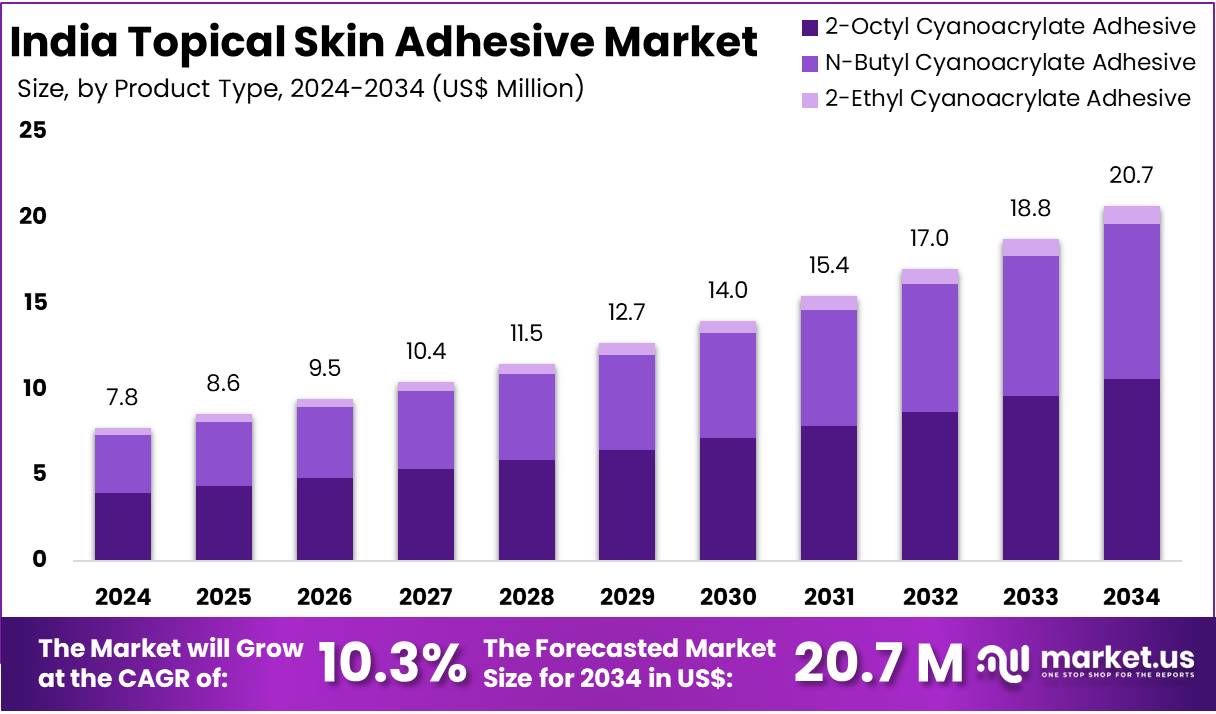
India Topical Skin Adhesive Market, Global Analysis, 2020-2024 (US$ Million)
| End-User | 2020 | 2021 | 2022 | 2023 | 2024 |
|---|---|---|---|---|---|
| Hospitals | 2.88 | 3.50 | 4.05 | 4.45 | 4.89 |
| Clinics | 0.50 | 0.61 | 0.72 | 0.80 | 0.89 |
| Trauma Centers | 1.15 | 1.41 | 1.64 | 1.82 | 2.01 |
Application Analysis
In 2024, Surgical Incisions held a dominant market position in the Application Segment of India Topical Skin Adhesive, and capturing more than a 37.2% share. Topical skin adhesives have emerged as a significant advancement in wound closure techniques in India, offering a modern alternative to traditional sutures and staples for surgical incisions. These adhesives, typically cyanoacrylate-based, are applied directly to the skin’s surface to bond the edges of an incision, promoting faster healing and reduced risk of infection.
In India, where access to advanced medical technologies and resources may vary, the use of skin adhesives provides a cost-effective solution that simplifies the surgical process. They are particularly valuable in settings with limited access to high-quality suturing materials or where postoperative care might be challenging. The rise in the number of surgeries in India has led to greater demand for advanced wound care solutions, including topical skin adhesives.
- The National Library of Medicine, projects that over 45 million surgical procedures will be performed in India in 2019.
India Topical Skin Adhesive Market, by Application, 2020-2024 (US$ Billion)
| Application | 2020 | 2021 | 2022 | 2023 | 2024 |
|---|---|---|---|---|---|
| Surgical Incisions | 1.67 | 2.04 | 2.37 | 2.62 | 2.89 |
| Trauma-Induced Lacerations | 1.17 | 1.43 | 1.66 | 1.82 | 2.01 |
| Burn and Skin Grafting | 0.48 | 0.59 | 0.68 | 0.74 | 0.81 |
| Wound Closure | 0.89 | 1.09 | 1.27 | 1.41 | 1.57 |
| Others | 0.31 | 0.37 | 0.43 | 0.47 | 0.51 |
Distribution Channel Analysis
In 2024, Offline held a dominant market position in the Distribution Channel Segment of India Topical Skin Adhesive, and capturing more than a 79.8% share. The offline channel is the preferred distribution channel among consumers due to the well-established network of hospital pharmacies, medical supply stores, and healthcare distribution centers that form a crucial part of the healthcare infrastructure. Offline provides immediate, tangible access to these essential products, allowing healthcare providers and patients to obtain topical skin adhesives quickly without waiting for online orders or navigating complex logistics.
The presence of physical hospital pharmacies ensures that medical professionals have direct access to a range of wound care products, with the opportunity to consult with knowledgeable staff who can offer advice on product selection and usage. This direct, hands-on approach to purchasing and stocking topical skin adhesives also facilitates prompt replenishment and reduces the likelihood of supply chain disruptions.
In India, several major offline channels play a significant role in distributing topical skin adhesives, particularly for chronic wound care. These offline channels ensure that topical skin adhesives are readily available to healthcare providers and patients across various regions, supporting effective wound management and enhancing accessibility in India.
India Topical Skin Adhesive Market, by Distribution Channel, 2020-2024 (US$ Billion)
| Distribution Channel | 2020 | 2021 | 2022 | 2023 | 2024 |
|---|---|---|---|---|---|
| Online | 0.86 | 1.07 | 1.25 | 1.41 | 1.57 |
| Offline | 3.66 | 4.46 | 5.15 | 5.66 | 6.22 |
Key Market Segments
By Product Type
- 2-Octyl Cyanoacrylate Adhesive
- N-Butyl Cyanoacrylate Adhesive
- 2-Ethyl Cyanoacrylate Adhesive
By End-User
- Hospitals
- Clinics
- Trauma Centers
By Application
- Surgical Incisions
- Trauma-Induced Lacerations
- Burn and Skin Grafting
- Wound Closure
- Others
By Distribution Channel
- Online
- Offline
Drivers
Increasing Preference for Minimally Invasive Surgeries
The India topical adhesive market is experiencing significant growth, driven by the increasing adoption of minimally invasive surgeries (MIS), rising healthcare investments, and advancements in wound closure technologies. Topical adhesives, particularly cyanoacrylate-based solutions, are widely used in surgical wound closure due to their faster healing, reduced infection risk, and improved cosmetic outcomes compared to traditional sutures and staples.
India witnesses over 1.5 million laparoscopic surgeries annually, with a 15% annual growth rate in MIS adoption. This shift is increasing demand for efficient wound closure solutions, including topical adhesives. With over 1.2 million cosmetic procedures performed annually, the need for minimally invasive wound closure techniques continues to rise.
Government initiatives such as Ayushman Bharat and increased private-sector investments are expanding access to advanced healthcare facilities, further propelling the topical adhesive market. Additionally, the rise in road accidents (over 400,000 annually in India) has increased the use of topical adhesives in emergency trauma care. With the increasing preference for less invasive medical procedures, a growing patient pool, and technological advancements, the India topical adhesive market is poised for sustained expansion in the coming years.
Restrains
High Costs of Adhesives
The high cost of topical adhesives is a major restraint in the growth of the India topical adhesive market, particularly in price-sensitive segments such as government hospitals and rural healthcare settings. Compared to traditional sutures and staples, topical adhesives—especially cyanoacrylate-based solutions—can be 2 to 5 times more expensive, making them less accessible to a broad patient population.
India’s per capita healthcare expenditure is approximately $73 (as of 2023), significantly lower than global averages. With over 65% of the population relying on public healthcare, cost-effective wound closure methods like sutures (costing as low as ₹50 per unit) are often preferred over topical adhesives, which can range from ₹500 to ₹2,000 per unit. Due to cost concerns, many hospitals and clinics in tier-2 and tier-3 cities opt for staples and absorbable sutures instead of adhesives. Moreover, imported medical adhesives face higher costs due to custom duties and supply chain constraints, further limiting affordability
Opportunities
E-commerce and Retail Growth
The rapid growth of e-commerce in India presents a significant opportunity for the distribution of topical adhesives, enhancing accessibility for both consumers and healthcare providers. E-commerce platforms are increasingly becoming the preferred mode of shopping due to convenience, wide product range, and ease of access to detailed product information. This trend allows consumers in both urban and rural areas to purchase medical adhesives and related wound care products without geographical constraints.
Additionally, healthcare providers, including clinics and hospitals, can streamline their procurement processes, accessing a variety of topical adhesives from different manufacturers, often with bulk purchasing options and competitive pricing. With platforms offering home delivery services, healthcare professionals can easily obtain supplies without the need for in-person visits to medical supply stores. The growth of e-commerce, combined with the increasing penetration of smartphones and internet access, has made it easier for both end-users and medical establishments to access high-quality, affordable topical adhesives.
Impact of Macroeconomic / Geopolitical Factors
Macroeconomic and geopolitical factors significantly impact the India Topical Adhesive market. Economic conditions, such as inflation and currency fluctuations, can affect the cost of raw materials and production, influencing the pricing of adhesives. Trade policies and tariffs also play a role, as any restrictions on the import of raw materials or finished products can disrupt supply chains.
Geopolitical tensions may lead to uncertainties in global trade, affecting market stability. Additionally, economic growth in healthcare spending and government initiatives can drive demand for medical adhesives, while recessions or economic slowdowns might hinder growth in the consumer and healthcare sectors.
Latest Trends
The India Topical Adhesive market is experiencing several emerging trends driven by advancements in technology and evolving consumer needs. One key trend is the shift towards biocompatible and skin-friendly adhesives, which cater to the increasing demand for wound care products that minimize irritation and promote faster healing.
Smart adhesives with antimicrobial properties are also gaining popularity, offering enhanced protection for patients with chronic wounds or burns. Eco-friendly adhesives are becoming more prevalent as consumers and manufacturers alike prioritize sustainable solutions, leading to a reduction in the environmental impact of disposable medical products.
The growth of personalized wound care products is another notable trend, with adhesives designed for specific conditions such as diabetic ulcers or post-surgical wounds. Additionally, the rise of home healthcare and self-care products is driving demand for easy-to-use adhesives for at-home wound management. Lastly, e-commerce platforms continue to expand, improving product accessibility and distribution to a wider range of consumers and healthcare providers across India.
Key Players Analysis
The competitive landscape of the Indian topical skin adhesive market is marked by intense rivalry among well-established brands, alongside a growing number of new entrants leveraging the increasing demand for these products. Leading the market are key players such as Meril Life Sciences Pvt. Ltd., Medtronic plc, Healthium Medtech Pvt. Ltd., Surgitech Innovation, Epiglue Pharma Pvt. Ltd., B. Braun, Johnson & Johnson, Medline, and Advanced Medical Solutions Group Plc.
Among these, Meril Life Sciences Pvt. Ltd. has maintained a dominant position, supported by its extensive product portfolio and strong market reach. The company’s emphasis on innovation and research has enabled it to introduce advanced topical skin adhesive solutions tailored to diverse medical applications. Additionally, companies such as Medline Industries, Inc., B. Braun, Healthium Medtech Pvt. Ltd., and Advanced Medical Solutions Group Plc have played a significant role in shaping market dynamics, each contributing their unique expertise and capabilities to the competitive landscape.
Top Key Players in the Topical Skin Adhesive Market
- bioMerieux
- Hoffmann-La Roche
- Bio-Rad Laboratories Inc.
- Novartis AG
- Qiagen N.V.
- DiaSorin Inc.
- Abbott Laboratories
- Affymetrix, Inc.
- Agilent Technologies
- Becton, Dickinson and Company (BD)
Recent Developments
- In March 2023, Johnson & Johnson launched DERMABOND ADVANCED™, a specialized adhesive intended for topical application. This product is designed to effectively close easily approximated skin edges of wounds resulting from surgical incisions, including those associated with minimally invasive procedures.
- In February 2023, Advanced Medical Solutions Group plc completed the acquisition of Connexicon Medical Limited, a company specializing in tissue adhesive technology. This strategic move strengthens AMS’s presence in the global tissue adhesive market, expands its product portfolio, and enhances its technical expertise and research capabilities, particularly in cyanoacrylate technology.