Global PACS and RIS Market was valued at US$ 6,579.46 Million in 2024 and is expected to grow at a CAGR of 7.2% from 2024 to 2034. In 2024, North America led the market, achieving over 42.4% share with a revenue of US$ 2991.85 Million.
PACS and RIS Market, Global Analysis, 2020-2024 (US$ Million)
According to industry reports, almost two-thirds of the organizations surveyed either already use the cloud for image viewing and storage or plan to adopt it within the next three years. Additionally, 63% of organizations currently using cloud software intend to increase its usage in the future. This trend is particularly prevalent among larger organizations, with 75% planning to expand their cloud adoption for diagnostic viewing.
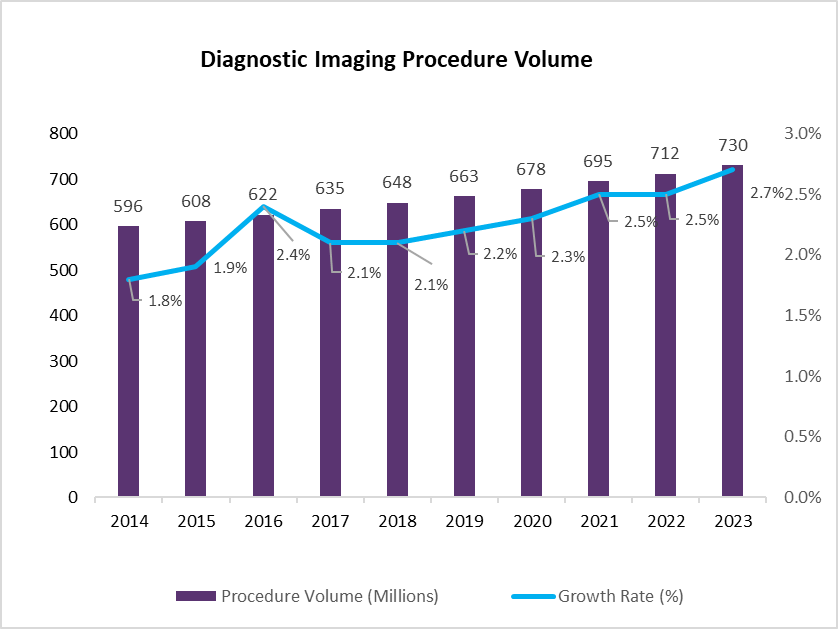
This graph illustrates the diagnostic imaging procedure volume from 2014 to 2023, highlighting both the volume of procedures in millions and the annual growth rate. From 2014 to 2023, there is a steady increase in the number of diagnostic imaging procedures performed, rising from 596 million in 2014 to 730 million in 2023. The growth rate fluctuates slightly, but it remains relatively stable, peaking at 2.4% in 2016 and gradually decreasing to 2.7% in 2023. The trend reflects consistent growth, indicating a steady demand for diagnostic imaging over this period, with a slight deceleration in the growth rate towards the later years.
Key Takeaways
The global PACS and RIS market was valued at USD 6,579.46 Million in 2024 and is anticipated to register substantial growth of USD 13,150.51 Million by 2034, with 7.2% CAGR.
In 2024, the PACS segment took the lead in the global market, securing 77.3% of the total revenue share.
The oncology segment took the lead in the global market, securing 29.9% of the total revenue share.
The software segment took the lead in the global market, securing 46.8% of the total revenue share.
The on-premise segment took the lead in the global market, securing b of the total revenue share.
The integrated segment took the lead in the global market, securing 62.8% of the total revenue share.
The hospitals segment took the lead in the global market, securing 45.4% of the total revenue share.
North America maintained its leading position in the global market with a share of 42.4% of the total revenue.
Product Analysis
Based on product the market is fragmented into PACS and RIS. Amongst these, PACS segment dominated the global PACS and RIS market capturing a significant market share of 77.3% in 2024.
The PACS segment held a dominated share in the PACS and RIS market due to its critical role in the management, storage, and retrieval of medical imaging data. PACS is central to modern radiology departments and healthcare facilities, as it allows for the digital storage of medical images such as X-rays, MRIs, CT scans, and ultrasounds. By eliminating the need for traditional film-based methods, PACS has revolutionized the way medical images are stored, accessed, and shared, offering substantial benefits in terms of efficiency, cost savings, and data accessibility.
As healthcare providers continue to seek more efficient and accurate diagnostic solutions, the PACS segment is poised for continued growth, driven by innovations in data accessibility, workflow efficiency, and clinical decision support. These advancements are accelerating the adoption of PACS systems across global healthcare systems.
In February 2025, Sectra, an international medical imaging IT and cybersecurity company, announced a collaboration with Siemens Healthineers to enhance radiologists’ diagnostic capabilities and patient care. The partnership aims to integrate Siemens Healthineers’ NAEOTOM Alpha photon-counting CT (PCCT) images into Sectra’s diagnostic application, providing seamless access and post-processing tools for radiologists.
In November 2023, Philips launched its new and enhanced PACS solution, Philips HealthSuite Imaging, built on AWS’ cloud infrastructure. This next-generation version of Philips’ Vue PACS introduces new features such as integrated reporting, remote access for diagnostic reading, and AI tools to streamline clinical workflows.
The PACS segment is gaining traction in emerging markets like Brazil, India, and China, where the demand for efficient, cost-effective imaging solutions is growing. As healthcare infrastructure improves, PACS solutions are being deployed to support scalable, flexible imaging across diverse healthcare settings, from small clinics to large hospitals.
PACS and RIS Market, Product Analysis, 2020-2024 (US$ Million)
Application Analysis
The market is fragmented by application into cardiology, orthopedics, ophthalmology, oncology, veterinary medicine, and others. Oncology dominated the global PACS and RIS market capturing a significant market share of 29.9% in 2024.
The oncology segment is expected to capture a high share of the PACS and RIS market due to the increasing need for advanced imaging technologies in the diagnosis, treatment, and monitoring of cancer. Oncology involves the use of various imaging techniques, including CT scans, MRIs, PET scans, and X-rays, to detect, stage, and monitor tumors.
As the incidence of cancer continues to rise globally, the demand for high-quality imaging solutions becomes even more critical for oncologists and radiologists. PACS and RIS play a pivotal role in managing the massive volumes of imaging data generated in cancer care, facilitating the timely and accurate assessment of tumors and treatment outcomes.
Recent studies suggest that India is emerging as the “cancer capital of the world,” with projections indicating an increase in cancer cases from 1.39 million in 2020 to 1.57 million by 2025. Common cancers include those of the breast, cervix, and oral cavity.
In the U.S., cancer remains a leading cause of morbidity and mortality. In 2024, it was estimated that there would be 2,001,140 new cancer cases and 611,720 cancer-related deaths. Notably, certain states exhibit higher incidence rates, influenced by factors such as tobacco use, obesity, and environmental exposures. For example, Kentucky has one of the highest cancer rates in the country, while New Mexico has one of the lowest.
PACS and RIS Market, Application Analysis, 2020-2024 (US$ Million)
Market Restraints
High Implementation Cost
One of the major restraints hindering the growth of the PACS and RIS market is the high implementation cost associated with these systems. The upfront expenses related to purchasing, installing, and maintaining PACS and RIS systems can be significant, especially for smaller healthcare facilities such as community hospitals, outpatient clinics, and imaging centers. These costs can be prohibitively high, limiting the ability of these smaller institutions to adopt the technology.
In addition to the hardware and software costs, healthcare organizations must also account for expenses related to training staff, ensuring proper system integration, and maintaining ongoing updates, software upgrades, and robust data security measures. Staff training alone can incur substantial costs, as personnel need to become proficient in operating the new systems. Furthermore, integrating PACS and RIS with existing IT infrastructure in hospitals and clinics adds complexity and further increases costs. The effort and time required for a smooth integration process can make the overall investment even more challenging for smaller providers who already operate with tight budgets.
For example, while the cost of PACS software for a practice generating 1,000 studies per month may be under US$ 10,000, the total cost of ownership can quickly rise to around US$ 40,000 when considering all associated expenses.
This high total cost of ownership can discourage smaller healthcare providers from adopting these systems, thus slowing the overall adoption rate and limiting the market’s growth potential. The need for significant financial investment is a barrier that many healthcare organizations, particularly in developing regions, find difficult to overcome, hindering the widespread use of PACS and RIS.
Market Opportunities
Favorable Government Policies and Funding
Favorable government funding have opened up significant new growth opportunities for the PACS and RIS market. Governments worldwide are increasingly recognizing the importance of digital health solutions, including imaging technologies, in improving healthcare delivery and reducing costs. As a result, they are introducing policies and allocating funding to support the adoption of advanced medical technologies such as PACS and RIS. These efforts not only encourage healthcare institutions to upgrade their systems but also stimulate innovation within the sector.
A notable example is INOVAIT, a pan-Canadian innovation network that supports advancements in image-guided therapy (IGT) and artificial intelligence (AI).
In September 2024, INOVAIT announced the latest recipients of its Pilot Fund, which awards competitive funding to promising medical technology projects. This funding, totaling just under US$ 730,000, is directed toward initiatives that leverage AI, machine learning, and big data analytics to enhance medical imaging and streamline patient care.
The support fosters collaborations between small- and medium-sized enterprises, hospital research centers, and academic institutions, helping to drive innovation and job creation within the healthcare sector.
Such government-backed funding programs are crucial in accelerating the development and commercialization of cutting-edge imaging technologies. They provide the necessary resources for research, product development, and the integration of new technologies into healthcare systems. With continued government support, the PACS and RIS markets are expected to grow significantly, as these policies help to drive the adoption of digital imaging solutions and further transform healthcare delivery.
Favorable government policies have significantly contributed to the growth of the PACS and RIS market.
In the Union Budget for 2024-25, the Indian government introduced measures aimed at bolstering the domestic manufacturing of medical devices, which directly impact the affordability and accessibility of imaging technologies. One notable initiative is the provision of a 20% capital subsidy to companies investing in the production of components essential for digital X-ray, CT scan, and MRI machines.
Impact of macroeconomic factors / Geopolitical factors
The picture archiving and communication system and radiology information system markets are influenced significantly by broader macroeconomic and geopolitical factors, which affect investment levels, healthcare infrastructure development, supply chain continuity, and technology adoption worldwide.
One of the key macroeconomic factors is economic slowdown or inflation, which impacts healthcare budgets and capital expenditure, especially in developing regions. When national economies experience instability or currency devaluation, hospitals and imaging centers may delay or scale back purchases of PACS/RIS systems due to high initial investment and operational costs. Similarly, interest rate hikes can make financing large-scale IT infrastructure projects more challenging for public and private providers.
Geopolitical tensions, such as conflicts or strained international relations, can disrupt the global supply chain of medical imaging components and IT hardware required for PACS and RIS. For instance, instability in key supplier regions or sanctions on major technology exporters may lead to delays in product availability and higher input costs, affecting system deployment timelines and increasing operational expenses.
A specific geopolitical-economic factor affecting the PACS and RIS market is the United States’ tariff policies on imported technology goods, particularly from countries such as China. U.S. tariffs imposed on medical imaging components, servers, and electronic hardware have increased costs for vendors sourcing internationally. These cost hikes are often passed on to healthcare providers, making it more expensive to acquire or upgrade PACS and RIS systems.
The Trump administration announced plans to impose a 10% universal tariff on goods from all countries starting April 5, 2025. Additionally, government officials intend to implement further reciprocal tariffs on nations with which the U.S. has significant trade deficits, according to the American Hospital Association. AdvaMed, which represents over 50 imaging manufacturers, including Bayer, Canon, GE HealthCare, Philips, Siemens Healthineers, and others, criticized the move. The medical technology association has called for radiological devices to be exempt from tariffs, expressing concerns that these tariffs will drive up prices while limiting patient access to essential healthcare services.
Latest Trends
The global picture archiving and communication system and radiology information system markets are experiencing significant transformation driven by several key trends. Foremost among these is the integration of artificial intelligence (AI) into radiology workflows, enhancing diagnostic accuracy and streamlining image analysis. AI-powered PACS and RIS solutions are increasingly employed to automate routine tasks, reduce radiologist workload, and improve patient outcomes.
Additionally, the shift toward cloud-based deployments is gaining momentum, offering scalable, cost-effective, and accessible solutions, particularly beneficial for smaller healthcare facilities and those in remote locations. The adoption of vendor-neutral archives (VNAs) is also on the rise, facilitating interoperability among diverse imaging systems and enabling seamless data sharing across departments and institutions.
Furthermore, the growing emphasis on cybersecurity is prompting vendors to implement robust security measures to protect sensitive patient data from potential breaches. Collectively, these trends are reshaping the PACS and RIS landscape, fostering innovation, and driving the adoption of advanced imaging technologies worldwide.
Regional Analysis
The Picture Archiving and Communication Systems (PACS) and Radiology Information Systems (RIS) markets in North America are experiencing significant growth, driven by technological advancements, increased healthcare digitization, and substantial investments in healthcare IT infrastructure.
The market is increasingly being shaped by the integration of Artificial Intelligence (AI) technologies. AI-powered tools within PACS systems, such as automated image analysis, lesion detection, and predictive analytics, are helping radiologists make faster, more accurate diagnoses. AI also aids in reducing repetitive manual tasks, freeing up radiologists’ time to focus on complex cases.
For example, AI can automatically prioritize images based on severity, helping to streamline workflows. This shift not only improves diagnostic accuracy but also enhances patient outcomes by enabling earlier intervention and personalized care. As a result, the demand for AI-enhanced PACS and RIS solutions is growing rapidly in North America.
According to data from Healthcare Business International, updated in 2023, the US has nearly seven times the CT capacity per capita compared to Mexico, and almost 14 times the MRI capacity per capita.
Chronic diseases such as diabetes, cardiovascular conditions, and cancer are major contributors to the growing demand for advanced medical imaging systems in North America. These diseases require frequent monitoring, diagnostic imaging, and long-term care, placing significant pressure on healthcare systems to adopt efficient PACS and RIS solutions.
As the number of patients with chronic diseases rises, healthcare providers are increasingly relying on digital imaging technologies to detect, monitor, and manage these conditions. PACS and RIS platforms facilitate faster image retrieval, easier diagnosis, and the ability to track disease progression over time, which improves patient care and reduces the cost of long-term treatment. PACS systems are essential for storing and sharing large imaging files that are critical for cancer diagnosis and treatment planning.
The Canadian Cancer Society reports that 2 in 5 Canadians are expected to be diagnosed with cancer during their lifetime.
According to the American Cancer Society, the average risk of a woman in the US developing breast cancer at some point in her life is approximately 13%. The National Breast Cancer Foundation, Inc. estimates that in 2025, around 316,950 women and 2,800 men will be diagnosed with invasive breast cancer, alongside 59,080 new cases of non-invasive (in situ) breast cancer.
PACS and RIS Market, Region Analysis, 2020-2024 (US$ Million)
Key Regions and Countries
North America
US
Canada
Europe
Germany
France
The UK
Spain
Italy
Russia
Netherland
Rest of Europe
Asia Pacific
China
Japan
South Korea
India
New Zealand
Singapore
Thailand
Vietnam
Rest of APAC
Latin America
Brazil
Mexico
Rest of Latin America
Middle East & Africa
South Africa
Saudi Arabia
UAE
Rest of MEA
Key Players Analysis
The competitive landscape for the PACS and RIS market is dynamic and continuously evolving, driven by rapid advancements in healthcare technology and the increasing adoption of digital solutions across healthcare facilities. The market is populated by a blend of multinational corporations and specialized firms, each vying to offer solutions that improve imaging workflows, diagnostic accuracy, and operational efficiency.
Key players in the PACS and RIS market include global giants like GE Healthcare, Philips Healthcare, Agfa-Gevaert Group, and Fujifilm Holdings, alongside specialized companies such as Carestream Health and Siemens Healthineers. These companies dominate the market by offering comprehensive solutions that cater to the needs of hospitals, imaging centers, and diagnostic labs, with a focus on integrating sophisticated imaging hardware with software systems for seamless data management and enhanced patient care.
Acquisitions and strategic partnerships are also a common strategy in this market to expand product portfolios, enhance technological capabilities, and gain access to new regional markets. For example, companies may acquire smaller, specialized firms with expertise in AI or cloud-based solutions to stay ahead of technological trends.
GE Healthcare is a leading global medical technology and digital solutions innovator, headquartered in Chicago, Illinois. A subsidiary of General Electric, the company provides a broad range of healthcare technologies, including medical imaging, monitoring, diagnostics, and digital health solutions.
In addition, Koninklijke Philips N.V., commonly known as Philips, is a Dutch multinational company headquartered in Amsterdam, primarily focused on health technology. With a strong presence in diagnostic imaging, patient monitoring, and health informatics, Philips delivers integrated solutions that span the health continuum—from healthy living and prevention to diagnosis, treatment, and home care.
Top Key Players
GE Healthcare
Koninnklijke Philips NV
Fujifilm Holdings Corporation
Siemens healthineers
Oracle Corporation
MedInformatix, Inc.
RadNet, Inc.
RamSoft
Agfa-Gevaert Group
Merative
Recent Developments
In October 2024, GE HealthCare partnered with Blackford to integrate artificial intelligence (AI)-enabled application orchestration feature into its True PACS and Centricity PACS. The new AI-enabled offerings help radiologists with their workload which could help lead to quicker diagnosis and treatment for patients.
In November 2023, Philips launched HealthSuite Imaging, a cloud-based next generation of Vue PACS, with new AI-enabled clinical and operational workflows. HealthSuite Imaging on Amazon Web Services (AWS) offers new capabilities such as high-speed remote access for diagnostic reading, integrated reporting and AI-enabled workflow orchestration, all delivered securely via the cloud to ease IT management burden.
In March 2025, Fujifilm partnered with Amazon Web Services for expanding and strengthening cloud hosting capabilities for Fujifilm’s North American Synapse Enterprise Imaging customer base. AWS cloud services allow Fujifilm to offer its customers industry leading cloud security and the ability to scale to any size Synapse organization, supporting the Synapse customer community as they look to transition from legacy data centers to public cloud infrastructure.