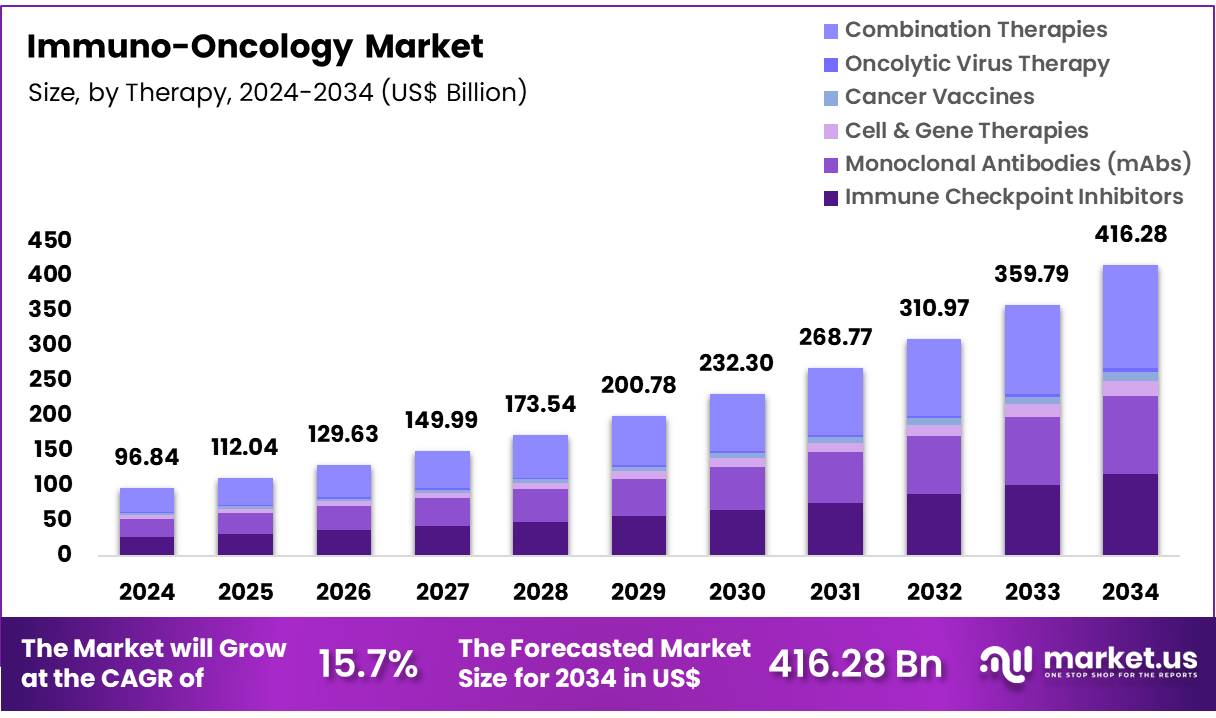
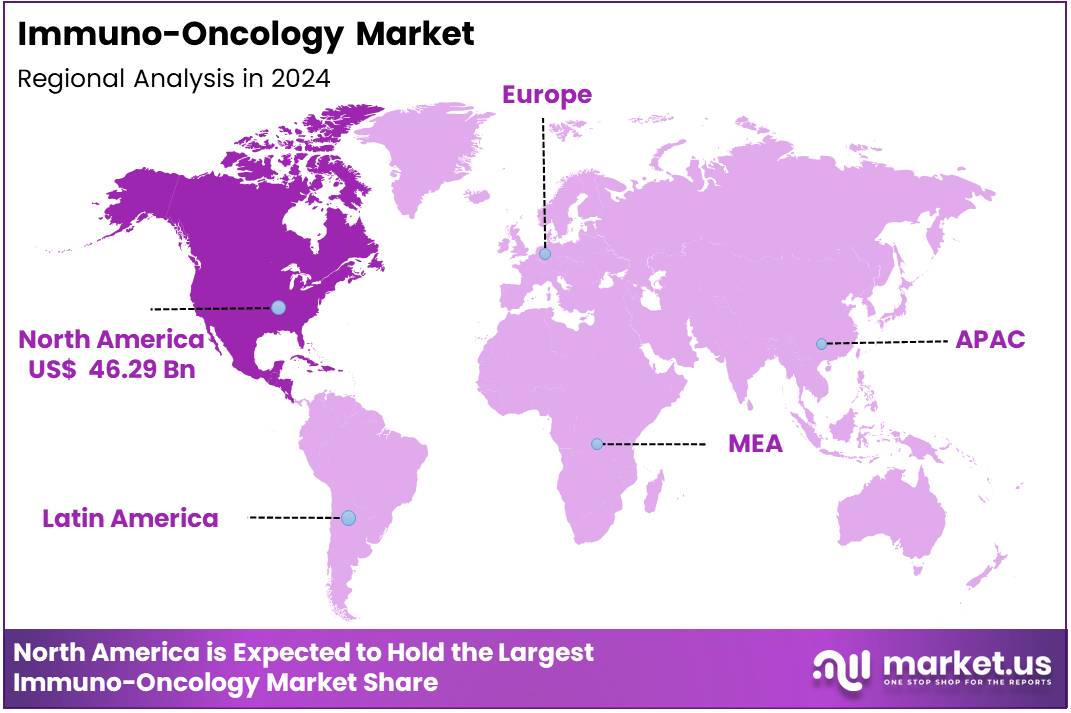
Global Immuno-Oncology Market size is expected to be worth around US$ 96.84 Billion by 2034 from US$ 416.28 Billion in 2024, growing at a CAGR of 15.7% during the forecast period 2025 to 2034. In 2024, North America led the market, achieving over 47.8% share with a revenue of US$ 46.29 Billion.
The immuno-oncology (I-O) market represents one of the most transformative areas in modern cancer treatment, centered on harnessing the body’s own immune system to identify and destroy tumor cells. Unlike traditional chemotherapy or radiation, which directly target cancer, immuno-oncology therapies stimulate or restore immune function to achieve durable and often long-lasting responses.
The field encompasses a wide range of modalities, including immune checkpoint inhibitors, monoclonal antibodies, CAR-T and other cell-based therapies, cancer vaccines, cytokine modulators, and oncolytic viruses.
Immuno-Oncology Market, Global Analysis, 2020-2024 (US$ Billion)
Favorable government policies and funding are playing a crucial role in driving the growth of the global Immuno-Oncology (IO) market. Governments across the world are increasingly recognizing the potential of immuno-oncology therapies in transforming cancer treatment, leading to enhanced funding for research and development.
Government-backed initiatives such as the U.S. National Cancer Moonshot program have directed significant resources toward advancing cancer research, particularly in immuno-oncology and precision medicine. Funding support has enabled the exploration of MSI-H/dMMR biomarkers, which are crucial in identifying patients who may benefit from immunotherapies like checkpoint inhibitors.
In 2023, the U.S. National Cancer Institute (NCI) allocated over US$7.5 billion in funding for cancer research, which includes a significant focus on immuno-oncology and targeted therapies
The U.S. Department of Defense DoD allocated approximately US$100 million for cancer research in fiscal year 2021, which includes funding for immuno-oncology therapies and novel treatments for cancers with MSI-H/dMMR characteristics.
Restraints
Severe Side Effects of Treatments
In some cases, these side effects can be life-threatening, leading to treatment discontinuation or long-term complications. For patients with cancers, therapies such as checkpoint inhibitors may also cause immune-related toxicity, which requires careful monitoring and management.
These risks may deter patients and healthcare providers from fully embracing immunotherapies, especially in populations where other treatment options are available with fewer side effects.
The common side effects are high fever, fatigue, nausea, skin irritation and more severe complications like hypotension (low blood pressure) and organ failure in extreme cases.
Opportunities
Expansion of Combination Therapies
The global immuno-oncology market lies in the expansion of combination therapies. Immuno-oncology treatments, particularly immune checkpoint inhibitors, have shown promising results in various cancers. However, their effectiveness can be limited in some patients. Combining these therapies with other treatment modalities, such as targeted therapies, chemotherapy, or personalized medicine, has the potential to enhance efficacy, overcome resistance, and broaden patient eligibility.
This approach may also help in addressing unmet needs for cancers that are difficult to treat, like pancreatic or glioblastoma. The increasing understanding of tumor microenvironments and the immune system’s role in cancer progression offers further opportunities for developing novel combination strategies.
Impact of Macroeconomic / Geopolitical Factors
Macroeconomic and geopolitical factors significantly influence the global immuno-oncology market by affecting investment, research funding, and regulatory policies. Economic downturns or recessions can reduce healthcare budgets and limit public and private investment in innovative therapies, slowing the development of immuno-oncology treatments.
Geopolitical tensions, such as the Russia-Ukraine conflict and strained U.S.–China relations, have disrupted global supply chains for raw materials, reagents, and advanced manufacturing components used in I-O drug development.
Companies like Bristol Myers Squibb and Merck have reported logistical and regulatory challenges in Eastern Europe, while Asian biotech firms have faced delays in cross-border technology transfers and trial collaborations.
Conversely, strong economic growth in key regions may boost healthcare spending, accelerating market expansion. Additionally trade conflicts or political instability, can disrupt the global supply chain for raw materials, manufacturing, and distribution of immuno-oncology drugs, leading to delays and increased costs.
Latest Trends
Rapid uptake of first‐line approvals
Shifting treatment paradigms earlier in the care pathway. For example, leading agents such as Pembrolizumab (Keytruda) and Nivolumab (Opdivo) have expanded into first‐line settings across multiple solid tumours, moving beyond salvage therapy contexts.
Another dimension of this trend is the surge in combination strategies: I-O agents are increasingly used alongside chemotherapy, targeted therapy, radiation or even other immunotherapies to enhance response rates. Clinical trial data and industry reports in 2024 highlight that nearly half of I-O studies now investigate such combinations.
The move into earlier‐line use is driven by improved outcomes in first‐line settings, growing regulatory approvals, and broader patient eligibility. At the same time, combinations are being pursued to tackle resistance and to expand benefit to patient populations previously non-responsive to monotherapy. Together these developments are reshaping the I-O market: more patients are treated earlier, with more complex regimens, signalling maturation of the field and intensifying competition among therapies and developers.
Regional Analysis
North America is leading the Immuno-Oncology Market
North America leads the immuno-oncology market with a 47.8% share. The growing incidence of cancer, particularly colorectal, endometrial, and other cancers, has increased the demand for targeted therapies. Regulatory support from agencies like the U.S. Food and Drug Administration (FDA), which has approved several therapies, including checkpoint inhibitors such as pembrolizumab and nivolumab, has further propelled market growth.
The American Cancer Society (ACS) estimates that approximately 1.9 billion new cancer cases will be diagnosed in the U.S. in 2024. Around 609,000 cancer-related deaths are expected in the same year. The most commonly diagnosed cancers in the U.S. include breast cancer, lung cancer, prostate cancer, and colorectal cancer. For example, breast cancer is expected to account for about 20% of all new cancer cases.
Key Regions and Countries
North America
US
Canada
Europe
Germany
France
The UK
Spain
Italy
Russia
Netherland
Rest of Europe
Asia Pacific
China
Japan
South Korea
India
Australia
New Zealand
Singapore
Thailand
Vietnam
Rest of APAC
Latin America
Brazil
Mexico
Rest of Latin America
Middle East & Africa
South Africa
Saudi Arabia
UAE
Rest of MEA
Key Players Analysis
Key players in the Immuno-Oncology market includes Merck & Co., Bristol-Myers Squibb (BMS), Roche Holding AG, AstraZeneca, Novartis AG, Pfizer Inc., Amgen Inc., Sanofi S.A., Gilead Sciences (Kite Pharma), Eli Lilly and Company, Takeda Pharmaceutical Company, GlaxoSmithKline (GSK), Incyte Corporation, Johnson & Johnson, Bayer AG, Genmab A/S, Regeneron Pharmaceuticals, BeiGene Ltd., and Other key players.
Merck & Co. – Merck is a global leader in immuno-oncology, driven by its flagship PD-1 inhibitor Keytruda (pembrolizumab). The drug dominates multiple tumor indications and underpins Merck’s extensive I-O pipeline, which focuses on combination regimens, biomarker-driven therapies, and novel immune modulators to expand efficacy across solid and hematologic cancers.
Bristol-Myers Squibb (BMS) – BMS pioneered immuno-oncology through Opdivo (nivolumab) and Yervoy (ipilimumab), setting benchmarks in melanoma and lung cancer treatment. The company continues advancing dual checkpoint blockade strategies and exploring next-generation immunotherapies, including T-cell engagers and novel targets, to maintain its leadership in durable, immune-mediated cancer control.
Roche Holding AG – Roche leverages its expertise in biologics and diagnostics to develop innovative immuno-oncology treatments. Its key assets include Tecentriq (atezolizumab) and a robust pipeline of bispecific antibodies and personalized combination approaches. Roche integrates biomarker-based patient selection and companion diagnostics to optimize therapeutic outcomes across diverse tumor types
Leaders Name
Opinion
Dr. Alicia Romero, MD, PhD, Oncologist, Memorial Sloan Center
“Merck continues to define the gold standard in immuno-oncology through the evolution of Keytruda. What’s impressive is not just its dominance but how Merck strategically expands its reach via rational combinations—whether with antibody-drug conjugates or targeted therapies. Their clinical focus on early-line and tumor-agnostic approvals reinforces Merck’s patient-centric innovation.”
Bristol-Myers Squibb (BMS) – Dr. Rajesh Mehta, MD, Director of Immunotherapy Research, King’s College London
“BMS remains a cornerstone of the I-O revolution. The synergy of Opdivo and Yervoy demonstrated the long-term potential of checkpoint inhibition. Now, their next frontier—dual and triple checkpoint blockade—signals a new wave of immune reactivation strategies. BMS’s translational research strength continues to drive meaningful clinical breakthroughs.”
Roche Holding AG – Dr. Elena Varga, MD, Clinical Immunologist, University Hospital Zurich
“Roche’s immuno-oncology strategy stands out for its integration of diagnostics and therapeutics. The precision-based use of Tecentriq alongside molecular profiling tools allows a level of personalization few can match. Their pipeline of bispecific antibodies and immune modulators shows Roche’s commitment to smart, data-driven cancer immunotherapy.”
Top Key Players
Merck & Co.
Bristol-Myers Squibb (BMS)
Roche Holding AG
AstraZeneca
Novartis AG
Pfizer Inc.
Amgen Inc.
Sanofi S.A.
Gilead Sciences (Kite Pharma)
Eli Lilly and Company
Takeda Pharmaceutical Company
GlaxoSmithKline (GSK)
Incyte Corporation
Johnson & Johnson
Bayer AG
Genmab A/S
Regeneron Pharmaceuticals
BeiGene Ltd.
Other key players
Recent Developments
In October 2025, Regeneron Pharmaceuticals, Inc. announced that the U.S. Food and Drug Administration (FDA) had approved Libtayo® (cemiplimab-rwlc), a PD-1 inhibitor, as an adjuvant treatment for adult patients with cutaneous squamous cell carcinoma (CSCC) who are at high risk of recurrence following surgery and radiation therapy.
In December 2023, GSK plc (LSE/NYSE: GSK) announced that the European Commission (EC) had granted marketing authorisation for Jemperli (dostarlimab) in combination with carboplatin-paclitaxel chemotherapy for the treatment of adult patients with mismatch repair-deficient (dMMR) or microsatellite instability-high (MSI-H) primary advanced or recurrent endometrial cancer who are eligible for systemic therapy.
In October 2023, Merck, known as MSD outside the United States and Canada, announced that the U.S. Food and Drug Administration (FDA) has approved KEYTRUDA®, the company’s anti–PD-1 therapy, for the treatment of patients with resectable non-small cell lung cancer (NSCLC) (tumors ≥4 cm or node-positive). The approval covers use of KEYTRUDA in combination with platinum-based chemotherapy as neoadjuvant treatment, followed by continued single-agent use as adjuvant therapy after surgery.
In April 2022, Merck announced that the European Commission has approved KEYTRUDA, Merck’s anti-PD-1 therapy, as monotherapy for the treatment of microsatellite instability-high (MSI-H) or deficient mismatch repair (dMMR) tumors in adults with unresectable or metastatic colorectal cancer after previous fluoropyrimidine-based combination therapy; advanced or recurrent endometrial carcinoma.