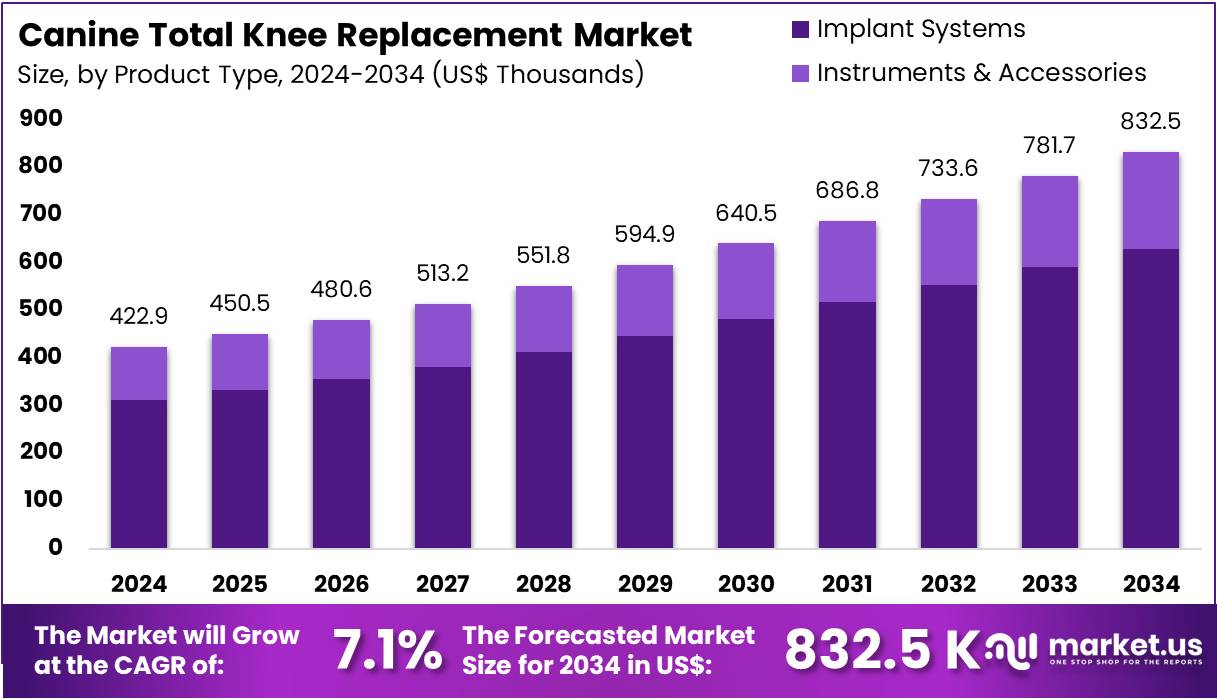
The Canine Total Knee Replacement Market Size is forecasted to be valued at US$ 832.5 K by 2034 from US$ 422.9 K in 2024, growing at a CAGR of 7.1% during the forecast period 2025 to 2034.
The Global Canine Total Knee Replacement (TKR) market is emerging as a specialized segment within veterinary orthopedics, driven by the growing prevalence of canine osteoarthritis and advancements in surgical solutions. Canine TKR is a surgical intervention used primarily for severe stifle joint degeneration, particularly in large or active breeds where traditional treatments like TPLO or TTA are ineffective. The market is supported by increasing pet ownership, rising willingness among owners to invest in advanced veterinary care, and improvements in implant materials and surgical tools.
Canine Total Knee Replacement Market, End-User Analysis, 2020-2024 (US$ Thousands)
Key Regions and Countries
North America
US
Canada
Europe
Germany
France
The UK
Rest of Europe
Asia Pacific
China
Australia
Rest of APAC
Rest of the World
Key Players Analysis
The global Canine Total Knee Replacement (TKR) market in 2024 is shaped by a mix of specialized implant manufacturers, veterinary orthopedic centers, and medical device suppliers. Key players include BioMedtrix, LLC, a U.S.-based pioneer known for offering one of the first full canine TKR systems; Fitzpatrick Referrals, a UK-based advanced veterinary center recognized for its custom-made total knee replacements; and Narang Medical, an India-based company offering a range of orthopedic instruments and accessories at competitive prices, with a strong global distribution network.
Top Key Players in the Canine Total Knee Replacement Market
BioMedtrix, LLC
Innoplant Medizintechnik GmbH
KYON AG
OrthoMed UK Ltd
Narang Medical
Fitzpatrick Referrals
Recent Developments
Texas A&M University performed its first canine TKR in 2022 and now offers knee, ankle, and elbow replacements. Their use of 3D-printed bone models for surgical planning improves precision in implant placement.
An unexpected collaboration between forensic anthropologists and veterinarians in June 2025 may offer a solution to reducing ligament injuries during total knee replacement (TKR) surgeries in dogs. Dr. Joe Hefner, a forensic anthropologist, and Savannah Holcombe, a doctoral student at Michigan State University (MSU), teamed up with researchers from MSU’s College of Veterinary Medicine and Cambridge Veterinary School. Together, they aim to enhance the accuracy of identifying collateral ligament attachment points in dogs. Their work seeks to improve surgical planning by providing orthopedic veterinarians with more precise imaging and anatomical references. According to Hefner, many TKR surgeries in dogs face challenges due to the limited visibility of the lateral and medial collateral ligaments in pre-surgical scans, often resulting in less successful outcomes.
“If the medial or lateral ligament is injured during surgery, it can significantly impact the dog’s mobility,” Hefner explained. “The leg will never fully recover its original mechanical strength.”