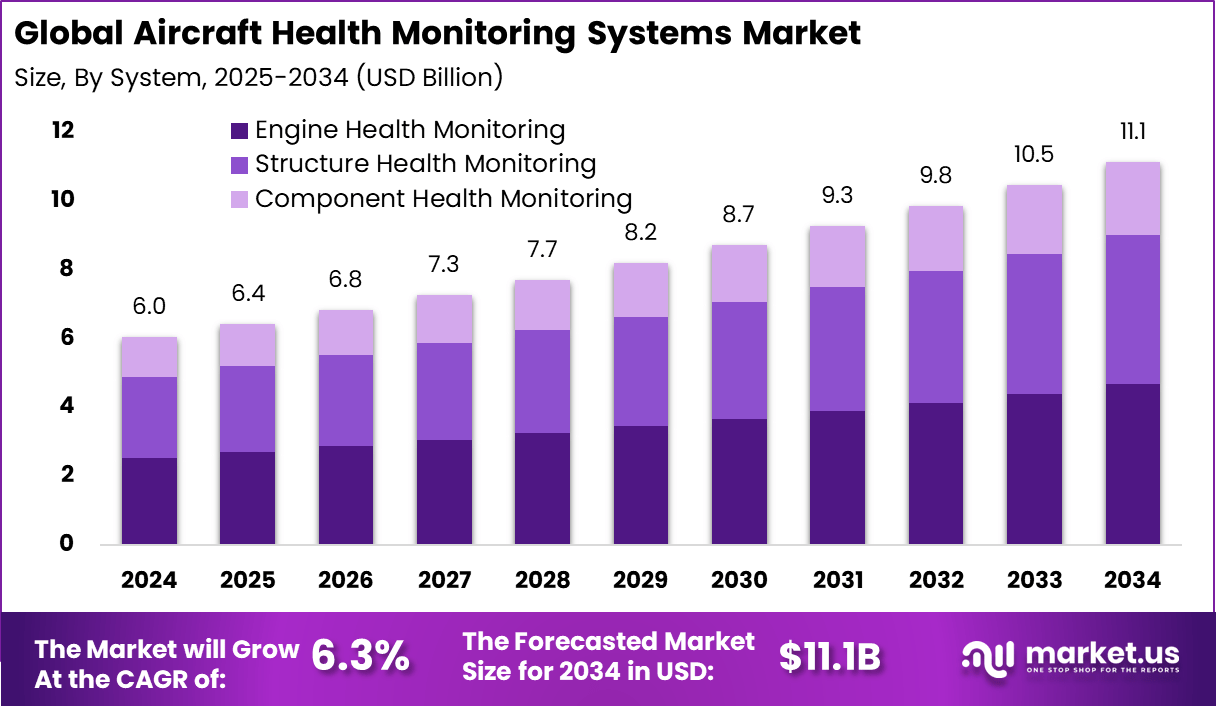
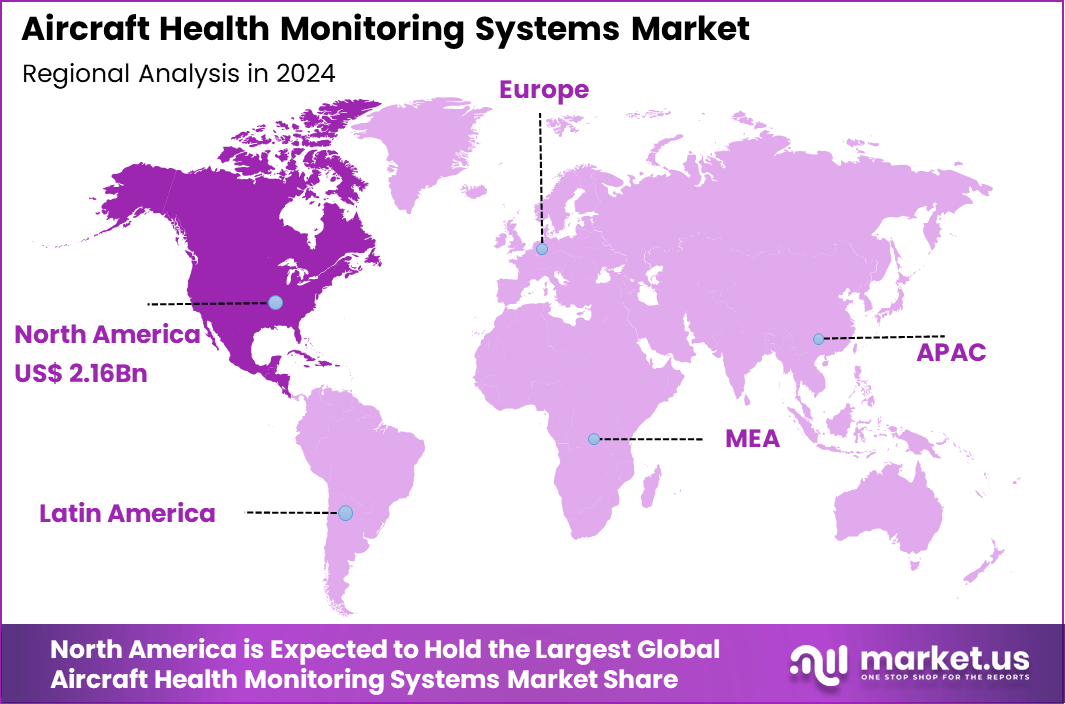
The Global Aircraft Health Monitoring Systems Market size is expected to be worth around USD 11.1 Billion By 2034, from USD 6.0 billion in 2024, growing at a CAGR of 6.3% during the forecast period from 2025 to 2034. In 2024, North America held a dominant market position, capturing more than a 36% share, holding USD 2.16 Billion revenue.
The Aircraft Health Monitoring Systems (AHMS) market represents a dynamic and rapidly evolving sector within the aviation industry, focused on the real-time surveillance and management of an aircraft’s operational health. These systems are designed to collect, analyze, and transmit critical data related to the performance and condition of various aircraft components, enabling predictive maintenance and early fault detection.
By shifting maintenance programs from reactive to proactive frameworks, AHMS not only enhances operational efficiency but also significantly improves safety standards. This market growth is propelled by the increasing sophistication of modern aircraft, rising air traffic demands, and the critical need for minimizing unscheduled downtime in the aviation sector.
Key drivers behind AHMS growth include escalating air traffic volumes and stringent safety regulations. The rising demand for predictive maintenance capabilities is prompting industry players to adopt real-time diagnostics and anomaly detection tools. Innovations in lightweight wireless sensors have further lowered integration barriers, enabling broader deployment of AHMS technologies.
Scope and Forecast
In 2024, North America held a dominant market position, capturing more than a 36% share, holding USD 2.16 billion in revenue. This leadership can be attributed to the region’s strong presence of commercial aviation operators and military aircraft programs, alongside stringent regulatory frameworks emphasizing real-time safety monitoring.
The Federal Aviation Administration (FAA) and related bodies have pushed for early fault detection systems and predictive maintenance technologies, making Aircraft Health Monitoring Systems (AHMS) an integral part of fleet operations. Additionally, the mature infrastructure and high investment in aerospace R&D in countries like the United States continue to support innovation in sensor technologies and data analytics for aircraft diagnostics.
By Solution: Hardware (47%)
Within the Aircraft Health Monitoring Systems market, hardware stands out as the leading solution segment. Aircraft depend heavily on reliable and precise hardware components such as advanced sensors, data acquisition modules, and embedded systems to monitor health parameters in real time.
These devices collect and transmit crucial data from various parts of the aircraft, enabling ground teams and operators to make quick, informed decisions about maintenance and repairs. The dependency on hardware-driven solutions stems from the need to have immediate access to accurate health diagnostics, supporting safe and efficient flight operations.
Growth in the hardware segment can be attributed to the continuous evolution of sensor technologies and the demand for more integrated systems on aircraft. With aircraft becoming more technologically sophisticated, the push for new-generation hardware is evident, ensuring that operators are better equipped to prevent failures and avoid costly disruptions.
By Installation: On-board (63%)
On-board installation is the top method, firmly holding the majority share in how aircraft health monitoring systems are deployed. On-board systems offer the unique advantage of gathering data in real time during flight, providing immediate feedback and enabling proactive responses to potential issues.
By embedding monitoring technology directly into the aircraft, operators ensure continuous surveillance of critical systems, instead of waiting for post-flight ground inspections. This approach significantly reduces the risk of undetected faults, improves turnaround time between flights, and increases overall fleet reliability.
Real-time on-board data is crucial for predictive maintenance, as it aids in minimizing unexpected delays and keeping aircraft in optimal condition for longer periods. The preference for on-board setups highlights a broader industry move away from solely ground-based checks to fully integrated flight solutions.
By System: Engine Health Monitoring (42%)
Engine Health Monitoring leads as the most significant system deployed within Aircraft Health Monitoring. Aircraft engines are sophisticated and expensive components that require meticulous oversight to avoid failures or unplanned maintenance.
Implementing real-time engine health monitoring allows for the assessment of key engine metrics such as vibration, temperature, and pressure, providing early warning signs before more significant problems emerge.
The adoption of robust monitoring for engines contributes directly to safety, operational efficiency, and cost effectiveness. Engines are at the heart of every flight, so detecting potential issues early through detailed surveillance helps maximize uptime and minimize downtime. Airlines recognize that investing in advanced engine monitoring supports both passenger safety and operational profitability.
By Technology: Diagnostics (38%)
Diagnostics technology holds the foremost position for technology application in this market. Diagnostic systems are instrumental in analyzing sensor data to pinpoint issues or irregularities within the aircraft. This technology leverages algorithms and digital tools to provide maintenance teams with actionable insights, supporting both immediate troubleshooting and long-term strategic planning.
With a strong emphasis on smart diagnostics, operators can address minor anomalies before they escalate into critical failures. This technological focus directly impacts maintenance costs, aircraft safety, and regulatory compliance. By ensuring timely maintenance and accurate problem identification, diagnostic technologies are becoming the linchpin for overall aircraft health strategies.
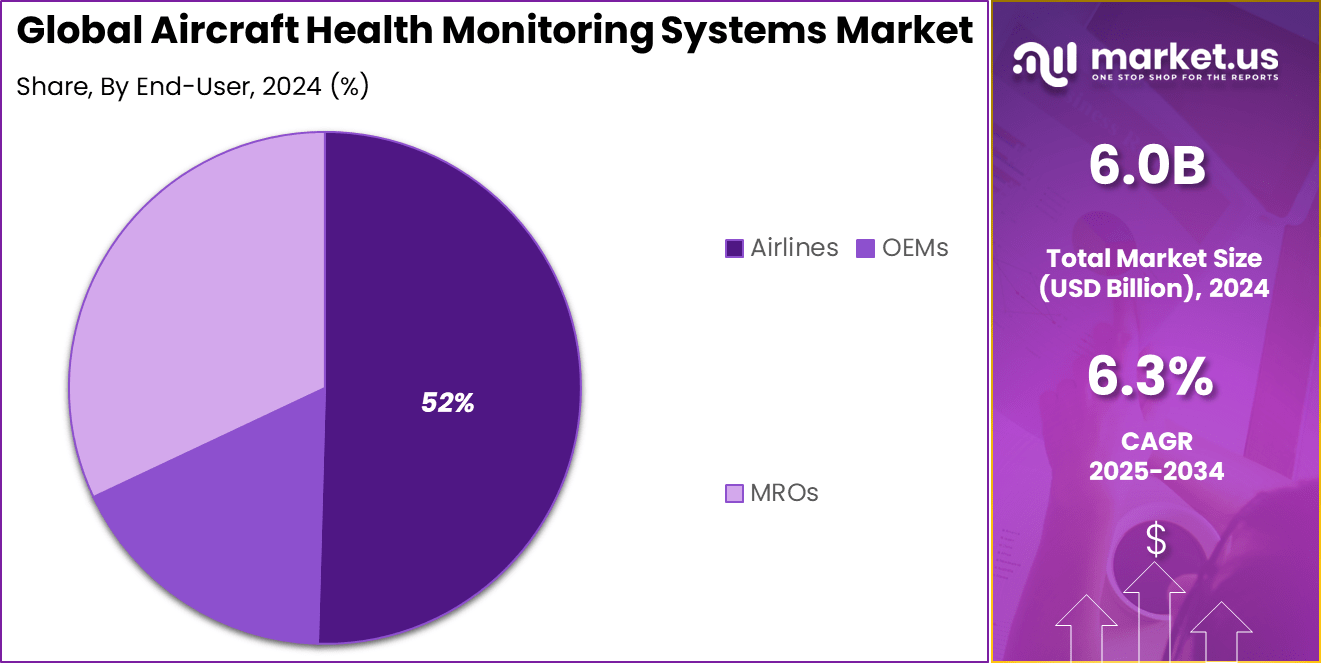
By End-User: Airlines (52%)
Airlines represent the leading end-user segment, as they have the most direct interest in maintaining high standards of safety, reliability, and efficiency across large and diverse aircraft fleets. Health monitoring systems empower airlines to keep their operations running smoothly and avoid granular delays that could have a cascading effect on schedules and customer satisfaction.
Deployment of these systems gives airlines a competitive edge, as preventive and predictive maintenance helps limit ground time and maximize fleet utilization. Furthermore, by accessing instant health reports and maintenance alerts, airlines are better equipped to minimize accidents, manage costs, and comply with stringent aviation regulations.
Key Market Segments
By Solution
Hardware
Sensors
Avionics
Flight Data Management Systems
Connected Aircraft Solutions
Grund Servers
Software
Onboard Software
Diagnostic Flight Data Analysis
Prognostics Flight Data Analysis Software
Services
By Installation
On-board
On-Ground
By System
Engine Health Monitoring
Structure Health Monitoring
Component Health Monitoring
By Technology
Diagnostics
Prognostics
Adaptive Control
Prescription
By End-User
Airlines
OEMs
MROs
Key Regions and Countries
North America
US
Canada
Europe
Germany
France
The UK
Spain
Italy
Russia
Netherlands
Rest of Europe
Asia Pacific
China
Japan
South Korea
India
Australia
Singapore
Thailand
Vietnam
Rest of Latin America
Latin America
Brazil
Mexico
Rest of Latin America
Middle East & Africa
South Africa
Saudi Arabia
UAE
Rest of MEA
Emerging Trend
AI & Machine Learning Integration
The most prominent shift occurring in the aircraft health monitoring sector stems from the adoption of artificial intelligence and machine learning. These technologies are transforming how aircraft maintenance is handled.
By processing massive amounts of sensor data collected during flights, predictive analytics can now flag performance anomalies and potential failures before they escalate. This leap to smart diagnostics is reducing both downtime and maintenance costs, fostering a move from reactive repairs to genuinely predictive maintenance strategies.
Driver
Demand for Predictive Maintenance
A core force behind the increasing use of aircraft health monitoring systems is the growing need for proactive, rather than reactive, maintenance methods. Airlines and operators are prioritizing safety, reliability, and efficiency as air traffic expands globally.
Predictive maintenance enabled by these systems lowers the risk of unexpected breakdowns, minimizes flight disruptions, and ensures passenger safety. The real-time insights derived from continuous monitoring allow for well-timed interventions, preventing costly issues before they affect operations.
Restraint
High Implementation Costs
The path to modern aircraft health monitoring is not without hurdles. One significant barrier is the high upfront cost of integrating advanced monitoring systems. These investments cover new sensors, digital platforms, system installations, and regular upgrades.
For smaller operators or those with older fleets, this financial burden can slow or outright limit system adoption, especially since ongoing costs such as maintenance and staff training further add up.
Market Opportunity
Uptake in Predictive Maintenance for Drones
A fresh growth area is the application of health monitoring systems to unmanned aerial vehicles and drones. With their growing presence in commercial, defense, and public services, the need to ensure drone reliability and longevity is greater than ever.
Health monitoring technologies are evolving to provide lightweight, intelligent solutions for drones, supporting advanced diagnostics for missions in diverse and often challenging environments. This segment is primed for rapid development as regulations become stricter and operational volumes rise.
Challenge
Integrating with Legacy Aircraft
Many airlines operate fleets containing older aircraft that lack modern digital infrastructure. Retrofitting these planes with cutting-edge health monitoring systems poses technical and financial challenges.
Modifying existing structures to support new sensors and processing capabilities can be costly and complex, often resulting in project delays and compatibility issues. These integration problems make it difficult for operators to uniformly upgrade their fleets, thus limiting the full potential benefits of new monitoring technologies.
Key Player Analysis
Leading aircraft OEMs such as Airbus SE and The Boeing Company have played a central role in advancing aircraft health monitoring systems (AHMS). Their integration of real-time diagnostics and predictive analytics into new-generation aircraft has set benchmarks for the aviation industry. These players focus on digital twins, IoT integration, and smart maintenance alerts.
Prominent engine and avionics providers like GE Aviation, Rolls-Royce, and Collins Aerospace have invested in health monitoring solutions tailored for propulsion systems and critical aircraft components. These firms have enabled condition-based maintenance through sensors and cloud-based analytics.
Honeywell International Inc. and Meggitt PLC are also contributing to onboard diagnostics, enhancing fuel efficiency and reducing unscheduled maintenance events. Their expertise in integrating software with legacy platforms continues to support fleet operators in meeting stringent safety and compliance standards.
Specialized solution providers such as FLYHT Aerospace Solutions Ltd, Curtiss-Wright Corporation, and Ultra Electronics Group offer advanced monitoring platforms that emphasize real-time data acquisition and fault detection. Meanwhile, Safran and Esterline Technologies Corporation are focusing on modular AHMS solutions compatible with civil and military aircraft.
In March 2025, the European Defence Agency (EDA) initiated a research project focused on Prognostic Health Management (PHM) to monitor and predict the health of aircraft batteries. Targeting hybrid aircraft and UAVs, the project aims to extend battery lifespan and ensure reliable performance by forecasting safe usage limits and minimizing the risk of system failure.
In April 2025, the Indian Air Force (IAF) invited industrial collaboration to develop a real-time in-flight health monitoring system, reinforcing its adoption of advanced technologies to protect aircrew in high-stress operational environments.