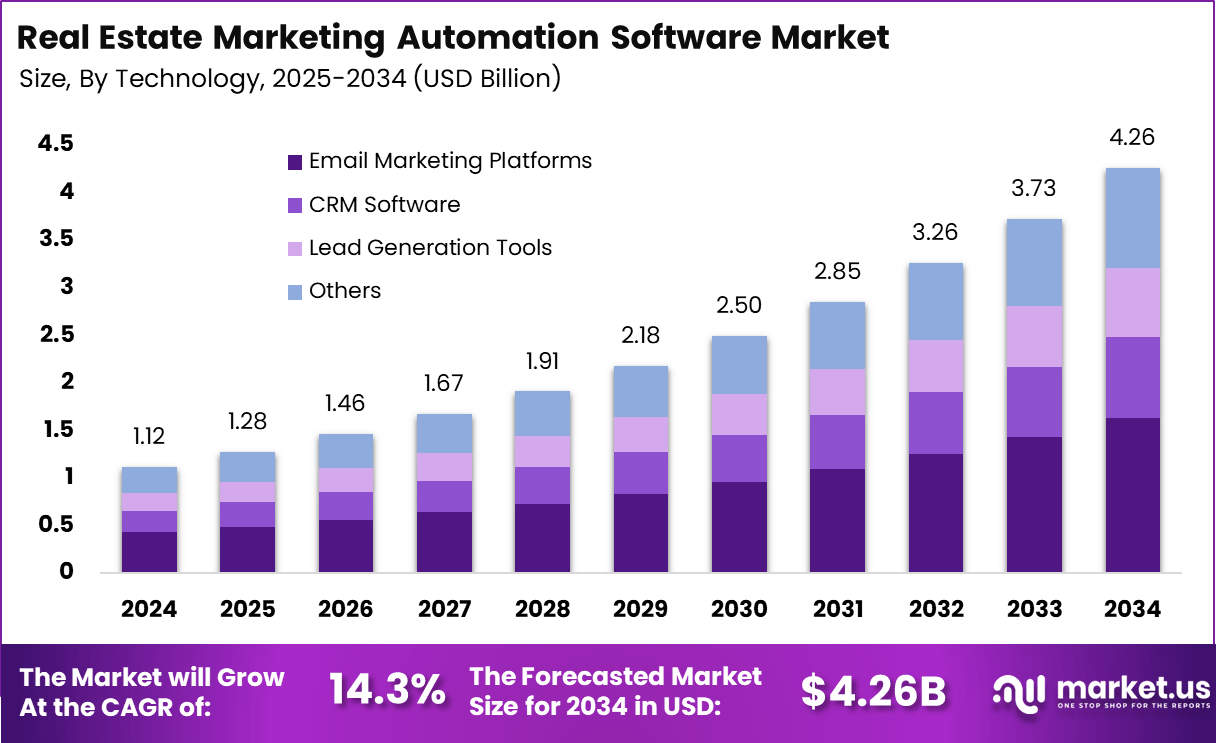
The Global Real Estate Marketing Automation Software Market size is expected to be worth around USD 4.26 billion by 2034, from USD 1.12 billion in 2024, growing at a CAGR of 14.3% during the forecast period from 2025 to 2034. In 2024, North America held a dominant market position, capturing more than a36.9% share, holding USD 0.41 billion in revenue.
The real estate marketing automation software market comprises digital platforms that streamline outreach efforts such as email campaigns, lead nurturing and social media posting. These systems are designed to reduce manual workloads and enable agents and firms to target prospects more effectively. The trend toward online property searches and virtual tours has made these tools essential for maintaining client engagement in a competitive industry.
According to Market.us, The Global Generative AI in Real Estate Market is projected to reach approximately USD 1,177.7 million by 2033, rising from USD 393 million in 2023, registering a CAGR of 11.6% during the forecast period from 2024 to 2033. Meanwhile, the Real Estate Software Market is expected to attain a value of around USD 27.4 billion by 2033, up from USD 10.1 billion in 2023, expanding at a CAGR of 10.5% over the same period.
One of the main factors driving the adoption of marketing automation in real estate is the pressure to deliver a customized client experience. With property buyers expecting instant responses and relevant suggestions, real-time communication tools have become essential. Additionally, firms are shifting toward data-based decision-making.
Scope and Forecast
In 2024, North America held a dominant market position in the Global Real Estate Marketing Automation Software Market, capturing more than a 36.9% share, holding USD 0.41 billion in revenue. This dominance is due to its early adoption of advanced technologies, high digital maturity, and the strong presence of leading software providers.
The region benefits from a tech-savvy real estate workforce, widespread use of CRM and AI-driven marketing tools, and robust investment in proptech innovation. Additionally, a well-established infrastructure, high internet penetration, and increasing demand for personalized customer experiences continue to drive market leadership in North America.
For instance, In March 2025, Inside Real Estate acquired ListAssist, an AI-driven property search and marketing platform. This acquisition reinforces North America’s leadership in the Real Estate Marketing Automation Software market, supported by strong AI investments, a growing pool of tech-savvy professionals, and advanced digital infrastructure.
Solution Analysis
In 2024, The Email Marketing Platforms segment held a dominant market position, capturing a 38.3% share of the Global Real Estate Marketing Automation Software Market. This dominance is due to the proven ability of email marketing platforms to deliver high ROI, streamline lead nurturing, and personalize client communication at scale.
Professionals in real estate use these tools to automate follow-ups, issue property notifications, and deliver content tailored to each client’s preferences. Enhanced segmentation and smooth integration with CRM systems lead to improved productivity, efficiency, and conversion rates. In a competitive market, email marketing is still essential for maintaining engagement and efficiently handling leads during the sales process.
For Instance, in September 2023, Hibu acquired Signpost’s marketing technology platform, reinforcing the strategic value of email marketing within the real estate marketing automation software landscape. This acquisition underscores the growing importance of integrated, automated communication tools, particularly email platforms that enable personalized outreach and efficient lead nurturing.
Type Analysis
In 2024, the Cloud-Based segment held a dominant market position, capturing a 68.4% share of the Global Real Estate Marketing Automation Software Market. This dominance is primarily driven by the need for flexible, scalable, and easily accessible solutions.
By utilizing cloud-based systems, real estate professionals can access tools and client information from anywhere, making updates smooth and easy to reorganize. These platforms promote effective collaboration, enhance data protection, and eliminate the need for IT staff on-site. As companies prioritize mobility and efficiency, cloud-based solutions are becoming more popular among both large and small businesses.
For instance, in January 2024, ZNet Technologies partnered with LeadSquared to enhance cloud-based sales and marketing automation capabilities, signaling a strong push toward scalable, digital-first solutions in the real estate sector. This collaboration exemplifies the growing demand for cloud-based real estate marketing automation platforms that offer flexibility, remote accessibility, and seamless integration.
Application Analysis
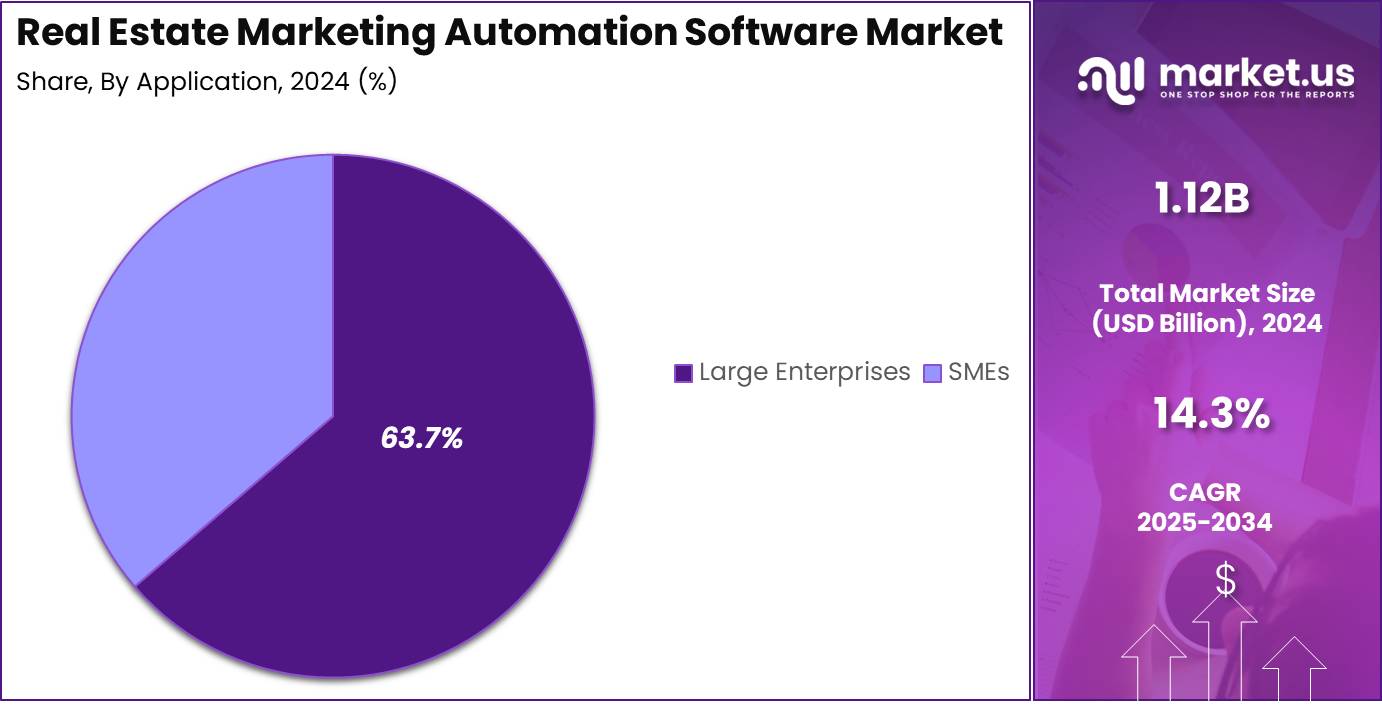
In 2024, The Large Enterprises segment held a dominant market position, capturing a 63.7% share of the Global Real Estate Marketing Automation Software Market. This dominance is due to large enterprises’ robust financial capacity, advanced digital ecosystems, and strategic focus on scalable marketing solutions.
These businesses allocate funds to advanced automation systems that can handle intricate campaigns, integrate with customer relationship management systems, and deliver personalized experiences for customers. The ability to manage extensive property portfolios and analyze data for targeted outreach gives them a competitive edge.
For Instance, in September 2024, Huawei collaborated with leading real estate enterprises to enhance smart building operations through advanced digital solutions, including marketing automation technologies. This collaboration reflects how large enterprises are integrating real estate marketing automation into broader digital transformation strategies.
Key Market Segments
By Solution
CRM Software
Email Marketing Platforms
Lead Generation Tools
Others
By Type
Cloud Based
Web Base
By Application
Large Enterprises
SMEs
Key Regions and Countries
North America
US
Canada
Europe
Germany
France
The UK
Spain
Italy
Russia
Netherlands
Rest of Europe
Asia Pacific
China
Japan
South Korea
India
Australia
Singapore
Thailand
Vietnam
Rest of Latin America
Latin America
Brazil
Mexico
Rest of Latin America
Middle East & Africa
South Africa
Saudi Arabia
UAE
Rest of MEA
Emerging Trends
The real estate sector is witnessing a significant shift towards automation, with artificial intelligence (AI) playing a pivotal role in transforming marketing strategies. AI-driven tools are enabling real estate professionals to automate routine tasks such as lead generation, email outreach, and social media management. This shift allows agents to focus more on personalized client interactions and strategic decision-making.
Additionally, the integration of AI facilitates the creation of hyper-personalized marketing campaigns, enhancing engagement and conversion rates. Another notable trend is the adoption of cloud-based platforms that offer scalability and seamless integration with mobile and web-based real estate platforms. These platforms support an omnichannel marketing approach, unifying messaging across email, SMS, social media, and websites, thereby broadening reach and improving consistency in client communication.
Drivers
Rising Adoption of Digital Technologies
Companies in the real estate industry are accelerating their digital transformation by utilizing CRM systems, marketing automation tools, and AI-powered technologies. The implementation of these innovations has resulted in simplified client communication, automated lead management processes, and improved personalization for campaigns, resulting in significant increases in operational efficiency and client engagement.
For instance, in January 2024, ZNet Technologies partnered with LeadSquared to revolutionize sales and marketing automation through AI-powered solutions. This collaboration highlights the expanding role of artificial intelligence in real estate marketing automation, enabling firms to enhance lead management, personalize client outreach, and streamline campaign execution.
Restraint
Skills Gap & Cost of Adoption
Many real estate firms are hesitant to adopt automation software due to a lack of skilled data analysis and marketing technology analysts, despite its obvious benefits. High upfront costs, subscription fees, and complex implementation processes further discourage small and mid-sized agencies.
Insufficient internal resources may result in the unproductive use of these tools, which can lower the return on investment. Bridging this skills gap and offering more accessible pricing models or training programs will be critical for expanding adoption across the broader market landscape.
For instance, in May 2025, PERQ introduced next-generation AI-powered websites tailored for multifamily marketers and property owners, aiming to reduce marketing costs while improving financial outcomes. This development directly addresses one of the key restraints in the adoption of real estate marketing automation software, the high cost of implementation.
Opportunities
Advanced Analytics & AI/ML Integration
The integration of AI and machine learning into real estate marketing automation presents transformative opportunities. Businesses can engage with potential clients more efficiently and affordably through predictive lead scoring, adaptive targeting, and automated drip campaigns.
The implementation of digital tools like virtual tours and chatbots enhances the customer experience and reduces manual labor. For instance, in June 2025, Salesforce introduced Agentforce, an AI-powered platform designed to revolutionize real estate marketing automation.
This platform, embedded within Salesforce CRM, automates marketing tasks, enhances lead qualification, and delivers personalized customer experiences on real estate websites. Since its launch, Agentforce has processed over 100,000 AI-driven interactions, reducing lead qualification time by 40%.
Challenges
Complex Integration and Data Quality Issues
While automation brings efficiency, integrating multiple platforms and ensuring data quality remains a significant challenge for the industry. Many agents and agencies juggle different tools for ads, lead capture, communication, and transaction management.
Without seamless integration, these systems can create data silos, leading to gaps in insight, inconsistent communication, or even missed follow-ups. The complexity of connecting marketing automation with other business systems requires technical know-how and regular management, which may be daunting for non-technical teams
Moreover, the usefulness of automation hinges on the quality and accuracy of the data being processed. If data is incomplete or outdated, automations could send irrelevant messages or recommend unsuitable properties, reducing client trust and campaign effectiveness. Ensuring smooth integration and maintaining accurate, up-to-date client databases is essential.
Key Players Analysis
Salesforce, HubSpot, and Marketo lead the real estate marketing automation software market with strong CRM tools, AI-driven personalization, and seamless digital integration. Their platforms support advanced lead management and are trusted for their scalability and global reach.
Oracle, Mindmatrix, and Infusionsoft are known for enabling multi-channel campaigns and automating workflows. Oracle brings enterprise-level precision, while Mindmatrix and Infusionsoft serve mid-size and smaller firms with user-friendly, cost-effective solutions.
Propertybase, IXACT Contact, and Constellation Real Estate Group offer real estate-specific platforms with IDX support, CRM, and email tools. Agent6S and other new entrants focus on AI-powered insights and mobile-ready features to meet evolving realtor needs.
Top Key Players in the Market
Salesforce
Hubspot
Marketo
Oracle
Mindmatrix
Infusionsoft
Propertybase
IXACT Contact
Constellation Real Estate Group
Agent6S
Others
Recent Developments
In April 2025, Salesforce reported significant growth in its Data Cloud and AI-driven product lines, achieving $900 million in annual recurring revenue (ARR). This growth reflects the increasing demand for AI-powered marketing automation solutions across industries, including real estate.
In August 2023, Constellation Real Estate Group acquired Showcase IDX, expanding its portfolio of industry-leading real estate technology solutions. This acquisition strengthens Constellation’s position in the real estate marketing automation market by integrating Showcase IDX’s advanced property search and lead generation tools with its existing platform.