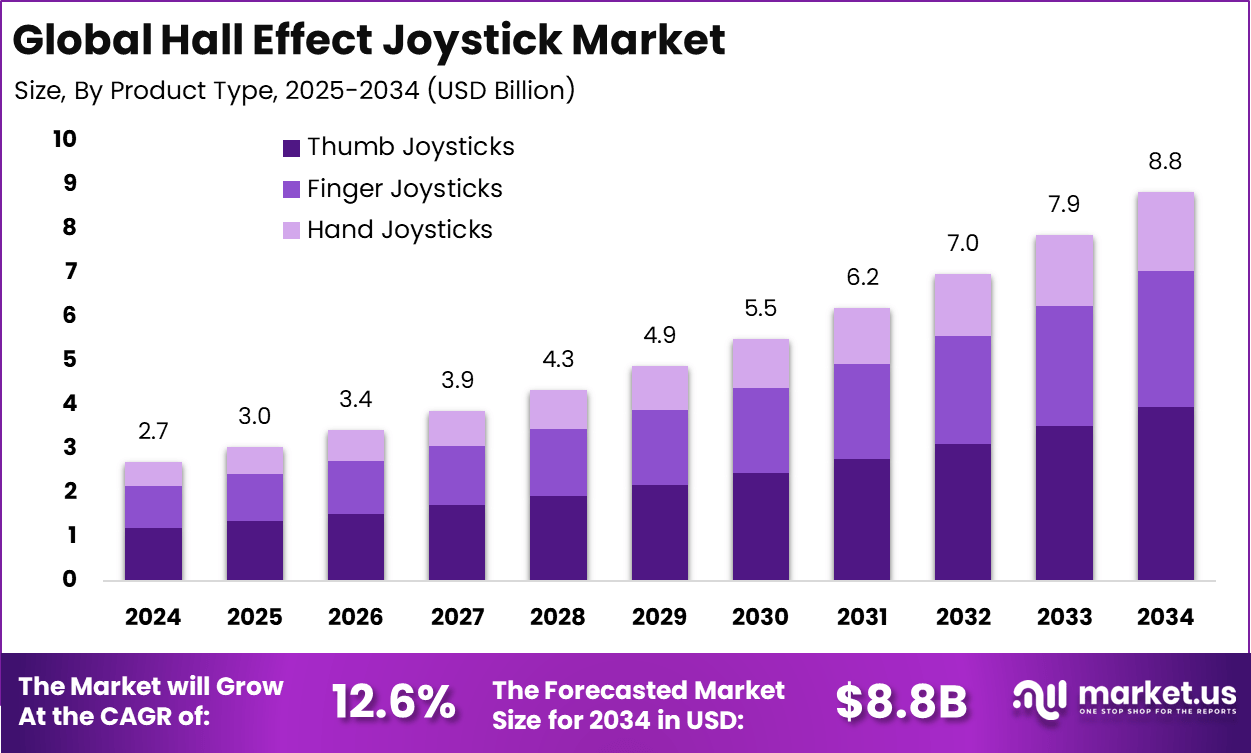
The Global Hall Effect Joystick Market size is expected to be worth around USD 8.8 billion by 2034, from USD 2.7 billion in 2024, growing at a CAGR of 12.6% during the forecast period from 2025 to 2034. In 2024, North America held a dominant market position, capturing more than a38.5% share, holding USD 1.03 billion in revenue.
The Hall Effect joystick market is defined by the rising need for advanced control systems across a wide range of industries. Hall Effect joysticks use magnetic field sensing to translate physical movement into electronic signals, allowing for more accurate, longer-lasting, and less maintenance-intensive operation compared to older mechanical joystick types.
A primary driver for Hall Effect joysticks is their impressive durability and precision. Unlike traditional systems prone to mechanical wear, these joysticks use contactless, magnetic-based position sensing, which leads to longer product life cycles and consistent performance even in tough or high-vibration environments. Industries like robotics, automation, automotive, and aviation use these joysticks for safe and precise real-time control.
For instance, in January 2025, leaks related to the Nintendo Switch 2 revealed the potential use of Hall Effect joysticks, signaling a major enhancement in the device’s input system. These joysticks, known for their precision and longevity, are designed to eliminate common problems like joystick drift, which has affected many analog-based controllers.
Scope and Forecast
In 2024, North America held a dominant market position in the Global Hall Effect Joystick Market, capturing more than a 38.5% share, holding USD 1.03 billion in revenue. This dominance is mainly attributed to the region’s advanced industrial automation, cutting-edge technological infrastructure, and a strong foothold in sectors like gaming, aerospace, defense, and healthcare.
The region’s established manufacturing capabilities and growing need for precise, dependable control systems have driven widespread adoption across diverse industries. Moreover, the presence of key industry players and continuous investments in innovation have solidified North America’s leading position in the Hall Effect joystick market.
For instance, in May 2025, PowerA, an official Nintendo partner, announced its initial lineup of licensed accessories for the upcoming Nintendo Switch 2, which includes controllers featuring Hall Effect joystick technology. This move highlights North America’s continued dominance in the Hall Effect joystick market, driven by the growing demand for high-precision, durable control solutions in gaming.
Product Type Analysis
In 2024, The Thumb Joysticks segment held a dominant market position, capturing a 44.7% share of the Global Hall Effect Joystick Market. This dominance is driven by the compact size, ergonomic design, and high precision of thumb joysticks, which make them perfect for space-constrained applications such as remote controls, medical devices, robotics, drones, and gaming controllers.
Their non-contact Hall Effect technology ensures smooth, reliable performance with minimal wear, making them a preferred choice in industries where durability and consistent operation are essential. The growing demand for ergonomic, durable, and precise control devices in consumer electronics, gaming, and industrial sectors has further accelerated the market growth of thumb joysticks.
For Instance, In October 2024, a new single-axis Hall Effect thumb joystick was launched, built for long life and IP65-rated durability. It offers precise control and withstands dust and water, making it suitable for harsh industrial uses like robotics and construction.
Application Analysis
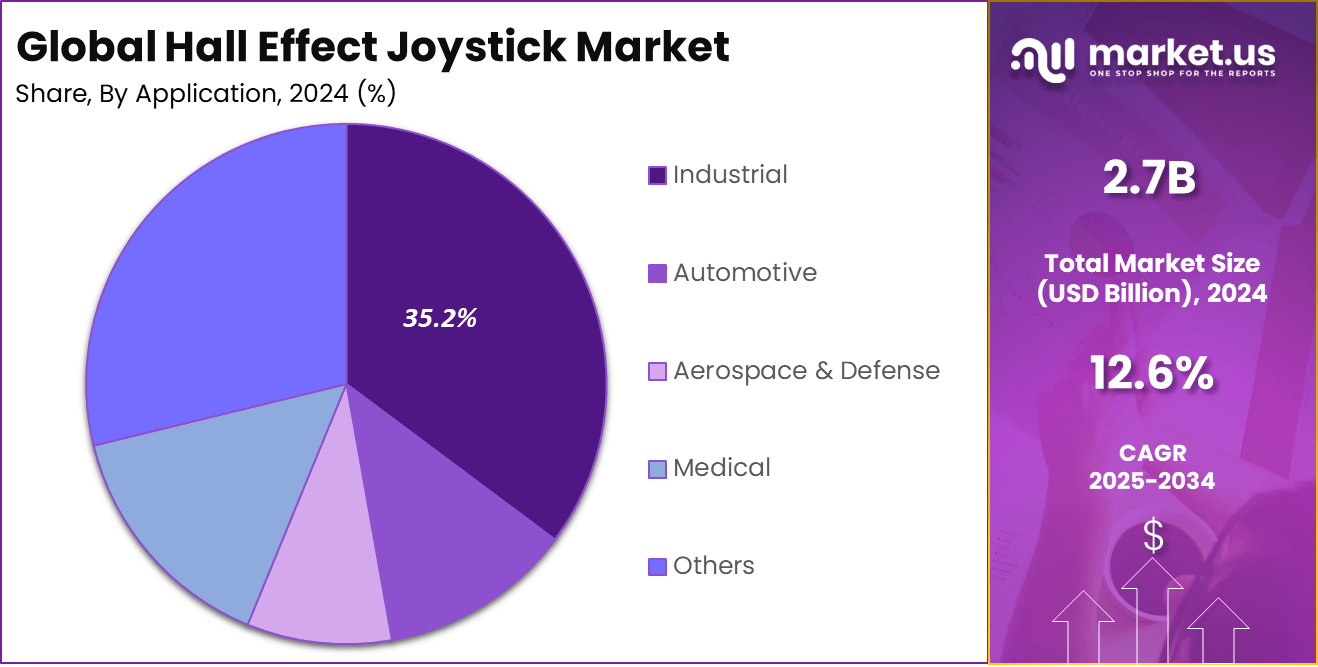
In 2024, the Industrial segment held a dominant market position, capturing a 35.2% share of the Global Hall Effect Joystick Market. The demand in this sector has been driven primarily by the increasing automation and need for precise control in industries such as manufacturing, robotics, and material handling.
Hall Effect joysticks are valued for their durability, accuracy, and reliability in harsh environments, where traditional joysticks may wear out quickly. Additionally, the growing adoption of automated machinery and robotic systems in industrial applications has further fueled the demand for these advanced control solutions.
In July 2025, Azeron launched a new ergonomic gamepad featuring Hall Effect joysticks and mechanical switches. Designed to replace standard gaming keyboards and controllers, it delivers improved precision and durability. The Hall Effect sensors allow non-contact operation, reducing joystick drift and offering smoother, more responsive control for gamers.
Distribution Channel Analysis
In 2024, The Online Stores segment held a dominant market position, capturing a 55.8% share of the Global Hall Effect Joystick Market. This dominance is due to their convenience, wide product selection, and competitive pricing offered by online platforms. Digital purchasing pathways are becoming more prevalent, enabling easy entry to international brands and effective procurement processes.
Producers and distributors are expanding their online presence to reach a larger audience, which includes small and mid-sized businesses. Furthermore, the increasing demand for fast procurement, particularly in sectors like industrial automation and gaming, has accelerated the growth of online stores as a key distribution channel for Hall Effect joysticks.
For Instance, in May 2025, the 8BitDo Ultimate 2C gaming controller, featuring Hall Effect joysticks, saw a significant 27% discount on Amazon, highlighting the growing popularity of Hall Effect technology in gaming peripherals. The controller’s integration of Hall Effect sensors ensures enhanced precision and durability, addressing common issues such as joystick drift.
End-User Analysis
In 2024, The Manufacturing segment held a dominant market position, capturing a 32.7% share of the Global Hall Effect Joystick Market. The dominance of automation is resulting from the increasing use of accurate and dependable control systems in manufacturing. Hall Effect joysticks are the preferred choice for their ability to handle robotic arms, equipment, and automated systems with precision and reliability.
With the increasing automation and efficiency in manufacturing, Hall Effect joysticks are now a crucial component of modern production facilities, providing manufacturers with dependable, low-maintenance control options that can produce high-quality products.
For Instance, in May 2023, RAFI GmbH & Co. KG opened a new factory in Bad Waldsee, Germany, to enhance its manufacturing capabilities and better serve its industrial clients. The new facility is focused on the production of advanced control systems, including Hall-effect joysticks, which are integral for precise and reliable control in various industrial applications.
Drivers
Increased Demand for Precision Control Systems
The exceptional precision and reliability of Hall Effect joysticks make them a perfect fit for applications that require precise control, such as autonomous vehicles, gaming, and robotic systems. The increasing automation and advancements in technology are contributing to the need for precise input devices across a wide range of industries.
These joysticks provide smooth, non-contact functionality and are especially useful in areas such as autonomous driving and high-precision robotics, where their popularity has increased. For instance, in March 2025, Curtiss-Wright introduced a new FNR (Forward-Neutral-Reverse) directional control switch, designed with Hall Effect sensor technology to provide high precision and reliability.
This innovative switch, aimed at demanding industrial environments, eliminates contact wear, ensuring long-lasting performance. The device is engineered to meet the stringent requirements of sectors like industrial automation, material handling, and construction, offering a durable and smooth control solution.
Restraint
High Initial Cost
Hall Effect joysticks offer long-term benefits, but their high initial cost could hinder adoption, particularly among small to medium enterprises and consumer groups with tight financial horizons. The process involves the use of specialized components, such as non-contact sensors and advanced materials, which results in higher manufacturing costs.
Therefore, Hall Effect joysticks are less appealing compared to cheaper alternatives like standard mechanical ones, which limits their widespread use in budget-friendly settings. For instance, in June 2025, the review of Nintendo’s Switch 2 Pro controller highlighted its integration of Hall Effect joysticks, which significantly enhanced the controller’s precision and longevity.
However, the review also pointed out that the advanced technology, including the Hall Effect sensors, contributed to a high manufacturing cost, making the controller more expensive than other options on the market.
Opportunities
Expanding Applications in Robotics and Drones
The growing use of robotics in industrial and consumer markets presents a significant opportunity for Hall Effect joysticks. The precision and resilience of their handling make them ideal for managing robotic arms, drones, and a range of automated systems.
In the fast-growing field of robotics and drones, Hall Effect joystick technology can meet the growing demand for precise yet reliable control systems, which will allow more widespread use and expand market reach.
For instance, In May 2025, the DJI RC compatibility guide highlighted the use of Hall Effect joysticks in their controllers, improving precision and durability for drone operators. This non-contact technology enables smoother control, which is vital for accurate flight. The move reflects rising demand for advanced and reliable input systems as drone applications grow more complex.
Challenges
Competition from Alternative Sensing Technologies
The continuous development of alternative sensing technologies, such as capacitive and optical sensors, presents a challenge to the Hall Effect joystick market. These alternatives often offer similar performance at lower prices, making them attractive options, especially in budget-friendly applications.
With the development of these technologies, Hall Effect joysticks may face difficulties in maintaining market share, especially in sectors where tech innovation and pricing are crucial. For instance, In April 2025, Apple secured a patent for a spatial tracking device intended for its future XR headset, posing potential competition to Hall Effect joysticks.
This device uses optical and sensor-based technologies to deliver precise input for tasks like writing, drawing, and gaming. Apple’s move underscores the growing presence of alternative control methods, signaling increased competition for Hall Effect technology in advanced input systems.
Key Market Segments
By Product Type
Thumb Joysticks
Finger Joysticks
Hand Joysticks
By Application
Industrial
Automotive
Aerospace & Defense
Medical
Others
By Distribution Channel
Online Stores
Offline Stores
By End-User
Manufacturing
Automotive
Aerospace
Healthcare
Others
Key Regions and Countries
North America
US
Canada
Europe
Germany
France
The UK
Spain
Italy
Russia
Netherlands
Rest of Europe
Asia Pacific
China
Japan
South Korea
India
Australia
Singapore
Thailand
Vietnam
Rest of Latin America
Latin America
Brazil
Mexico
Rest of Latin America
Middle East & Africa
South Africa
Saudi Arabia
UAE
Rest of MEA
Key Players Analysis
Honeywell, Curtiss-Wright, and APEM lead the Hall Effect joystick market with strong expertise in aerospace and industrial control. Alps Alpine and ZF Friedrichshafen offer compact, rugged designs suited for automotive and medical sectors. These companies focus on durability and precision to meet evolving industrial needs.
Parker Hannifin and Sensata provide high-reliability solutions for harsh environments. Otto Engineering, RAFI, and Grayhill support heavy machinery and defense use. Bourns, R. Merritt Controls, and P-Q Controls focus on marine, rail, and gaming applications with customized multi-axis designs.
Elobau, Eaton, and MEGATRON drive innovation in ergonomic and sensor-rich joysticks. Kavlico and Penny & Giles serve safety-critical fields like aviation. NKK Switches and Saitek cater to simulation and gaming users. These players strengthen the market through product variety and application-specific solutions.
Top Key Players in the Market
Honeywell International Inc.
Curtiss-Wright Corporation
APEM Inc.
Alps Alpine Co., Ltd.
ZF Friedrichshafen AG
Parker Hannifin Corporation
Sensata Technologies Holding PLC
RAFI GmbH & Co. KG
Otto Engineering, Inc.
Grayhill, Inc.
Bourns, Inc.
R. Merritt Controls, Inc.
P-Q Controls, Inc.
Elobau GmbH & Co. KG
Eaton Corporation
MEGATRON Elektronik AG & Co.
Kavlico Corporation
Penny & Giles Controls Ltd.
NKK Switches Co., Ltd.
Saitek Industries Ltd.
Others
Recent Developments
In November 2023, Sensata Technologies announced its plans to unveil a new electrification initiative at CES 2024, showcasing advancements in sensor technologies, including Hall-effect sensors. This initiative reflects Sensata’s commitment to supporting the growing demand for electrification across various industries, such as automotive and industrial automation.
In May 2023, Curtiss-Wright launched a new electronic joystick controller featuring advanced Hall-effect sensor technology. This controller is designed to eliminate contact wear, ensuring long-lasting and reliable performance. Engineered for demanding industrial environments, it offers dual analog outputs for enhanced safety functionality.