

Report Overview
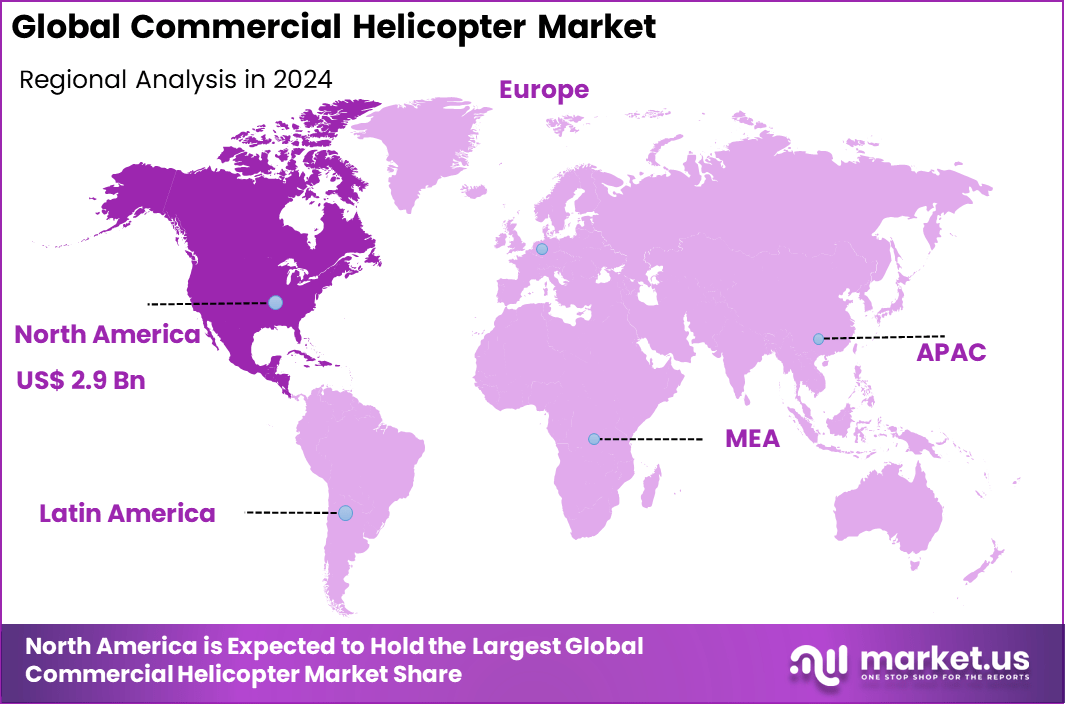
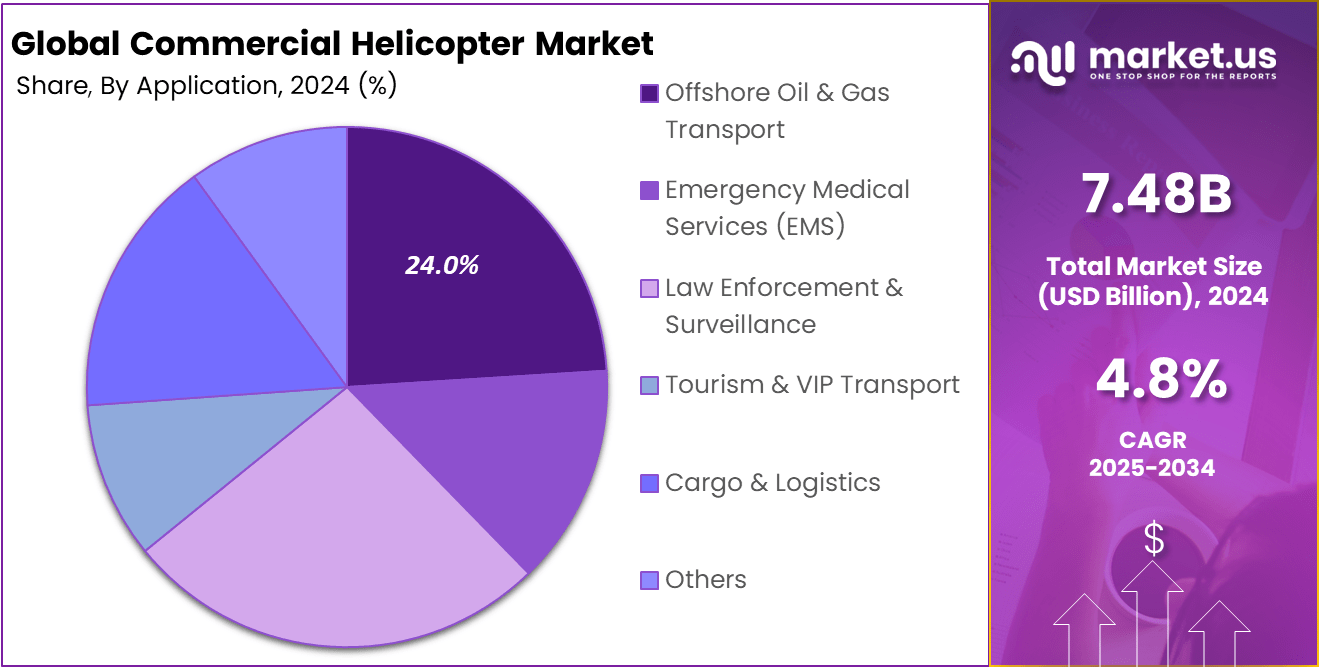
The Global Commercial Helicopter Market size is expected to be worth around USD 11.9 billion by 2034, from USD 7.48 billion in 2024, growing at a CAGR of 4.8% during the forecast period from 2025 to 2034. In 2024, North America held a dominant market position, capturing more than a 40% share, holding USD 2.9 billion in revenue.
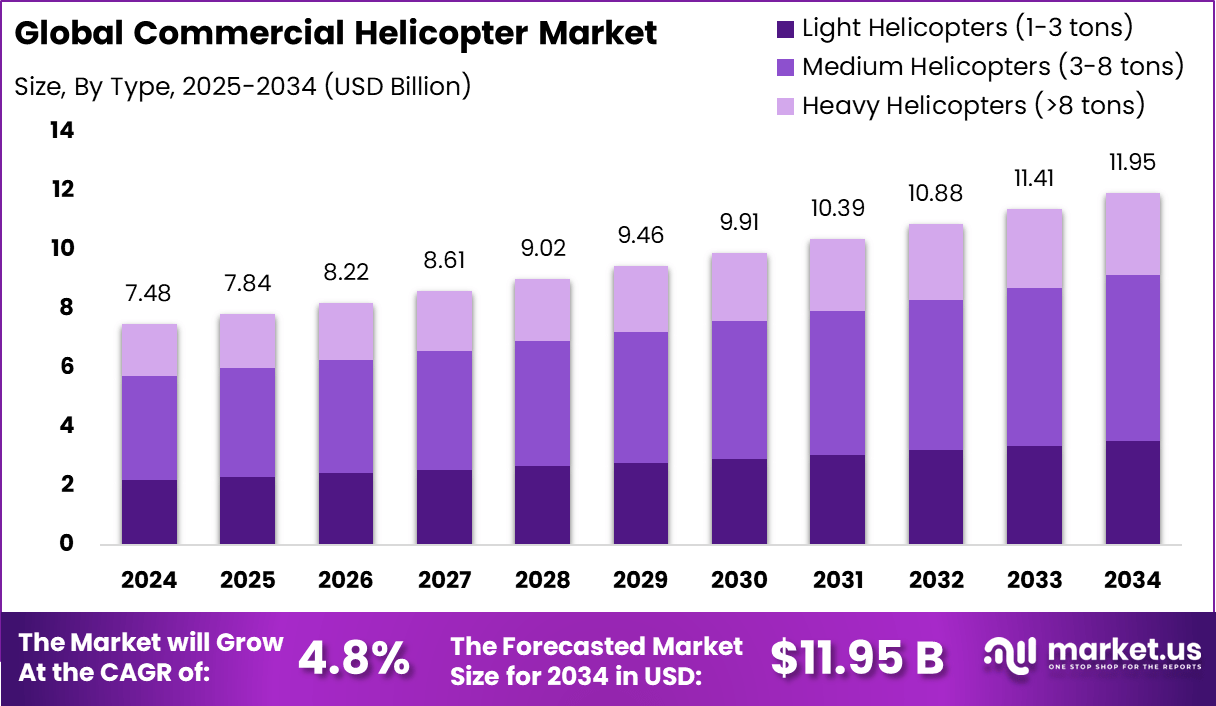
The commercial helicopter market stands as a dynamic sector within aviation, acting as a cornerstone for industries such as emergency medical services, oil and gas exploration, law enforcement, public safety, and urban transportation. With their unique ability to access remote or constrained environments, helicopters provide invaluable support for critical tasks like patient evacuation, cargo delivery, firefighting, and sightseeing.
Growth is powered by increasing demand in emergency medical services and offshore support operations. Expanding public safety needs and increased urbanization are contributing to a steady rise in deployments. Investments in industries such as offshore wind support and aerial firefighting are also serving as key levers for greater adoption.
In March 2025, Global Medical Response (GMR) agreed to acquire up to 15 H140 helicopters from Airbus, starting with an initial order of 10 units. This move supports the growing demand for air medical services and is expected to boost commercial helicopter industry growth by enhancing rapid emergency response capabilities.
A key feature of the present market is the increasing adoption of innovative technologies. Hybrid-electric and electric propulsion systems, lightweight materials, advanced avionics, and predictive maintenance software are at the forefront. Modern helicopters are now integrated with health monitoring systems and AI-powered diagnostics to ensure reliability while reducing operational costs.
For instance, In July 2024, RTX Corporation entered into a strategic partnership with Airbus to co-develop a hybrid-electric propulsion system for the H145-based PioneerLab demonstrator. This collaboration reflects the industry’s urgent push toward cleaner aviation technologies. The initiative is expected to deliver a 30% improvement in fuel efficiency while significantly lowering CO2 emissions.
Scope and Forecast
| Feature / Trend | Details |
|---|---|
| Hybrid/Electric Propulsion | Rapid R&D in fuel-efficient, low-emission technologies to meet sustainability demands. |
| Advanced Avionics & Automation | Incorporation of smart cockpit tech, autopilot, and predictive maintenance systems. |
| Lightweight Composite Materials | Enhancing payload/range and reducing costs/noise. |
| Modular & Multipurpose Designs | Helicopters designed for easy mission conversion (EMS, SAR, VIP, cargo). |
| Data Analytics & IoT Monitoring | Use of real-time monitoring, remote diagnostics, AI-driven maintenance for fleet uptime. |
| Subscription & On-demand Models | Rise of helicopter leasing and on-demand air mobility services. |
| Safety System Innovation | Investments in safety features, crash survivability, and regulatory compliance. |
| UAV/Autonomous Flight Integration | Increasing overlap with UAVs and autonomous flight capabilities. |
Driving Factor
Urban tourism, luxury travel, and VIP charters
Urban tourism, luxury travel, and VIP charters are emerging as major driving forces in the global commercial helicopter market, particularly in regions with dense urban centers, scenic landscapes, or high-net-worth populations. These services cater to time-sensitive travelers, celebrities, corporate executives, and tourists seeking premium, time-saving transport options.
According to Airbus Helicopters, VIP and corporate helicopter demand accounted for around 20% of civil deliveries globally in recent years. With rising disposable incomes, urban congestion, and evolving tourism preferences, this segment continues to fuel commercial helicopter market growth worldwide.
Helicopter charters offer point-to-point travel, avoiding ground congestion and airport delays, especially relevant in megacities like New York, São Paulo, Mumbai, Dubai, and London. In New York, companies like BLADE provide luxury helicopter services between Manhattan and JFK/LaGuardia airports, reducing travel time from over an hour to under 10 minutes.
The company reported over 200,000 passenger flights in 2023, a testament to growing demand. Tourist-centric helicopter services are thriving in scenic regions such as the Grand Canyon, the Swiss Alps, the French Riviera, and the Great Barrier Reef, offering aerial sightseeing experiences. In India, companies like Pawan Hans and Thumby Aviation operate heli-tourism services across pilgrimage routes (e.g., Kedarnath, Vaishno Devi) and luxury destinations (e.g., Coorg, Goa).
Restraining Factor
High acquisition and operational costs
One of the most significant restraints in the global commercial helicopter market is the high cost associated with acquiring and operating helicopters. The initial purchase price of a new commercial helicopter ranges from USD 1 million for light models to over USD 30 million for heavy-lift or VIP-configured models.
For example, the Airbus H225 Super Puma, widely used in offshore transport, can cost upwards of USD 27 million, excluding customization. These high acquisition costs act as a major barrier, especially for small operators and startups in developing regions. Operational costs are also substantial.
The hourly operating cost of a helicopter can range from USD 1,000 to over USD 5,000, depending on the model and mission profile. This includes fuel, maintenance, crew salaries, insurance, and regulatory compliance. According to a report by Honeywell, maintenance expenses alone account for nearly 35% of the total operational cost over a helicopter’s lifecycle.
Additionally, helicopters require frequent inspections and part replacements under strict aviation safety standards, further inflating ongoing expenses. Such high capital and operational burdens limit market penetration in cost-sensitive segments like EMS in rural areas or tourism in emerging economies. Consequently, many operators are shifting toward leasing models or used helicopters, though even these come with complex cost structures and regulatory scrutiny.
Growth Opportunity
Strategic partnerships and assembly expansion
Strategic partnerships and local assembly expansion present a significant opportunity in the global commercial helicopter market, enabling OEMs and regional players to reduce costs, accelerate delivery timelines, and strengthen market presence. By collaborating with local governments or private entities, global helicopter manufacturers can bypass high import tariffs, create jobs, and cater to region-specific demand more effectively.
A notable example is Airbus Helicopters’ partnership with the Tata Group in India. In January 2024, they announced the establishment of India’s first private helicopter assembly line in Karnataka to produce the H125 light utility helicopter, primarily for civil and tourism applications. The facility is expected to be operational by 2026, positioning India as a strategic hub for Airbus’s South Asian operations.
Similarly, Bell Textron and Leonardo Helicopters have entered into various joint ventures and localization agreements across the Middle East and Asia-Pacific, aiming to enhance after-sales service capabilities and increase fleet deployment in high-growth regions. These partnerships also facilitate technology transfer, training, and the development of regional maintenance, repair, and overhaul (MRO) hubs, which reduce long-term operational costs.
Key Market Segments
Type
- Light Helicopters (1-3 tons)
- Medium Helicopters (3-8 tons)
- Heavy Helicopters (>8 tons)
Number of Engines
- Single-Engine
- Multi-Engine
Rotor System Type
- Single Main Rotor
- Tandem Rotor
- Co-Axial Rotor
- Tilt-Rotor
Application
- Offshore Oil & Gas Transport
- Emergency Medical Services (EMS)
- Law Enforcement & Surveillance
- Tourism & VIP Transport
- Cargo & Logistics
- Others
Key Regions and Countries Covered in this Report
- North America
- The US
- Canada
- Europe
- Germany
- France
- The UK
- Spain
- Italy
- Russia
- Netherland
- Rest of Europe
- APAC
- China
- Japan
- South Korea
- India
- Australia & New Zealand
- ASEAN
- Rest of APAC
- Latin America
- Brazil
- Mexico
- Rest of Latin America
- Middle East & Africa
- GCC Countries
- South Africa
- Rest of MEA
Key Player Analysis
In the global commercial helicopters market, key players dominate with a strong presence across multiple segments. Airbus Helicopters leads the market with an estimated 27–30% share in 2024, owing to its broad portfolio and global customer base. Bell Textron follows with around 22–24%, driven by demand in North America and Asia.
Leonardo Helicopters holds approximately 15–17%, supported by strong EMS and defense-related contracts. Russian Helicopters and MD Helicopters also contribute significantly, especially in emerging markets. These players focus on strategic partnerships, assembly expansion, and innovation, especially in hybrid and sustainable rotorcraft, to maintain competitive advantages in a consolidating market landscape.
Top Key Players in the Commercial Helicopter Market
- Leonardo S.p.A.
- Bell Textron
- Airbus SE
- Aviation Industry Corporation of China
- Hindustan Aeronautics Limited
- Kaman Corporation
- Lockheed Martin Corporation
- MD Helicopters Inc.
- Robinson Helicopter Company
- Rostec
- Textron Inc.
- Other Key Players
Recent Developments
- June 2025: Airbus unveiled its HTeaming modular crewed–uncrewed teaming system ahead of the Paris Air Show, successfully tested in May with an H135 and Flexrotor UAS. The system is expected to be available to operators from
- May 2025: Malaysia ordered up to 28 Leonardo AW149 helicopters under a long-term lease-to-own deal worth ~USD 3.5 billion. Deliveries are slated for 2026–27 to support CSAR, EMS, maritime surveillance, and policing.
- March 2025: Bell partnered with Omni Helicopters for a six-month operational evaluation of the Bell 525 in Guyana’s offshore environment, preparing the model for oil & gas missions pending certification.
- March 2025: At VERTICON 2025 in Dallas, Airbus secured 118 orders and commitments, including 63 firm orders – notably over 74 for its new H140 light twin-engine helicopter targeting EMS operators like Air Methods, Stat Medevac, and ADAC.