

Report Overview
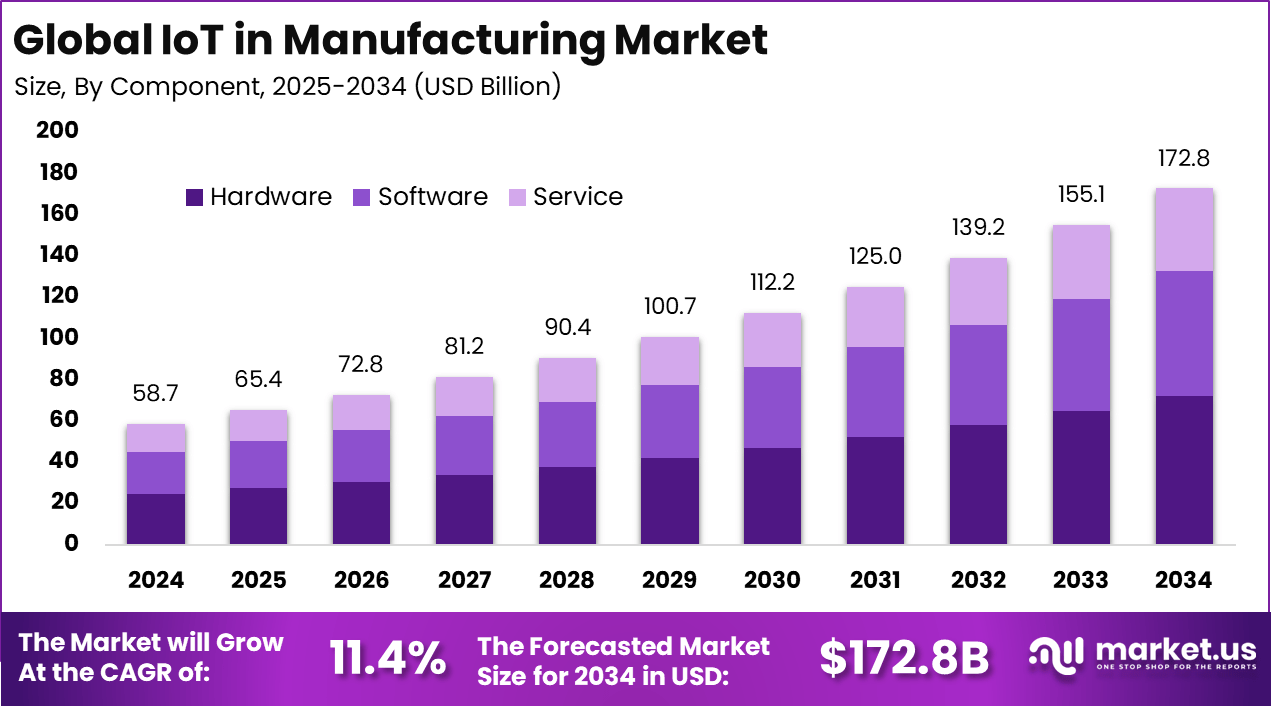
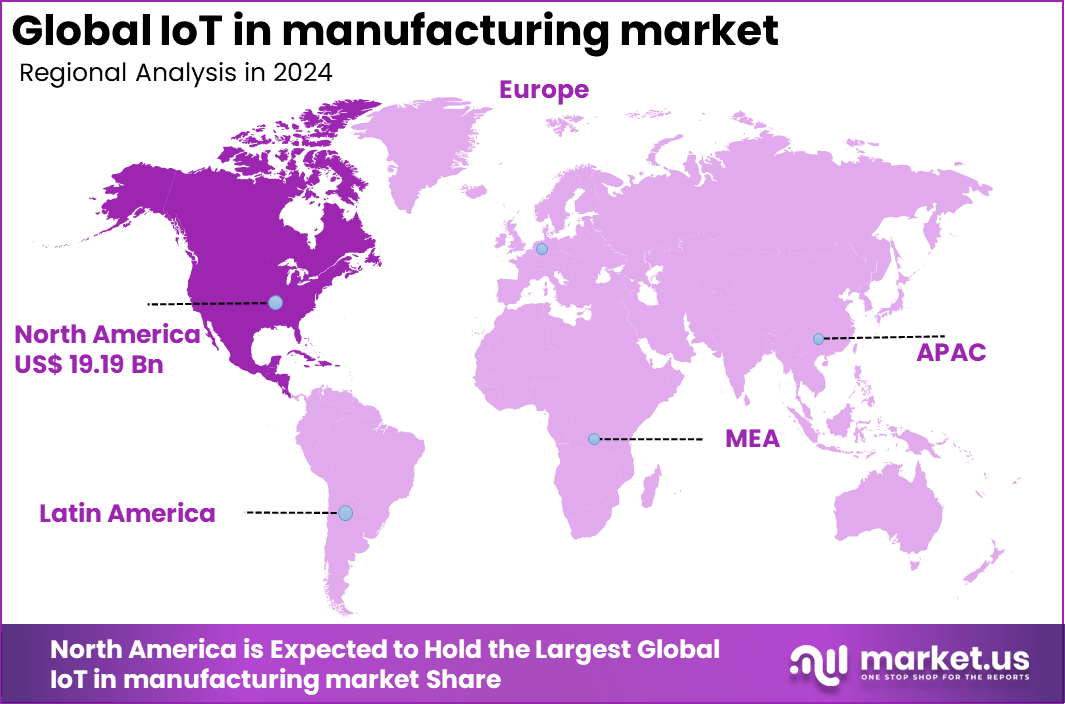
The Global IoT in manufacturing market size is expected to be worth around USD 172.8 billion by 2034, from USD 58.7 billion in 2024, growing at a CAGR of 11.4% during the forecast period from 2025 to 2034. In 2024, North America held a dominant market position, capturing more than a32.7% share, holding USD 19.19 billion in revenue.
IoT in manufacturing refers to the integration of connected sensors, devices, and industrial systems that communicate with analytics and cloud or edge computing platforms to support smart factory operations. This environment supports improved monitoring, control, and automation across production lines. IoT‑enabled cyber‑physical systems enable real‑time data flow from machines, enabling rapid decision making, operational responsiveness, and adaptation to production needs.
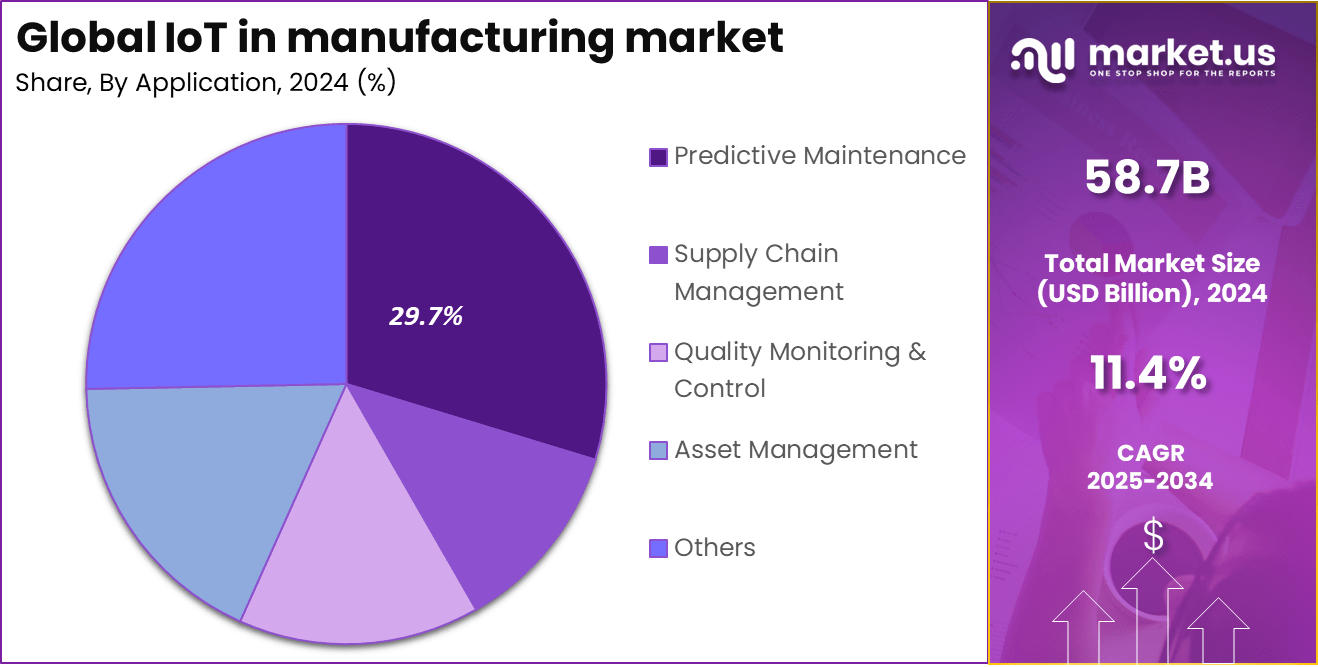
Demand is primarily emerging from the need to reduce unplanned maintenance costs through predictive maintenance, enhance asset management, and streamline production. A recent industry survey revealed that approximately 62 % of manufacturers have adopted IoT in some form within manufacturing or assembly lines, reflecting a steady increase in uptake
Market Size and Growth
| Key points | Description |
|---|---|
| Demand for Automation | Manufacturers want to automate processes to cut costs, increase productivity, and reduce errors. |
| Operational Efficiency | Real-time monitoring and analysis helps companies streamline operations and improve output quality. |
| Advancements in Technology | Growth in 5G, artificial intelligence, and edge computing makes IoT implementation faster and more reliable. |
| Predictive Maintenance | IoT enables quick detection of equipment issues, minimizing unexpected downtime. |
| Digital Transformation & Smart Factories | Companies are shifting to new, data-driven ways of working with the help of IoT-enabled smart factories. |
Key Features and Latest Trends
| Feature / Trend | Description |
|---|---|
| Real-Time Data | IoT sensors provide live data on machines, products, and resources for faster decisions. |
| Edge Computing | Data is processed near the source, supporting real-time analytics and less reliance on cloud. |
| AI and Machine Learning | AI helps analyze IoT data for smarter automation, predictive maintenance, and quality control. |
| Connected Workers | IoT tools boost worker safety, training, and productivity by connecting people and devices. |
| Digital Twins | Virtual replicas of equipment or plants help monitor, simulate, and optimize production. |
| Quality Control | Automated inspection with IoT sensors reduces defects and product recalls. |
Drivers
Increased Automation
IoT accelerates automation in manufacturing by interconnecting machines, sensors, and devices within a unified network. This connection facilitates the immediate occurrence of changes and monitoring, which greatly enhances how things function.
Automated systems can replace manual labor in repetitive tasks, which reduces the need for human staff and decreases human error. Manufacturers can improve their processes, increase output, and complete tasks faster, resulting in more flexible and cost-effective operations.
For instance, In May 2024, Zebra Technologies highlighted its industrial automation innovations at Automate 2024, focusing on connected factory advancements. The company unveiled the Zebra FS42 scanner for complex tasks such as deep learning OCR and introduced the 3S Series 3D sensors, which use parallel structured light for precise 3D sensing of both stationary and moving objects.
Restraint
Fragmented Standards and Interoperability Issues
A major barrier limiting the restricting IoT adoption in manufacturing is the absence of universal communication standards. IoT devices often operate on different protocols, making system integration complex and slowing the creation of unified networks. This lack of standardization hampers seamless data exchange and delays measurable returns on investment.
Interoperability issues also raise concerns about vendor lock-in and future upgrade costs. Manufacturers are cautious about adopting technologies that may not align with existing or future systems, leading to fragmented architectures and inefficient data flows across platforms.
Opportunities
Smart Manufacturing
The rise of IoT presents a transformative opportunity for smart manufacturing. IoT enables the creation of smart factories, where machines and systems can autonomously monitor, adjust, and optimize production processes. The use of automation enables work to be done more quickly, products are better, and resources are utilized more efficiently due to the absence of the need for people to watch everything closely.
As IoT devices continuously collect data, manufacturers gain valuable insights that enable predictive maintenance, reduced downtime, and more precise control over production, fostering innovation and operational excellence.
For instance, in April 2025, Pegatron inaugurated its AI and 5G-powered smart manufacturing facility in Batam, Indonesia, marking a significant step in the country’s digital industrial transformation. This facility, operated by PT Pegaunihan Technology Indonesia, integrates advanced AI, automation, and 5G connectivity to enhance production efficiency and adaptability.
Challenges
Data Management
Handling the massive volumes of real-time data generated by IoT devices presents a significant challenge for manufacturers. Effective data management requires robust cloud infrastructure and advanced analytics capabilities to process and extract actionable insights.
Without the proper tools to manage this data influx, manufacturers risk experiencing delays, inefficiencies, and missed opportunities for optimization. The need for scalable, high-performance data systems is essential to leverage IoT’s full potential while ensuring that manufacturers can make informed, data-driven decisions.
For instance, In January 2025, IBM underscored the transformative impact of IoT on industry innovation, noting that traditional data centers face limitations in managing the volume and speed of IoT data. To overcome this, IBM promoted edge computing as a solution, enabling data processing near the source to reduce latency and improve real-time application performance.
Key Market Segments
By Component
- Hardware
- Software
- Service
By Connectivity
- Satellite Network
- Cellular Network
- Radio-Frequency Identification (RFID)
- Near-Field Communication (NFC)
- Others
By Application
- Predictive Maintenance
- Supply Chain Management
- Quality Monitoring & Control
- Asset Management
- Others
Key Regions and Countries
North America
- US
- Canada
Europe
- Germany
- France
- The UK
- Spain
- Italy
- Russia
- Netherlands
- Rest of Europe
Asia Pacific
- China
- Japan
- South Korea
- India
- Australia
- Singapore
- Thailand
- Vietnam
- Rest of APAC
Latin America
- Brazil
- Mexico
- Rest of Latin America
Middle East & Africa
- South Africa
- Saudi Arabia
- UAE
- Rest of MEA
Key Players Analysis
The IoT in Manufacturing market is supported by key players who are actively driving digital transformation across industrial ecosystems. Companies like SAP SE, NEC Corporation, and IBM Corporation are leading in software solutions and cloud-based platforms that enable real-time analytics, predictive maintenance, and production optimization. These firms have leveraged AI and machine learning integration to increase operational efficiency.
In the hardware and automation segment, Zebra Technologies, General Electric, Intel Corporation, and Hewlett Packard Enterprise are advancing edge computing, data acquisition devices, and industrial sensors. Their contributions are crucial in building connected factory environments. By providing IoT-enabled equipment, these players ensure seamless communication between machines and systems.
A group of globally recognized manufacturers, including Honeywell International Inc., Huawei Technologies Co. Ltd., Dell Inc., Hitachi Ltd., Bosch Software Innovations GmbH, ABB Ltd., and Cisco Systems Inc., continue to expand their presence in the IoT in Manufacturing landscape. Their portfolios include industrial routers, robotics, automation software, and security solutions.
Top Key Players in the Market
- SAP SE
- NEC Corporation
- IBM Corporation
- Zebra Technologies
- General Electric
- Intel Corporation
- Hewlett Packard Enterprise
- Honeywell International Inc.
- Huawei Technologies Co. Ltd.
- Dell Inc.
- Hitachi Ltd.
- Bosch Software Innovations GmbH
- ABB Ltd.
- Cisco Systems Inc.
- Other Major Players
Recent Developments
- Samsara Inc. made headlines in June 2025 with the launch of its connected safety wearable for industrial workers. This smart device features over a year of battery life and is capable of detecting falls or accidents in real time, instantly notifying supervisors through Samsara’s cloud platform. With the wearable, Samsara extends digital protection to workers, especially in hazardous or remote environments.
- Honeywell introduced a new AI-driven smart building management platform in June 2025, designed to optimize energy use in large manufacturing facilities. This platform leverages advanced IoT and AI to enable real-time monitoring and intelligent control, helping manufacturers curb operational costs and improve sustainability.