

Report Overview
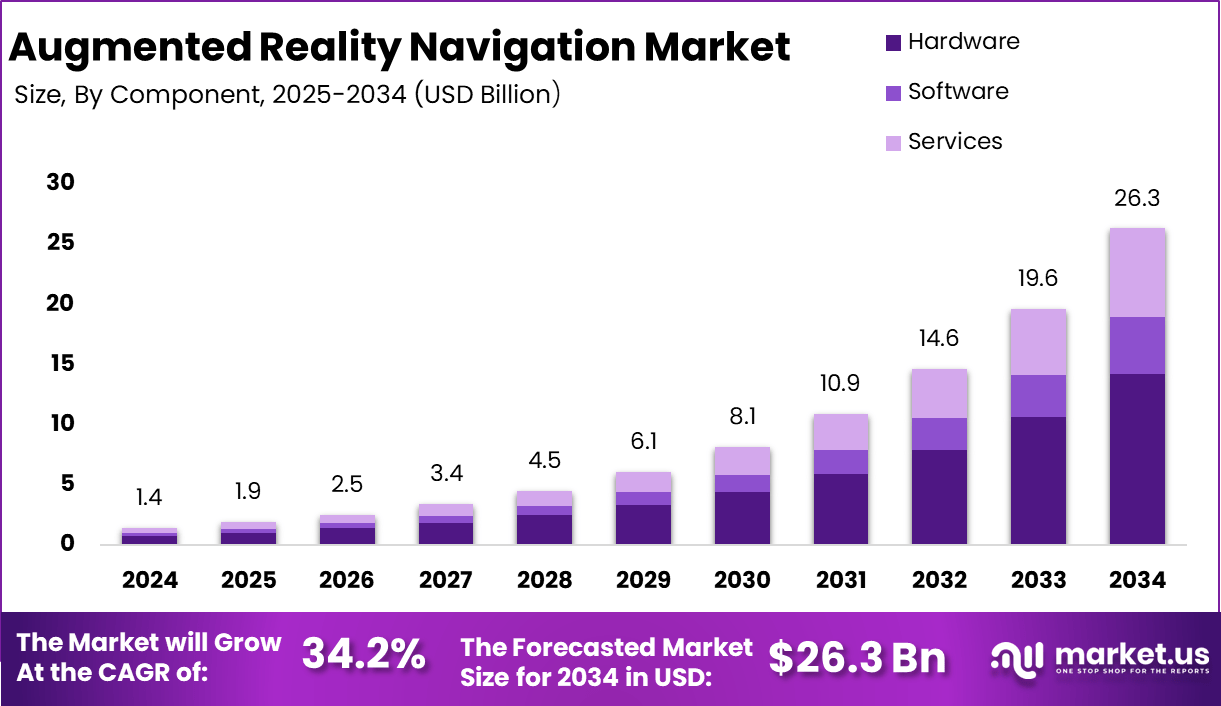
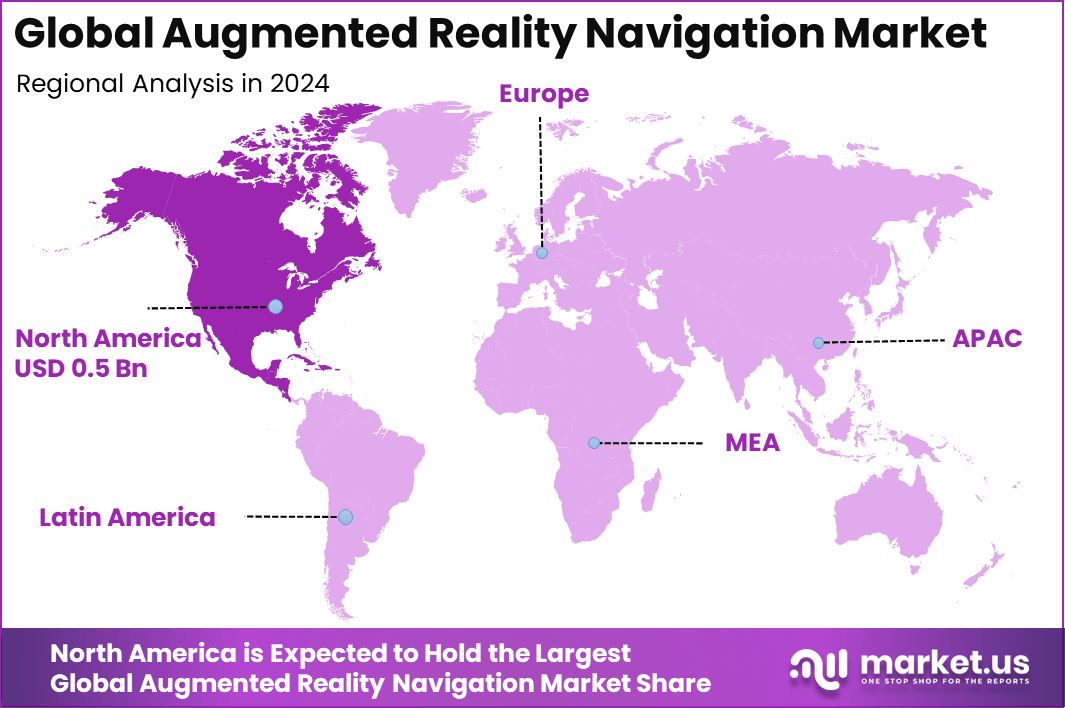
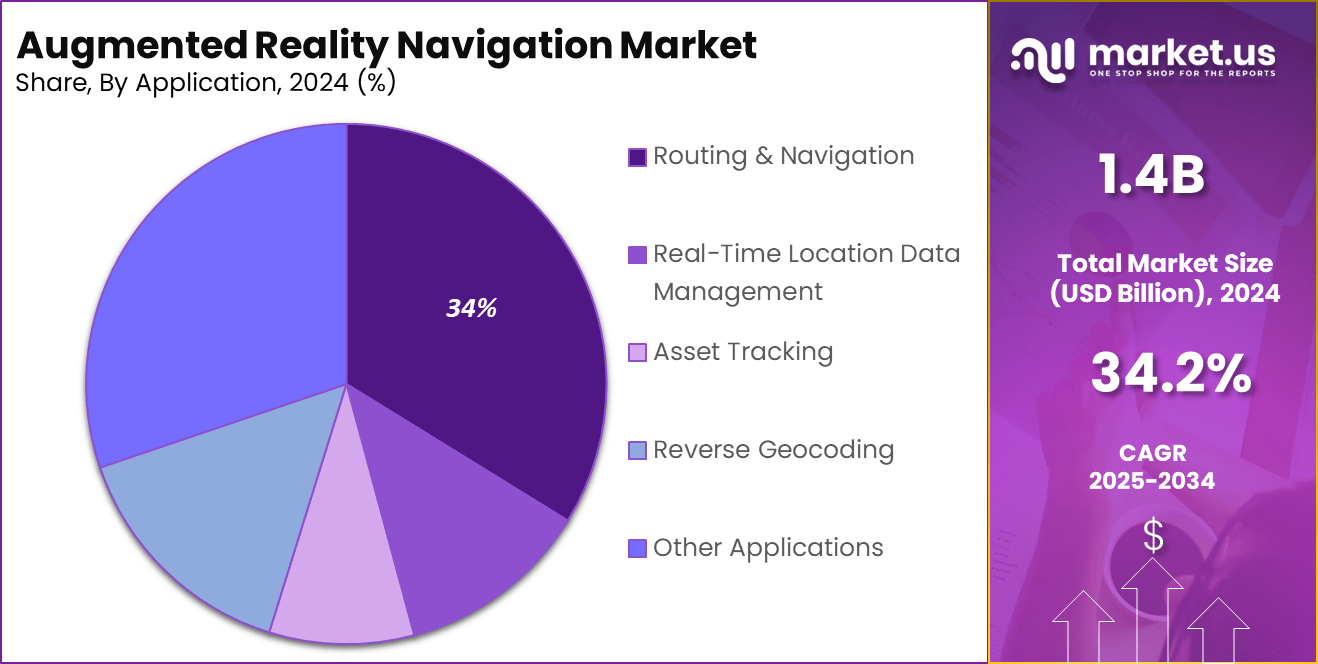
The Global Augmented Reality Navigation Market size is expected to be worth around USD 26.3 Billion by 2034, from USD 1.4 Billion in 2024, growing at a CAGR of 34.2% during the forecast period from 2025 to 2034. In 2024, North America held a dominant market position, capturing more than a 38% share, holding USD 0.5 Billion revenue.
The augmented reality navigation market is positioned as a transformative segment within the broader AR ecosystem. It involves overlaying digital guidance, landmarks, and routing information directly onto the user’s real‑world view via smart devices, head‑mounted displays, wearables, or vehicle head‑up systems. This integration of spatial awareness and visual guidance is reshaping navigation experiences across outdoor and indoor environments.
According to Market.us insights, the global Augmented Reality Market is projected to reach USD 591.7 billion by 2033, growing from USD 29.6 billion in 2024 at a robust CAGR of 39.5% during 2024 to 2033. Similarly, the AI in Augmented Reality Market is expected to expand from USD 16.0 billion in 2023 to approximately USD 446.5 billion by 2033, maintaining the same CAGR of 39.5% over the forecast period.
Data from Ortmor Agency further indicates strong adoption trends. Smart glasses are leading this shift, with more than 150 million units forecasted to ship globally by 2024, showing significant growth. Global AR users are set to surpass 1.7 billion in 2024, while mobile AR users are expected to exceed 2.5 billion by year-end. Enterprise adoption is also rising, with 70% of Forbes Global 2000 companies anticipated to implement AR solutions within their operations in 2024.
The growth of market can be attributed to heightened consumer demand for intuitive, immersive navigation experiences, particularly in automotive and urban mobility contexts. Integration of AR into vehicle HUDs and mobile apps has enhanced situational awareness and reduced cognitive load for users. Fast progress in AR tech, 5G, and smart devices has sped up use in transport, retail, and industry.
Market Size and Growth
| Factor | Description |
|---|---|
| Rise of Smart Devices | More people using smartphones, AR glasses, and tablets boosts AR navigation use. |
| Urbanization and Complex Spaces | Bigger cities and complex buildings make clear navigation more necessary. |
| Demand for Immersive Experiences | People want navigation that’s hands-free and feels more natural and interactive. |
| 5G and Fast Internet | High-speed connections make real-time AR navigation smooth and reliable. |
| Automotive Integration | Car makers add AR navigation to dashboards for safer, easier driving. |
Key Features and Trends
| Feature/Trend | Description |
|---|---|
| Real-Time Overlays | Live arrows, markers, or info appear right on your view (road, building, etc.). |
| Indoor & Outdoor Navigation | Works both inside malls and outside in complex city streets. |
| Voice and Multilingual Support | AR directions can be read out loud and shown in different languages. |
| AI-Powered Personalization | Guided routes adjust to your needs, habits, or even obstacles instantly. |
| 5G Powered Performance | Quick updates and smoother experiences thanks to faster data. |
| Seamless Integration with Smart Tech | Runs on phones, AR glasses, and even car windshields. |
| Accessibility Enhancements | AR helps people with disabilities or tourists navigate unfamiliar places. |
Drivers
Growing Demand for Immersive Navigation Experiences
The growing demand for immersive navigation experiences is driving the augmented reality (AR) navigation market globally. In the United Kingdom, the government’s Smart Cities initiative has been investing in AR to enhance urban mobility and pedestrian navigation. In 2022, the UK government allocated £100 million towards improving infrastructure for smart cities, including the integration of AR into transportation systems.
The project focuses on using AR for real-time navigation and traffic management. Similarly, in Japan, the government has supported the development of AR navigation systems for public transportation, ensuring seamless travel experiences in major cities like Tokyo. A notable project is the AR navigation system in the Tokyo Metro, which overlays real-time guidance and train schedules on users’ smartphones, enabling easier navigation through complex subway networks.
Additionally, South Korea has launched a nationwide initiative, with the Ministry of Land, Infrastructure, and Transport (MOLIT) investing in the use of AR in urban mobility applications. These government-backed initiatives, along with advancements in AR hardware and software, are helping to drive the global demand for immersive AR navigation solutions, making transportation and urban mobility more efficient and user-friendly.
Restraint
Challenges in Ensuring Data Privacy and Security
Data privacy and security challenges are significant restraints in the augmented reality (AR) navigation market, particularly as AR systems process vast amounts of personal and location-based data. In the European Union, the GDPR has set stringent standards for data privacy, which impacts AR companies offering navigation solutions.
AR navigation systems that collect user data, such as location, preferences, and behavior, must comply with GDPR’s requirements for data handling, storage, and consent. This adds complexity to the implementation of AR systems, as companies must ensure that data privacy and security protocols are in place to avoid fines and maintain consumer trust.
In Australia, the Office of the Australian Information Commissioner (OAIC) has also raised concerns about data privacy in AR applications, especially those used in public spaces like shopping centers and city streets. The OAIC has been working with businesses to ensure that AR-based navigation systems comply with national privacy laws and offer transparent user agreements.
Opportunities
Integration of AR with Autonomous Vehicle Navigation
The integration of AR with autonomous vehicle navigation presents a substantial opportunity to enhance driving safety and efficiency. In the United States, the U.S. Department of Energy (DOE) has been funding research into integrating AR with autonomous vehicle systems, particularly focusing on the improvement of situational awareness for drivers and passengers.
In 2024, the DOE allocated $15 million to a project that aims to integrate AR technology into autonomous vehicles, enhancing the display of critical navigation information like road conditions, traffic signs, and hazard detection. Similarly, in Germany, Audi and Volkswagen have been collaborating with augmented reality companies to develop HUD that overlay navigation data onto the windshield of autonomous vehicles, providing drivers with real-time updates.
The project, which was unveiled in early 2024, aims to make autonomous driving more intuitive by offering visual navigation cues directly in the driver’s line of sight. These developments highlight the growing opportunities in combining AR with autonomous vehicles, with governments and manufacturers investing in the integration of these technologies to improve transportation systems worldwide.
Challenges
Balancing Real-Time Data Processing and AR Accuracy
Balancing real-time data processing with AR accuracy is a major challenge in the development of AR navigation systems, especially for applications in dynamic environments. In Canada, the National Research Council (NRC) has been involved in research to improve the performance of AR systems, particularly for transportation and infrastructure.
In 2023, the NRC launched a project that focuses on optimizing real-time data processing for AR navigation in autonomous vehicles. This project aims to reduce latency in data transmission, which is crucial for providing accurate, real-time navigation in vehicles. The integration of high-definition maps, LiDAR data, and camera feeds requires processing a large volume of data simultaneously, which can lead to delays in AR navigation systems.
Moreover, in Singapore, the government has been testing AR navigation solutions for smart city applications, such as autonomous public transport. However, the challenge remains in ensuring that these systems can process real-time data without compromising the accuracy of the information displayed to users. Despite these efforts, achieving a balance between fast data processing and maintaining high AR accuracy remains a key obstacle to the widespread adoption of AR navigation solutions.
Key Market Segments
By Component
- Hardware
- Software
- Services
By Type
- Indoor Navigation
- Outdoor Navigation
By Application
- Real-Time Location Data Management
- Routing & Navigation
- Asset Tracking
- Reverse Geocoding
- Other Applications
By End-Use
- Aerospace & Defense
- Gaming & Entertainment
- Healthcare
- E-Commerce & Retail
- Military & Defense
- Education
- Industrial & Manufacturing
- Others
Key Regions and Countries
North America
- US
- Canada
Europe
- Germany
- France
- The UK
- Spain
- Italy
- Russia
- Netherlands
- Rest of Europe
Asia Pacific
- China
- Japan
- South Korea
- India
- Australia
- Singapore
- Thailand
- Vietnam
- Rest of APAC
Latin America
- Brazil
- Mexico
- Rest of Latin America
Middle East & Africa
- South Africa
- Saudi Arabia
- UAE
- Rest of MEA
Key Players Analysis
The global augmented reality (AR) navigation market is experiencing dynamic growth, driven by advancements in AR technology and increasing demand for immersive navigation experiences. Major technology companies are at the forefront of this evolution, integrating AR into their navigation systems to enhance user engagement and functionality.
For instance, Google has been enhancing its AR capabilities through the development of the Android XR platform, which supports AI-integrated experiences on smart glasses and mixed-reality headsets. This platform aims to provide contextual and multimodal interactions using voice, gestures, and real-time camera input, with applications in navigation and other areas.
Similarly, Apple has introduced the Vision Pro, a spatial computer that seamlessly blends digital content with the physical world. While primarily focused on immersive experiences, the Vision Pro’s capabilities extend to navigation, offering users an intuitive interface for exploring and interacting with their surroundings.
In the automotive sector, companies like WayRay are pioneering the integration of AR into vehicle navigation systems. WayRay’s Deep Reality Display technology transforms the entire windshield into a virtual world, displaying navigation information directly onto the glass, thereby enhancing driver awareness and safety.
Top Key Players in the Market
- Google LLC
- Apple, Inc.
- Microsoft Corporation
- WayRay AG
- Neusoft Corporation
- FURUON ELECTRIC CO., LTD.
- ARway Corp.
- Mapbox
- HERE Technologies
- Sygic
- Wiser Marine Technologies
- Viewar GmbH
- Other Key Players
Recent Developments
- On May 30, 2024, Google announced a strategic partnership with augmented reality startup Magic Leap to create immersive experiences that combine physical and digital elements. This collaboration leverages Magic Leap’s expertise in optics and device manufacturing with Google’s technology platforms, aiming to enhance AR navigation capabilities.
- On April 26, 2024, Neusoft Corporation launched its OneCoreGo global smart mobility solution 5.0 at Auto China 2024 in Beijing. This solution showcases Neusoft’s innovative achievements in AI technology and the automotive field, aiming to enhance navigation and mobility services.
- On January 8, 2024, Mapbox introduced new AI-powered features in its latest Navigation SDK. These features equip automakers to offer compelling alternatives to Apple CarPlay and Android Auto, enhancing in-vehicle navigation experiences.