

Report Overview
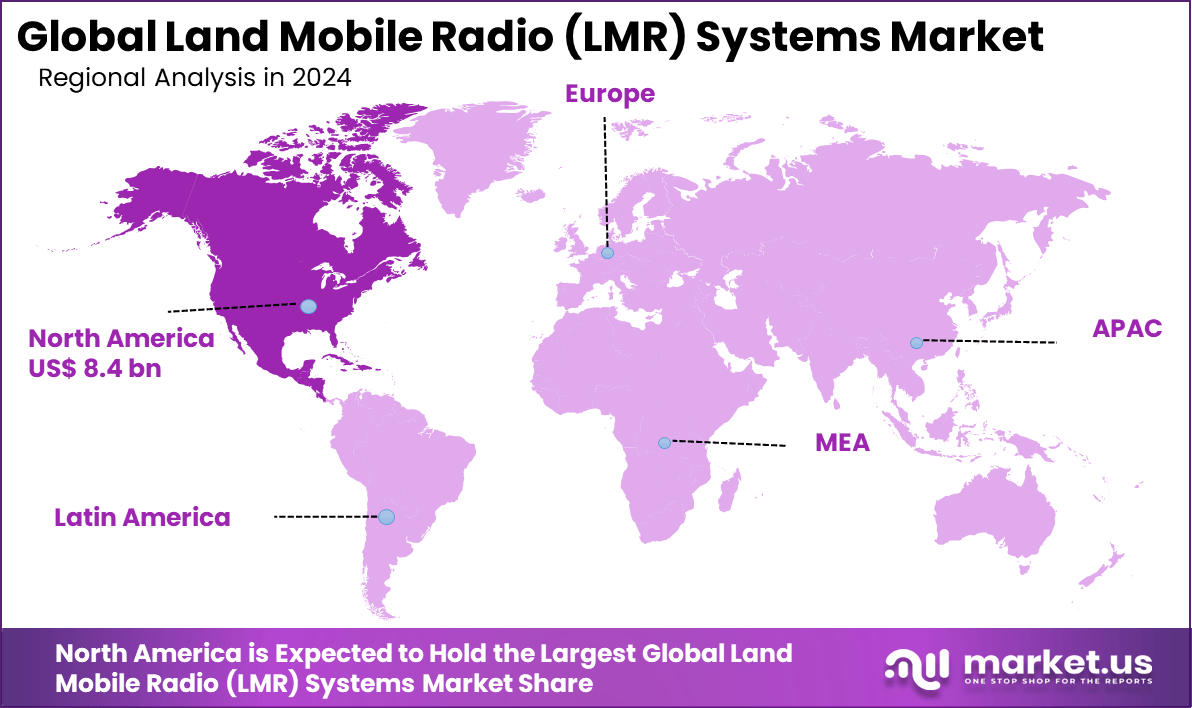
The Global Land Mobile Radio (LMR) Systems Market size is expected to be worth around USD 70.53 billion by 2034, from USD 24.84 billion in 2024, growing at a CAGR of 11% during the forecast period from 2025 to 2034. In 2024, North America held a dominant market position, capturing more than a34% share, holding USD 8.4 billion in revenue.
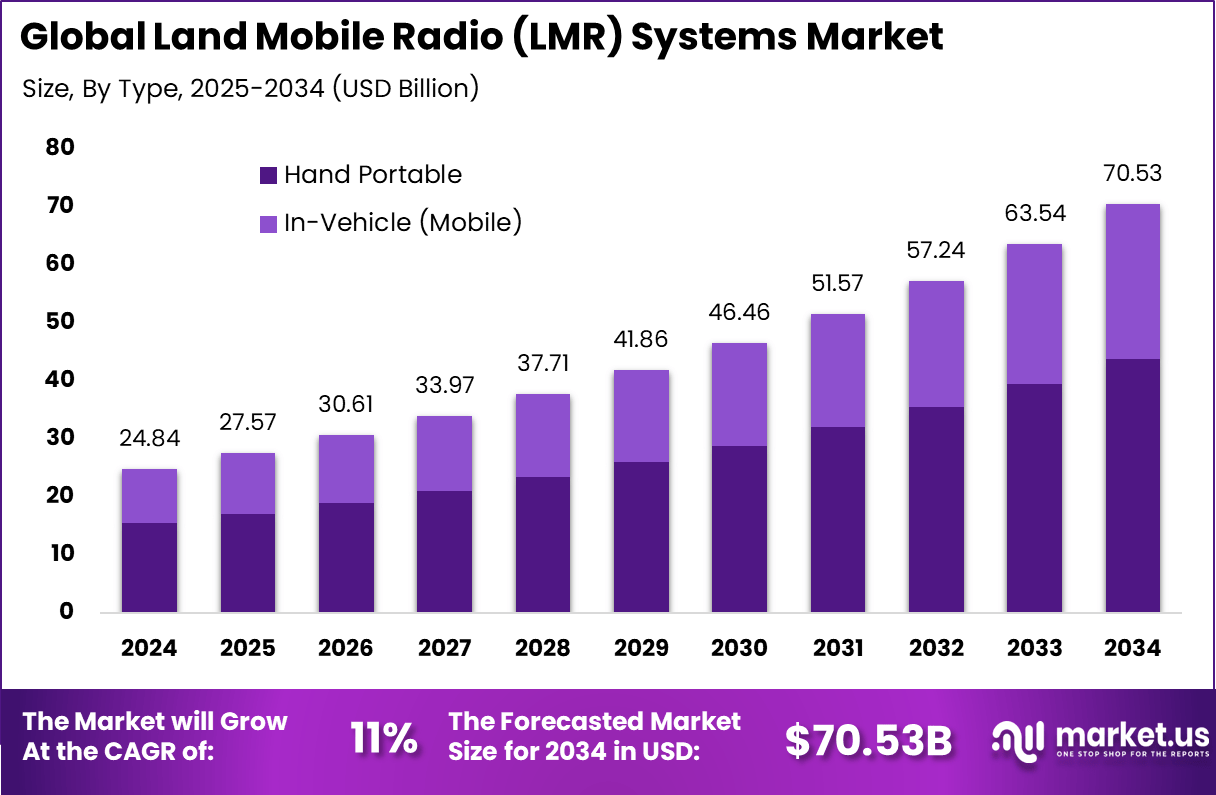
The Land Mobile Radio (LMR) Systems Market can be described as a mission‑critical communication ecosystem built around portable, fixed‑base and vehicle‑mounted two‑way transceivers operating primarily in VHF and UHF bands. These systems are employed by public safety agencies, utilities, transportation, and commercial operations that require dependable, secure, real‑time voice and limited data exchange even in remote or disaster‑affected environments.
According to the latest data from the U.S. Federal Communications Commission, there are approximately 1,530,000 licensed land mobile radio (LMR) users in the United States. These systems play a vital role across sectors such as public safety, transportation, utilities, and business. LMRs provide reliable, mission-critical communication for emergency services, government bodies, and field teams needing secure and constant coordination.
The top driving factors include the persistent need for secure and reliable communications in public safety, defense, transportation, and utility sectors, where cellular networks may fail or become congested during emergencies. The shift from analog to digital LMR systems has further accelerated adoption due to improved audio clarity, spectrum efficiency, interoperability, encryption and advanced features such as GPS tracking and messaging.
For instance, in May 2023, CPS Energy and Mission Critical Partners collaborated on a successful upgrade to their Land Mobile Radio (LMR) system. The upgraded system, which uses P25 technology, enhances communication capabilities for CPS Energy’s workforce, ensuring secure and reliable communication in critical situations.
Market Size and Growth
| Key Factor | Description |
|---|---|
| Rising Demand for Reliable, Secure Communication | Mission-critical industries (public safety, defense, transportation, utilities) require robust and instant voice/data services. |
| Shift from Analog to Digital LMR Systems | Transition drives improved spectrum efficiency, audio quality, encryption, and broader system functionality. |
| Technological Integration & Modernization | LMR systems increasingly integrate with broadband (LTE, 5G), IoT, and AI for advanced features and better coordination. |
| Growing Infrastructure Investments | Government and enterprise spending boosts network modernization, coverage, and resilience, especially for disaster/emergency use. |
| Regulatory Mandates & Interoperability Needs | Compliance with standards and the need for interoperability between agencies fuels adoption and upgrade cycles. |
Latest Trends
| Key Trends | Description |
|---|---|
| Hybrid LMR-LTE & 5G Solutions | Convergence of LMR with cellular broadband enables richer voice, data, video, and IoT applications for first responders. |
| AI & Advanced Analytics for Communications | AI-driven spectrum management, predictive maintenance, and real-time network optimization emerging for enhanced reliability. |
| Enhanced Cybersecurity & Encrypted Networks | Growing emphasis on end-to-end encryption and quantum-proof security for critical communication networks. |
| Cloud-Based & Software-Defined Solutions | Move toward cloud-controlled, software-defined LMR systems increases flexibility and scalability. |
| Rugged, Portable, and Wearable Devices | Deployment of portable/wearable LMRs with GPS, text messaging, |
Type Analysis
In 2024, the Hand Portable segment held a dominant market position, capturing a 62% share of the Global Land Mobile Radio (LMR) Systems Market. This dominance is due to the increasing demand for portable, lightweight, and reliable communication devices, especially in critical sectors like public safety and defense.
Hand-portable radios provide flexibility, mobility, and ease of use, ensuring seamless communication in dynamic and challenging environments. Their widespread adoption is fueled by advancements in digital technology, longer battery life, better ergonomics, and the growing need for secure, real-time communication in remote and fast-changing operational settings.
For Instance, in August 2024, TrellisWare Technologies introduced its new handheld TW Shadow 750 radio, designed to enhance communication capabilities for mission-critical operations. This hand-portable LMR is built for rugged environments, offering advanced features such as secure voice communication, long battery life, and reliable performance in remote locations.
Technology Analysis
In 2024, the Digital segment held a dominant market position, capturing a 67% share of the Global Land Mobile Radio (LMR) Systems Market. This dominance is due to the growing need for enhanced voice clarity, stronger security features, and improved spectrum efficiency over analog systems.
Digital LMR technologies like P25 and TETRA provide superior performance in critical communication, offering benefits such as encryption, interoperability, and broader coverage, making them ideal for public safety, defense, and other essential sectors. Furthermore, digital systems enable seamless integration with broadband, IoT, and emerging AI-based applications, driving their widespread adoption.
For instance, in October 2023, the Danish government extended its nationwide TETRA network, ensuring that 40,000 first responders can continue to communicate securely and efficiently through 2034. This expansion highlights the increasing demand for reliable, secure communication systems in public safety sectors.
Frequency Analysis
In 2024, the 200–512 MHz (UHF) segment held a dominant market position, capturing a 45% share of the Global Land Mobile Radio (LMR) Systems Market. This dominance is due to the UHF band’s ability to provide reliable communication over both urban and rural areas, offering a balance of range and signal penetration through buildings and obstacles.
UHF frequencies are mostly used in sectors like public safety, transportation, and utilities, where seamless communication in diverse environments is crucial. Additionally, the UHF band supports a wide range of devices and enables better spectrum efficiency.
For Instance, in March 2024, Sepura launched its SCL3 TETRA mission-critical broadband hand portable device, designed to enhance communication capabilities for first responders and other public safety professionals. The device operates within the 200–512 MHz (UHF) frequency band, offering reliable and secure communication over extended ranges, making it ideal for use in both urban and remote areas.
Application Analysis
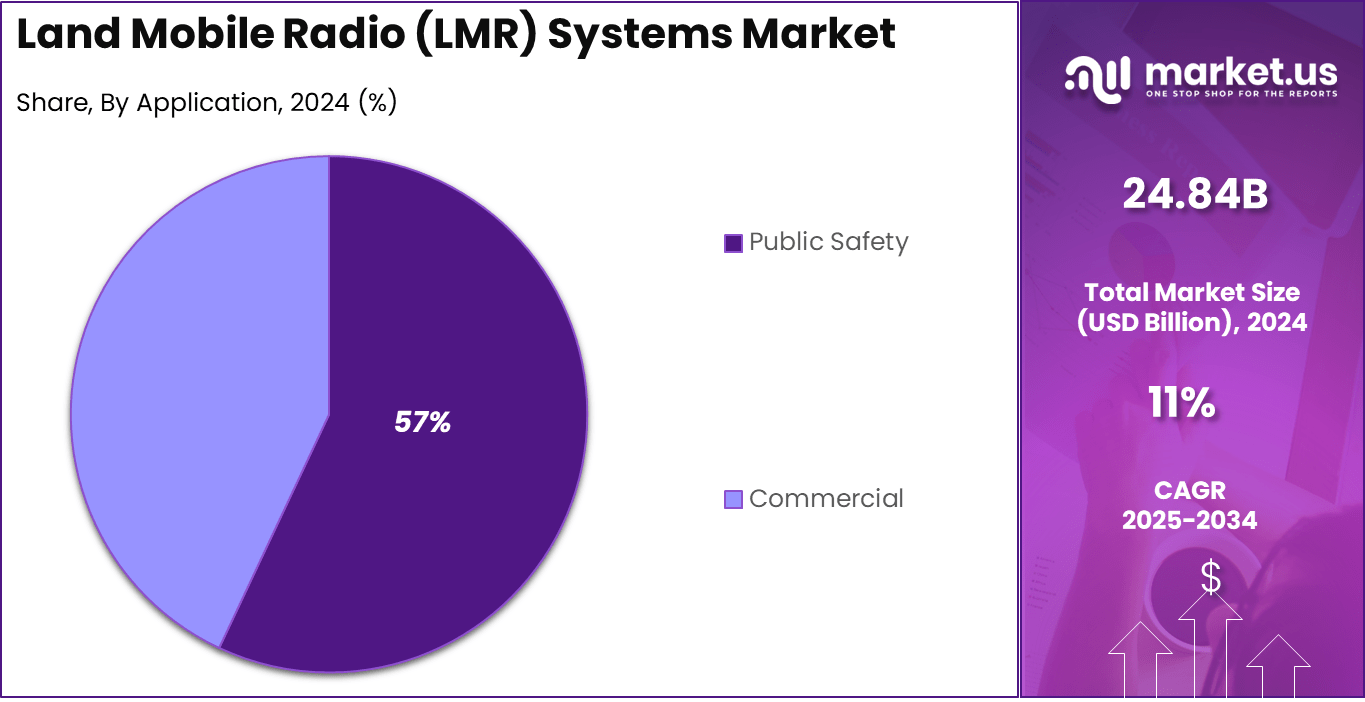
In 2024, the Public Safety segment held a dominant market position, capturing a 57% share of the Global Land Mobile Radio (LMR) Systems Market. This dominance is due to the increasing need for secure, real-time communication in emergency response and law enforcement operations.
Public safety agencies, such as police, fire departments, and emergency medical services, rely on LMR systems for critical voice communication, enabling efficient coordination and ensuring the safety of personnel. As public safety infrastructure continues to improve and digital LMR technologies advance, the adoption of these systems in the public safety sector is expected to increase, further solidifying their market dominance.
For Instance, in June 2025, Sepura announced the launch of its new series of advanced digital mobile radios, designed to enhance communication for critical infrastructure, public safety, and defense sectors. The new radios offer superior performance with enhanced voice clarity, increased battery life, and seamless integration with broadband technologies.
Key Market Segments
By Type
- Hand Portable
- In-Vehicle (Mobile)
By Technology
- Analog
- Digital
By Frequency
- 25-174 MHz (VHF)
- 200-512 MHz (UHF)
- 700 MHz & Above (SHF)
By Application
- Commercial
- Retail
- Transportation
- Utilities
- Mining
- Others
- Public Safety
- Military & Defense
- Homeland Security
- Emergency & Medical Services
- Fire Department
- Others
Key Regions and Countries
- North America
- US
- Canada
- Europe
- Germany
- France
- The UK
- Spain
- Italy
- Russia
- Netherlands
- Rest of Europe
- Asia Pacific
- China
- Japan
- South Korea
- India
- Australia
- Singapore
- Thailand
- Vietnam
- Rest of Latin America
- Latin America
- Brazil
- Mexico
- Rest of Latin America
- Middle East & Africa
- South Africa
- Saudi Arabia
- UAE
- Rest of MEA
Drivers
Increasing Demand for Public Safety Communications
The demand for reliable, secure communication systems in public safety is rapidly increasing, especially for law enforcement and emergency response teams. LMR systems provide robust, real-time communication, crucial for managing emergencies, coordinating responses, and ensuring safety.
As incidents become more complex, LMR technology offers enhanced capabilities like clear voice quality, wide coverage, and encryption, making it indispensable for mission-critical communications. This growing need for dependable systems across various regions fuels continued market growth for LMR solutions.
For instance, in July 2025, emergency communications tech firm Carbyne raised $100 million to enhance its solutions for public safety communications. This funding underscores the increasing demand for advanced communication technologies that enable real-time, reliable, and secure connections in emergencies. This development highlights the ongoing growth and importance of the public safety communications sector.
Restraint
High Initial Capital Expenditure
The initial setup and ongoing maintenance of LMR systems demand significant financial resources, including buildings, equipment, and training. For public safety organizations and critical sectors, this high initial capital expenditure can be a significant barrier.
Smaller groups or businesses in developing countries may face difficulties in obtaining the necessary funds for updating or replacing their systems. It can be challenging to use and expand LMR systems due to money constraints, particularly in tight budgets or other crucial areas.
Opportunities
Expanding Applications in New Industries
The LMR systems market is witnessing growing interest from industries beyond traditional sectors such as public safety and defense. Sectors like logistics, agriculture, mining, and energy are increasingly adopting LMR solutions to improve operational efficiency, safety, and coordination.
The need for communication tools to simplify tasks and enhance teamwork is essential in these sectors, which are typically dispersed across a large geographical area. The rise in LMR applications presents numerous chances for growth and offers new opportunities for service providers.
For instance, in January 2022, Motorola Solutions was awarded a contract by the U.S. Navy to provide advanced Land Mobile Radio (LMR) systems for improved communication capabilities. This contract underscores the increasing demand for reliable, secure, and efficient communication solutions in mission-critical sectors, particularly in defense and public safety.
Challenges
Competition from Alternative Technologies
LMR systems face growing competition from alternative communication technologies such as broadband and IoT-based solutions. These technologies offer integrated voice, high-capacity data, and real-time communication capabilities, which LMR may struggle to fully support.
As users seek more versatile, data-rich systems for enhanced connectivity and functionality, LMR systems must adapt to maintain relevance. The rapid development of broadband and IoT technologies poses a challenge for traditional LMR solutions to stay competitive, especially in sectors requiring advanced data processing.
For instance, in May 2025, JVCKENWOOD USA and EFJohnson realigned their operations to focus on technology platforms, marking a significant shift in their approach to Land Mobile Radio (LMR) solutions. This move reflects the increasing competition from emerging technologies like LTE, 5G, and broadband-based communication systems, which are gaining traction in mission-critical industries.
Key Players Analysis
The LMR Systems Market is highly competitive with the presence of major global players. Motorola Solutions Inc. and L3Harris Technologies Inc. are leading due to their strong product portfolios and high global penetration. In May 2025, Motorola Solutions is set to close its acquisition of Silvus Technologies for approximately $4.4 billion.
Airbus DS and Thales are also significant players, particularly in Europe, offering advanced TETRA and LTE-integrated solutions. Their systems are widely adopted in public safety and defense applications across the EU and the Middle East. Asian companies such as Hytera Communications, JVCKENWOOD Corporation, and Icom Inc. are gaining global presence through cost-effective and feature-rich LMR products.
These brands have expanded in emerging markets due to rising demand for digital and hybrid radio systems. Their innovations include AI-driven dispatch systems, enhanced interoperability, and encryption capabilities. Tait Communications and Sepura Limited are focused on customization and scalable infrastructure, serving clients in transport, utilities, and mining sectors with flexible deployment models.
Other key contributors include Codan Limited, Simoco, BK Technologies, and Leonardo S.p.A., which serve niche applications and regional markets. Companies like Neolink and Selex ES S.p.A. are expanding their portfolios with secure digital mobile systems and P25 upgrades. Strong competition has driven strategic alliances, government contracts, and product enhancements.
Top Key Players in the Market
- Airbus DS
- KENWOOD Corporation
- Codan Limited
- Hytera Communications Corporation Limited
- Simoco
- Sepura Limited
- Tait Communications
- Selex ES S.p.A
- Neolink
- Motorola Solutions Inc.
- L3Harris Technologies Inc.
- JVCKENWOOD Corporation
- Icom Inc.
- BK Technologies
- Leonardo S.p.A.
- Thales
- Other Key Players
Recent Developments
- In February 2025,Kenwood Corporation announced the upcoming launch of its new digital mobile radio, the TM-D750A, which will feature built-in Wi-Fi capabilities. This new product is designed to meet the growing demand for advanced communication solutions, offering enhanced functionality for both voice and data transmission.
- Motorola Solutions made a significant acquisition by integrating Barrett Communications into its portfolio in February 2025. This strategic move allows Motorola to expand offerings beyond conventional LMR, particularly by incorporating HF and advanced radio technologies for public safety and defense.