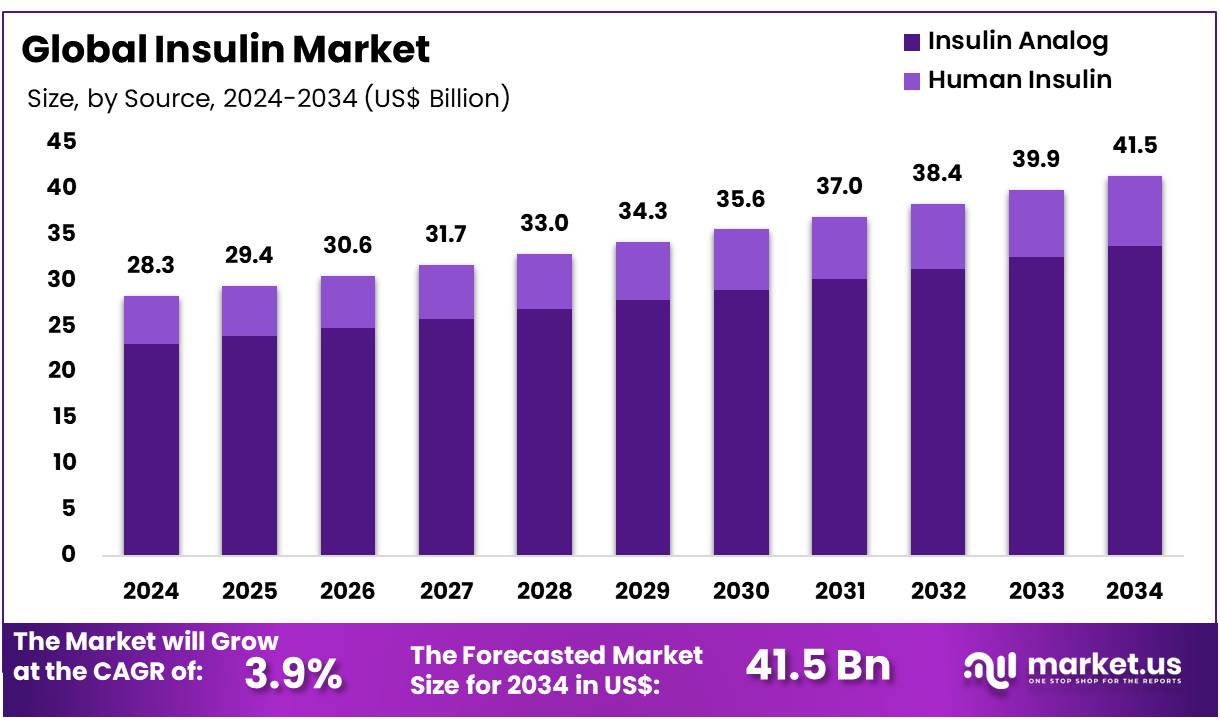
Global Insulin Market size is forecasted to be valued at US$ 41.5 Billion by 2034 from US$ 28.3 Billion in 2024, growing at a CAGR of 3.9% during the forecast period 2025 to 2034. In 2024, North America led the market, achieving over 43.1% share with a revenue of US$ 12.2 Billion.
The market is growing steadily, primarily due to the increasing number of diabetes cases, advances in insulin formulations, and a greater demand for easier-to-use treatment options. Diabetes, especially type 2, is becoming more common worldwide, with millions of people now living with the condition. The World Health Organization (WHO) projects that by 2030, diabetes will be one of the leading causes of death, highlighting the urgent need for effective treatment options like insulin.
Over the years, insulin therapies have seen significant improvements. Long-acting insulins, such as insulin degludec, offer better control with fewer injections, making diabetes management easier for patients. On the other hand, rapid-acting insulins like insulin aspart are designed for quicker action, particularly useful for controlling blood sugar levels after meals. These advancements are making insulin more effective and convenient for patients, driving demand for better treatment options.
The introduction of biosimilar insulins has made insulin more affordable. These biosimilars are similar to existing insulin products but are priced lower, making them more accessible to people who might not have been able to afford the brand-name versions. Another change in the insulin market is the move toward non-injectable insulin.
Inhalable insulin products, like Afrezza, offer an alternative for patients who find injections uncomfortable. The demand for insulin is also increasing in developing regions such as Asia-Pacific and Africa, where rising urbanization and lifestyle changes are leading to more cases of diabetes. As these regions grow and improve healthcare access, the demand for insulin therapies is expected to rise even more.
Despite these positive developments, the insulin market still faces challenges. The cost of insulin remains high in many countries, and this can make it difficult for some patients to afford the medication they need. Even though biosimilars are helping to bring prices down, many people in low-income areas still struggle to get the treatment.
Lilly’s Efforts to Improve Insulin Access and Affordability:
Key Market Segments
By Product Type
Rapid-acting
Long-acting
Intermediate-acting
Premixed
Regular/short-acting
Others
By Source
Human Insulin
Insulin Analog
By Diabetes Type
Type 1 Diabetes Mellitus
Type 2 Diabetes Mellitus
Gestational Diabetes
By Delivery Device
Insulin Pens
Jet Injection
Insulin Pumps
Pen Needles & Syringes
Others
By Distribution Channel
Hospital Pharmacies
Retail Pharmacies
Online Pharmacies
Drivers
Rising Diabetes Prevalence
The global insulin market is experiencing significant growth, largely driven by the rising prevalence of diabetes worldwide. According to the International Diabetes Federation (IDF), approximately 589 million adults aged 20–79 were living with diabetes in 2024, and this number is projected to increase to 853 million by 2050 . This surge in diabetes cases is contributing to a higher demand for insulin and related therapies. The World Health Organization (WHO) reports that the number of people living with diabetes has risen from 200 million in 1990 to 830 million in 2022, with a global prevalence of 14% among adults aged 18 years and older.
The rising diabetes prevalence is influenced by several factors, including aging populations, urbanization, and lifestyle changes. Increased consumption of high-calorie diets, sedentary lifestyles, and higher obesity rates are contributing to the higher incidence of type 2 diabetes. Additionally, genetic predispositions and environmental factors play significant roles in the development of the disease.
As the number of individuals diagnosed with diabetes continues to grow, the demand for insulin and other diabetes management products is expected to rise correspondingly. This trend underscores the importance of addressing the underlying causes of diabetes through public health initiatives, promoting healthy lifestyles, and ensuring equitable access to medical care. By focusing on prevention and early intervention, it is possible to mitigate the impact of the diabetes epidemic and reduce the strain on healthcare systems globally.
Number of Adult Population (20–79 years) with Diabetes (Mn), by Region, 2024 & 2050:
Key Regions and Countries
North America
US
Canada
Europe
Germany
France
The UK
Spain
Italy
Russia
Netherland
Rest of Europe
Asia Pacific
China
Japan
South Korea
India
Australia
New Zealand
Singapore
Thailand
Vietnam
Rest of APAC
Latin America
Brazil
Mexico
Rest of Latin America
Middle East & Africa
South Africa
Saudi Arabia
UAE
Rest of MEA
Key Players Analysis
The global insulin market is dominated by major players like Novo Nordisk, Sanofi, and Eli Lilly, which hold a significant share due to their extensive product portfolios and innovations in insulin delivery methods. Novo Nordisk leads with products like insulin glargine (Lantus) and insulin degludec (Tresiba), while Sanofi is known for Lantus and expanding its biosimilars. Eli Lilly, with products like Humalog, has also focused on addressing insulin affordability.
The rise of biosimilars, such as Biocon’s Semglee, has introduced more affordable alternatives, especially in emerging markets, intensifying competition. Regional players like Gan & Lee and Tonghua Dongbao are gaining ground by offering cost-effective insulin options. As the demand for affordable insulin increases, these companies are adapting through price reductions, biosimilars, and digital health solutions to maintain their market positions.
Top Key Players
Novo Nordisk A/S
Sanofi
Eli Lilly and Company
Biocon Ltd
Pfizer Inc.
Wockhardt
Julphar
Sedico
Insulet Corporation
Tonghua Dongbao Pharmaceutical Co. Ltd.
Adocia
Boehringer Ingelheim International GmbH
United Laboratories International
Gan & Lee Pharmaceuticals
MannKind Corporation
Recent Developments
In June 2025, Indian pharmaceutical companies Biocon, Eris Lifesciences, and Wockhardt announced that they are increasing their insulin production to capitalize on the expanding global market, while industry leader Novo Nordisk is reducing its focus on human insulin to prioritize high-margin GLP-1 therapies and insulin analogues.
In April 2025, it was stated by Novo Nordisk that its flagship insulin brand, Mixtard, will continue to be available in India in vial form, even as other delivery formats, such as Penfill cartridges, are being phased out. The announcement was made amid widespread concern over the discontinuation of some of the country’s most-used insulin products. In response to reports suggesting the withdrawal of Mixtard India’s top-selling insulin brand with annual sales of over Rs 800 crore a statement was issued by Novo Nordisk. The company explained that, to meet increasing patient demand and ensure a stable supply of its medicines, its insulin portfolio is being consolidated. This consolidation is expected to create the necessary space within the global manufacturing network. As part of this process, the Penfill delivery format is being phased out. While the company acknowledged that this shift will be disruptive for people with diabetes who rely on its treatments, it emphasized that this move would allow for the expansion of its insulin portfolio, ultimately reaching many millions of patients in the next decade.
In March 2025, Eli Lilly, which recently introduced its blockbuster anti-obesity drug Mounjaro (tirzepatide) in India, revealed plans to increase insulin production, partner on therapies for non-communicable diseases, and advance biomanufacturing within the country.