

Report Overview
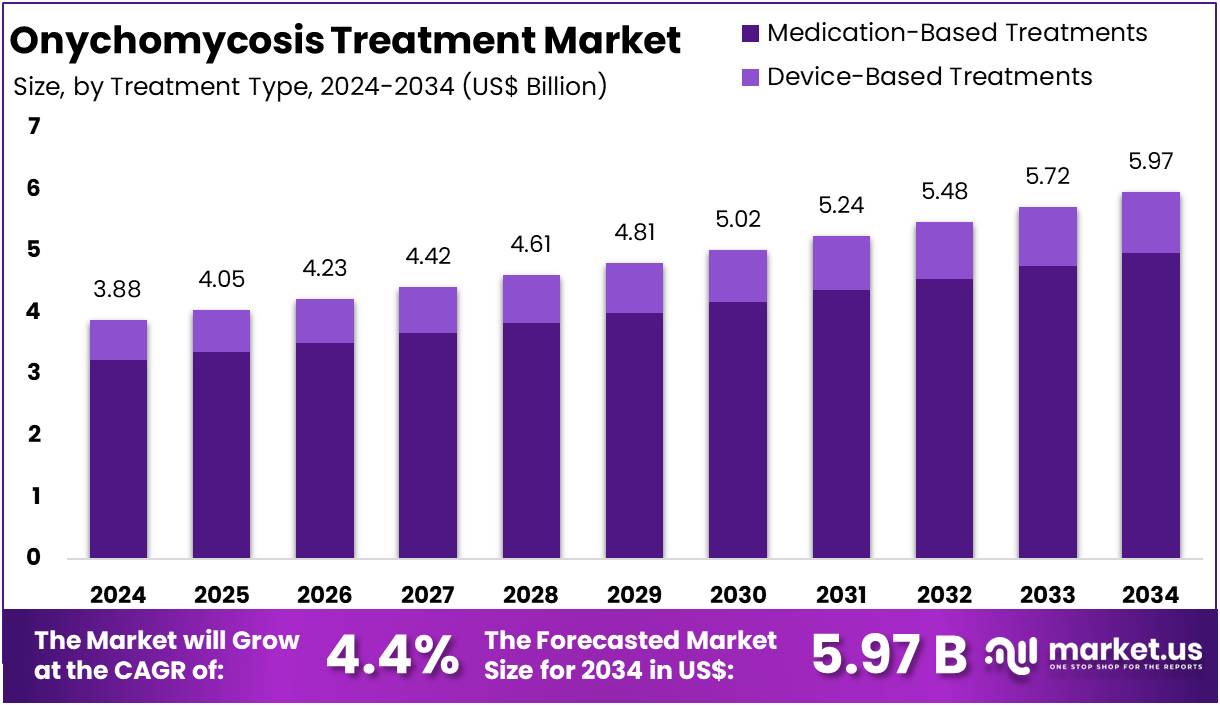
The Onychomycosis Treatment Market Size is expected to be worth around US$ 5.97 billion by 2034 from US$ 3.88 billion in 2024, growing at a CAGR of 4.4% during the forecast period 2025 to 2034. North America held a dominant market position, capturing more than a 40.4% share and holds US$ 1.57 Billion market value for the year.
Onychomycosis refers to a fungal infection affecting the nail unit, commonly caused by dermatophytes, in which case it is specifically termed tinea unguium. The broader term onychomycosis includes infections caused by dermatophytes, yeasts, and saprophytic molds. A dystrophic nail, in contrast, is a nail with abnormalities not related to a fungal infection. While onychomycosis can affect both fingernails and toenails, it is notably more common in toenails. The following sections delve into various aspects of this condition, including its disease burden, clinical types, staging, diagnosis, and management, with a focus on toenail onychomycosis.
Approximately 50% of abnormal toenails are affected by fungal infections. The prevalence of onychomycosis is estimated to range from 1% to 8%, with the incidence on the rise. Genetic susceptibility to dermatophyte infections follows an autosomal dominant inheritance pattern. Key risk factors include aging, diabetes, tinea pedis, psoriasis, immunodeficiency, and living in households with individuals affected by onychomycosis. The global onychomycosis treatment market—which comprises therapies for fungal nail infections—is experiencing steady growth due to the increasing prevalence of nail fungal infections, particularly among geriatric and diabetic populations.
Drug therapies is the major treatment option, accounting for more than 80% of revenue, driven by the efficacy and ease of access to oral and topical antifungals such as terbinafine and ciclopirox. In addition to pharmaceutical treatments, the market is seeing rising interest in non-invasive modalities, such as photodynamic therapy and laser treatments, which are particularly attractive for patients intolerant to systemic drugs.
Current Treatment Options (Dug Therapies) for Onychomycosis Treatment
| Leader Name | Opinion |
|---|---|
| Dr. Emily Patterson, MD, FAAD, Bausch Health Companies Inc. | “Jublia (efinaconazole) has shown tremendous promise in my clinical practice for treating onychomycosis, especially in patients with mild-to-moderate infections. Topical treatments, like Jublia, allow patients to treat their condition without the systemic side effects often associated with oral antifungals. In my experience, early intervention with topical therapies can significantly reduce the progression of the disease and enhance patient compliance, which is crucial in managing onychomycosis effectively.” |
| Dr. Liam Griffin, PhD, DSc, Galderma S.A. | “I believe that oral antifungals have often been over-prescribed for onychomycosis, especially when effective topical treatments are available. Galderma’s new innovations in topical antifungal formulations offer a less invasive alternative for patients. By focusing on topical treatments, we can minimize the risk of side effects while ensuring that the infection is treated at the source. It’s important that clinicians adopt personalized treatment plans that are tailored to the severity of the infection and the patient’s individual needs.” |
| Dr. Olivia Martinez, MD, PhD, Novartis AG | “Tavaborole (Kerydin) has been a game-changer in the treatment of onychomycosis, especially for patients who have localized infections or who cannot tolerate oral antifungals due to underlying health conditions. The targeted action of Tavaborole allows for effective treatment with minimal systemic absorption, which is a significant advantage. I always emphasize the importance of combining topical therapies with early diagnosis. Educating patients on the chronic nature of the disease and the importance of adherence is key to achieving long-term success in managing onychomycosis.” |
Top Key Players in the Onychomycosis Treatment Market
- Bausch Health Companies Inc.
- Galderma S.A.
- Novartis AG
- Pfizer Inc.
- Moberg Pharma AB
- Cipla Limited
- Reddy’s Laboratories Ltd.
- GlaxoSmithKline plc (GSK)
- Kaken Pharmaceutical Co., Ltd.
- Merz Pharma
- Bayer AG
- Teva Pharmaceutical Industries Ltd.
- Sun Pharmaceutical Industries Ltd.
- Lumenis Ltd.
- Medimetriks Pharmaceuticals Inc.
- TheOTCLab B.V.
- Xian Janssen Pharmaceutical Ltd.
- Other key players
Recent Developments
- In September 2024, Moberg Pharma AB announced that it has received information regarding clinical cure outcomes in a subset of patients in its ongoing North American Phase 3 study for MOB-015, a treatment for nail fungus. The number of patients who have achieved clinical cure in this blinded subset is lower than the company’s expectations, prompting Moberg Pharma to inform the market about this development.
- In January 2024, Vanda Pharmaceuticals Inc. announced that the U.S. Food and Drug Administration (FDA) has approved the Investigational New Drug (IND) application to evaluate VTR-297 for the treatment of onychomycosis.
- In April 2020, the U.S. Food and Drug Administration (FDA) approved a supplemental New Drug Application for efinaconazole (JUBLIA) topical solution, 10%, to treat onychomycosis. This approval extends the use of efinaconazole to treat fungal infections of the toenails in patients aged 6 years and older.