

Report Overview
Global Liver Cancer Drugs Market size is expected to be worth around US$ 16.39 Billion by 2034 from US$ 3.78 Billion in 2024, growing at a CAGR of 15.8% during the forecast period 2025 to 2034. In 2024, North America led the market, achieving over 38.8% share with a revenue of US$ 1.47 Billion.
The liver cancer drugs market is experiencing significant growth, driven by the increasing prevalence of liver cancer worldwide. Hepatocellular carcinoma (HCC), the most common form of liver cancer, is largely caused by risk factors such as chronic hepatitis B and C, alcohol consumption, and non-alcoholic fatty liver disease.
With over 800,000 new cases diagnosed annually, the demand for effective treatments continues to rise. The market is dominated by targeted therapies like sorafenib (Nexavar) and lenvatinib (Lenvima), as well as immunotherapies such as nivolumab (Opdivo) and pembrolizumab (Keytruda), which have significantly improved survival rates for patients with advanced liver cancer. The growth of the market is further supported by ongoing research into innovative drug combinations and novel treatment modalities, such as personalized medicine and combination therapies.
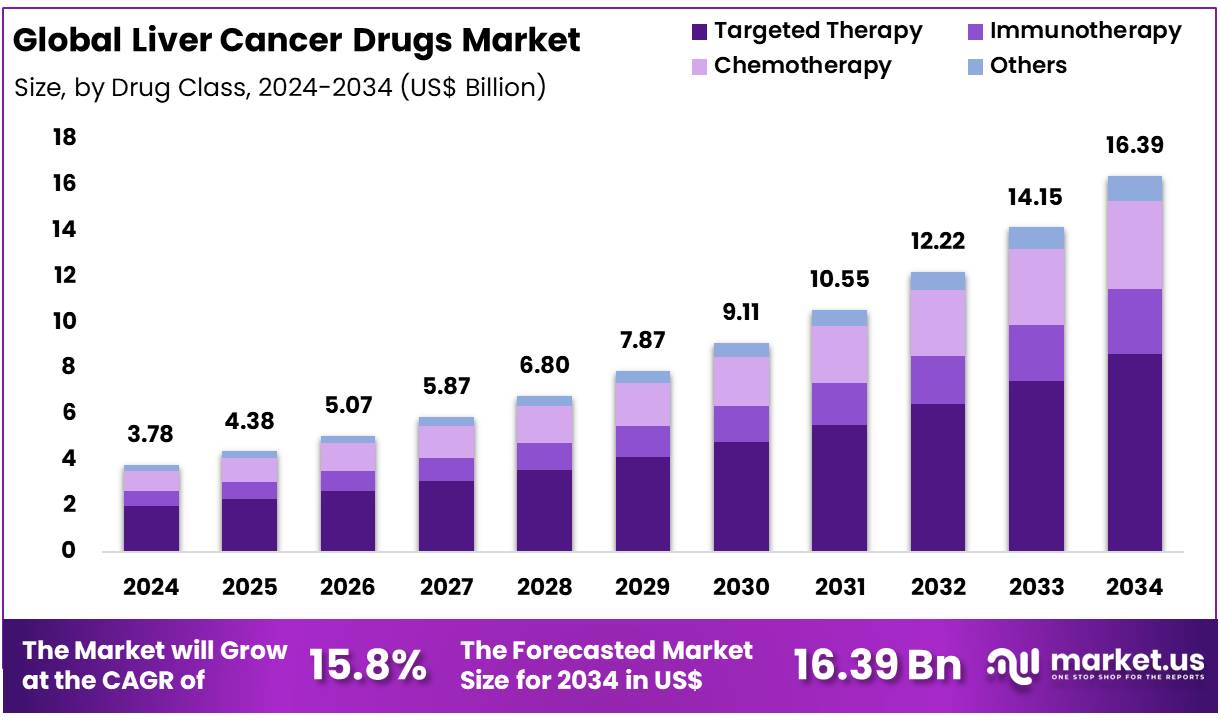
However, the high cost of treatments remains a key challenge, limiting access for patients in low- and middle-income countries. Despite this, the development of biosimilars and generic versions of existing drugs is expected to ease cost burdens in the coming years. As healthcare systems globally improve and more patients gain access to modern therapies, the liver cancer drugs market is projected to continue expanding, with an increasing focus on improving patient outcomes through more targeted and efficient treatment strategies.
Food and Drug Administration (FDA) has approved a number of drugs for liver cancer, below is the list:
| Dr. Mark Johnson, Senior Oncologist at Memorial Hospital, USA | Dr. Laura Adams, Clinical Investigator and Hepatology Specialist, UK | Dr. Richard Lee, Medical Director, Oncology Research Group, Germany | “Eisai’s Lenvima (lenvatinib) has become a key player in the treatment landscape for advanced liver cancer. It offers a potent option for patients, particularly when used in combination with immunotherapy. The combination of Lenvima with Pembrolizumab (Keytruda) has shown exceptional results in clinical trials, positioning Eisai as a leader in combination therapies. Lenvima’s approval as a first-line treatment for hepatocellular carcinoma has made it a first-choice drug in many oncology centers, and the data supporting its efficacy continues to grow.” |
|---|
Recent Developments
- In December 2024, Medivir AB, a pharmaceutical company dedicated to developing innovative cancer treatments for high unmet medical needs, today announced the approval of its US Investigational New Drug (IND) application. This approval allows the evaluation of fostrox in combination with Lenvima, versus Lenvima alone, in a Phase 2b study for second-line advanced hepatocellular carcinoma (HCC).
- In September 2024, updated results from the HIMALAYA Phase III trial revealed that AstraZeneca’s Imfinzi (durvalumab) combined with Imjudo (tremelimumab) showed a sustained and clinically meaningful overall survival (OS) benefit at five years for patients with unresectable hepatocellular carcinoma (HCC) who had not previously received systemic therapy and were ineligible for localized treatment. These significant findings from the HIMALAYA trial will be presented today at the European Society for Medical Oncology (ESMO) Congress 2024 in Barcelona, Spain (presentation 947MO).
- In October 2022, the FDA approved the combination of tremelimumab (Imjudo, AstraZeneca) and durvalumab (Imfinzi, AstraZeneca) for the treatment of adult patients with unresectable hepatocellular carcinoma (HCC), the most common form of liver cancer.