

Report Overview
Global High Purity Alumina Market size is expected to be worth around USD 20.9 Billion by 2034, from USD 4.1 Billion in 2024, growing at a CAGR of 17.7% during the forecast period from 2025 to 2034. In 2024 North America held a dominant market position, capturing more than a 38.4%share, holding USD 0.7 Billion in revenue.
High Purity Alumina (HPA) is an extremely refined form of aluminum oxide, typically 99.99% (4N) pure or higher, valued for its superior chemical stability, hardness, electrical insulation, and thermal properties, making it essential for high-tech applications. The HPA market is driven by its critical role in advanced materials across electronics, LEDs, ceramics, and specialty glass applications.
- According to the SEMI, the industry association serving the global semiconductor and electronics design and manufacturing supply chain, in 2025, global advanced process capacity reached 982,000 wafers per month (wpm), with 2026 projected to be the first year to surpass 1 million wpm, with capacity reaching 1.16 million wpm.
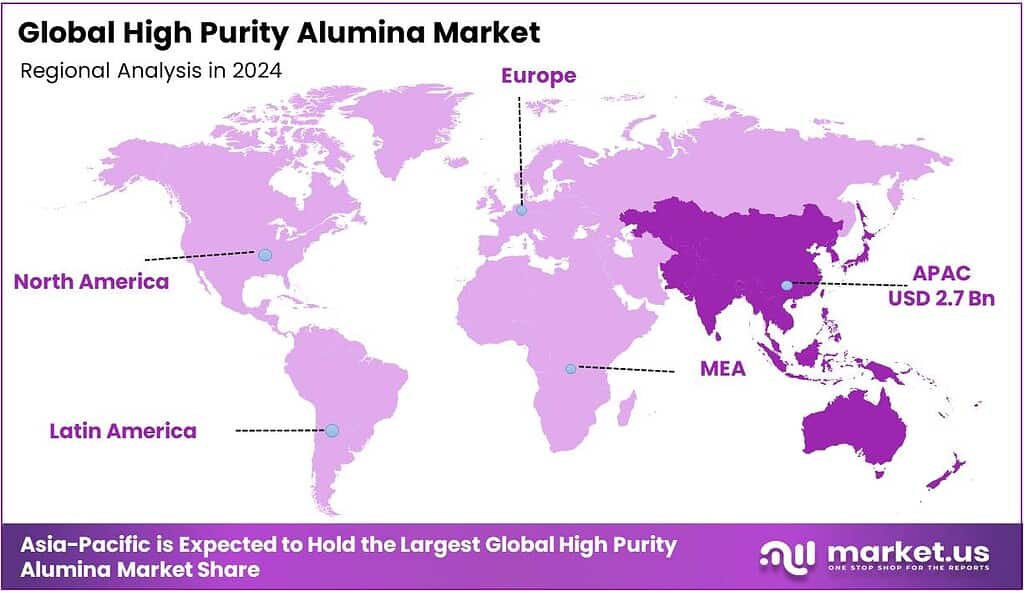
According to the International Energy Agency (IEA), China accounted for around 70% of total global EV production in 2024, supporting downstream battery-grade applications where alumina coatings enhance separator performance. Additionally, China built more than 7,000 advanced smart factories by 2025 and had become the world’s largest intelligent manufacturing application base. Similarly, the government initiatives in the Asia Pacific illustrate institutional backing for regional supply chain development in HPA processing. These data collectively reinforce that Asia Pacific’s industrial structure and targeted public support underlie its status as the largest HPA market globally. Manufacturers of high purity alumina concentrate on technology development, supply-chain integration, and strategic partnerships to enhance competitiveness and market share. These firms focus on advancing proprietary production processes and capacity to meet stringent purity and performance specifications, including the expansion of high-purity alumina output. Additionally, strategic activities include securing long-term supply and distribution agreements with downstream partners, widening their product reach. Similarly, manufacturers prioritize capacity expansion and project financing supported by government and institutional backing to build new HPA facilities and bring advanced technologies into effect.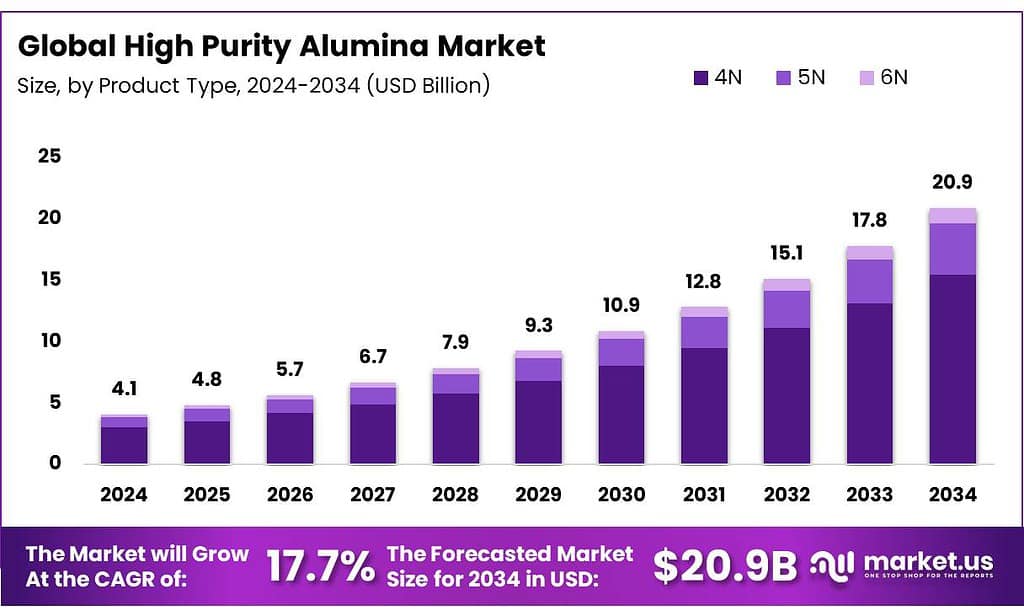
Key Regions and Countries
Key Players Analysis
The Major Players in The Industry
Key Development