

Report Overview
The Global Laser Welding Machine Market size is expected to be worth around USD 5.6 Billion by 2035 from USD 3.2 Billion in 2025, growing at a CAGR of 5.7% during the forecast period 2026 to 2035.
Laser welding machines utilize focused laser beams to join materials through controlled thermal energy. These advanced systems deliver precise, high-quality welds with minimal heat-affected zones. Moreover, they enable non-contact processing that reduces contamination risks and mechanical stress on components.
Rising labor costs and skilled welder shortages accelerate automation adoption across global manufacturing facilities. Companies invest in robotic laser welding cells to maintain competitive production capabilities. Therefore, automated laser welding technology becomes essential for manufacturers seeking operational excellence and market competitiveness. Laser welding requires precise control of multiple interdependent parameters including power, speed, and focal position. Inexperienced operators struggle to optimize settings for different materials and joint configurations. Consequently, manufacturers face extended learning curves and potential quality issues during initial implementation phases. Process development demands significant engineering expertise and iterative testing to achieve desired weld characteristics. Material variations and design changes necessitate parameter adjustments that challenge production consistency. Additionally, limited in-house technical knowledge forces companies to rely on external consultants and equipment suppliers. High initial investment costs for training programs and process development deter smaller manufacturers from adoption. Companies must balance equipment expenses with ongoing workforce development and technical support requirements. Therefore, technical complexity creates barriers particularly for small and medium enterprises entering laser welding markets. Electronics miniaturization drives demand for precision welding technologies capable of joining microscopic components. Laser systems enable controlled energy delivery essential for micro-scale applications without thermal damage. Moreover, medical device manufacturers increasingly adopt laser welding for miniaturized implantable devices and surgical instruments. Growing Internet of Things and wearable technology markets create new opportunities for micro-welding applications. These emerging sectors require hermetic sealing and reliable electrical connections in compact form factors. Additionally, sensor manufacturing and semiconductor packaging utilize laser welding for precise component assembly. Battery technology advancement for electric vehicles and energy storage demands sophisticated joining techniques. Laser welding addresses critical requirements for thin foil materials and thermal-sensitive connections in battery cells. Therefore, expanding microfabrication applications position laser welding as essential technology for next-generation manufacturing processes. Manufacturing facilities increasingly implement intelligent monitoring systems for real-time weld quality assessment and control. Smart sensors detect process variations and automatically adjust parameters to maintain optimal welding conditions. Consequently, manufacturers achieve unprecedented consistency and reduce defect rates throughout production operations. Digital twin technology enables virtual process simulation before physical production implementation. Engineers optimize welding parameters through computational modeling that predicts thermal behavior and joint characteristics. Moreover, simulation-based approaches significantly reduce development time and material costs during process qualification phases. Hybrid laser welding techniques combine multiple energy sources to expand process capabilities and material compatibility. These innovative approaches address challenges in dissimilar material joining and thick section welding. Therefore, technological convergence creates new application possibilities and competitive advantages for early adopters. Asia Pacific commands the largest market position with 38.1% share, valued at USD 1.21 Billion, driven by extensive manufacturing activity and automotive production. China, Japan, and South Korea lead regional adoption through government initiatives supporting advanced manufacturing technologies. Moreover, growing electronics production and electric vehicle manufacturing accelerate laser welding system deployment across the region. North America demonstrates strong market presence through aerospace, defense, and medical device manufacturing sectors. Advanced research facilities and technology leadership drive innovation in laser welding applications. Additionally, reshoring initiatives and automation investments support sustained market growth across United States and Canadian manufacturing industries. Europe maintains significant market share through automotive excellence and precision engineering capabilities. Germany leads regional adoption with established manufacturing infrastructure and Industry 4.0 initiatives. Furthermore, stringent quality standards and environmental regulations encourage laser welding technology adoption throughout European industrial sectors. Middle East and Africa exhibit emerging market potential through infrastructure development and industrial diversification efforts. Energy sector investments and shipbuilding activities drive laser welding adoption in Gulf Cooperation Council nations. However, market growth remains constrained by limited manufacturing infrastructure and technical expertise availability. Latin America shows gradual market development through automotive manufacturing and energy sector applications. Brazil and Mexico attract foreign manufacturing investments that incorporate advanced welding technologies. Nevertheless, economic volatility and capital constraints moderate the pace of laser welding system adoption across the region. North America Europe Asia Pacific Latin America Middle East & Africa TRUMPF Group maintains global leadership in laser technology through comprehensive product portfolios and continuous innovation investments. The company delivers integrated laser welding solutions for automotive, electronics, and medical device manufacturing sectors. Moreover, TRUMPF provides extensive technical support and training programs that enhance customer productivity and process optimization capabilities across diverse industrial applications. IPG Photonics Corporation specializes in high-power fiber laser systems that deliver superior performance and reliability. Their advanced photonics technology enables efficient energy conversion and exceptional beam quality for demanding welding applications. Additionally, IPG focuses on expanding market presence through strategic partnerships and development of application-specific laser solutions. Han’s Laser Technology Group represents Asia’s leading laser equipment manufacturer with extensive domestic and international market presence. The company offers cost-competitive solutions that address diverse industrial welding requirements across multiple sectors. Furthermore, Han’s Laser invests significantly in research development to advance laser technology capabilities and expand application portfolios. Coherent Corp. provides precision laser systems and components for scientific, industrial, and commercial applications worldwide. Their laser welding solutions emphasize process control and quality consistency for high-reliability manufacturing operations. Consequently, Coherent serves demanding aerospace, medical, and semiconductor sectors requiring stringent performance standards and traceability.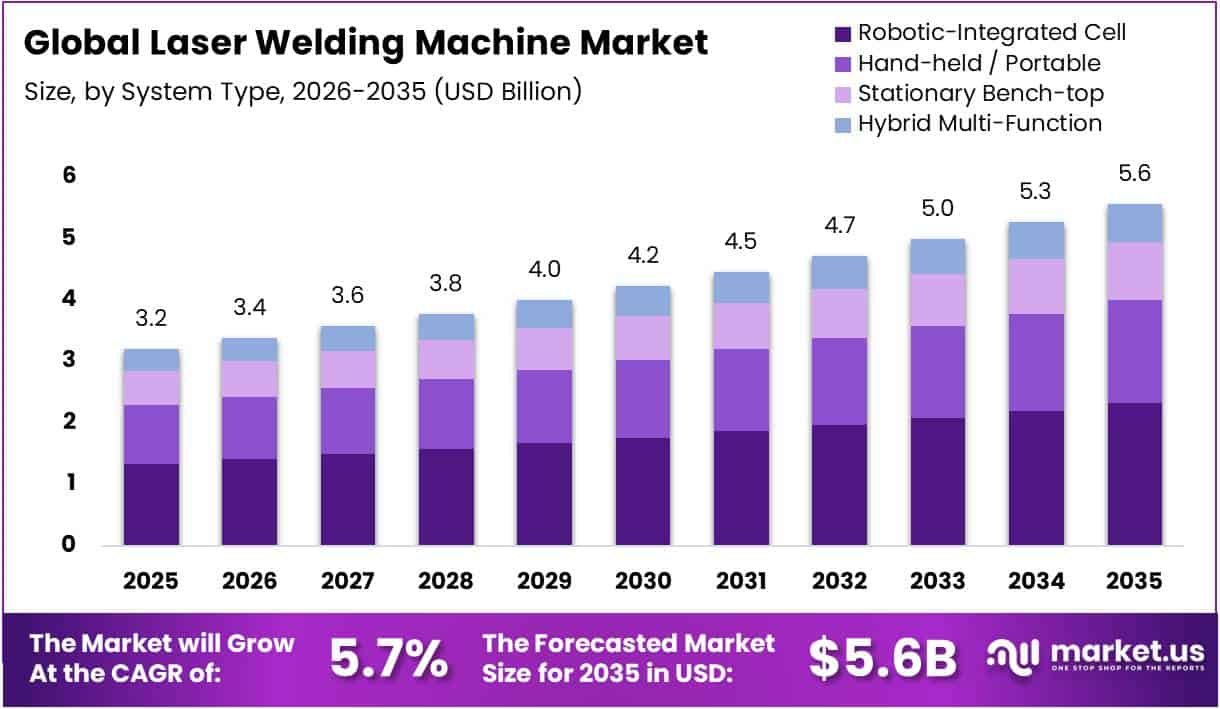
Restraints
Technical Complexity in Process Parameter Optimization Limits Market Adoption
Growth Factors
Expanding Application Scope in Microfabrication and Miniaturized Components Accelerates Market Expansion
Emerging Trends
Integration of Smart Sensors for Enhanced Weld Quality Consistency Reshapes Market Landscape
Regional Analysis
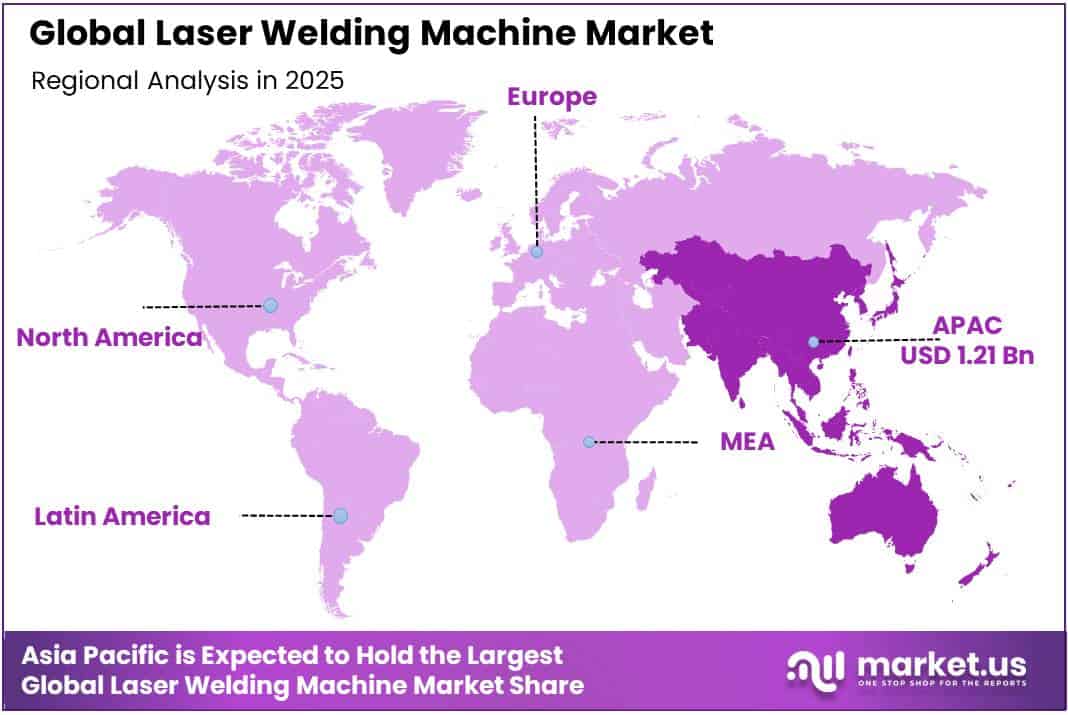
Asia Pacific Dominates the Laser Welding Machine Market with a Market Share of 38.1%, Valued at USD 1.21 Billion
North America Laser Welding Machine Market Trends
Europe Laser Welding Machine Market Trends
Middle East & Africa Laser Welding Machine Market Trends
Latin America Laser Welding Machine Market Trends
Key Regions and Countries
Key Company Insights
Key players
Recent Developments