

Report Overview
Global Industrial Diagnostic Tools Market size is expected to be worth around USD 67.3 Billion by 2035 from USD 44.2 Billion in 2025, growing at a CAGR of 4.3% during the forecast period 2026 to 2035.
Industrial diagnostic tools enable manufacturers to monitor equipment health and prevent costly failures in production environments. These specialized instruments include vibration analyzers, thermal imaging cameras, ultrasonic testers, and portable spectrum analyzers. Companies deploy these technologies to detect mechanical anomalies, electrical issues, and structural defects before catastrophic breakdowns occur in critical assets.
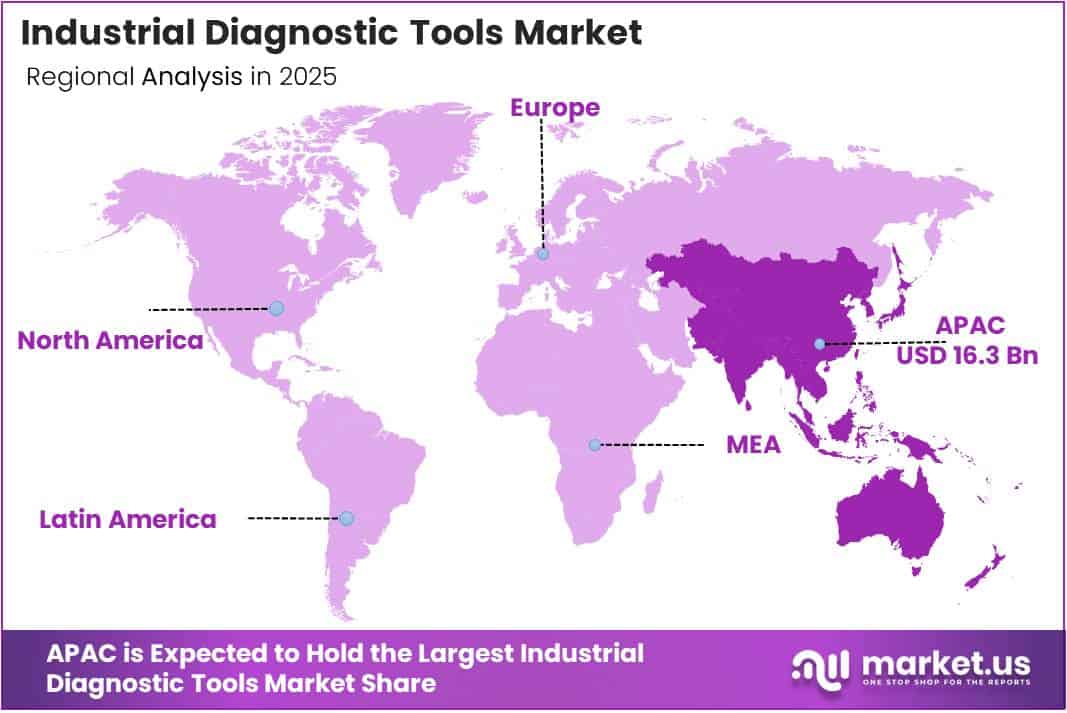
In June 2025, Sensirion Connected Solutions acquired Kuva Systems to expand its methane emissions monitoring and industrial IoT sensing capabilities. This consolidation demonstrates market convergence between environmental compliance and equipment diagnostics. Moreover, according to ArXiv, IoT-enabled smart manufacturing systems can lead to an 18% reduction in energy consumption and a 22% decrease in machine downtime, validating smart factory investments. Manufacturers pursue comprehensive digitalization strategies that unify diagnostic data with enterprise resource planning systems. Cloud platforms enable centralized monitoring across geographically distributed facilities and supply chain partners. Consequently, organizations achieve holistic visibility into asset performance and production efficiency metrics. Artificial intelligence transforms diagnostic capabilities from reactive monitoring to autonomous anomaly identification systems. Machine learning algorithms analyze historical data patterns to establish equipment baseline behaviors and detect deviations. Therefore, AI-powered tools reduce dependence on expert technicians for interpretation tasks. According to KTVZ, 35% of maintenance professionals say they use IIoT sensors extensively, with another 41% testing or considering them. Additionally, 32% of maintenance teams have fully or partially implemented AI solutions across maintenance processes, with 65% expecting to adopt AI in the next 12 months through 2026. Neural networks enable predictive models that forecast remaining useful life for critical components accurately. Deep learning architectures process vibration signatures, thermal images, and acoustic data simultaneously for comprehensive assessments. Moreover, according to ArXiv, advanced vibration and machine-learning diagnostic systems have achieved classification accuracy above 97% and mean errors below 1% for key metrics in predictive maintenance models. In 2025, Asia Pacific held a dominant position with 36.9% market share valued at USD 16.3 Billion. Rapid industrialization across China, India, and Southeast Asian nations drives diagnostic equipment adoption. Moreover, manufacturing expansion and infrastructure development create substantial demand for condition monitoring solutions throughout the region.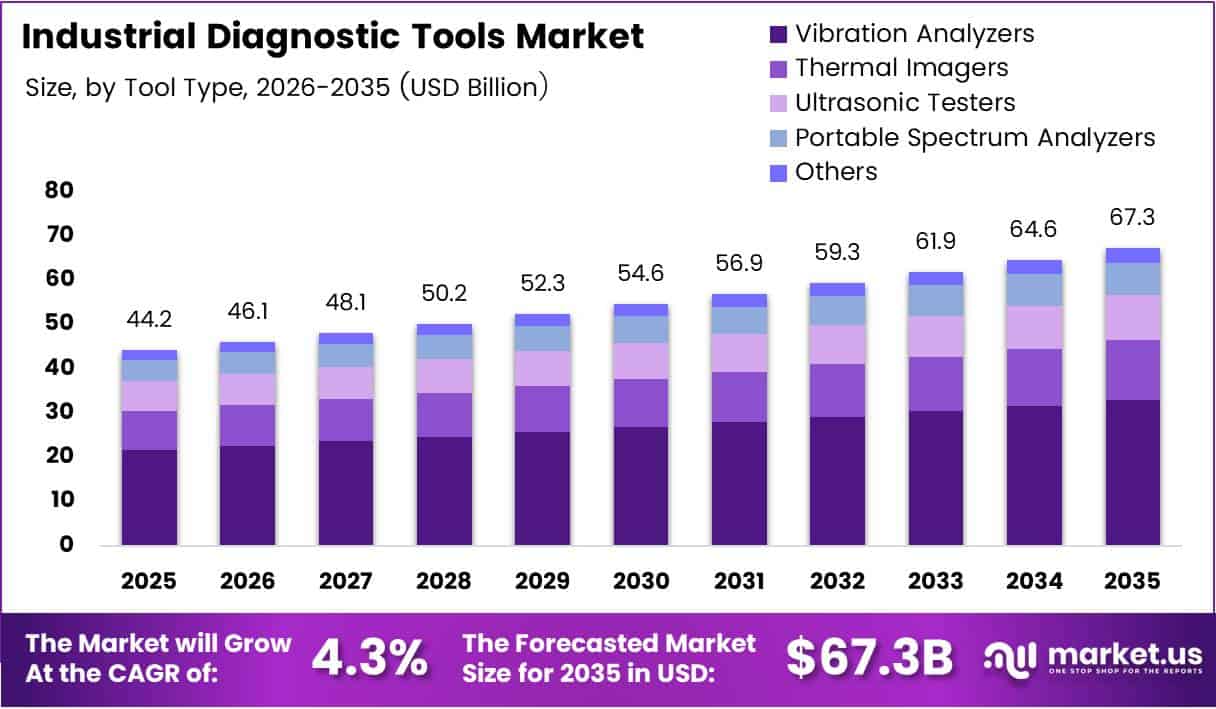
Emerging Trends
Integration of AI and Machine Learning for Automated Fault Detection and Root Cause Analysis
Regional Analysis
Asia Pacific Dominates the Industrial Diagnostic Tools Market with a Market Share of 36.9%, Valued at USD 16.3 Billion
Key players
Recent Developments