

Report Overview
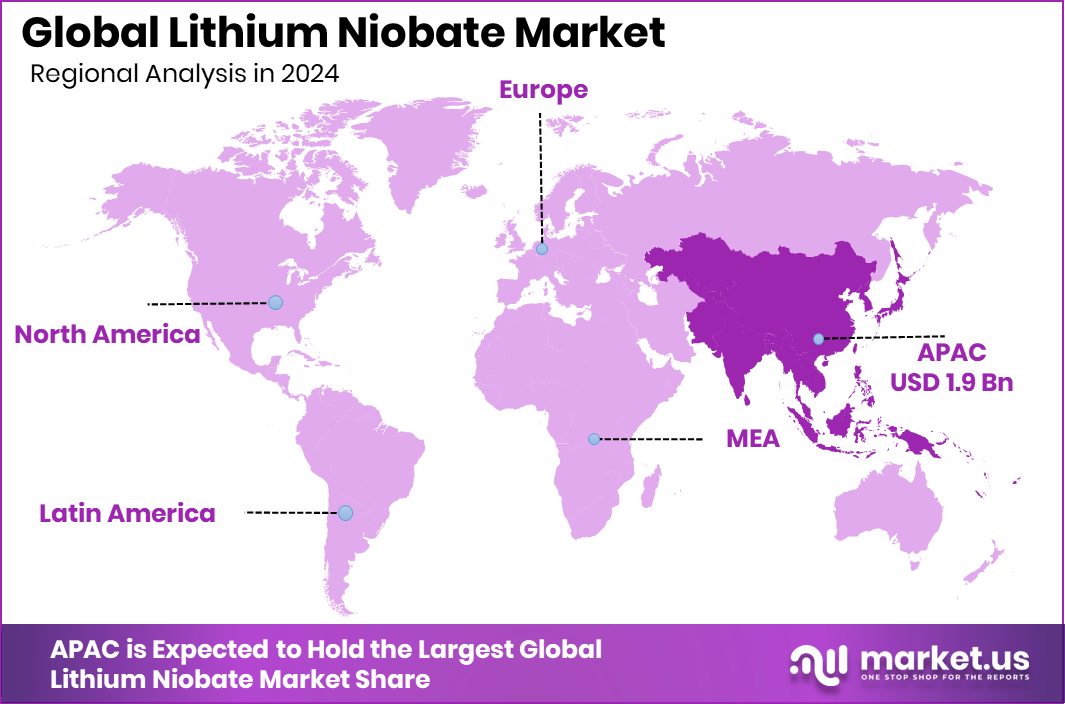
The Global Lithium Niobate Market is expected to be worth around USD 8.6 billion by 2034, up from USD 4.3 billion in 2024, and is projected to grow at a CAGR of 7.2% from 2025 to 2034. Demand for optical components kept Asia Pacific dominant at 45.6% and USD 1.9 Bn.
Lithium niobate is a widely used crystalline material known for its strong electro-optical, acousto-optical, and nonlinear optical properties. It enables functions such as modulation, frequency conversion, and precision wave control, making it essential in communication systems, sensing devices, and advanced photonics. The global Lithium Niobate Market covers forms such as powder, ingot, and wafer, along with grades used for electronic, industrial, and specialized applications.
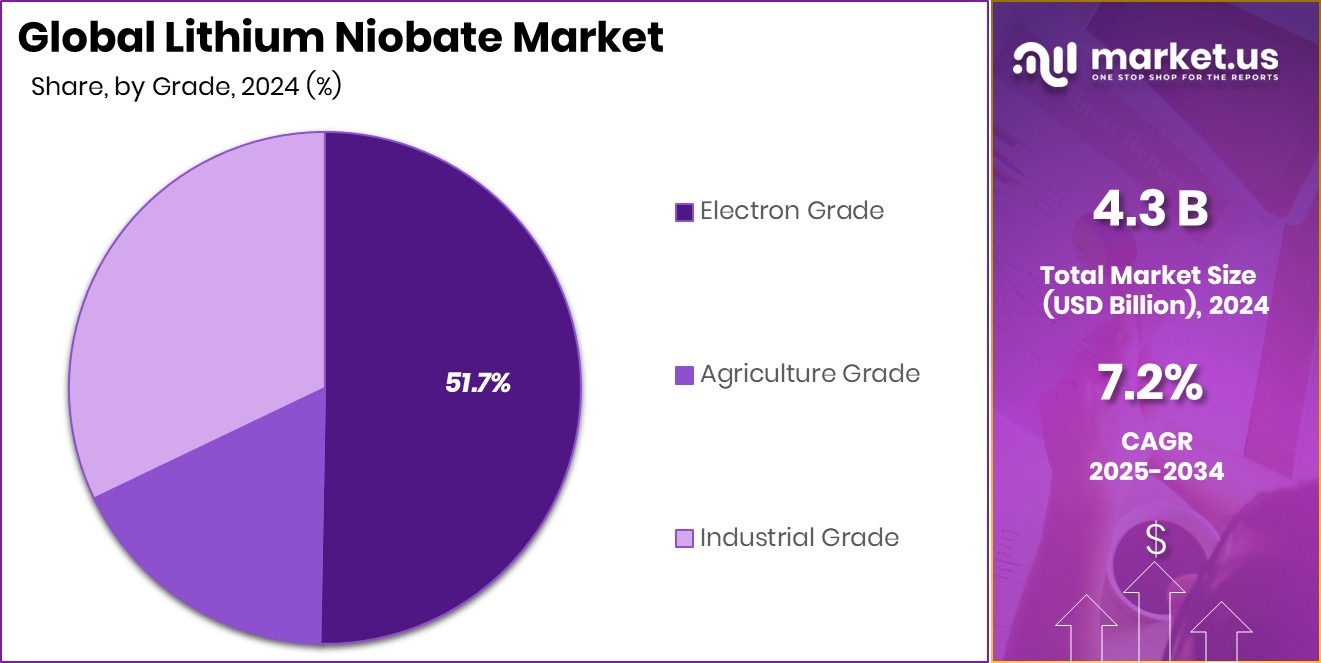
Research support also contributes to market expansion. Twelve HKU projects received HK$72 million under RGC schemes, reinforcing innovation in optical sciences. Meanwhile, HyperLight secured $37 million to advance lithium niobate technologies, reflecting strong commercial confidence. The Lithium Niobate Market sees wafer form dominating with 56.9% share globally today. In 2024, the lithium niobate market saw wafer form dominating with a strong 56.9% share, driven by its widespread use in optical communication and integrated photonics. Wafer-based lithium niobate continues to gain momentum because it supports high-precision fabrication of modulators, frequency converters, and resonators essential for next-generation telecom systems. Its excellent electro-optical properties make it preferred in 5G infrastructure and high-speed data centers. Moreover, the shift toward compact photonic chips increased demand for wafer-level processing, strengthening this segment’s position. Manufacturers are also investing in thin-film technologies to improve performance while lowering production costs, further supporting wafer growth. As telecom operators upgrade networks, wafer-grade lithium niobate remains the backbone of high-speed optical devices. In this market, electron-grade materials hold a strong 51.7% overall share. In 2024, electron-grade lithium niobate accounted for 51.7%, emerging as the leading grade due to its exceptional purity and superior electro-optic efficiency. This grade is crucial for applications requiring precision performance, including quantum communication, nonlinear optics, and advanced signal processing. The global push for faster data transfer and high-bandwidth communication significantly boosted demand for electron-grade crystals. Its ability to deliver low optical loss and enhanced stability makes it the preferred material for high-end photonic components. As industries focus on next-generation modulators and frequency doublers, electron-grade lithium niobate continues to play a pivotal role. Increasing R&D funding in photonic integrated circuits further solidifies the dominance of this high-purity grade across global markets. Increasing use of integrated photonic circuits A key trend shaping the Lithium Niobate Market is the accelerating use of integrated photonic circuits. These compact systems merge multiple optical functions into a single platform, improving speed, efficiency, and power use for communication and sensing applications. Investment activity further validates this shift. Photonics chip manufacturer Infinera secured USD 93 million in new funding, reinforcing market interest in advanced integrated photonics. Such financial support helps accelerate research, manufacturing capability, and the commercialization of lithium-niobate-based circuits. As integrated photonics gains adoption in telecom and computing, lithium niobate continues to play a crucial role in enabling high-performance optical functions. Asia Pacific led the Lithium Niobate Market with 45.6%, reaching USD 1.9 Bn. In the Lithium Niobate Market, Asia Pacific stood out as the dominant region, securing a strong 45.6% share valued at USD 1.9 Bn, supported by rising optical communication deployments and expanding photonics manufacturing. North America continued to show steady demand driven by telecom upgrades, growing adoption of high-speed modulators, and increased integration of advanced electro-optic components in communication networks. Europe maintained consistent growth as industries strengthened investments in optical systems and signal-processing technologies, sustaining regional momentum. Meanwhile, the Middle East & Africa observed a gradual uptake as data infrastructure evolved in emerging economies, supporting the need for optical materials. Latin America demonstrated moderate progress, supported by telecom modernization and the gradual adoption of photonic technologies across developing markets. In 2024, Sumitomo Metal Mining continued strengthening its position in the global Lithium Niobate Market by leveraging its long-standing expertise in advanced materials and precision crystal growth. The company’s capability to manufacture high-purity lithium niobate crystals supported the growing demand for optical modulators, frequency converters, and integrated photonic components. Its disciplined production approach, combined with a strong materials science foundation, helped ensure a stable supply for telecom and industrial photonics clients seeking consistent electro-optical performance. At the same time, Coherent Corp. played a crucial role in shaping technological adoption across high-performance optical systems. Known for its innovation in electro-optical devices and photonic integration, the company expanded its use of lithium niobate across communication equipment requiring fast modulation speeds and reduced signal loss. Coherent’s engineering depth enabled it to meet rising expectations for next-generation telecom networks and precision sensing platforms. Meanwhile, CASTECH remained a key supplier of lithium niobate crystals through its specialization in crystal growth and optical component fabrication. Its ability to deliver tailored crystal specifications supported applications in lasers, nonlinear optics, and high-frequency communication systems. CASTECH’s strong manufacturing discipline and customization capability allowed it to serve a broad end-user base seeking reliable, application-ready lithium niobate components.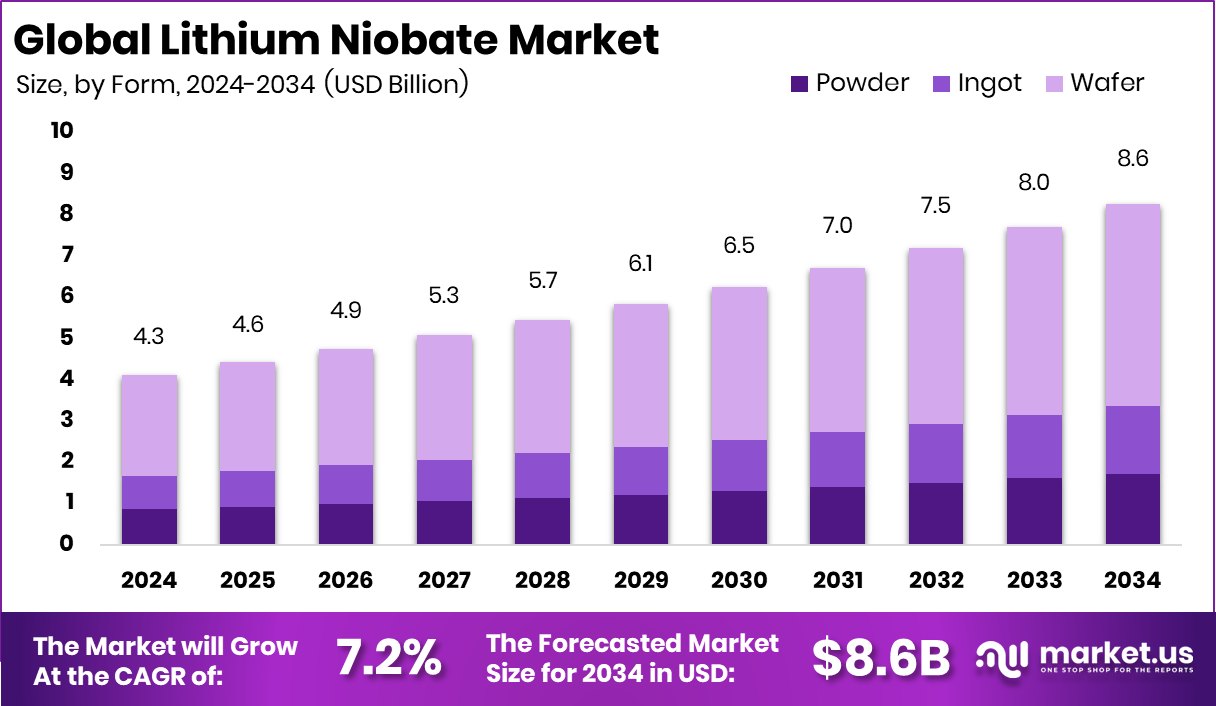
Key Takeaways
By Form Analysis
By Grade Analysis
Latest Trends
Regional Analysis
Key Regions and Countries
Key Players Analysis
Top Key Players in the Market
Recent Developments