

Report Overview
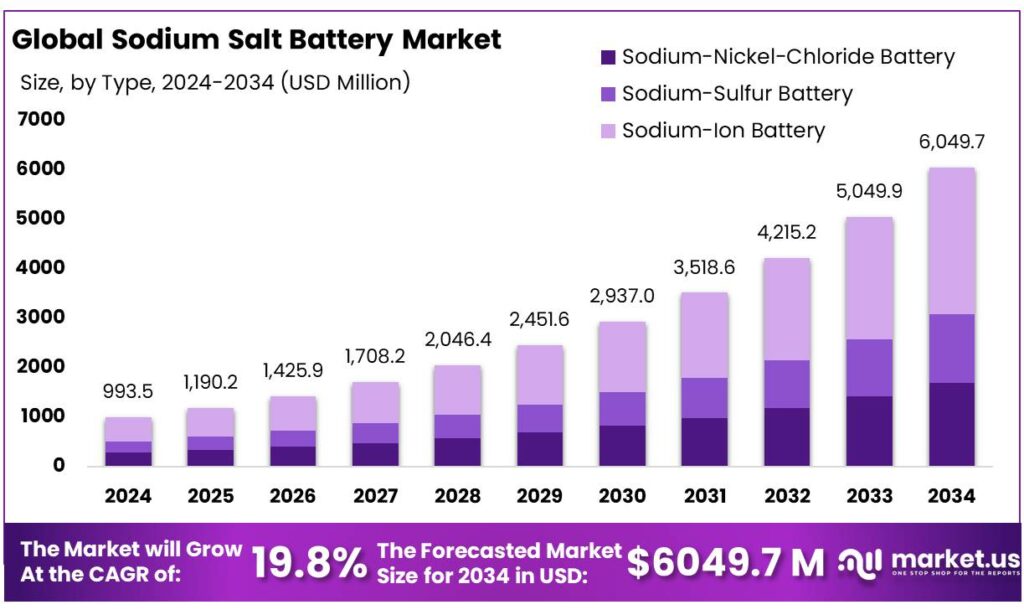
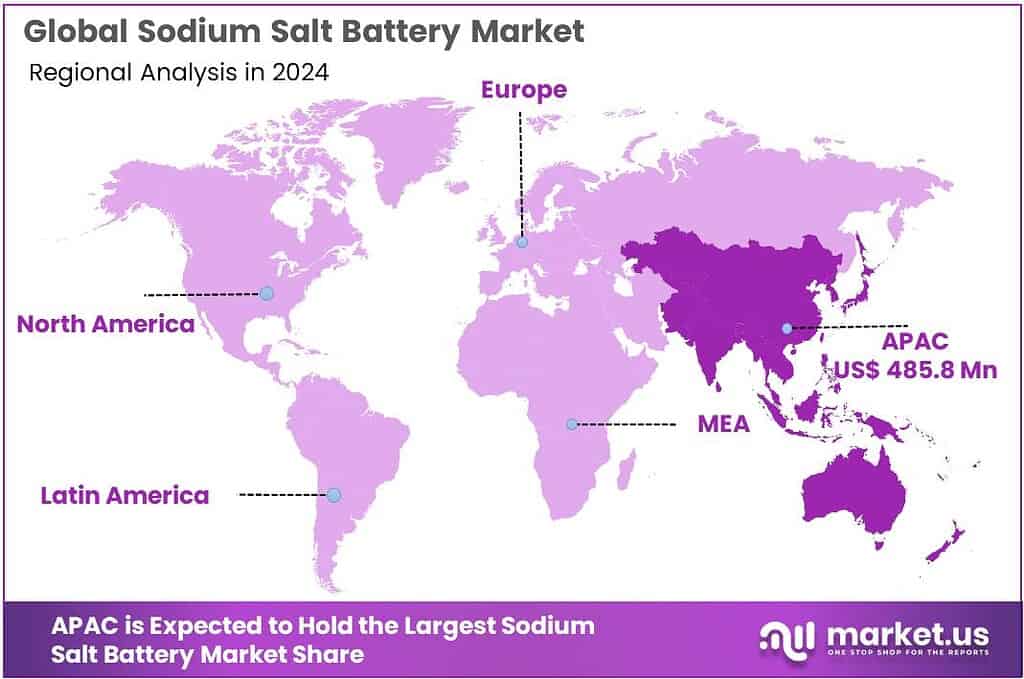
The Global Sodium Salt BatteryMarket is expected to be worth around USD 6049.7 Million by 2034, up from USD 993.5 Million in 2024, and is projected to grow at a CAGR of 19.8%, from 2025 to 2034. Asia Pacific accounted for 48.9%, reaching USD 485.8 Mn.
The sodium salt battery industry – typically referring to sodium-ion and sodium-sulfur systems that use sodium salts as charge carriers – is emerging as one of the most credible alternatives to lithium-ion in stationary storage and selected mobility segments.
- The technology benefits from the abundance of sodium and the ability to reuse much of the existing lithium-ion manufacturing footprint, positioning it well as global battery storage scales. Global battery storage capacity grew by about 120% in 2023 to reach 55.7 GW, with China alone rising to 27.1 GW and the United States to 16.2 GW, underscoring the scale of the addressable market for lower-cost chemistries such as sodium salt batteries.
 USD 580 billion in 2025, reinforcing why backup power and grid flexibility are becoming board-level priorities.
Public-sector support strengthens this growth path by accelerating scale-up from pilots to repeatable manufacturing. In the United States, Argonne National Laboratory described a $50 million consortium effort to develop sodium-ion batteries as a lower-cost, more sustainable alternative and improve technology readiness. The U.S. Department of Energy also released a funding opportunity of $15.7 million to improve manufacturability and scalability of next-generation storage options, explicitly including sodium-ion batteries.
Regional Insights
Asia Pacific dominates with 48.9% share and USD 485.8 Mn, backed by unmatched battery manufacturing scale
Asia Pacific is the dominating region in the Sodium Salt Battery market, holding 48.9% share and reaching USD 485.8 Mn. The region’s lead is strongly linked to its deep battery industrial base, where cell manufacturing, materials processing, and system integration sit close together, reducing cost and speeding up commercialization for newer chemistries such as sodium-salt. The International Energy Agency notes that China has almost 85% of global battery cell production capacity, which gives Asia Pacific a practical advantage in scaling alternative battery platforms once they pass performance validation.
On the demand side, Asia Pacific benefits from both mobility and grid drivers that create steady pull for storage technologies. The IEA reports over 11 million electric cars were sold in China in 2024, and electric cars accounted for almost half of all car sales in the country—an indicator of how large and investment-ready the regional battery ecosystem has become. While sodium batteries are not yet the main EV chemistry, this manufacturing momentum supports faster learning curves, supplier readiness, and cost-down pathways for sodium-based products.
Key Regions and Countries Insights
- North America
- US
- Canada
- Europe
- Germany
- France
- The UK
- Spain
- Italy
- Rest of Europe
- Asia Pacific
- China
- Japan
- South Korea
- India
- Australia
- Rest of APAC
- Latin America
- Brazil
- Mexico
- Rest of Latin America
- Middle East & Africa
- GCC
- South Africa
- Rest of MEA
Key Players Analysis
NGK is a long-standing stationary storage supplier with sodium-based technology experience, which supports its positioning as sodium-salt batteries scale beyond pilots. In FY2024 (ended March 31, 2025), NGK reported ¥619.513B net sales, ¥81.241B operating income, and ¥54.933B profit attributable to owners of the parent, indicating financial headroom for manufacturing and product investment. Its sustainability reporting also lists 19,540 employees (as of March 31, 2024), supporting global production and service coverage.
Altech Batteries is advancing sodium-chloride solid-state concepts for stationary use, positioning itself around safety and supply-chain simplicity. For the year ended 30 June 2025, the company reported 24 permanent employees, signaling a lean development model. Its segment reporting shows Total Revenue of $176,490 (FY2025) and discloses 112,650,000 performance rights on issue at 30 June 2025, reflecting an incentive structure aligned with project milestones rather than large-scale commercialization today.
Faradion is an IP-driven sodium-ion technology player founded in 2011, with founders named publicly and a defined patent base. The company states its portfolio comprises 21 current patent families (including 8 granted), providing defensibility in cathode/anode/electrolyte and safety domains. A major strategic milestone was Reliance’s agreement to acquire 100% of Faradion for an enterprise value of £100M, alongside a planned £25M growth investment to accelerate rollout—an indicator of industrial backing for commercialization.
Top Key Players Outlook
- GE Energy
- NGK INSULATORS, LTD.
- Altech Batteries Ltd
- Faradion
- CATL
- HiNa Battery Technology Co., Ltd
- Altris
- Aquion Energy
- TIAMAT Energy
Recent Industry Developments
In 2025, GE Vernova reported $38.068B total revenues, $3.710B free cash flow, and $150.238B backlog, which signals a large pipeline of utility and grid projects where sodium-based storage can be bundled as an “affordable, safe” option when customers don’t need maximum energy density.
In 2025, Altech published further prototype progress, reporting 650+ charge–discharge cycles with no detectable capacity loss, up to 92% energy efficiency and near-100% coulombic efficiency for prototype cells; for the 60 kWh pack, it highlighted around 88% round-trip efficiency and 110+ cycles with no observable capacity fade under varied load profiles, including pulses up to 50 A.