

Report Overview
The Global Marine Lubricants Market is expected to be worth around USD 10.8 billion by 2035, up from USD 8.1 billion in 2025, and is projected to grow at a CAGR of 2.9% from 2026 to 2035. Asia Pacific maintains 49.4% share, pushing marine lubricants value toward USD 4.0 Bn.
Marine lubricants are specialized oils and fluids used to protect and maintain the moving parts of marine engines, hydraulic systems, compressors, and onboard machinery. They reduce friction, prevent corrosion, manage heat, and ensure smooth functioning even under heavy loads and long operating hours at sea. The Marine Lubricants Market covers the supply, demand, and development of these products across vessel categories such as bulk carriers, tankers, container ships, and others, segmented by base oil types—mineral, synthetic, and bio-based—and product types including engine oils, hydraulic fluids, and compressor oils.
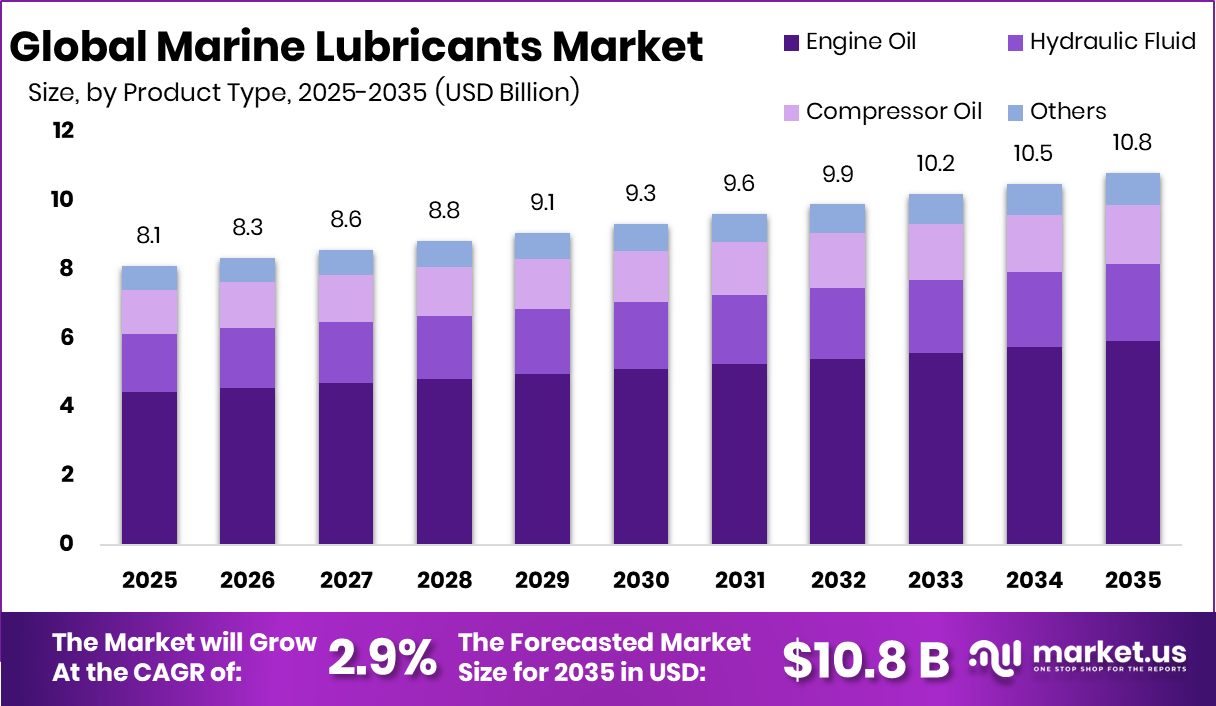 Stricter emission rules limit lubricant consumption.
Stricter global emission rules reduce lubricant usage by pushing ships toward cleaner fuels and newer engines that often require lower consumption volumes or optimized formulations. These environmental measures encourage operators to shift toward engines with tighter burn efficiencies, limiting the frequency of certain lubricant applications.
Additionally, market uncertainty increases as major companies adjust their portfolios, such as BP deciding to sell the majority stake of its $10bn Castrol lubricants business to reduce debt. This realignment contributes to caution across distributors and fleets that depend on stable supply chains. Regulatory pressure combined with corporate restructuring influences purchasing strategies and can delay bulk procurement, making these two forces key restraints on the Marine Lubricants Market.
Growth Opportunity
Expansion of eco-friendly lubricant formulations globally.
There is growing room for expansion in eco-friendly and high-performance lubricant formulations as vessel owners look for solutions that reduce environmental impact while supporting heavy-duty marine engines. The shift toward sustainability encourages suppliers to upgrade base-oil blends, improve additive packages, and develop bio-based alternatives for auxiliary and propulsion systems.
Growth sentiment is strengthened by clean-energy investments, including Motor Oil securing a €111.7m EU grant for a 50MW hydrogen project at a Greek refinery, which showcases rising regional focus on modernizing port-linked energy infrastructure. These developments support maritime transitions and open the door for advanced lubricants that align with cleaner operations. As fleets modernize, demand for environmentally improved fluids becomes a growing opportunity.
Latest Trends
Shift toward synthetic marine lubricant solutions.
The market continues to trend toward synthetic marine lubricant solutions, driven by their better oxidation resistance, longer service intervals, and ability to support engines operating under variable fuel regimes. More operators are shifting to high-performance synthetic blends to manage higher efficiency engines and unpredictable load cycles.
A parallel trend is the rise in hydrogen-related maritime investments, including the EU’s approval of €111.7m in state aid for Motor Oil Hellas to expand renewable hydrogen production. While hydrogen itself is a fuel transition pathway, such investments encourage technological upgrades in vessels and supporting infrastructure, further increasing the relevance of modern synthetic lubricants. These shifts define the evolving direction of the Marine Lubricants Market.
Regional Analysis
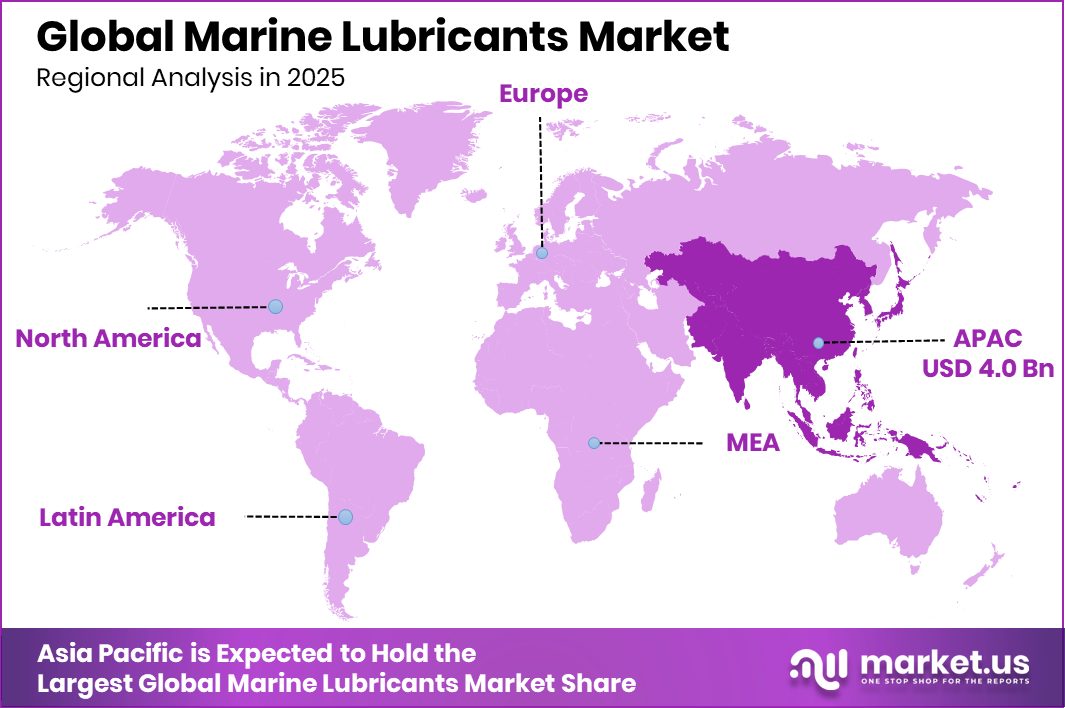
Asia Pacific holds 49.4% market share, driving marine lubricants demand to USD 4.0 Bn.
In 2025, the Marine Lubricants Market shows steady regional variation across North America, Europe, Asia Pacific, the Middle East & Africa, and Latin America, with each region influenced by fleet size, port activity, and vessel maintenance cycles.
Asia Pacific remains the dominant region, holding 49.4% of the market and reaching USD 4.0 Bn, supported by large commercial fleets and major shipping hubs. North America sees stable demand due to strong maritime trade on both the Atlantic and Pacific coasts, while Europe maintains consistent consumption driven by active cargo movement and established port infrastructure.
The Middle East & Africa region benefits from continuous marine traffic linked to energy exports and strategic waterways, contributing to steady lubricant usage. Latin America experiences moderate growth, supported by increasing port modernization and expanding bulk carrier operations.
Across all regions, the reliance on marine lubricants remains tied to vessel maintenance spending, operational hours, and the ongoing importance of marine transportation in global trade flows.
Key Regions and Countries
- North America
- US
- Canada
- Europe
- Germany
- France
- The UK
- Spain
- Italy
- Rest of Europe
- Asia Pacific
- China
- Japan
- South Korea
- India
- Australia
- Rest of APAC
- Latin America
- Brazil
- Mexico
- Rest of Latin America
- Middle East & Africa
- GCC
- South Africa
- Rest of MEA
Key Players Analysis
In 2025, BP p.l.c. continues to strengthen its role in the Marine Lubricants Market by focusing on performance-driven formulations aligned with operational reliability. The company remains known for supplying marine oils designed for heavy-duty engine protection, helping fleets manage long operational hours and varying fuel qualities. Its continued emphasis on dependable lubrication solutions keeps it well-positioned among ship operators looking for consistency and efficient maintenance planning across global trade routes.
Chevron Corporation maintains a strong market presence by leveraging its long-standing expertise in lubricant chemistry and its established distribution network. The company continues to support marine customers with oils built to reduce engine wear, stabilize viscosity, and support durable performance in demanding maritime environments. Its product focus remains aligned with vessel operators that require a reliable lubricant supply across major ports, reinforcing its credibility in the marine operational ecosystem.
Exxon Mobil Corporation retains a leading position by emphasizing high-performance marine lubricants designed for both modern and legacy marine engines. In 2025, the company continues to meet customer needs through formulations that support engine cleanliness, efficient combustion, and lower maintenance downtime. Its strong brand reputation and technical support offerings help it remain a preferred partner for fleets seeking proven solutions that match long-haul shipping demands and global operational consistency.
Top Key Players in the Market
- BP p.l.c.
- Chevron Corporation
- Exxon Mobil Corporation
- Shell plc
- TotalEnergies SE
- Petronas
- LUKOIL
- Idemitsu Kosan Co., Ltd
- China Petroleum & Chemical Corporation
- ENEOS Holdings, Inc.
Recent Developments
- In May 2025, BP started the formal sale process of its global lubricants division, Castrol, which produces engine oils and industrial lubricants used in marine, automotive, and industrial sectors. This strategic move aimed to refocus BP’s business and reduce debt by selling a major portion of its lubricants operations. The potential transaction was valued at around US$10 billion, making it one of the company’s largest divestments. This step reflects BP’s shift in priorities towards its core energy operations while still maintaining a presence through specialty products.
- In November 2024, Chevron Marine Lubricants, part of Chevron Corporation, expanded its global supply network to include Port Elizabeth in South Africa. This step means ships calling at this major port will now have better access to Chevron’s marine lubricant products, including popular engine oils like the Taro Ultra range. The move supports vessels taking longer routes around southern Africa and improves Chevron’s service and reliability in a key Southern Hemisphere port.