

Report Overview
Global Skin Tightening Products Market size is expected to be worth around USD 2,915.7 Million by 2035 from USD 964.3 Million in 2025, growing at a CAGR of 11.7% during the forecast period 2026 to 2035.
The skin tightening products market covers topical formulations — including creams, serums, and face oils — designed to firm skin, stimulate collagen production, and reduce visible signs of aging. These products sit at the intersection of cosmetics and cosmeceuticals, where clinical efficacy increasingly defines purchase decisions rather than brand familiarity alone.
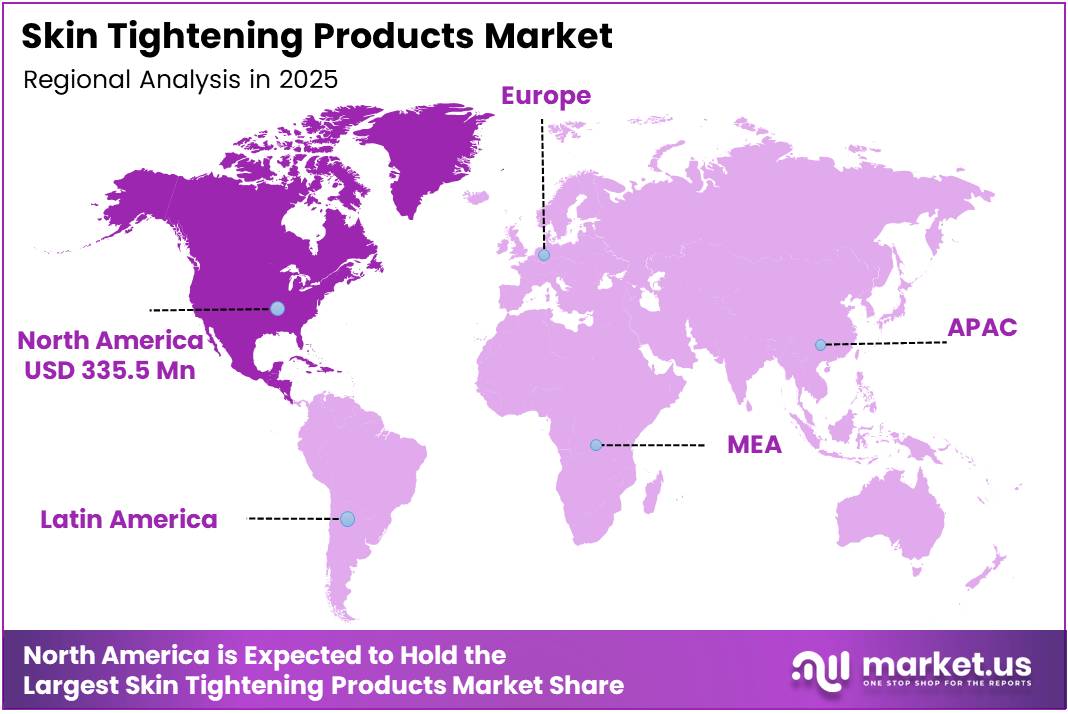
Consumer preference for clean-label, dermatologically tested skin tightening products reflects a broader shift in purchase criteria — from fragrance and texture to ingredient transparency and safety documentation. Brands that publish clinical testing data and third-party dermatologist validation capture the trust premium that marketing spend alone cannot buy, particularly among buyers researching purchases through digital channels. Multi-functional creams that combine hydration, lifting, and UV protection reduce the step-count in skincare routines while maintaining efficacy expectations. This format resonates with time-constrained urban consumers who previously required three separate products. According to findyourbeautiful.com, Ultherapy PRIME treatments are 20% faster than prior versions while delivering equivalent lifting results — a device-side efficiency benchmark that topical multi-functional formats are now competing against in consumer preference surveys. Sustainable packaging adoption in premium skincare lines signals a shift in brand positioning strategy. Consumers purchasing premium skin tightening products increasingly factor environmental credentials into their choice. Additionally, home-use skin tightening devices now complement topical products rather than compete with them, creating bundle opportunities where a serum or cream becomes a prescribed companion to a personal RF or ultrasound device — expanding the total transaction value per skin tightening buyer. North America leads with a 34.80% share valued at USD 335.5 Million in 2025. The region’s dominance reflects mature consumer skincare spending habits, strong dermatologist-recommended product ecosystems, and early adoption of cosmeceutical ingredients. The US market, in particular, supports premium price points that sustain high revenue concentration relative to volume. Europe represents the second-largest market, supported by stringent cosmetic ingredient regulations that paradoxically raise consumer trust. Buyers in Germany, France, and the UK associate regulatory compliance with product safety, making certified formulations a commercial advantage. Premium anti-aging brand heritage across Western Europe also supports above-average spending per unit. Asia Pacific presents the fastest-expanding consumer base for skin tightening formulations. China, South Korea, and Japan lead regional consumption, driven by high beauty expenditure per capita and a cultural premium placed on youthful skin appearance. South Korea’s cosmeceutical innovation pipeline also positions APAC as a product development hub, not just a consumption market. Latin America’s market develops on the back of rising middle-class disposable income and increasing digital retail penetration. Brazil and Mexico anchor regional volume. In November 2025, Classys acquired JL Health (Brazil) for $13 million, securing exclusive HIFU device distribution rights across South America — signaling that global players now view the region as a strategic priority worth direct investment. The Middle East and Africa region records early-stage but consistent consumption growth in skin tightening products, concentrated within GCC countries where high per-capita income supports luxury cosmetics spending. Clinic-based aesthetic treatments remain the primary entry point for skin tightening awareness, creating downstream demand for topical maintenance products among post-treatment consumers. North America Europe Asia Pacific Latin America Middle East & Africa Neutrogena positions itself at the convergence of dermatology credibility and mass-market distribution, a combination that few competitors replicate effectively. Its clinical heritage — reinforced through dermatologist endorsements — allows Neutrogena to sustain premium pricing within supermarket and pharmacy channels where competing brands rely primarily on packaging. This dual-channel advantage creates a defensible volume and margin position simultaneously. Olay leverages decades of consumer trust data to target the anti-aging segment with science-backed formulations accessible at mass-market price points. Its Regenerist and Collagen Peptide lines directly address the skin firming category, competing on clinical ingredient credibility rather than luxury positioning. This strategy captures cost-sensitive buyers who demand visible results without premium pricing — a large and structurally stable segment. SkinCeuticals concentrates its competitive advantage in the professional and clinic-based distribution channel, where dermatologist recommendations drive purchase decisions rather than advertising. Products supported by antioxidant and collagen-stimulation science command significantly higher unit prices. This clinic-first model creates high brand loyalty and insulates SkinCeuticals from price competition in mass retail channels where ingredient storytelling is harder to execute. The Ordinary disrupted the premium skincare market by publishing ingredient concentrations transparently and pricing formulations at accessible levels, forcing legacy brands to justify their price premiums with comparable clinical evidence. Within skin tightening, its retinol and peptide products attract ingredient-educated consumers who would previously have purchased at two to five times the price point. This value-led positioning expands the category’s total consumer base.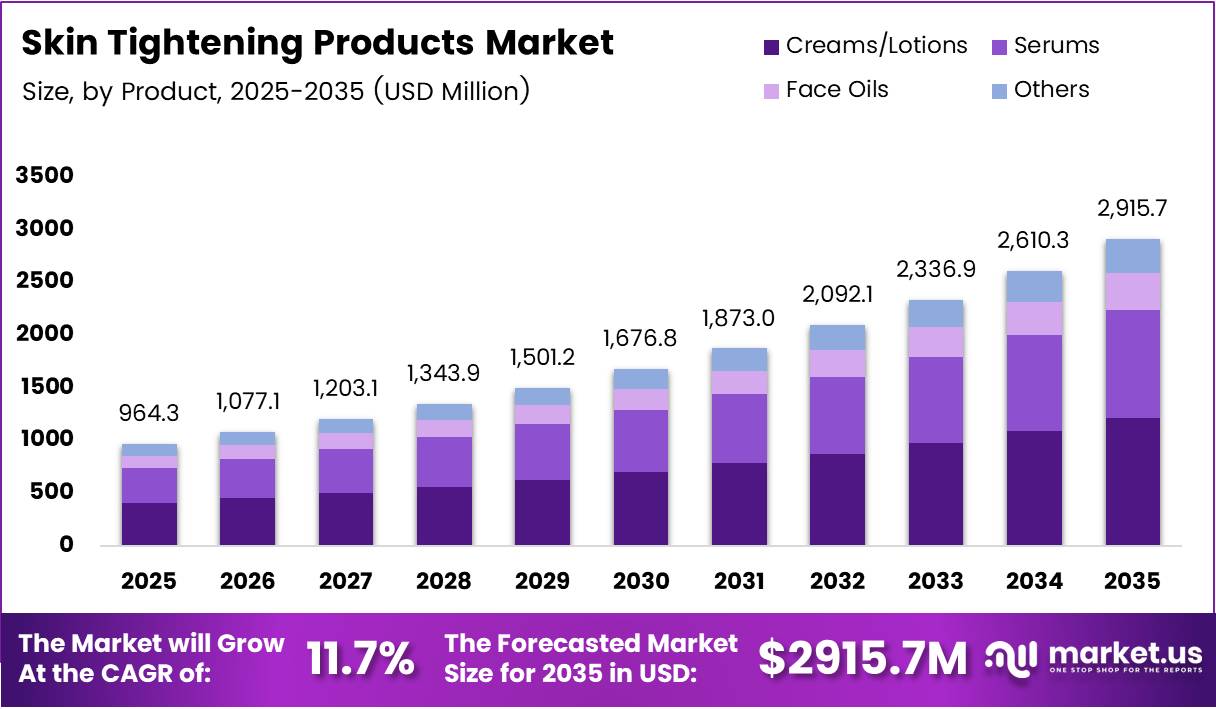
Emerging Trends
Clean-Label Formulations, Multi-Functional Products, and Device Complementarity Redefine the Skin Tightening Category
Regional Analysis
North America Dominates the Skin Tightening Products Market with a Market Share of 34.80%, Valued at USD 335.5 Million
Europe Skin Tightening Products Market Trends
Asia Pacific Skin Tightening Products Market Trends
Latin America Skin Tightening Products Market Trends
Middle East and Africa Skin Tightening Products Market Trends
Key Regions and Countries
Key Company Insights
Key Players
Recent Developments