

Report Overview
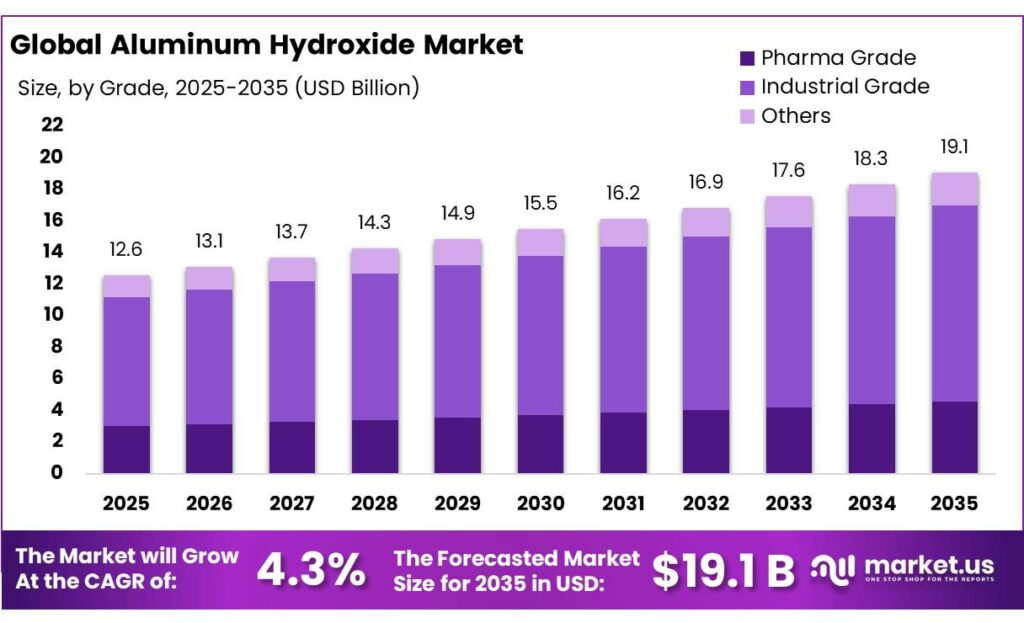
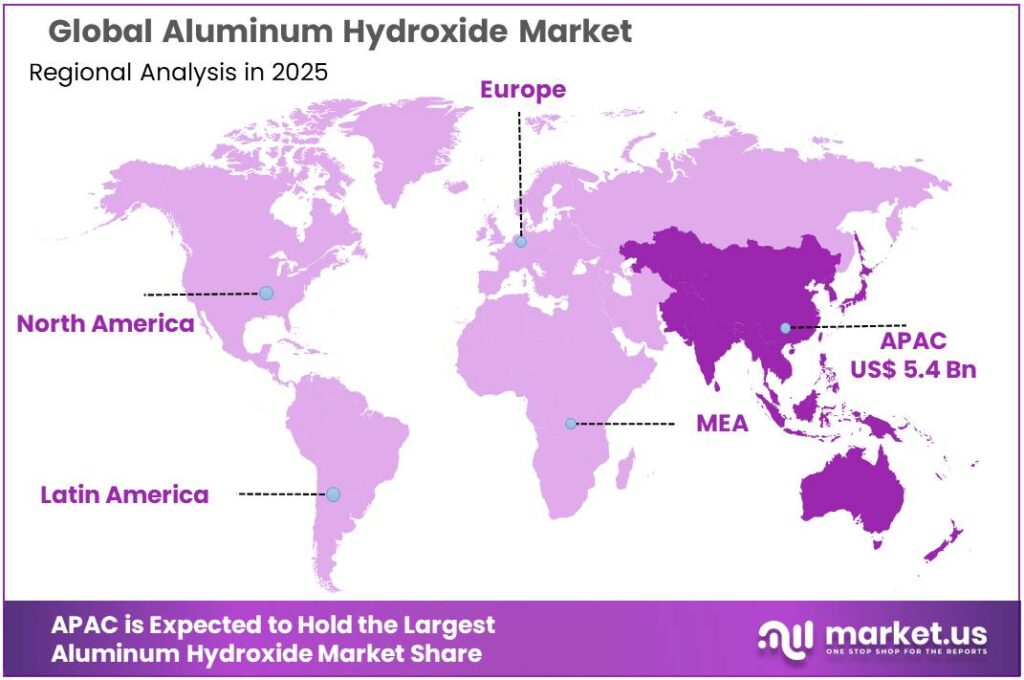
The Global Aluminum Hydroxide Market is expected to be worth around USD 19.1 Billion by 2035, up from USD 12.6 Billion in 2025, at a CAGR of 4.3% from 2026 to 2035. The Asia Pacific segment maintained 43.4%, supporting a Aluminum Hydroxide value of USD 5.4 Bn.
Aluminium hydroxide is positioned at the crossroads of mining, chemicals, pharmaceuticals and food processing. Industrially it is produced mainly as a hydrate intermediate in the Bayer process and then refined into alumina or specialty grades for flame-retardant fillers, antacids, water treatment and food additives.
- According to the U.S. Geological Survey, about 76% of mined bauxite is refined by the Bayer process into alumina or aluminium hydroxide, with the remainder going to cement, abrasives and other niche uses.
 13.2% food loss and 19% waste problem is likely to contain more aluminum-hydroxide-based cables, panels and coatings than the facilities they replace. Over time, this steady, regulation-backed shift toward food-safe, halogen-free fire protection stands out as one of the strongest and most durable trends shaping the aluminum hydroxide market.
Drivers
Growing demand for safer, halogen-free materials in food facilities and cold-chain infrastructure
A major driving factor for the aluminum hydroxide market today is the surging global push to modernize food systems, strengthen cold-chain infrastructure, and improve safety across food-processing, storage and distribution environments. Food systems worldwide are facing unprecedented pressure to reduce losses, improve hygienic standards and ensure safer operations.
- According to the Food and Agriculture Organization (FAO), about 13.2% of all food produced is lost between harvest and retail, and an additional 19% is wasted at retail, in food service, and in households.
Governments and global organizations now view safer infrastructure—cold rooms, logistics hubs, processing lines, warehouses and packaging plants—as essential to reducing these losses. This is where aluminum hydroxide plays a central role. As a halogen-free flame retardant and smoke suppressant, it is widely used in power cables, insulations, wall systems, coated panels and polymer components found throughout food-handling and cold-storage environments.
The urgency of upgrading food-system infrastructure is backed by strong data. The UN Environment Programme (UNEP) reports that in 2022, food waste reached 1.05 billion tonnes, nearly one-fifth of all food available to consumers, while 783 million people still faced hunger. These numbers have pushed countries to adopt policies aligned with SDG Target 12.3, which aims to halve per-capita food waste by 2030 and reduce losses throughout supply chains.
Sustainable Energy for All estimates that 13% of all food produced—around 526 million tonnes—is lost every year due to inadequate cold chains, with the potential to feed nearly 950 million people if properly preserved. Upgrading these systems requires fire-safe, halogen-free materials, particularly in electrical wiring and insulated composite structures.
Restraints
Strict food-safety limits on aluminium exposure are slowing broader use of aluminum hydroxide
A major restraining factor for the aluminum hydroxide market is the tight regulatory cap on aluminium intake in food and health applications, which makes large buyers in the food, beverage, infant nutrition and pharmaceutical sectors very cautious. The European Food Safety Authority (EFSA) has recommended a tolerable weekly intake (TWI) of 1 mg aluminium per kilogram of body weight per week from all dietary sources.
- EFSA’s exposure work shows that many Europeans are already close to that ceiling: average weekly intakes were estimated in the range of 0.2–1.5 mg/kg body weight for adults, and 0.7–2.3 mg/kg body weight for children and young people, meaning a significant share of the population can exceed the TWI depending on diet.
Global food-safety bodies have reinforced this cautious stance. The Joint FAO/WHO Expert Committee on Food Additives (JECFA) set a provisional tolerable weekly intake (PTWI) of 2 mg/kg body weight for total aluminium, covering all aluminium compounds in food, including aluminium-based additives. That figure was derived from a no-observed-adverse-effect level (NOAEL) of 30 mg/kg body weight per day, applying a standard safety factor of 100.
Even though the PTWI is numerically higher than EFSA’s TWI, both benchmarks are low enough that high-aluminium product concepts quickly run into regulatory and public-health concerns. A recent European risk-assessment exercise found that children aged 3–6 years can reach mean weekly aluminium intakes of 0.64 mg/kg body weight, and 95th-percentile values of 1.02 mg/kg body weight, already hitting or slightly exceeding EFSA’s 1 mg/kg TWI.
Governments have translated these scientific opinions into concrete restrictions. The European Union’s Commission Regulation (EU) No 380/2012 amended Annex II of Regulation (EC) No 1333/2008 by tightening the conditions of use and use levels for aluminium-containing food additives. In practice, this regulation removed some aluminium silicates from the approved list and introduced lower maximum levels or narrower permitted categories for several aluminium-containing additives.
Opportunity
Expanding cold chains and safer food infrastructure open a big growth window for aluminum hydroxide
One of the clearest growth opportunities for aluminum hydroxide sits inside the global push to fix food loss, food waste and cold-chain gaps. The Food and Agriculture Organization (FAO) estimates that 13.2% of food is lost in the supply chain after harvest and before retail, and another 19% is wasted at retail, in food service and in households. Combined, food loss and waste are responsible for around 8–10% of global greenhouse-gas emissions, making them a major climate issue as well as a food-security problem.
- The UN Environment Programme (UNEP) Food Waste Index 2024 puts some hard numbers on this: in 2022, food waste reached 1.05 billion tonnes, almost one-fifth of all food available to consumers, while 783 million people experienced hunger in the same year.
Cold-chain infrastructure is one of the biggest levers, and here aluminum hydroxide has real room to grow. Sustainable Energy for All reports that 13% of all food production is lost because of missing or weak cold chains, equivalent to 526 million tonnes of food every year, enough to feed around 950 million people.
The same analysis notes that food loss and waste cost nearly USD 1 trillion per year and that closing cooling gaps could cut these losses sharply. To support this, FAO and UNEP act as custodians of SDG target 12.3, which calls for halving per-capita food waste at retail and consumer level and reducing food losses along production and supply chains by 2030.
Policy frameworks reinforce this trajectory. FAO’s SDG monitoring shows no real progress in reducing food losses since 2015, with global post-harvest and pre-retail losses climbing slightly to 13.3% in 2023, underlining the need for new investment in storage, transport and processing infrastructure. Sustainable Energy for All estimates that enabling policies for sustainable cold chains translate into an investment opportunity of about USD 270 billion in supply-chain infrastructure and efficiency upgrades.
Regional Insights
Asia Pacific leads the aluminum hydroxide market with a 43.4% share, worth about USD 5.4 billion.
In 2024, Asia Pacific held a dominant position in the aluminum hydroxide market, capturing more than a 43.4% share, with regional demand estimated at around USD 5.4 billion. This leadership is underpinned by the region’s role as the manufacturing and infrastructure hub of the world. Asia Pacific is home to more than half of the global population, which concentrates construction, power, automotive, and electronics activity in a relatively compact geography.
Construction alone is a major pillar: recent infrastructure analysis shows that Asia-Pacific accounts for roughly 39.7% of global construction industry value, underscoring how much cement, steel, cables, insulation, and composite panels are being installed in this region. Those same materials are key outlets for aluminum-hydroxide-based flame-retardant and smoke-suppressant systems.
Key Regions and Countries Insights
- North America
- US
- Canada
- Europe
- Germany
- France
- The UK
- Spain
- Italy
- Rest of Europe
- Asia Pacific
- China
- Japan
- South Korea
- India
- Australia
- Rest of APAC
- Latin America
- Brazil
- Mexico
- Rest of Latin America
- Middle East & Africa
- GCC
- South Africa
- Rest of MEA
Key Players Analysis
Alteo is a major specialty alumina and hydrate supplier into flame-retardant and technical polymer markets. It runs over 700 kt/year of specialty alumina capacity and generates around €280 million in annual turnover, serving roughly 600 customers across 60 countries and about 1,000 delivery sites.
Chalco is one of the largest integrated alumina and aluminum groups and a leading producer of chemical alumina and aluminum hydroxide grades. Its chemical-alumina operations in Shandong, Zhongzhou and Zhengzhou provide around 1.05 million tons per year of capacity, positioning Chalco as the world’s largest chemical alumina producer and supplier.
Sumitomo Chemical offers a broad portfolio of aluminum hydroxide and alumina products engineered via a controlled Bayer precipitation process. Its aluminum hydroxide line covers low-viscosity ATH, high-loading ATH and thermally conductive filler grades, all under CAS No. 21645-51-2, tailored for flame-retardant CCL, solid surface materials and polymer compounds.
Top Key Players Outlook
- Almatis
- Alteo
- ALUMINA – CHEMICALS & CASTABLES
- Chalco
- Sumitomo Chemical Co. Ltd.
- Huber Materials.
- Sibelco
- LKAB Minerals AB
- Donau Carbon GmbH
- TOR Minerals International, Inc.
- Hindalco
Recent Industry Developments
In 2025, Sumitomo Chemical Co. Ltd aimed for a 30% increase in ultrahigh purity alumina (derived from aluminum hydroxide) sales revenue compared to 2023, highlighting demand growth for highly engineered materials with particle sizes of 150 nm or less for electronics and energy applications.
In 2024, Sibelco reported €2,225 million in revenue, up 6% from 2023, and €471 million in EBITDA, growing 14% year-over-year, reflecting resilience and market demand for industrial minerals even under challenging conditions.