

Report Overview
Global J-Beauty Products Market size is expected to be worth around USD 58.8 Billion by 2035 from USD 37.0 Billion in 2025, growing at a CAGR of 4.7% during the forecast period 2026 to 2035.
J-Beauty, or Japanese beauty, refers to skincare, haircare, and cosmetic products developed under Japan’s distinct philosophy of skin health, ingredient science, and minimalist routines. This market spans conventional and organic formulations distributed through specialty stores, e-commerce platforms, and mass retail. Its appeal extends well beyond Japan, with authentic product formulations now reaching consumers across North America, Europe, and Southeast Asia.
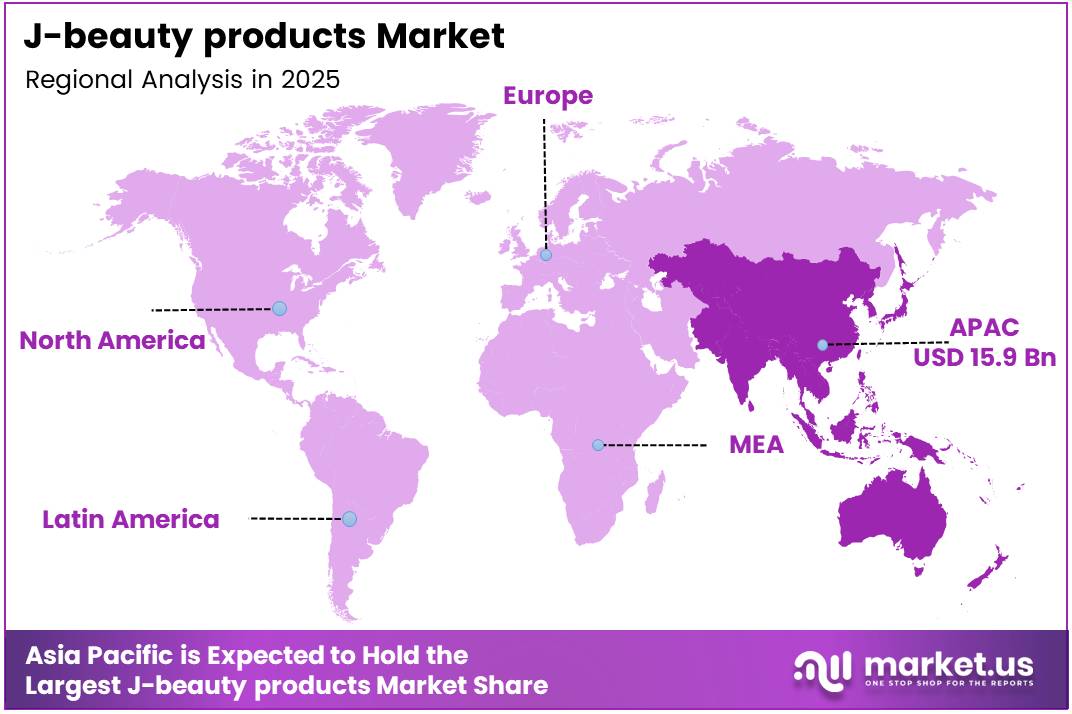
Asia Pacific holds a 43.10% share of the J-Beauty Products Market, valued at USD 15.9 Billion. Japan’s home market anchors this dominance through high per-capita cosmetics spending, deep retail infrastructure, and a culturally embedded daily skincare routine. Neighboring markets in South Korea, China, and Southeast Asia reinforce regional strength through strong cultural alignment with Japanese beauty values and established cross-border trade flows. North America represents the highest-potential Western expansion market for J-Beauty brands, driven by premium consumer segments that actively seek dermatologically validated skincare alternatives to domestic brands. Physical retail entries like the Maison KOSÉ store in Los Angeles and influencer-driven social media exposure have accelerated brand awareness. However, shelf presence in mainstream retail remains limited, creating a gap between consumer interest and purchase conversion. Europe’s J-Beauty penetration is strongest in the UK, Germany, and France, where premium beauty consumers show documented interest in international skincare formats. EU cosmetic regulations align closely with Japanese quality standards, reducing the compliance burden for Japanese brands entering European retail. Additionally, European consumers’ familiarity with multi-step skincare routines — particularly in skincare-focused Northern European markets — creates a receptive buyer base for J-Beauty education. Latin America presents an early-stage but structurally promising entry opportunity for J-Beauty brands, particularly in Brazil and Mexico where premium beauty consumption is expanding. E-commerce platforms have outpaced physical retail as the primary channel for imported beauty brands in the region. Cultural affinity for skin whitening and UV protection products creates direct alignment with core J-Beauty product categories, especially sunscreen and brightening serums. The Middle East and Africa market for J-Beauty products remains at an early adoption stage, with the Gulf Cooperation Council countries representing the most commercially viable entry point. GCC consumers’ high per-capita beauty spend and preference for luxury-positioned international brands align with J-Beauty’s premium pricing structure. South Africa serves as a secondary access point to Sub-Saharan Africa, though broader regional distribution infrastructure requires further development before meaningful scale is achievable. North America Europe Asia Pacific Latin America Middle East & Africa Shiseido Co., Ltd. positions itself as the global ambassador of Japanese prestige beauty, operating across skincare, makeup, and fragrance through an integrated R&D and retail platform. Its strategy centers on premium brand building in Western and Chinese markets through both retail partnerships and proprietary research facilities. This dual investment in brand equity and formulation science creates defensible positioning that private-label competitors cannot easily replicate. L’Oréal Groupe engages with J-Beauty through its Japanese brand acquisitions and its established distribution infrastructure across over 150 countries. Its competitive advantage in this market lies in applying global marketing scale to Japan-originated product science — a combination that accelerates J-Beauty’s reach into mass and mid-market segments that pure Japanese brands rarely penetrate independently. This scale advantage also enables faster retail shelf expansion in emerging markets. Procter & Gamble Company competes in J-Beauty-adjacent segments through its SK-II brand, which builds its entire identity on Japanese fermentation science and premium positioning. P&G’s strategic strength is translating J-Beauty’s technical credibility into globally scalable marketing narratives that resonate with luxury skincare consumers across Asia Pacific and North America. SK-II’s brand story functions as a conversion engine that justifies premium price points in mass global retail environments. Kao Corporation operates across skincare, haircare, and hygiene with a research-driven product development model rooted in Japanese consumer science. In September 2025, Kao reported increased sales in its skincare and cosmetics division, driven by luxury skincare performance and expanded global operations. This growth confirms that Kao’s strategy of combining science-backed formulations with selective international distribution is producing measurable commercial results at a global scale.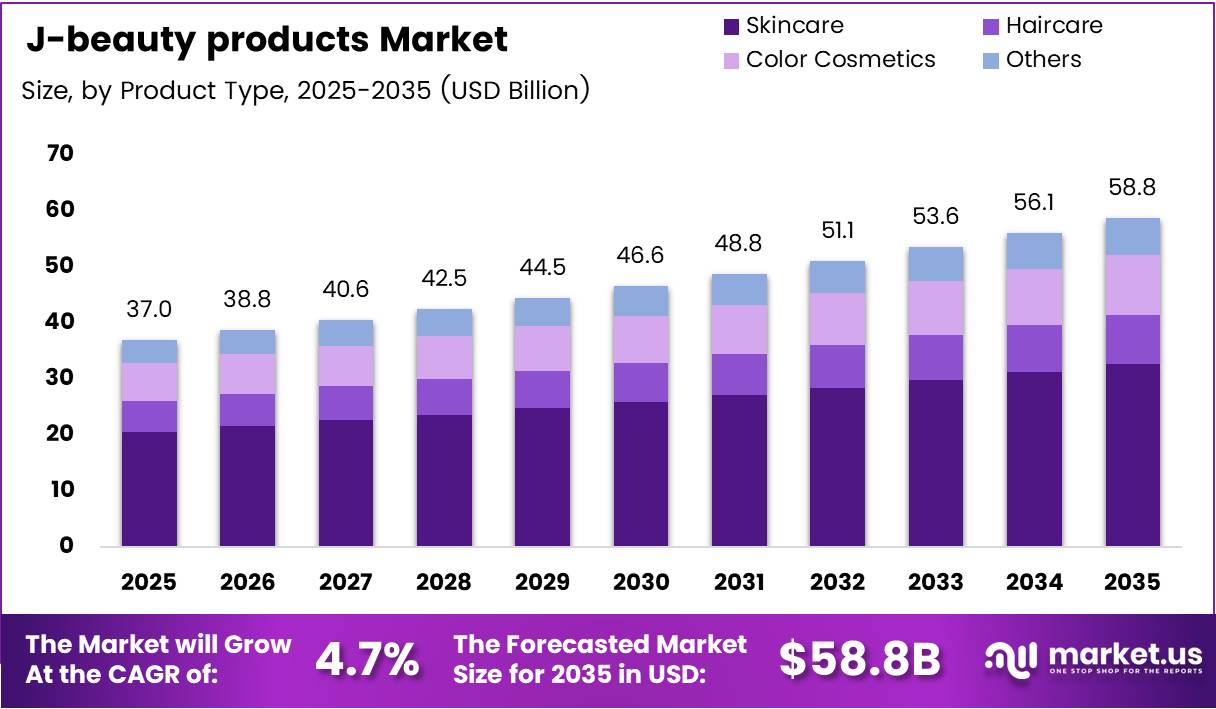
Regional Analysis
Asia Pacific Dominates the J-Beauty Products Market with a Market Share of 43.10%, Valued at USD 15.9 Billion
North America J-Beauty Products Market Trends
Europe J-Beauty Products Market Trends
Latin America J-Beauty Products Market Trends
Middle East and Africa J-Beauty Products Market Trends
Key Regions and Countries
Key Company Insights
Key Players
Recent Developments