

Report Overview
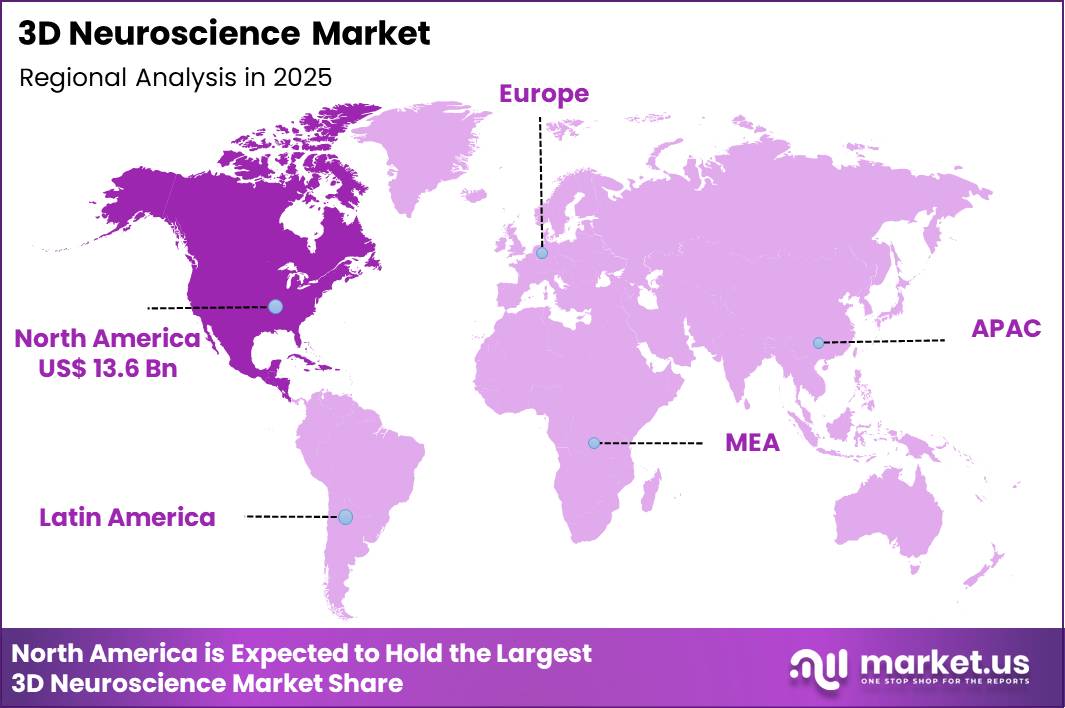
The Global 3D Neuroscience Market size is expected to be worth around US$ 65.5 Billion by 2035 from US$ 35.2 Billion in 2025, growing at a CAGR of 6.4% during the forecast period 2026-2035. In 2025, North America led the market, achieving over 38.5% share with a revenue of US$ 13.6 Billion.
Increasing demand for advanced tools that replicate complex neural architecture propels the 3D neuroscience market as researchers and clinicians require spatially accurate models to study brain function, disease mechanisms, and therapeutic interventions.
Neuroscientists increasingly employ 3D brain organoids derived from human pluripotent stem cells to model neurodevelopmental disorders, enabling detailed investigation of cortical layering and neuronal connectivity in conditions such as autism spectrum disorder and microcephaly.
North America is leading the 3D Neuroscience Market North America accounted for 38.5% of the 3D neuroscience market in 2025 as research institutions and biotechnology firms expanded advanced brain research platforms that replicate complex neural environments. Universities and medical research centers increasingly adopted three dimensional neural culture systems and brain organoid models to study neurodegenerative diseases and neurological disorders. The National Institutes of Health reported that it invested more than USD 3.8 billion in neuroscience research through the BRAIN Initiative between 2014 and 2023, supporting development of innovative technologies for understanding brain structure and function. Pharmaceutical companies across the United States and Canada are also integrating advanced neural tissue models into drug discovery pipelines to improve the accuracy of neurological disease testing. Growing prevalence of neurological disorders such as Alzheimer’s disease and Parkinson’s disease has increased demand for advanced research tools capable of replicating real brain tissue environments. Academic laboratories are strengthening collaborations with biotechnology startups to develop improved neural organoid platforms and microfluidic brain models. Government grants and venture capital funding are accelerating innovation in neurotechnology and regenerative brain research. These factors collectively supported strong expansion of advanced neural modeling technologies across North America in 2025. The Asia Pacific region is expected to experience the highest CAGR during the forecast period Asia Pacific is expected to experience significant growth during the forecast period as governments and research institutions expand investments in neuroscience innovation and biomedical technology. Countries such as China, Japan, South Korea, and Singapore are strengthening national research programs focused on neurological disease and brain science. China’s Ministry of Science and Technology launched the China Brain Project with funding estimated at about USD 1 billion to support large scale neuroscience research and brain simulation technologies. Universities and biotechnology companies across the region are increasing research activity in neural tissue engineering, brain organoids, and advanced cell culture technologies. Pharmaceutical firms are also adopting advanced neural models to improve drug discovery for neurodegenerative and psychiatric disorders. Expanding biotechnology clusters and innovation parks are supporting collaboration between academic researchers and private life science companies. Governments are encouraging research commercialization and startup development in neurotechnology sectors. Rising awareness of neurological disorders and aging populations are also increasing demand for improved research tools that support disease understanding. These developments are expected to accelerate adoption of advanced neural research platforms throughout Asia Pacific in the coming years. North America Europe Asia Pacific Latin America Middle East & Africa Key participants in the 3D Neuroscience market expand their capabilities by developing advanced neural organoid platforms, high-content imaging systems, and scalable 3D cell culture technologies that enable more accurate modeling of brain biology. Companies strengthen growth through partnerships with pharmaceutical developers and academic research institutes to accelerate drug discovery for neurological disorders such as Alzheimer’s and Parkinson’s disease. They also invest in stem-cell-derived neuronal models and organ-on-chip technologies that replicate complex neural networks and improve preclinical testing outcomes. Three-dimensional neural culture platforms allow cells to interact in a structure that closely mimics the human brain environment, which improves disease modeling and therapeutic research. Axol Bioscience represents a notable participant in the 3D Neuroscience market and operates as a biotechnology company that develops induced pluripotent stem cell-derived neuronal models used for neuroscience research and drug discovery. The company supplies disease-specific neural cell lines and laboratory tools that help researchers investigate neurological conditions including Alzheimer’s, Parkinson’s, and ALS. Industry competitors including Thermo Fisher Scientific, Corning, and Stemcell Technologies expand their offerings through advanced culture media, reagents, and research platforms designed for complex neural modeling. These initiatives strengthen innovation pipelines and support broader adoption of three-dimensional neuroscience technologies across pharmaceutical and academic research environments.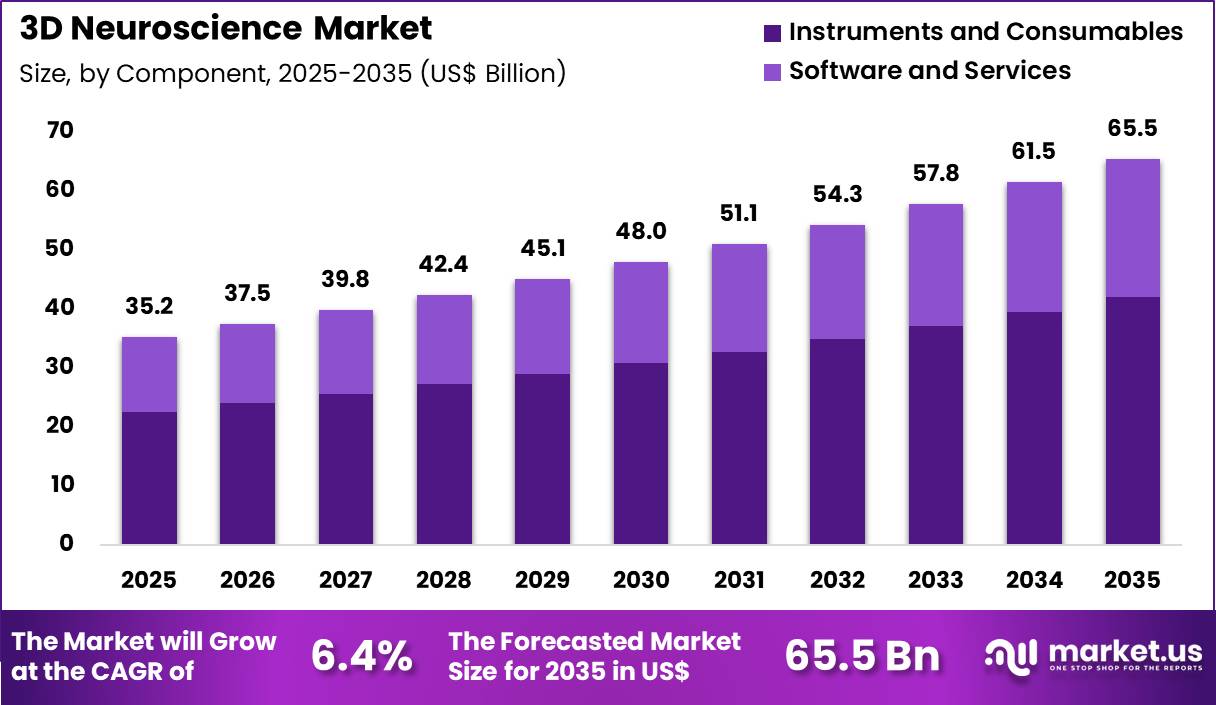
Regional Analysis
Key Regions and Countries
Key Players Analysis
Top Key Players
Recent Developments