

Report Overview
Global Cargo Handling Equipment Market size is expected to be worth around USD 37.5 Billion by 2035 from USD 23.3 Billion in 2025, growing at a CAGR of 4.9% during the forecast period 2026 to 2035.
The cargo handling equipment market covers machinery used to move, lift, stack, and transport freight across ports, warehouses, manufacturing floors, and logistics hubs. Core equipment categories include forklifts, cranes, conveyors, pallet trucks, and automated guided vehicles. This market sits at the intersection of global trade infrastructure and industrial automation investment.
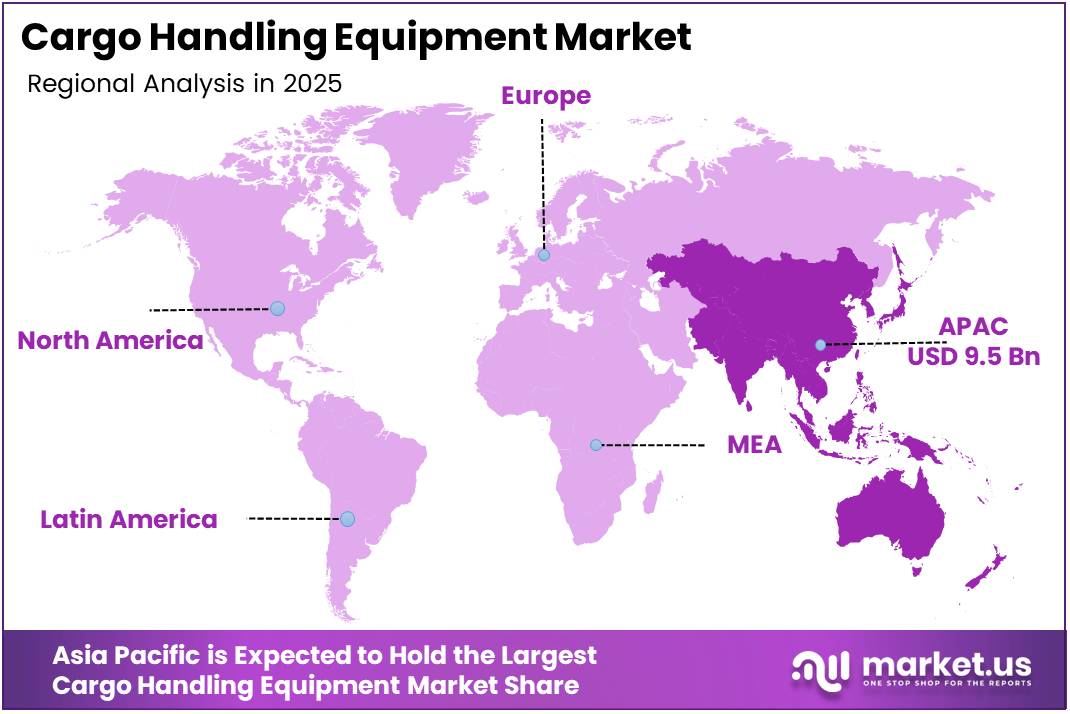
Asia Pacific holds 40.8% of the global cargo handling equipment market, valued at USD 9.5 Billion. This position reflects the region’s role as the world’s dominant container trade hub, anchored by China’s port infrastructure scale, Japan’s terminal automation programs, and India’s ongoing port capacity expansion. Regional governments continue funding port modernization that directly translates into equipment procurement cycles. North America benefits from mature port regulatory frameworks and active green port compliance programs that are converting diesel equipment fleets to electric alternatives on defined timelines. US Gulf and West Coast terminals are running large-scale automation investments. These structural conditions create sustained, policy-driven equipment procurement demand that differentiates North America from more price-sensitive emerging markets. Europe’s cargo handling equipment market is shaped by stringent IMO emissions compliance requirements and EU port sustainability directives that mandate measurable carbon reduction at major terminals. Northern European ports, particularly in Germany, the Netherlands, and Belgium, lead terminal automation adoption. This regulatory environment accelerates the replacement of conventional equipment with electric and hybrid alternatives ahead of other global regions. Latin America’s cargo handling equipment demand concentrates in Brazil and Mexico, where port capacity investment programs are expanding container throughput infrastructure. Equipment procurement in this region skews toward proven mid-range technology rather than high-specification automation, reflecting both cost constraints and the earlier stage of terminal modernization compared to Asia Pacific and North America. The Middle East is investing heavily in port infrastructure as Gulf states diversify economies beyond oil revenue, with UAE and Saudi Arabia running major logistics hub development programs that require advanced cargo handling fleets. Africa’s equipment market remains price-constrained but is growing as Sub-Saharan port expansion projects attract international terminal operators who bring standardized procurement practices with them. North America Europe Asia Pacific Latin America Middle East & Africa Caterpillar Inc. positions itself as a full-spectrum cargo handling and industrial equipment supplier with one of the deepest dealer and service networks globally. Its strategic advantage lies in cross-selling material handling equipment alongside construction and mining machinery to the same industrial buyer base. This integrated go-to-market approach lowers customer acquisition costs and strengthens long-term account retention in high-value fleet procurement cycles. Kalmar (Cargotec) has made electrification and automation the centerpiece of its competitive strategy, moving decisively ahead of peers in product development for electric straddle carriers, reachstackers, and RTG cranes. Its second-generation lithium-ion battery launch in July 2025 and the April 2025 Shanghai production expansion signal a deliberate push to control both technology development and global supply chain for electric cargo handling equipment — a combination that is difficult for competitors to replicate quickly. Toyota Industries Corporation leverages its position as the world’s largest forklift manufacturer to drive volume-based cost advantages that smaller competitors cannot match at scale. Its October 2025 strategic investment in Advanced Charging Technologies demonstrates a forward-looking move to own more of the electric fleet value chain — transitioning Toyota from a hardware supplier toward an integrated energy and equipment solutions provider for cargo operations. Terex Corporation concentrates its cargo handling positioning around crane systems and specialty lifting equipment for port, construction, and industrial applications. Its differentiation comes from engineering depth in high-specification lifting configurations rather than volume production. This specialization insulates Terex from direct commodity price competition in standard equipment categories while capturing premium margins in complex, application-specific crane deployments.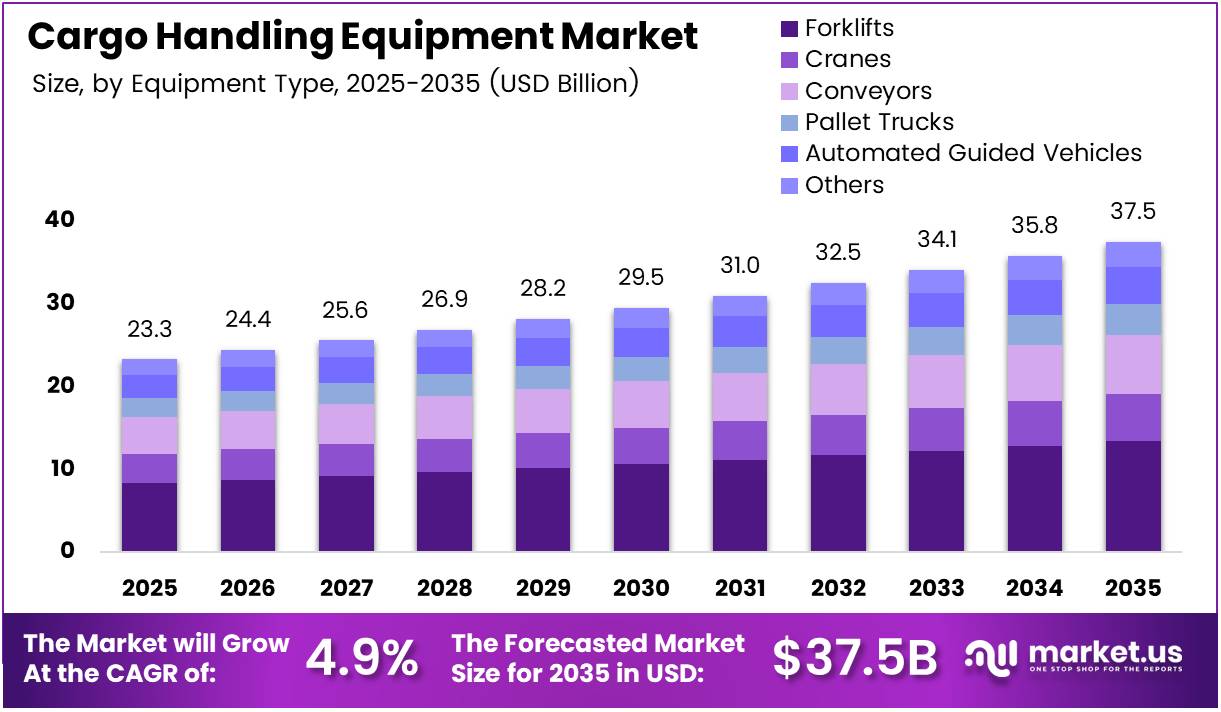
Regional Analysis
Asia Pacific Dominates the Cargo Handling Equipment Market with a Market Share of 40.8%, Valued at USD 9.5 Billion
North America Cargo Handling Equipment Market Trends
Europe Cargo Handling Equipment Market Trends
Latin America Cargo Handling Equipment Market Trends
Middle East and Africa Cargo Handling Equipment Market Trends
Key Regions and Countries
Key Company Insights
Key Players
Recent Developments