

Report Overview
Global Vibration Sensor Market size is expected to be worth around USD 11.6 Billion by 2035 from USD 5.6 Billion in 2025, growing at a CAGR of 7.5% during the forecast period 2026 to 2035.
Vibration sensors detect mechanical oscillations in rotating and stationary equipment, converting physical motion into measurable electrical signals. These devices serve as the diagnostic backbone for industrial condition monitoring, enabling facilities to track equipment health without halting operations. Their application spans motors, turbines, compressors, and structural assets across heavy industry.
Advanced industrial vibration monitoring systems require specialized installation, precise calibration, and ongoing signal interpretation — each step adding cost beyond the sensor hardware itself. For smaller manufacturers and mid-tier industrial operators, the total system investment frequently exceeds budget thresholds for maintenance capital expenditure. This cost barrier concentrates adoption among large enterprises with dedicated reliability engineering teams, slowing overall addressable market penetration. Interpreting vibration data for accurate fault diagnosis demands technical expertise that many plant operators do not have in-house. Without skilled analysts, raw vibration signals produce limited actionable output — reducing the perceived ROI of the system and increasing reliance on third-party service providers. This dependency adds recurring cost and creates hesitation at the point of initial investment decision. According to Dr. Shruti Bhat, maintenance costs decreased by 15% in a case study using vibration-monitoring IoT sensors — a meaningful saving, but one that requires months of data collection before the benefit materializes. For operators with short capital payback requirements, deferred savings profiles reduce the financial attractiveness of full-system deployments, particularly when upfront installation and calibration costs are front-loaded against uncertain timelines. Industrial IoT-enabled wireless vibration sensors remove the wiring and infrastructure costs that historically limited broad sensor deployment across large facilities. Remote monitoring capability allows operators to cover geographically dispersed equipment — pipelines, offshore platforms, wind farms — without permanent instrumentation runs. In January 2025, TE Connectivity launched its IoT Wireless Vibration Sensors featuring piezoelectric accelerometers, embedded FFT analysis, and up to 10-year battery life, directly addressing the operational cost objection that previously blocked wireless adoption at scale. Renewable energy infrastructure, particularly wind turbines and hydropower plants, represents a structurally new installation base for vibration monitoring. Wind turbine drivetrains operate under variable load conditions that accelerate mechanical fatigue, making continuous vibration analysis essential for asset life management. According to Path of Science, piezoelectric harvesters on wind turbine blades generated 100 μW to power vibration sensors in an offshore wind farm case study — demonstrating that energy-autonomous sensor operation is achievable in remote renewable installations, eliminating grid power dependency. Compact MEMS-based vibration sensors are creating demand in consumer electronics, wearables, and smart infrastructure — markets previously outside the industrial sensor addressable base. Structural health monitoring on bridges, railways, and smart city infrastructure adds a new category of long-life, low-power deployment that fits MEMS technical capabilities precisely. This diversification reduces the market’s historical concentration in heavy industry and extends the total addressable sensor population. AI-integrated vibration analysis platforms now process sensor signals in real time, moving fault detection from a manual review task to an automated alert system. According to IJRASET, a CNN model using continuous wavelet transform scalograms from vibration signals achieved 99.13% fault classification accuracy — outperforming traditional FFT-based models at 93.8%. This accuracy gap is large enough to materially change maintenance decision quality, and it signals that AI-augmented platforms will progressively replace manual signal interpretation across industrial condition monitoring programs. The market shift toward wireless and battery-powered vibration monitoring devices reflects a fundamental change in deployment economics. Eliminating hardwired infrastructure cuts installation time and cost, enabling sensor networks to scale across facilities without proportional capital expenditure. In April 2025, Wilcoxon Sensing Technologies released the 883M digital triaxial accelerometer with Modbus protocol support for direct PLC and SCADA integration, confirming that digital-native connectivity has become a standard product specification requirement. Cloud-based analytics platforms connected to industrial vibration monitoring solutions extend the value of sensor data beyond the plant floor, enabling enterprise-level benchmarking, cross-facility trend analysis, and remote diagnostics. Advancements in MEMS technology continue driving higher sensitivity into smaller form factors, making dense sensor networks more economically viable. Together, these developments compress the timeline from sensor installation to actionable operational insight. Asia Pacific holds the largest regional share at 28.9%, valued at USD 1.6 Billion, driven by the concentration of manufacturing output, automotive production, and industrial automation investment across China, Japan, South Korea, and India. The region’s high density of process industries and expanding smart factory programs sustains vibration sensor demand across multiple end-use verticals simultaneously, creating a broad and structurally stable revenue base. North America maintains a strong position in the global vibration sensor market, underpinned by mature oil and gas infrastructure, large aerospace manufacturing capacity, and well-developed industrial IoT adoption. The region’s early deployment of condition monitoring programs in power generation and refining has produced an installed base that now generates recurring upgrade and replacement demand alongside new system deployments. Europe’s vibration sensor demand centers on precision manufacturing, aerospace, and energy transition infrastructure including offshore wind farms and grid modernization projects. Germany’s industrial machinery sector and the region’s strong automotive OEM base provide consistent sensor procurement volumes, while regulatory pressure on industrial energy efficiency accelerates condition monitoring adoption across manufacturing facilities. Latin America represents an earlier-stage but expanding market for vibration sensors, where mining, oil and gas, and agricultural processing industries drive the primary demand base. Brazil and Mexico lead regional deployment, supported by infrastructure investment and increasing technology adoption among industrial operators seeking to reduce unplanned downtime in remote and challenging operating environments. The Middle East and Africa market centers on oil and gas refining, petrochemical processing, and power generation — all sectors where equipment failure carries significant financial and safety consequences. GCC countries, particularly Saudi Arabia and the UAE, lead regional investment in asset integrity programs that incorporate vibration monitoring as a core component of facility reliability management. North America Europe Asia Pacific Latin America Middle East & Africa Baumer positions itself at the intersection of precision sensor engineering and application-specific customization, serving automotive, food processing, and industrial automation markets with a portfolio that spans mechanical, optical, and inductive sensing. Their competitive advantage lies in deep application engineering support — a capability that reduces customer switching risk and maintains long-term supply relationships with OEM accounts across Europe and Asia. Bosch Sensortec GmbH leverages its parent company’s semiconductor manufacturing infrastructure and automotive-grade quality standards to deliver MEMS-based vibration sensing solutions at consumer electronics and automotive scale. This manufacturing depth enables Bosch Sensortec to compete on cost-per-unit economics that pure-play sensor companies cannot replicate, positioning it as the default supplier for high-volume, cost-sensitive vibration monitoring applications. TE Connectivity brings a broad connectivity and sensor portfolio that allows it to bundle vibration sensing within larger industrial monitoring system solutions, reducing customer procurement complexity. Their January 2025 launch of the IoT Wireless Vibration Sensor series — featuring embedded FFT analysis and up to 10-year battery life — demonstrates a deliberate shift toward integrated wireless solutions that extend their addressable market beyond traditional wired sensor replacement. Honeywell International Inc. applies its industrial process control expertise and global service infrastructure to deliver vibration monitoring within broader asset management and safety system platforms. Their strategic positioning targets large enterprise accounts in oil and gas, aerospace, and power generation where integration with existing Honeywell control and analytics platforms reduces implementation risk and creates multi-product account stickiness.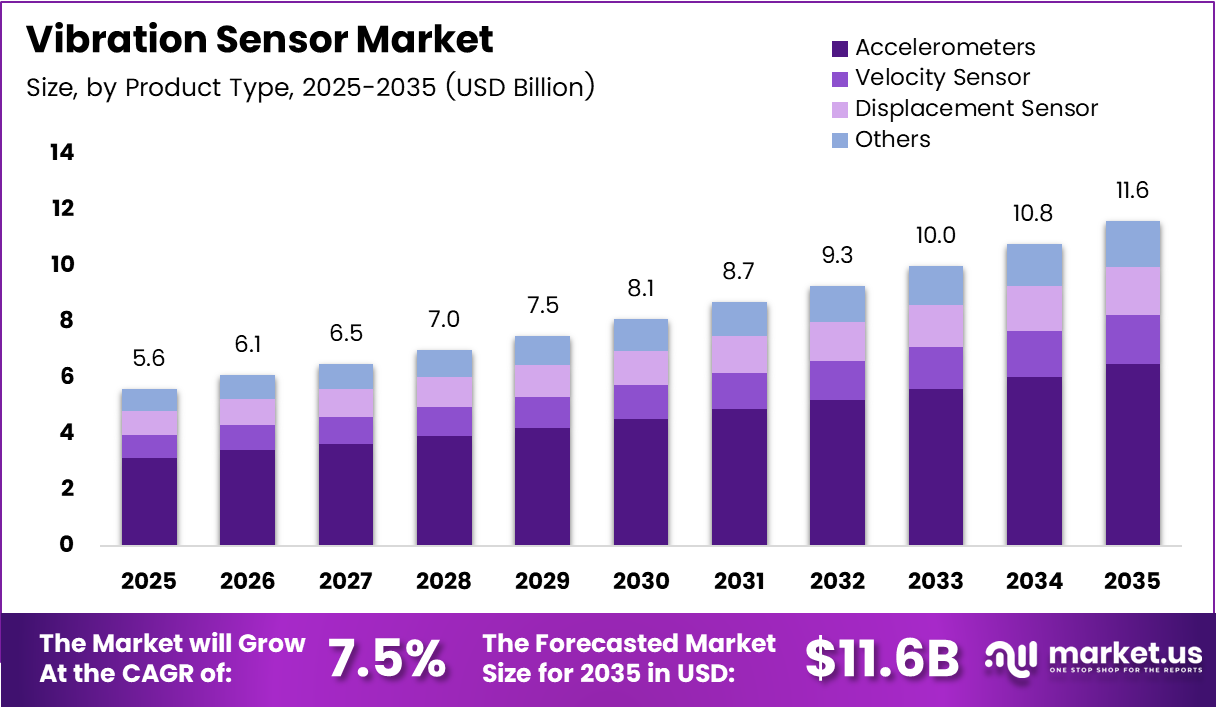
Restraints
High System Costs and Technical Complexity Limit Vibration Monitoring Adoption Among Mid-Market and Smaller Industrial Operators
Growth Factors
Wireless IoT Sensors, Renewable Energy Deployment, and MEMS Miniaturization Open New Revenue Channels Across Industrial and Consumer Markets
Emerging Trends
AI-Integrated Analysis, Wireless Platforms, and Cloud-Connected Monitoring Redefine How Vibration Data Translates Into Operational Decisions
Regional Analysis
Asia Pacific Dominates the Vibration Sensor Market with a Market Share of 28.9%, Valued at USD 1.6 Billion
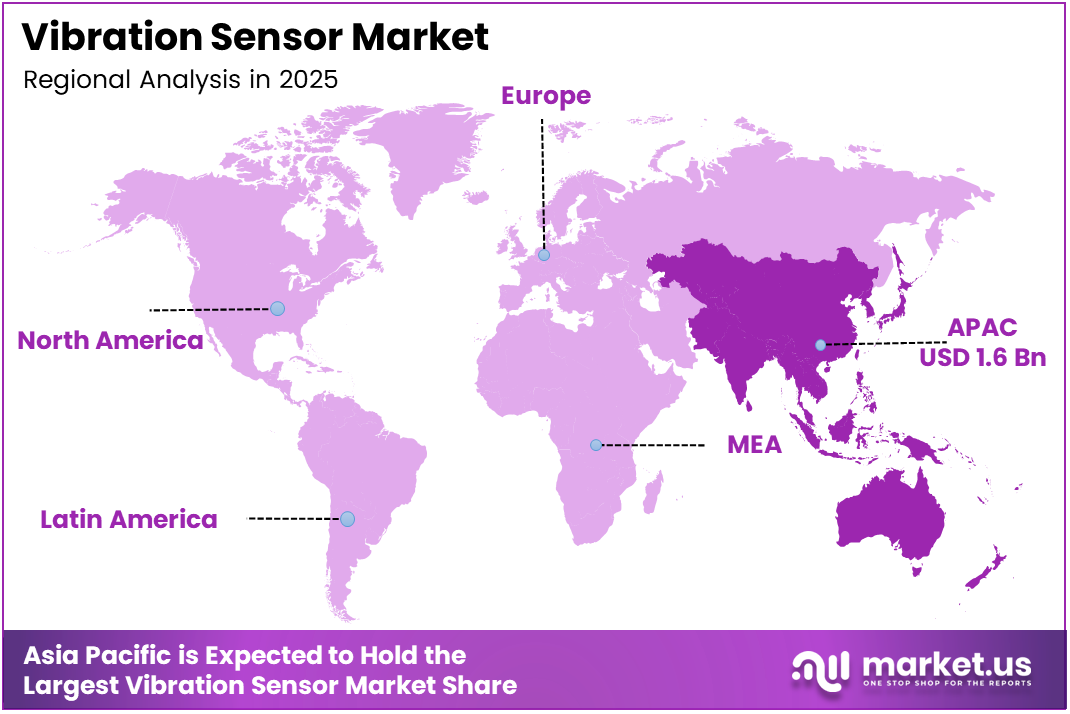
North America Vibration Sensor Market Trends
Europe Vibration Sensor Market Trends
Latin America Vibration Sensor Market Trends
Middle East and Africa Vibration Sensor Market Trends
Key Regions and Countries
Key Company Insights
Key Players
Recent Developments