

Report Overview
Global CNC Controller Market size is expected to be worth around USD 7.1 Billion by 2035 from USD 3.5 Billion in 2025, growing at a CAGR of 7.2% during the forecast period 2026 to 2035.
CNC controllers are the electronic systems that direct machine tool movements with precision across milling, turning, grinding, and multi-axis machining operations. Manufacturers across automotive, aerospace, and medical device sectors rely on these systems to hold tight tolerances and maintain output consistency at scale. Without capable controllers, high-mix production environments cannot sustain competitive cycle times.
Aerospace, automotive, and medical device manufacturers drive precision machining requirements beyond what legacy two- and three-axis controllers support. Turbine components, structural airframe parts, and surgical implants now require simultaneous five-axis interpolation with real-time compensation. According to machinetoolnews.ai, AI-enabled predictive maintenance on CNC systems delivers a 30% improvement in overall equipment effectiveness — a direct productivity gain that justifies the premium cost of advanced controller platforms. Electronics and semiconductor manufacturing add another structural pull. Board-level miniaturization and packaging complexity push machining tolerances tighter each product generation. Automated production lines in this sector run continuously and cannot absorb the schedule disruption of unplanned controller failures — creating strong commercial logic for investing in higher-capability, diagnostics-rich control systems from the outset. Advanced CNC controllers carry significant upfront costs that extend well beyond hardware procurement. System integration, software configuration, machine recalibration, and staff retraining all add to the total implementation cost. For small and mid-sized manufacturers operating on thin margins, this cumulative investment frequently pushes controller upgrades into multi-year deferral cycles. Skilled CNC programmers and operators remain scarce across major manufacturing economies. Modern multi-axis controllers require proficiency in CAM software, G-code programming, and increasingly in IIoT data interpretation. According to a peer-reviewed study published in Discover Mechanical Engineering, optimized CNC tool pathway strategies achieve up to 33% energy savings for circular pocket operations — but realizing those savings requires operator expertise that many facilities currently lack. The skills gap compounds the capital constraint. Manufacturers that invest in advanced controllers but cannot staff them effectively see slower productivity gains, longer payback periods, and increased risk of costly programming errors. This double constraint — financial and human — slows adoption velocity most severely among the mid-market manufacturer segment that represents the largest volume opportunity for controller vendors. AI-integrated predictive maintenance transforms the commercial proposition for next-generation CNC controllers. Rather than selling hardware, vendors now offer measurable operational outcomes — reduced downtime, avoided repair costs, and extended asset life. According to machinetoolnews.ai, CNC users report a 10x return on investment within weeks of deploying AI-enabled monitoring systems. That payback speed fundamentally changes the CFO conversation around controller upgrade budgets. Small and medium-sized manufacturers represent the largest underpenetrated segment in the CNC controller market. These facilities historically deferred advanced controllers due to cost and complexity. However, compact, lower-cost controller platforms — combined with cloud-based configuration and remote support — now make sophisticated control accessible to job shops and contract manufacturers that previously relied on basic two-axis systems. In November 2025, Onefinity CNC released the Redline Controller upgrade kits for all Elite series machines, demonstrating direct product response to this SME upgrade demand. Cloud-connected CNC controllers open a recurring revenue model that hardware-only controller sales cannot support. Remote monitoring, over-the-air software updates, and centralized analytics give vendors post-sale engagement that deepens customer relationships and raises switching costs. Asia-Pacific manufacturing hubs, where new facilities are built with digital infrastructure from the ground up, are the fastest adoption environment for cloud-native controller architectures. Open-architecture CNC controllers remove the proprietary lock-in that has historically constrained machine builders and end-users alike. By supporting standardized communication protocols and third-party software integration, open platforms allow manufacturers to combine best-in-class motion control with specialized CAM, simulation, and analytics tools. This flexibility directly lowers total system cost and shortens time-to-production for new machining programs. IIoT connectivity turns CNC controllers into active production intelligence nodes rather than passive motion executors. Real-time spindle load, tool wear, thermal drift, and cycle time data feed into plant-level dashboards and ERP systems. According to machinetoolnews.ai, AI-enabled monitoring systems achieve 75% faster troubleshooting for maintenance technicians — a gain that compounds across multi-machine facilities and directly reduces the skilled labor hours consumed by reactive maintenance. Digital twin technology enables manufacturers to simulate and validate CNC programs before cutting a single part. Collision detection, cycle time prediction, and toolpath optimization happen in software, not on the machine. In March 2025, AI-driven startup LimitlessCNC raised USD 4.1 Million in seed funding to develop AI agent technology that automates CNC programming workflows — signaling that venture capital now views intelligent CNC software as a distinct, investable category separate from the controller hardware itself. FANUC Corporation holds a structurally advantaged position through its deep OEM integration with machine tool builders globally. Its proprietary servo systems, motors, and controllers operate as a closed ecosystem — creating high switching costs that protect installed base revenue. FANUC’s multi-decade relationships with Japanese and international machine builders give it first-mover access to new platform decisions before competitors are even considered. Siemens competes on the strength of its SINUMERIK platform, which integrates CNC control with broader factory automation, drives, and digital enterprise software. This end-to-end positioning allows Siemens to sell controller upgrades as part of larger digital transformation contracts — moving the conversation from unit price to total value of the production system. European manufacturing’s preference for integrated automation stacks plays directly to this strategy. Mitsubishi Electric leverages its combined strength in servo technology, programmable controllers, and CNC systems to serve automotive and electronics manufacturers requiring tightly coordinated motion and process control. Its MELDAS and M8 series platforms are embedded across Asian manufacturing supply chains, giving Mitsubishi Electric durable installed base density in the region with the highest near-term growth rate. Heidenhain differentiates through precision measurement integration — combining linear encoders, angle encoders, and CNC control into systems optimized for die-and-mold, aerospace, and medical machining. This vertical focus commands premium pricing in applications where measurement accuracy is non-negotiable. Heidenhain’s engineering reputation creates a defensible niche that broad-line competitors find difficult to displace on technical grounds alone.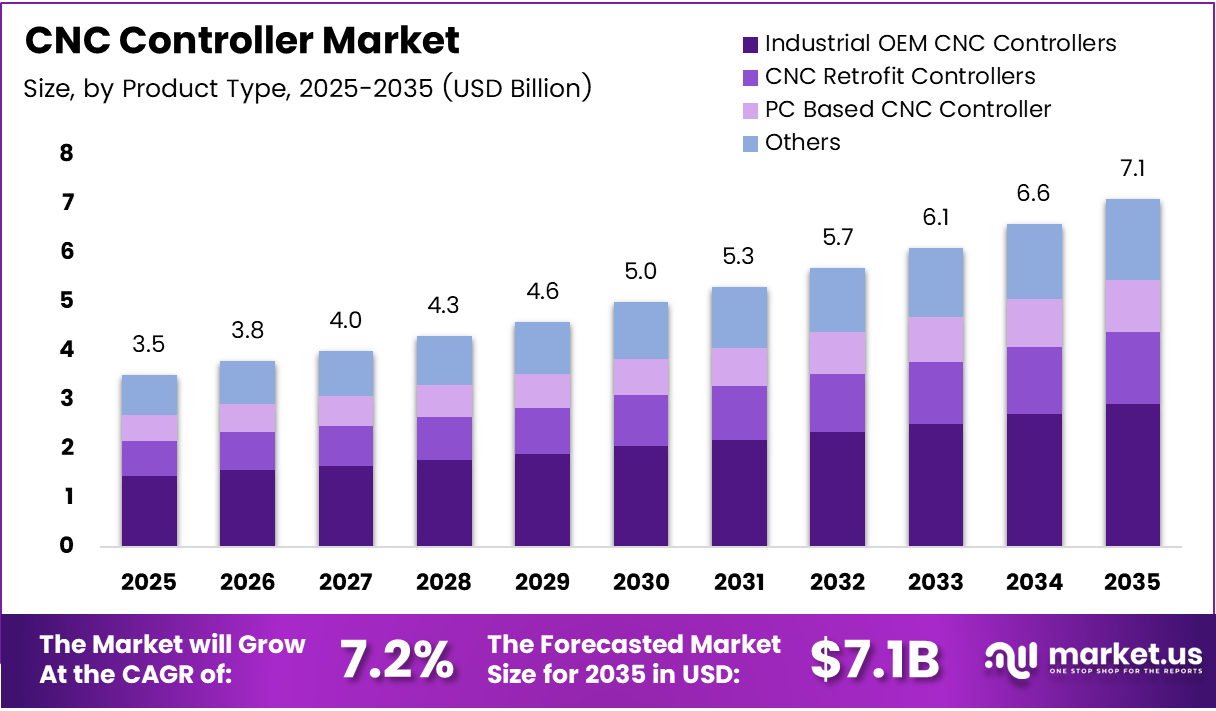
Restraints
High Capital Costs and Operator Skill Gaps Limit CNC Controller Adoption Among Mid-Tier Manufacturers
Growth Factors
AI-Enabled Maintenance, Cloud Connectivity, and SME Expansion Create New Revenue Layers for CNC Controller Vendors
Emerging Trends
Open Architecture, IIoT Integration, and Digital Twin Adoption Redefine CNC Controller Functionality Expectations
Key Company Insights
Key Players
Recent Developments