

Report Overview
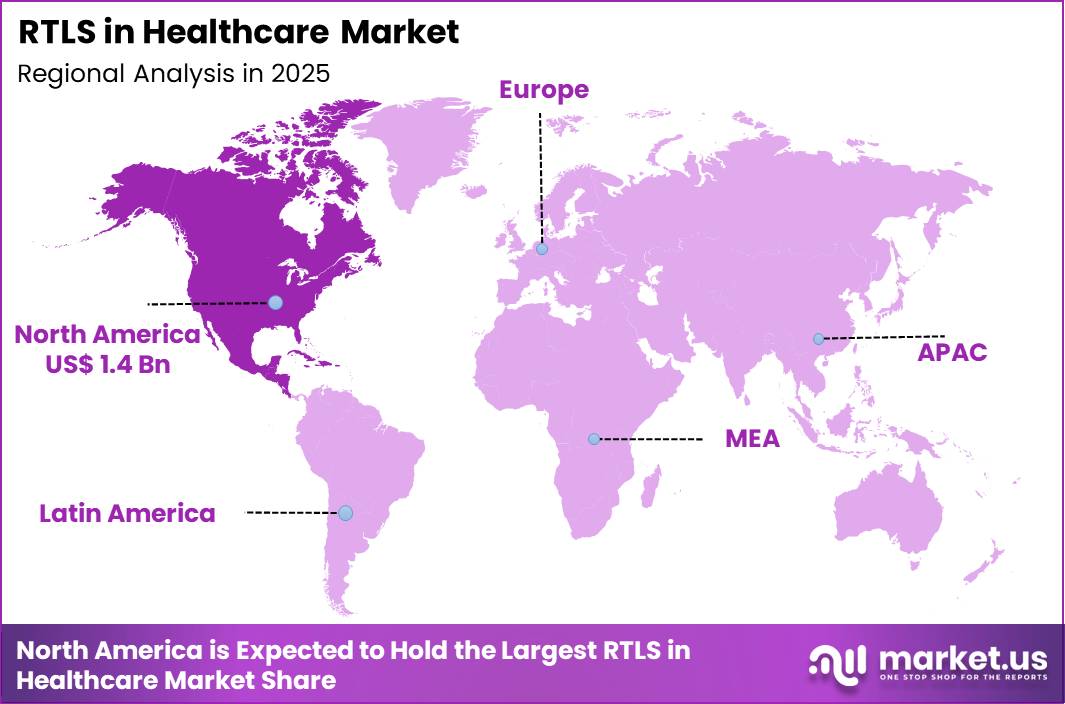
The Global RTLS in Healthcare Market size is expected to be worth around US$ 14.5 Billion by 2035 from US$ 2.9 Billion in 2025, growing at a CAGR of 17.5% during the forecast period 2026-2035. In 2025, North America led the market, achieving over 47.5% share with a revenue of US$ 1.4 Billion.
Increasing emphasis on operational efficiency and patient safety propels the RTLS in Healthcare market as hospitals and healthcare systems deploy real-time location systems to track assets, staff, and patients with high accuracy and immediacy.
Facility managers increasingly use RTLS to locate critical medical equipment such as infusion pumps, wheelchairs, and portable ultrasound machines, reducing search time and ensuring availability during urgent procedures in emergency departments and operating rooms.
Increased deployment of UWB-based RTLS solutions in healthcare facilities is driving the market. Ultra-wideband technology has gained traction for its superior accuracy in indoor positioning applications within complex hospital environments. Systems achieve sub-meter precision for tracking both assets and personnel in real time. The 2024-2025 period reflects accelerated installations leveraging UWB anchors for minimal interference in dense wireless settings. Facilities benefit from reliable performance in areas with metal shielding and multipath challenges. The advancement supports expanded use cases including patient elopement prevention and staff duress alerting. The trend aligns with regulatory emphasis on patient safety and workflow optimization. Providers report reduced implementation complexity compared to legacy infrared solutions. The development stimulates upgrades from Wi-Fi or RFID-based legacy systems. Early adopters demonstrate consistent location reliability across multi-floor buildings. Overall, this technological shift elevates performance standards in healthcare location intelligence applications. North America is leading the RTLS in Healthcare Market North America accounted for 47.5% of the RTLS in healthcare market in 2025 as hospitals and large health systems increasingly deployed real-time location technologies to track medical equipment, staff, and patients across complex clinical environments. Healthcare providers across the United States and Canada are integrating RFID, Wi-Fi, and Bluetooth tracking systems that allow hospitals to monitor the movement of devices and personnel in real time, improving workflow coordination and patient safety. Studies show that RTLS deployment in hospitals significantly improved operational efficiency, reducing scheduling time for procedures from about 12 minutes to 5 minutes in clinical environments. Hospitals are adopting these systems to address operational challenges such as misplaced equipment, delayed patient transport, and inefficient asset utilization. In many hospitals, nurses may spend up to 60 minutes per shift searching for equipment, highlighting the need for location-tracking technologies that streamline workflow and reduce productivity losses. Health systems are also implementing staff safety badges and patient tracking systems that enable rapid response during emergencies and improve care coordination. Integration of RTLS with hospital information systems and electronic health records is enabling advanced analytics for hospital operations. These developments collectively supported strong adoption of real-time hospital tracking technologies across North America in 2025. The Asia Pacific region is expected to experience the highest CAGR during the forecast period Asia Pacific is expected to experience strong expansion during the forecast period as healthcare systems modernize and invest in smart hospital technologies. Governments across countries such as China, Japan, South Korea, and Singapore are promoting digital health infrastructure that integrates Internet of Things sensors and real-time data systems within hospitals. Smart hospital initiatives increasingly rely on location-tracking platforms to monitor medical devices, manage patient flow, and optimize resource utilization. Real-time tracking systems allow hospitals to locate equipment instantly, which reduces delays in patient care and improves clinical efficiency. Healthcare providers in the region are adopting RTLS to strengthen infection control monitoring, staff safety management, and asset tracking across large hospital campuses. Expanding hospital networks and rising patient volumes are encouraging administrators to adopt automated monitoring technologies that support efficient care delivery. Technology companies are introducing cloud-based location tracking software that integrates with existing hospital infrastructure. Universities and medical research institutions are also exploring location analytics to improve hospital workflow design and patient management systems. These developments are expected to accelerate the adoption of smart hospital tracking technologies throughout Asia Pacific in the coming years. North America Europe Asia Pacific Middle East & Africa Latin America Key participants in the RTLS in Healthcare Market expand growth by developing advanced location tracking platforms, integrating wireless technologies such as RFID, Bluetooth Low Energy, and Wi-Fi, and partnering with hospitals to improve asset visibility and patient safety. Companies focus on software analytics and real-time monitoring tools that help healthcare facilities track medical equipment, staff movement, and patient flow across clinical environments. They also invest in cloud-based dashboards and interoperability features that connect tracking systems with hospital information platforms. Zebra Technologies represents a notable participant in the RTLS in Healthcare Market and operates as a U.S.-based technology company that provides enterprise asset tracking, data capture solutions, and healthcare mobility technologies. The company develops location intelligence platforms that support equipment tracking, workflow optimization, and clinical asset management. Industry competitors continue to expand wireless tracking technologies, strengthen healthcare collaborations, and enhance analytics capabilities to accelerate adoption of real-time location systems across hospitals and healthcare networks.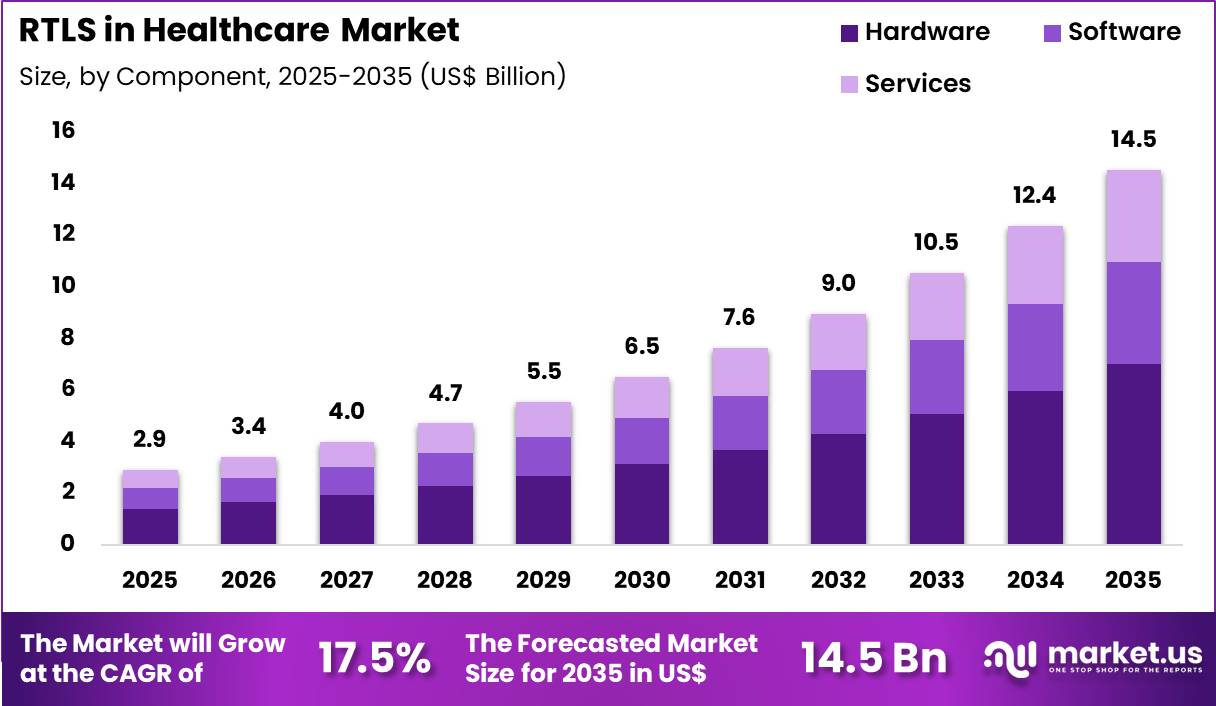
Latest Trends
Regional Analysis
Key Regions and Countries
Key Players Analysis
Top Key Players
Recent Developments