


Report Overview
The Global Crop Micronutrients Market size is expected to be worth around USD 11.8 billion by 2035 from USD 7.4 billion in 2025, growing at a CAGR of 4.7% during the forecast period 2026 to 2035.
Crop micronutrients are essential mineral elements that plants require in small quantities for healthy growth. These include zinc, iron, boron, manganese, copper, and molybdenum. Farmers apply them through soil, foliar sprays, or fertigation systems to correct nutrient deficiencies and improve crop yields.
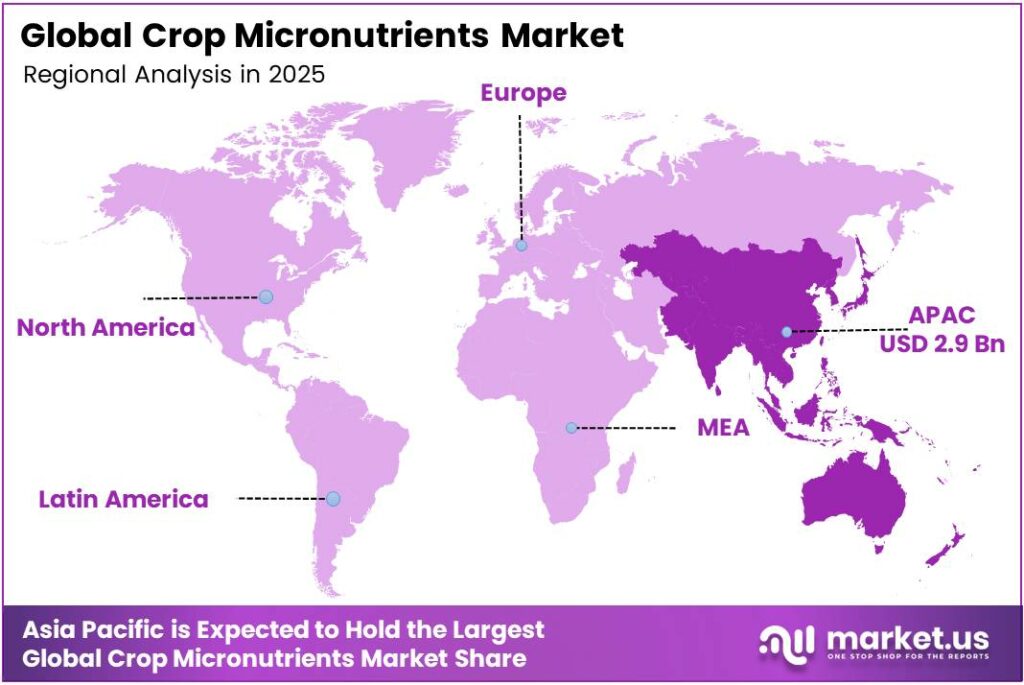
Agronomists increasingly combine organic and inorganic micronutrient sources in climate-smart farming protocols to address climate-induced declines in crop nutrient bioavailability. Global policy frameworks aligned with Sustainable Development Goals now actively support precision nutrient management tools. Consequently, research institutions and agri-input companies are collaborating to design solutions that maintain crop nutrition under increasingly unpredictable weather patterns. Intensive cropping systems continuously deplete soil micronutrient reserves faster than natural replenishment cycles allow. Exclusive reliance on macronutrient fertilisers worsens this depletion over time. Zimbabwe’s large-scale farms applied fertiliser nutrients at 290 kg per hectare compared to only 15 kg per hectare in communal lands, illustrating how uneven input intensity drives targeted micronutrient deficiency and correction demand. Modern high-yielding crop varieties demand supplemental micronutrients to achieve their full genetic yield potential under intensive cultivation conditions. Precision farming practices enable farmers to deliver micronutrients at exactly the right time and location. Additionally, international initiatives promoting balanced fertilisation elevate crop nutritional quality while simultaneously addressing food security goals across major agricultural regions globally. Micronutrient fertilisers carry significantly higher per-unit costs than standard macronutrient inputs, limiting their accessibility for smallholder farmers. Mandatory soil or tissue testing adds further time and expense to the application process. Sudan’s fertiliser consumption averaged approximately 4kg of total nutrients per hectare, indicating how extremely low input intensity in cost-constrained regions directly reflects affordability and access challenges for micronutrient adoption. Innovative micronutrient formulations face persistent regulatory hurdles related to environmental risk assessment and approval processes. Companies must invest heavily in toxicology studies and compliance documentation before launching new products. Consequently, these extended development timelines increase costs and reduce speed-to-market, discouraging smaller manufacturers from entering the premium micronutrient formulation space in highly regulated markets. Integrated foliar micronutrient programs combined with optimised macronutrient regimes deliver measurably higher nutrient-use efficiency on commercial farms. Comprehensive soil micronutrient mapping helps identify high-risk zones needing targeted intervention. South Africa’s fertiliser consumption reached approximately 1,400 thousand tonnes of nutrients in peak periods, demonstrating how large nutrient markets create infrastructure for scaling advanced micronutrient delivery programs. Agronomic biofortification techniques are gaining strong traction globally, elevating micronutrient levels in staple crops to address dietary deficiencies. Collaborative public-private programs are developing next-generation sustainable fertiliser technologies that reduce environmental impact. Global fertiliser use datasets now cover major countries based on surveys conducted every 2 to 4 years since 1990, supporting evidence-based micronutrient intervention programs worldwide. Asia Pacific leads the global crop micronutrients market with a 39.5% share, valued at USD 2.9 billion in 2025. The region benefits from massive agricultural output in countries like China, India, and Southeast Asia. Moreover, government-backed soil health programs and subsidised fertiliser distribution networks actively support micronutrient adoption across millions of smallholder farms. North America maintains a mature and technology-driven crop micronutrients market supported by advanced soil testing infrastructure. Precision agriculture adoption is high across the US and Canada, enabling targeted micronutrient applications. Additionally, robust agronomic advisory networks and strong distribution channels ensure consistent product availability across diverse farming systems in the region. Europe’s crop micronutrients market benefits from stringent environmental regulations that encourage efficient and sustainable fertiliser use. Farmers in Germany, France, and the UK actively adopt balanced nutrient programs under EU agricultural policy frameworks. Consequently, demand for chelated and slow-release micronutrient formulations is particularly strong across high-value horticultural and speciality crop sectors. Latin America is emerging as a high-growth region for crop micronutrients, driven by expanding soybean, sugarcane, and coffee cultivation in Brazil and Mexico. Large-scale commercial farming operations increasingly adopt micronutrient programs to sustain soil productivity. Furthermore, regional agribusinesses are partnering with international input companies to introduce advanced formulations that support export-oriented high-yield crop production.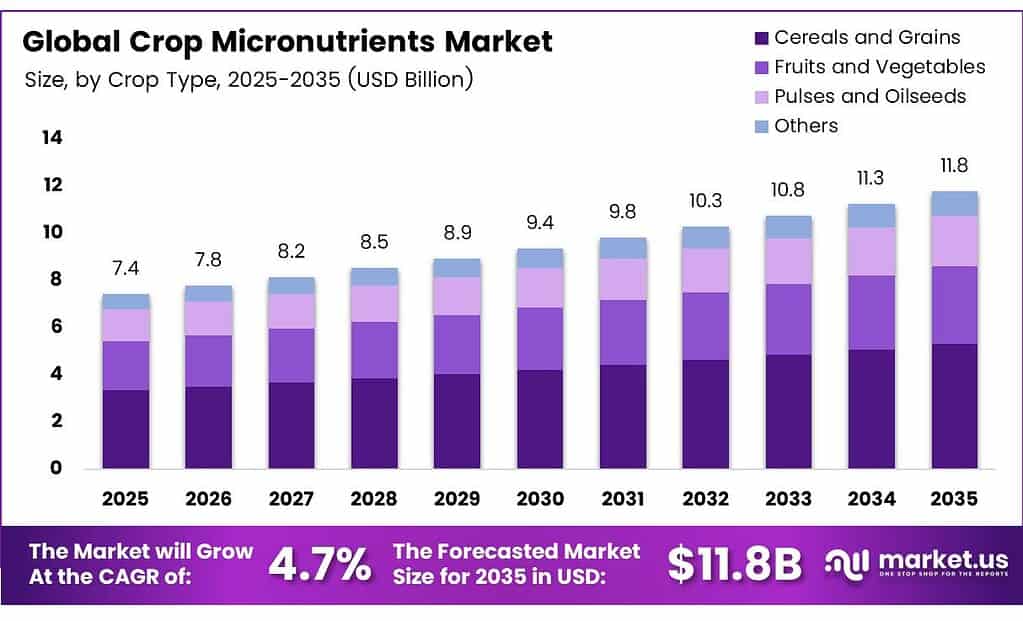
Climate-Smart Agriculture Integrates Organic and Inorganic Micronutrient Sources
Drivers
Soil Micronutrient Depletion Accelerates Demand for Corrective Inputs
High-Yielding Cultivars and Precision Farming Boost Micronutrient Requirement
Restraints
High Product Costs and Testing Requirements Create Adoption Barriers
Regulatory Approval Challenges Slow New Formulation Market Entry
Growth Factors
Foliar Integration and Soil Mapping Unlock Efficiency Gains
Biofortification and Public-Private Partnerships Expand Market Reach
Regional Analysis
Asia Pacific Dominates the Crop Micronutrients Market with a Market Share of 39.5%, Valued at USD 2.9 Billion
Top Key Players in the Market
Recent Developments









