


Report Overview
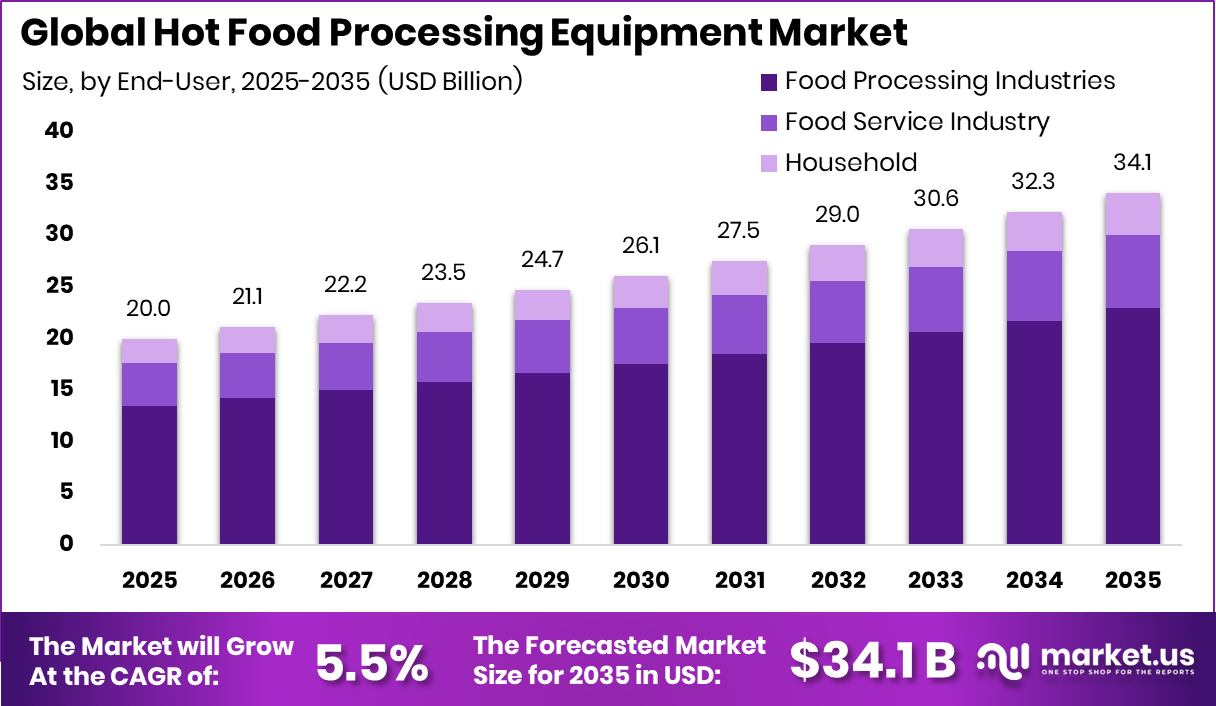
The Global Hot Food Processing Equipment Market is expected to be worth around USD 34.1 billion by 2035, up from USD 20.0 billion in 2025. It is projected to grow at a CAGR of 5.5% from 2026 to 2035. With a USD 8.7 Bn valuation, Asia Pacific holds 43.7% of the hot food processing equipment market.
Hot food processing equipment refers to machines used to apply heat during food production, including baking, frying, roasting, pasteurizing, sterilizing, and drying. These systems help improve food safety, extend shelf life, and enhance taste and texture. The taxonomy of this market includes equipment such as baking, evaporation, pasteurization, dehydration, roasting and grilling, frying, sterilization, blanching, and others, serving different processing needs across industries.
 $23 million to help food processors adopt advanced technologies.
Such funding encourages the implementation of smart systems that improve operational performance. As industries increasingly focus on precision and efficiency, connected equipment is becoming a standard feature, transforming how food processing operations are managed and monitored.
Compact multifunctional machines are gaining market popularity
Compact and multifunctional equipment is gaining traction as businesses seek flexible and space-saving solutions. These machines combine multiple processing functions, such as frying, roasting, and baking, into a single unit, making them ideal for both commercial and small-scale operations. This trend is supported by investments like Ontario allocating $25 million to increase food processing capacity, encouraging modernization and efficiency.
The demand for versatile equipment is particularly strong among small and medium enterprises looking to maximize productivity with limited space and budget. As a result, multifunctional systems are becoming an important trend, offering convenience, cost savings, and operational flexibility.
Regional Analysis
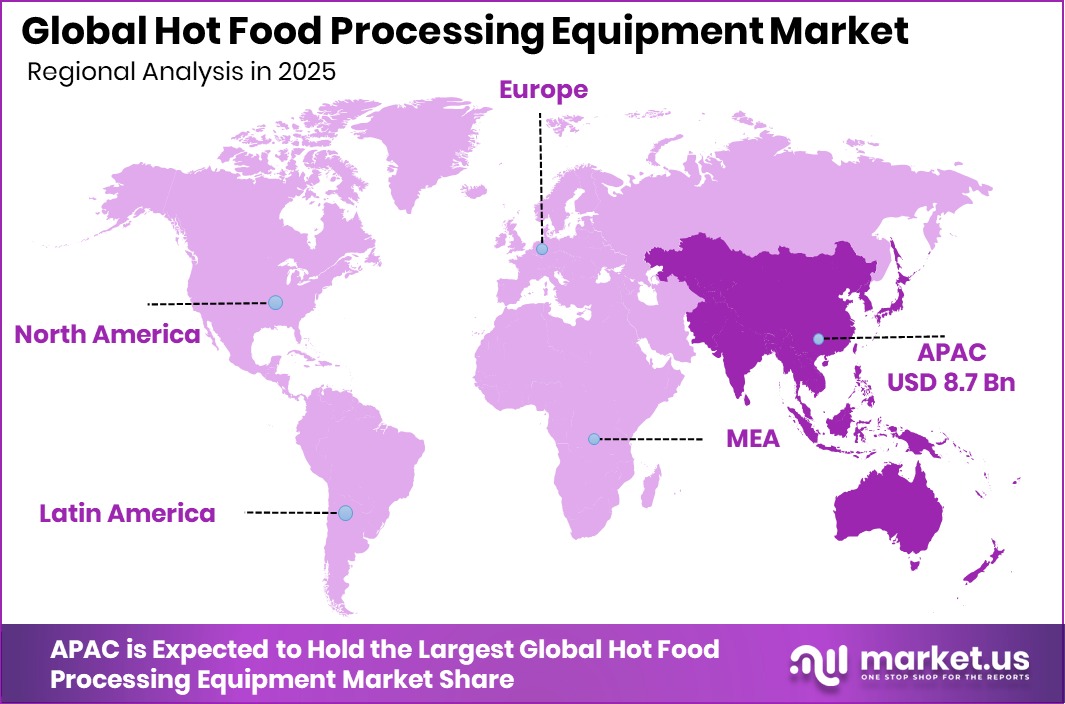
In 2025, Asia Pacific dominates the Hot Food Processing Equipment Market with 43.7% share, USD 8.7 Bn value.
The Hot Food Processing Equipment Market demonstrates varied regional dynamics across North America, Europe, Asia Pacific, the Middle East & Africa, and Latin America, reflecting differences in industrial development and consumption patterns. Asia Pacific emerges as the dominating region, accounting for 43.7% of the market with a valuation of USD 8.7 Bn, driven by strong demand from expanding food processing industries and rapid urbanization.
North America and Europe maintain steady growth, supported by established food manufacturing sectors and consistent demand for processed and convenience foods. Meanwhile, the Middle East & Africa region is gradually advancing, supported by increasing investments in food infrastructure and rising consumption needs.
Latin America also shows moderate progress, with growing adoption of food processing technologies in response to shifting consumer preferences. Overall, while all regions contribute to market expansion, Asia Pacific clearly leads in both share and value, positioning itself as the central hub for growth in the global Hot Food Processing Equipment Market.
Key Regions and Countries
- North America
- US
- Canada
- Europe
- Germany
- France
- The UK
- Spain
- Italy
- Rest of Europe
- Asia Pacific
- China
- Japan
- South Korea
- India
- Australia
- Rest of APAC
- Latin America
- Brazil
- Mexico
- Rest of Latin America
- Middle East & Africa
- GCC
- South Africa
- Rest of MEA
Key Players Analysis
In 2025, GEA Group Aktiengesellschaft continues to demonstrate a strong strategic focus within the global Hot Food Processing Equipment Market. The company’s strength lies in its diversified equipment portfolio and engineering expertise, enabling it to cater to a wide range of food processing requirements. Its emphasis on process optimization and efficiency positions it as a reliable partner for manufacturers seeking consistent output and operational stability. GEA’s structured approach to product development and system integration supports scalable solutions, making it well-aligned with evolving production needs.
Bühler AG maintains a competitive stance through its deep-rooted specialization in food processing technologies. The company’s ability to deliver precision-driven equipment supports high-quality production outcomes, particularly in thermal and processing applications. Bühler’s focus on technological refinement and application-specific solutions enhances its relevance across diverse food segments. Its strong engineering capabilities and consistent product innovation contribute to its positioning as a dependable provider in the global market landscape.
Marel stands out for its integrated approach to food processing equipment and systems. The company emphasizes streamlined processing solutions that improve productivity and operational flow. Marel’s capability to offer end-to-end systems supports efficiency across multiple processing stages. Its focus on reliability and performance enables it to address the practical needs of food manufacturers, reinforcing its role as a key participant in the Hot Food Processing Equipment Market.
Top Key Players in the Market
- GEA Group Aktiengesellschaft
- Bühler AG
- Marel
- The Middle by Corporation
- JBT
- Heat & Control, Inc
- SPX Flow
- Tetra Laval International S.A
- Alfa Laval
- TNA Australia Pty Limited
Recent Developments
- In July 2025, GEA opened a new Food Application and Technology Center in Wisconsin, USA. The company, known for manufacturing food processing equipment, developed this facility to support advanced food production technologies such as thermal processing, fermentation, and alternative protein manufacturing. This development strengthens GEA’s capability in hot food processing by enabling large-scale testing and production optimization.
- In January 2025, Bühler acquired advanced puffing technology from CEREX. The company, which develops food processing equipment, made this move to expand its product portfolio for snacks, cereals, bakery, and dairy applications. This technology uses heat and pressure to process food, making it highly relevant for hot food processing equipment. It improves product texture, shelf life, and production efficiency while reducing energy consumption.









