


Report Overview
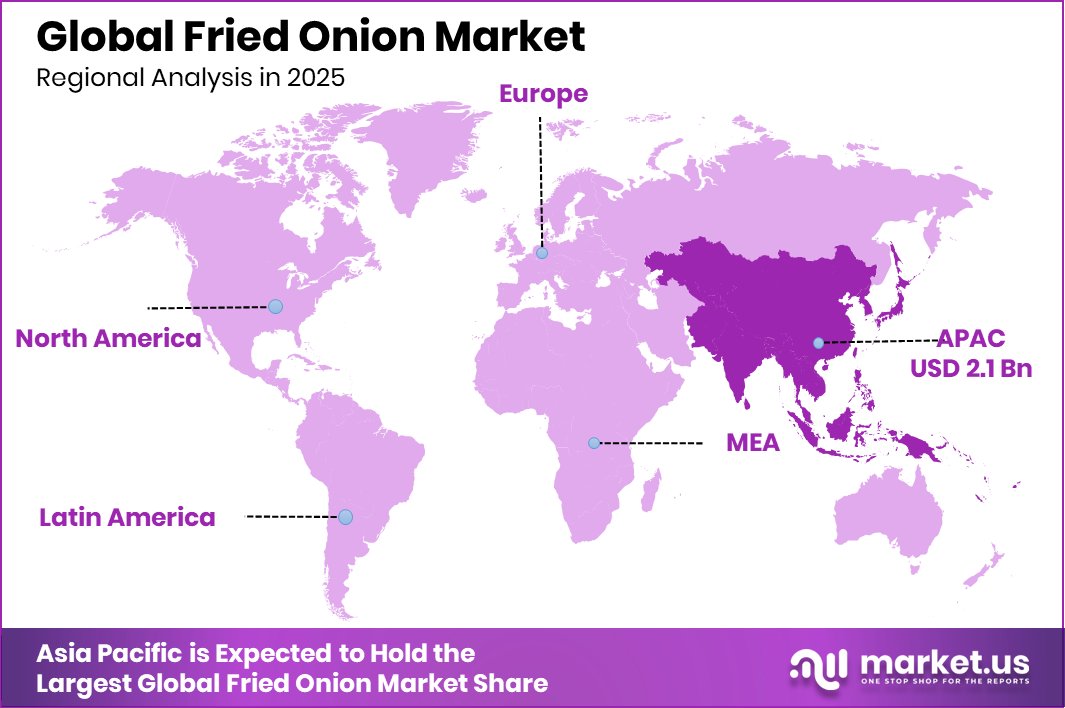
The Global Fried Onion Market is expected to be worth around USD 7.7 billion by 2035, up from USD 5.0 billion in 2025. It is projected to grow at a CAGR of 4.4% from 2026 to 2035. The Asia Pacific region represented 42.1%, generating USD 2.1 Bn for the Fried Onion Market.
Fried onion refers to sliced, chopped, powdered, flaked, or string-cut onions that are cooked in oil until they develop a golden-brown color, crisp texture, and rich savory taste. It is widely used as a topping, garnish, flavor enhancer, and ready ingredient in soups, stews, salads, sandwiches, instant noodles, ramen, snacks, meal toppings, and seasoning stocks. Its appeal comes from convenience, longer shelf life, and the ability to instantly improve taste and texture.
Such funding momentum across packaged and prepared food ecosystems indirectly strengthens opportunities for fried onion applications in next-generation meal kits, ready snacks, and shelf-stable recipe solutions, supporting sustained category expansion. The Fried Onion Market is also benefiting from expanding use in snacks and noodles, where crispy onion inclusions are increasingly valued for savory taste, aroma, and crunchy mouthfeel. Fried onion flakes, strings, and powder forms are becoming common in instant noodles, ramen bowls, extruded snacks, and coated savory products. This application growth aligns with the expansion of innovative food brands, highlighted by FoodTech LANCH securing €26 million to scale food brands, which indicates strong investment appetite in convenient and flavor-led packaged foods. As snack makers and noodle producers focus on differentiated textures and premium seasoning experiences, fried onion continues to gain importance as a functional flavor ingredient. A major challenge for the Fried Onion Market is volatile onion prices, which directly influence raw material sourcing costs and create margin pressure for processors and packaged food manufacturers. Seasonal supply fluctuations, crop yield variations, and storage limitations can all contribute to unstable input pricing, affecting profitability and long-term pricing strategies. This cost sensitivity is especially relevant in mass-market food categories where fried onion is used extensively. Broader funding activity, such as The Naked Market’s $27.5 million Series A funding, reflects how food brands continue to invest in resilience and supply chain optimization, yet raw material price unpredictability remains a persistent restraint for fried onion producers. Oil quality concerns remain an important restraint in the Fried Onion Market because frying medium selection strongly affects product shelf life, taste consistency, oxidation resistance, and consumer acceptance. Poor oil stability can reduce crispness retention and shorten storage performance, especially in retail packs and export channels. Maintaining premium oil quality standards increases production costs and quality control requirements. This challenge parallels the broader snack industry’s focus on better formulations, supported by Quinn natural foods snack brand securing $10M in Series B funding, highlighting continued emphasis on cleaner, higher-quality ingredient systems that also influence fried onion processing expectations. A strong opportunity in the Fried Onion Market lies in the growth of seasoning blends and toppings, where powder and flakes are increasingly used in dry soup bases, spice mixes, savory coatings, and meal garnishes. Their ability to deliver concentrated onion flavor with convenience makes them highly suitable for both retail and foodservice innovation. This opportunity is reinforced by wider alternative food investments, including Meati receiving a $100M funding boost, which reflects strong market interest in ingredient-led product differentiation. Fried onion can benefit from this trend through expanded use in premium flavor systems, snack coatings, and ready seasoning sachets. Rising demand from quick service restaurants offers another significant opportunity for the Fried Onion Market, as these outlets increasingly use crispy onion toppings, burger inclusions, sandwich layers, and side garnishes to enhance flavor and texture appeal. Growth in delivery-focused and fast-casual formats is creating consistent bulk demand for standardized fried onion ingredients. This expansion mirrors food retail and snack investment momentum, such as KoRo’s €35M oversubscribed funding round, signaling broader confidence in scalable food categories that support topping and inclusion ingredients. One of the latest trends in the Fried Onion Market is the growing retail demand for premium crispy flakes, driven by consumers seeking restaurant-style toppings for home meals, salads, noodles, and soups. Premium packaging, improved crunch retention, and gourmet seasoning variations are making flakes more attractive in modern retail shelves. This trend aligns with innovation-focused funding across branded foods, including Partake Foods’ $11.5 million Series B funding, which highlights rising investor interest in premium packaged food experiences and supports the continued evolution of upscale fried onion retail offerings. Clean-label flavored onion toppings are emerging as a strong global trend in the Fried Onion Market, supported by consumer preference for simple ingredient lists, natural oils, and recognizable seasonings. Brands are increasingly exploring onion toppings with herbs, mild spices, and reduced additive formulations for salads, meal bowls, and snack kits. This movement is consistent with healthy snack innovation momentum, reflected by the $5 million funding secured by a low-sugar snack bar brand, indicating sustained demand for better-for-you ingredient positioning that also benefits clean-label fried onion innovations. In the Asia Pacific, the Fried Onion Market reached USD 2.1 Bn with 42.1% share. In 2025, the Fried Onion Market demonstrates a diverse regional footprint across North America, Europe, Asia Pacific, the Middle East & Africa, and Latin America, with demand patterns shaped by processed food consumption, convenience meal adoption, and foodservice expansion. Among these, Asia Pacific stands out as the dominating region, accounting for 42.1% of the global market and reaching a value of USD 2.1 Bn, reflecting its strong concentration of food processing industries and widespread culinary use of fried onion ingredients in packaged foods, soups, stews, snacks, and ready-to-cook dishes. The region’s leadership is further supported by its established supply chain for onion cultivation and dehydration, which strengthens large-scale production capabilities and export competitiveness. Meanwhile, North America and Europe continue to represent important mature markets driven by premium convenience foods and seasoning applications, while the Middle East & Africa and Latin America show steady adoption across retail and foodservice channels. However, Asia Pacific remains the clear market leader in both share and value, with 42.1% and USD 2.1 Bn firmly positioning it as the key revenue-generating regional segment in the Fried Onion Market. In 2025, the global Fried Onion Market reflects a competitive structure shaped by the strategic strengths of Olam International and McCormick & Company. From an analyst’s viewpoint, Olam International brings strong upstream sourcing and ingredient supply capabilities, making it highly influential in ensuring raw onion availability, processing continuity, and global distribution efficiency. McCormick & Company, with its deep expertise in seasonings and flavor solutions, strengthens the branded and value-added side of the market through product consistency, culinary innovation, and extensive retail as well as foodservice reach. Together, these companies represent supply-chain depth and finished-product strength, creating a balanced competitive dynamic. Ajinomoto Co., Inc. adds a strong formulation-driven perspective to the Fried Onion Market in 2025, supported by its long-standing expertise in savory taste enhancement and processed food integration. Its ability to align fried onion ingredients with umami-rich seasonings, soup bases, and convenience meal applications positions it as a highly strategic player in value-added food solutions. This makes the company especially relevant in premium packaged food and quick-preparation segments. Meanwhile, B&G Foods, Inc. contributes through its strength in branded grocery portfolios and shelf-stable food categories. Its role in packaged meal accompaniments, seasoning mixes, and pantry staples supports stable downstream demand for fried onion ingredients. From an analyst perspective, the combined presence of these four companies creates a strong mix of sourcing scale, flavor expertise, product innovation, and consumer-brand penetration in 2025.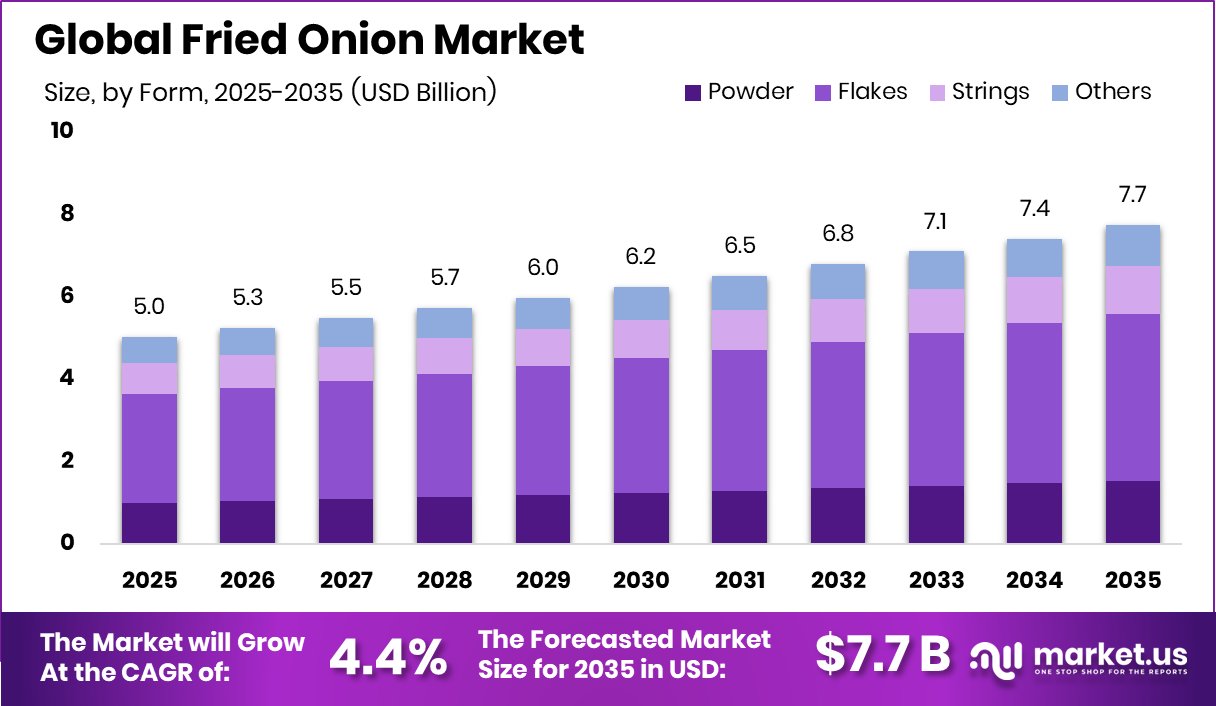
Expanding use in snacks and noodles
Restraining Factors
Volatile onion prices impact production costs
Oil quality concerns affect shelf stability
Growth Opportunity
Growth in seasoning blends and toppings
Rising demand from quick service restaurants
Latest Trends
Premium crispy flakes are gaining retail demand
Clean-label flavored onion toppings are trending globally
Regional Analysis
Key Regions and Countries
Key Players Analysis
Top Key Players in the Market
Recent Developments









