


Report Overview
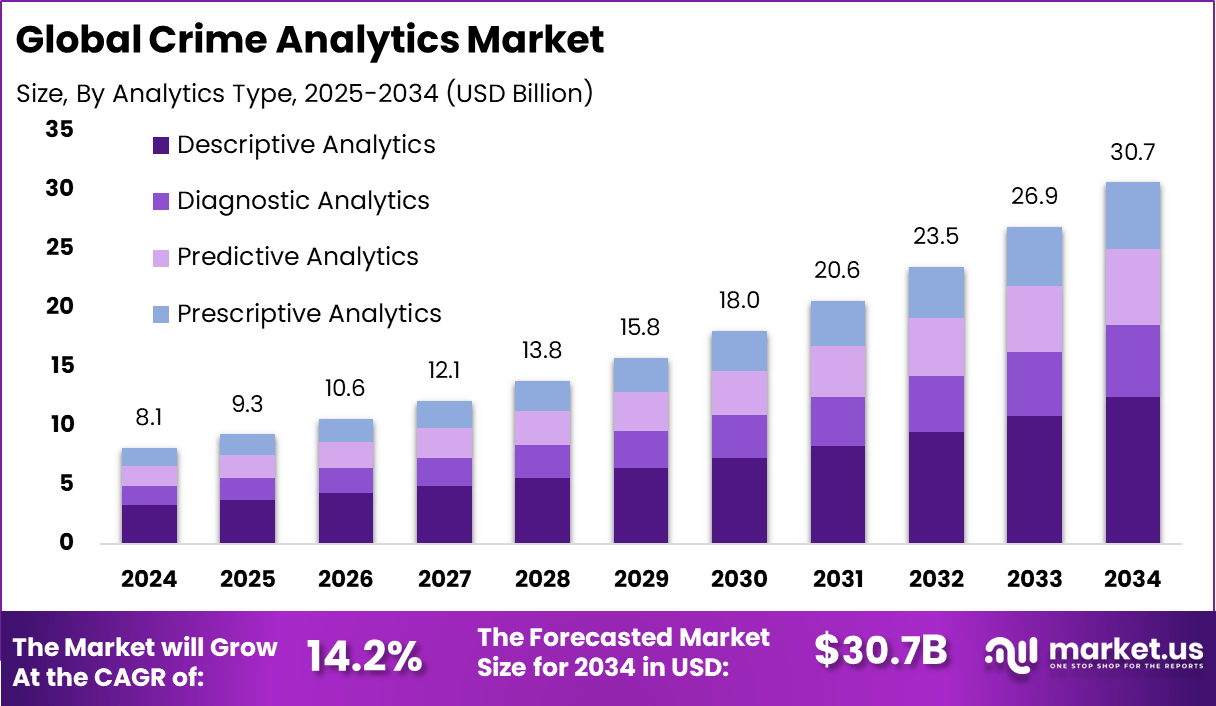
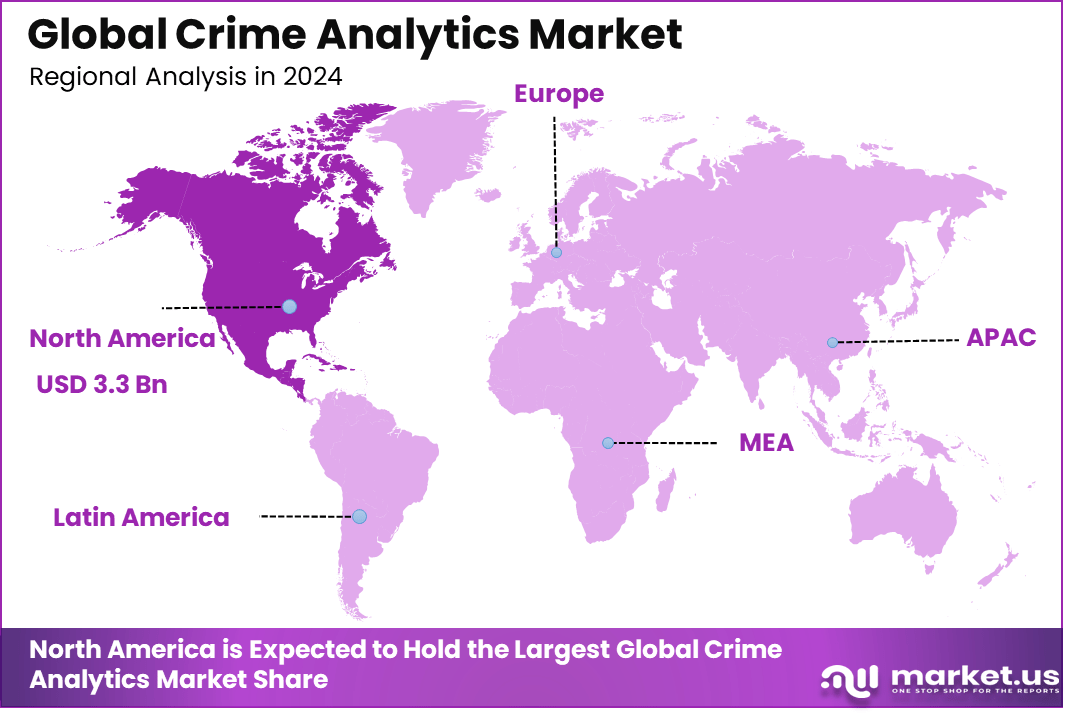
The Global Crime Analytics Market generated USD 8.1 billion in 2024 and is predicted to register growth from USD 9.3 billion in 2025 to about USD 30.7 billion by 2034, recording a CAGR of 14.2% throughout the forecast span. In 2024, North America held a dominan market position, capturing more than a 41.8% share, holding USD 3.3 Billion revenue.
The Crime Analytics Market is growing steadily, largely due to the increasing need for law enforcement agencies and security organizations to efficiently address rising crime rates. The growing availability of large datasets, including crime reports, social media feeds, and sensor data, provides the foundation for effective analytics. Technologies like AI and ML are enhancing predictive capabilities, allowing agencies to identify crime hotspots and optimize resource deployment.
Top driving factors in this market include the rapid rise in criminal activities such as cybercrime and organized crime, which demand better crime monitoring and analysis tools. Public safety concerns, combined with government initiatives aimed at enhancing security infrastructure, are pushing agencies to adopt advanced crime analytics. Another strong driver is the emphasis on data-driven policing for transparency and accountability, which increases confidence in authorities.
Quick Market Facts
- By component, solutions dominate with 65.4%, driven by the growing use of advanced software for crime prediction and investigation.
- By deployment model, on-premise systems hold 55.3%, reflecting preference for secure, locally managed platforms in sensitive law enforcement environments.
- By application, incident analysis accounts for 30.7%, highlighting strong use of analytics to detect, link, and resolve crime patterns.
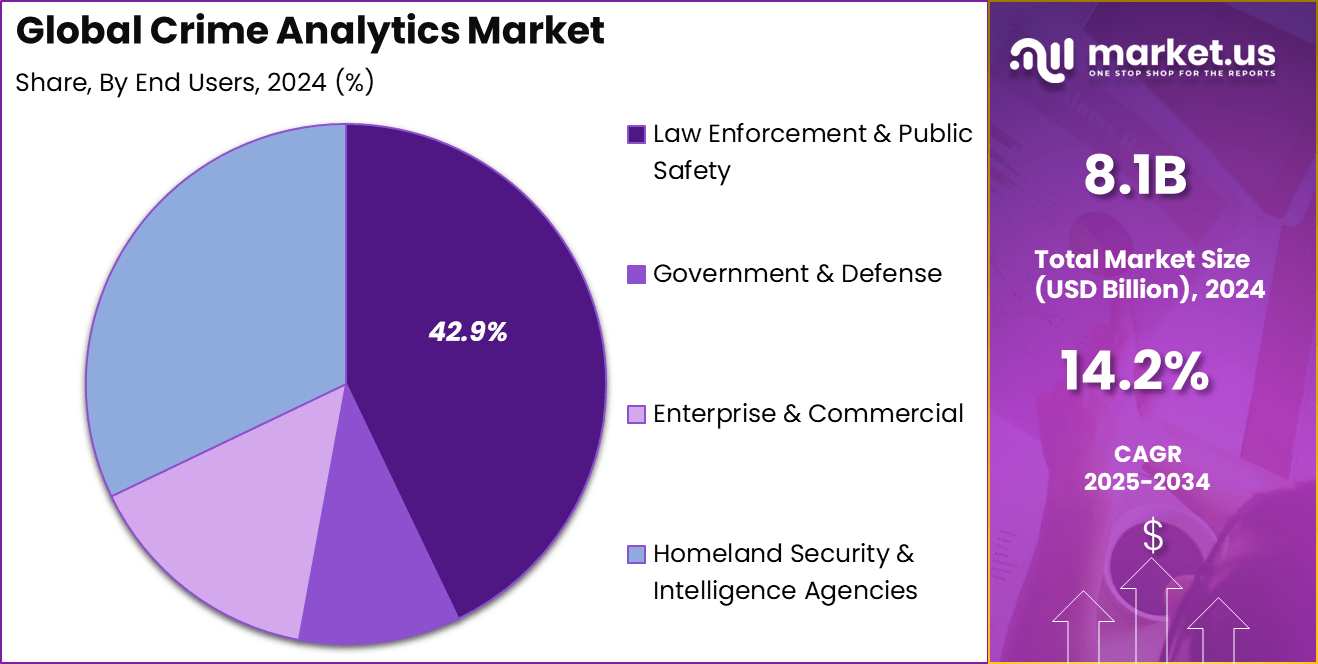
- By end-user, law enforcement and public safety agencies represent 42.9%, underscoring the critical role of analytics in crime prevention and response.
- By analytics type, descriptive analytics leads with 40.5%, showing its importance in mapping historical crime trends and supporting strategic decisions.
- North America leads with 41.8%, backed by strong adoption of data-driven policing tools.
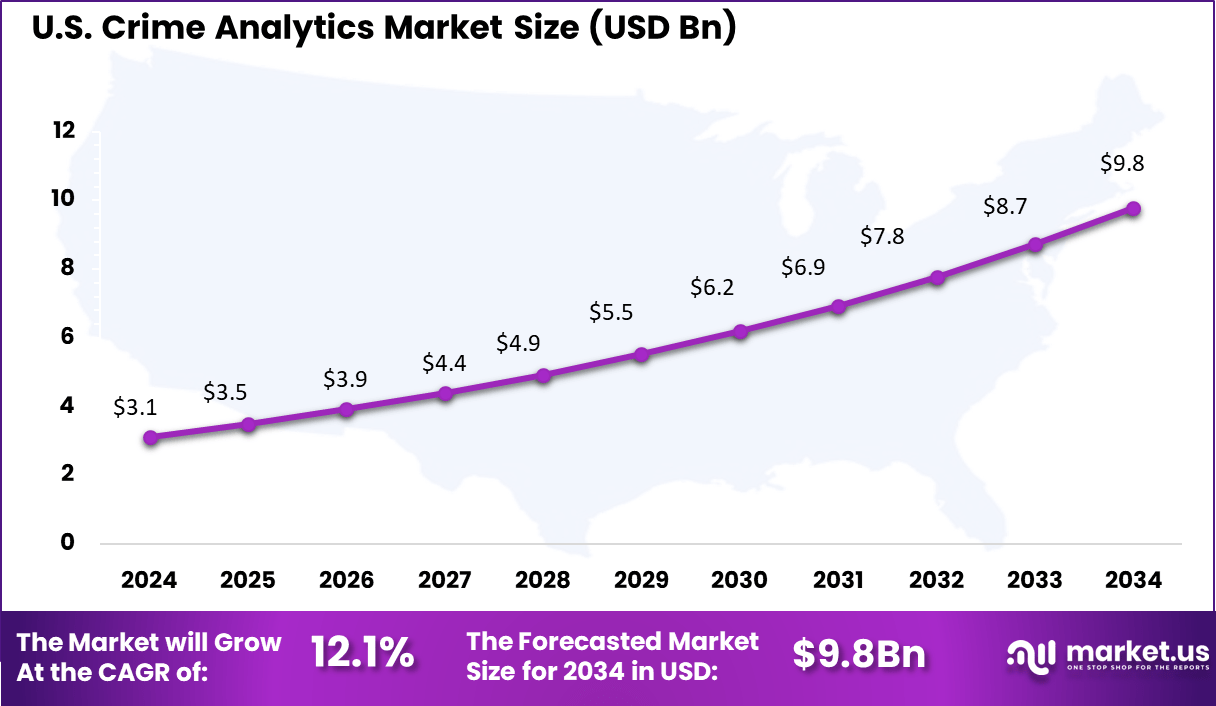
- The US market reached USD 3.12 billion and is growing at a steady CAGR of 12.1%, reflecting increased investment in smart public safety infrastructure.
Core Crime Statistics
- Crime rate: This refers to the number of crimes recorded per 100,000 people, offering a standardized benchmark for comparing crime levels across different regions or time periods.
- Total volume of crimes: This represents the absolute number of recorded criminal incidents, such as total cognizable offenses in a jurisdiction. It provides a direct measure of the scale of crime without population adjustment.
- Crime type frequency: These statistics break down crime data by specific offense categories, including murder, burglary, auto theft, sexual assault, cybercrime, and economic offenses. This helps identify which types of crimes are most prevalent and require targeted intervention.
- Geospatial data and hotspot analysis: Crime data is mapped to specific geographic areas such as police beats, districts, or cities. Hotspot analysis highlights locations where crime is concentrated, enabling focused policing and resource deployment.
- Temporal data: This analysis tracks when crimes occur, including time of day (e.g., peak hours like 5–7 PM), day of the week, and seasonal patterns. It provides valuable insights for anticipating crime trends and optimizing patrol schedules.
- Victim and offender demographics: These statistics include the age, sex, and other characteristics of victims and known offenders. Such data supports the creation of offender profiles and helps uncover relationships or risk factors between the individuals involved.
Role of Generative AI
Generative AI has emerged as a transformative force in crime analytics by enabling the simulation and analysis of complex criminal behaviors and attack patterns. It can autonomously generate new cyberattack models by learning from vast datasets of known incidents, which enhances both the preventative and investigative measures in law enforcement.
This technology improves anomaly detection and flags suspicious activities with greater accuracy, helping reduce false positives by more than 50%. The ability of generative AI to analyze large and diverse data sets in real time allows agencies to predict and respond to criminal actions more effectively than traditional methods.
Generative AI also plays a significant role in financial crime compliance by automating routine tasks and enabling seamless investigations. Its capacity to centralize and process data supports improved Know Your Customer (KYC) measures and risk assessments, which are crucial for identifying complex criminal networks.
In forensic data analysis, generative AI simulations of cyberattack scenarios offer realistic and adaptive models that assist in preparing for evolving threats, thus strengthening cyber forensics and crime prevention efforts. These advancements contribute to a more proactive approach in tackling crime using intelligence-driven solutions.
US Market Size
The United States alone holds an estimated market size of around USD 3.12 billion with a high compound annual growth rate (CAGR) of about 12.1%. This growth is propelled by investments in law enforcement modernization, smart city projects, and national security programs. The U.S. has a diverse ecosystem of federal, state, and local agencies that drive demand for solutions capable of handling complex, varied crime data.
In 2024, North America leads the crime analytics market with about 41.8% of the total share. The region benefits from technological sophistication, strong law enforcement funding, and early adoption of analytics solutions. Its public safety agencies are equipped with advanced crime prevention tools and infrastructures supported by robust regulatory frameworks.
By Component: Solutions
In 2024, Solutions dominate the crime analytics market, making up about 65.4% of the total. These solutions include software platforms for data integration, visualization, and predictive modeling, which help law enforcement and public safety agencies analyze crime data efficiently.
Advanced technologies such as AI and machine learning are increasingly embedded into these solutions to provide actionable insights from diverse data sources. This focus on software over hardware or services highlights the market’s emphasis on smart, scalable, and adaptable systems that meet evolving public safety needs.
The growth of solutions is driven by continual innovation, including the integration of real-time analytics and user-friendly dashboards. These tools support proactive crime prevention by identifying patterns and hotspots, improving decision-making and resource allocation. Vendors are investing heavily in enhancing capabilities such as incident forecasting and case management, which makes solutions indispensable for modern crime analytics strategies.
By Deployment Model: On-Premise
In 2024, On-premise deployment is the preferred model for 55.3% of users, particularly among government and public safety organizations with stringent data privacy and security requirements. This model allows agencies to retain direct control over sensitive information and comply with regulatory standards.
Although on-premise systems often require higher upfront costs and dedicated maintenance, their advantages in customization and data sovereignty make them crucial for many law enforcement bodies. Despite the growing popularity of cloud services, on-premise deployment remains significant due to concerns over data breaches and compliance complexities.
Organizations deploying these systems prioritize security controls and infrastructure stability, often integrating advanced cybersecurity measures. The persistence of this model reflects a cautious but strategic approach in handling sensitive crime data, especially in regions with strict regulatory environments.
By Application: Incident Analysis
In 2024, Incident analysis holds a 30.7% share as a key application area. This involves examining past crime events to uncover trends, patterns, and causal relationships that improve understanding and response strategies. Effective incident analysis supports law enforcement agencies in identifying repeat offenders, crime hotspots, and emerging threats.
It also aids in resource optimization, ensuring quicker response times and targeted interventions. The rising complexity of crime and public safety challenges is amplifying demand for advanced incident analysis capabilities.
Analytics tools now incorporate multi-source data such as surveillance feeds, social media inputs, and geographic information systems (GIS) to supplement traditional crime reports. This enriched context helps agencies make informed decisions, improving both tactical operations and long-term crime prevention efforts.
By End-User: Law Enforcement & Public Safety
In 2024, Law enforcement and public safety organizations are the primary end-users, constituting about 42.9% of the market. These entities leverage crime analytics to enhance policing efficiency, deploy resources smartly, and increase community safety. Innovations in crime mapping, predictive policing, and performance monitoring have made analytics indispensable for modern public safety operations.
The increasing volume and diversity of crime data require agencies to adopt integrated analytics platforms capable of handling large datasets securely and efficiently. This focus is extending beyond traditional law enforcement to public safety agencies handling emergencies, disaster response, and critical infrastructure protection. These users drive demand for solutions tailored to operational needs and regulatory compliances.
By Analytics Type: Descriptive Analytics
In 2024, Descriptive analytics commands about 40.5% of the crime analytics market. It focuses on interpreting historical data to provide clear insights into past crime trends, frequencies, and outcomes. This foundational analytics type supports reporting, visualization, and baseline assessments essential for informed law enforcement decision-making and performance evaluation.
While predictive and prescriptive analytics continue to grow, descriptive analytics maintains a vital role due to its simplicity, transparency, and ease of integration with existing systems. It forms the basis for more sophisticated analytical layers and remains critical to agencies seeking to understand and communicate crime patterns effectively.
Emerging Trends
A key trend in crime analytics is the growing shift towards predictive policing enabled by AI and machine learning. Advanced algorithms analyze historical crime data alongside real-time inputs to forecast crime hotspots and optimize law enforcement resources. Approximately 15% annual growth is seen in the adoption of predictive policing tools, which are becoming crucial for urban safety strategies.
Another emerging trend is the integration of cloud-based platforms that offer scalable, accessible crime analytics solutions, allowing agencies to handle increasing data volumes from sources like surveillance footage, social media, and IoT devices efficiently. Data integration and visualization tools are also advancing, enabling actionable intelligence from diverse data streams.
Public safety analytics now incorporate sensor networks, drone surveillance, and AI-powered incident response optimizations. Around 11% year-to-date crime reduction trends in some regions have been partly attributed to such data-driven approaches that improve situational awareness and emergency response times. The rise of these technologies is especially prominent in North America and Europe, with expanding interest from emerging economies fueling innovation and investment in crime analytics.
Growth Factors
The expanding market for crime analytics is largely driven by the increasing need to combat rising crime rates with more efficient and technologically advanced methods. The availability of large datasets, including crime records and sensor data, fuels the development of sophisticated analytical models that improve crime prediction and resource allocation.
Annual market growth rates of around 9.5% to 15% reflect how law enforcement agencies and private security firms are embracing AI and machine learning to enhance effectiveness and accountability in public safety. Another major growth contributor is the escalating collaboration between public agencies and private security firms. This synergy facilitates sharing of intelligence and security resources, driving innovations in crime prevention and detection.
Furthermore, smart city initiatives globally are prompting investments in crime analytics tools as part of broader urban security infrastructure upgrades. This integration of technology allows for better monitoring, faster decision-making, and more proactive interventions, fueling the continuous expansion of the crime analytics ecosystem.
Key Market Segments
By Component
- Solutions
- Crime Data Management
- Predictive Analytics
- Pattern Detection
- Geolocation Analytics
- Investigative Leads Management
- Video Analytics
- Social Media Analytics
- Services
- Professional Services
- Consulting
- Implementation
- Training
- Managed Services
- Professional Services
By Deployment Model
- On-Premise
- Cloud-Based
By Application
- Predictive Policing
- Incident Analysis
- Investigative Leads Management
- Forensic Analysis
- Others
By End-User
- Law Enforcement & Public Safety
- Government & Defense
- Enterprise & Commercial
- Homeland Security & Intelligence Agencies
By Analytics Type
- Descriptive Analytics
- Diagnostic Analytics
- Predictive Analytics
- Prescriptive Analytics
Regional Analysis and Coverage
- North America
- US
- Canada
- Europe
- Germany
- France
- The UK
- Spain
- Italy
- Russia
- Netherlands
- Rest of Europe
- Asia Pacific
- China
- Japan
- South Korea
- India
- Australia
- Singapore
- Thailand
- Vietnam
- Rest of Latin America
- Latin America
- Brazil
- Mexico
- Rest of Latin America
- Middle East & Africa
- South Africa
- Saudi Arabia
- UAE
- Rest of MEA
Driver
Rising Urban Crime Rates Increase Demand
The ongoing rise in crime rates across urban centers is a significant force driving the growth of the crime analytics market. As cities grow denser, law enforcement agencies face mounting challenges in managing public safety effectively.
Crime analytics software helps analyze vast crime data, identify hotspots, and predict criminal activities, enabling proactive policing. This improved foresight allows authorities to allocate resources more efficiently, which is crucial in high-crime areas seeking to safeguard their communities.
Moreover, increasing public concerns about safety have spurred governments and private organizations to invest heavily in advanced crime analytics tools. The need for data-driven crime prevention strategies is stronger than ever, and this has positioned crime analytics as a critical technology for modern policing. These factors combine to create a stable and growing demand that sustains the market’s momentum.
Restraint
High Implementation Costs Limit Adoption
One of the key hurdles restraining the crime analytics market is the substantial cost involved in deploying these advanced technologies. Crime analytics systems typically require heavy investments in specialized software, data infrastructure, and skilled personnel who can interpret complex analytics outputs.
Smaller law enforcement agencies or organizations with limited budgets often find these costs prohibitive, slowing widespread adoption. Additionally, the integration of analytics solutions with existing systems can be complex and costly.
The need for continuous updates and maintenance adds further financial burdens. These cost factors deter some potential users, particularly in less developed regions, from embracing cutting-edge crime analytics solutions despite their potential benefits, thereby limiting market expansion in certain segments.
Opportunity
AI and Big Data Integration for Smarter Policing
The integration of artificial intelligence (AI) and big data analytics into crime analytics tools offers considerable growth opportunities. AI enhances pattern recognition, predictive policing, and real-time crime detection, allowing agencies to intercept criminal activities before they occur or escalate.
The explosion of data availability – from crime reports to social media and sensor data – fuels these AI-powered models, creating richer and more accurate insights. Furthermore, smart city initiatives globally are driving demand for integrated security platforms that combine crime analytics with other municipal services.
Vendors that can offer scalable, user-friendly AI tools tailored for varying crime types or geographies are well-positioned to capture market share. This opportunity expands as law enforcement prioritizes technology-enabled crime prevention and more partnerships emerge across public and private sectors.
Challenge
Data Privacy and Ethical Concerns
A major challenge facing the crime analytics market is the growing concern over data privacy and ethical use of predictive policing technologies. Collecting and analyzing large amounts of personal and behavioral data raises fears about surveillance overreach and potential bias in AI algorithms. These ethical considerations have led to regulatory scrutiny, hampering deployment and acceptance.
Law enforcement agencies need to ensure transparency, fairness, and accountability while using these tools to maintain public trust. Policymakers are increasingly demanding clear guidelines and standards to mitigate risks related to civil liberties and discrimination. Balancing the advantages of data-driven crime prevention with rights protection remains a complex hurdle that market participants must navigate carefully.
Competitive Analysis
IBM Corporation, Accenture PLC, and Cognizant Technology Solutions Corporation lead the Crime Analytics market through advanced AI, data integration, and real-time intelligence platforms. Their solutions support public safety agencies by enabling faster crime detection and predictive decision-making. With global deployment and scalable tools, these firms help optimize patrol allocation, improve emergency response, and streamline case management.
SAS Institute Inc., Palantir Technologies Inc., and Hexagon AB are at the forefront of advanced analytics, geospatial intelligence, and data visualization. Their platforms uncover crime trends by analyzing data from surveillance networks, social media, and public databases. Esri, Verisk Analytics, and Nice Ltd. further support the market by offering risk modeling, GIS mapping, and evidence management solutions.
Specialized providers such as PredPol, Inc., Wynyard Group, and LexisNexis Risk Solutions focus on crime prediction and behavioral analytics. These firms enable law enforcement agencies to anticipate crime hotspots and deploy resources proactively. Motorola Solutions, Inc. and BAE Systems plc offer integrated security and communication systems, enhancing situational awareness and public safety coordination.
Top Key Players in the Market
- IBM Corporation
- Accenture PLC
- SAS Institute Inc.
- Palantir Technologies Inc.
- LexisNexis Risk Solutions
- Motorola Solutions, Inc.
- BAE Systems plc
- Hexagon AB
- Esri (Environmental Systems Research Institute)
- Verisk Analytics, Inc.
- Nice Ltd.
- Capgemini SE
- Cognizant Technology Solutions Corporation
- Wynyard Group
- PredPol, Inc.
- Others
Recent Developments
- May, 2025, SAS Institute launched its updated Financial Crimes Analytics platform, delivering AI-powered tools that provide faster, more accurate detection and prevention of financial crimes. The platform uses machine learning to reduce false positives and uncover hidden risk patterns, enabling law enforcement agencies to prioritize high-risk cases efficiently.
- March, 2025, Palantir Technologies formed a partnership with Societe Generale to deploy its Anti-Financial Crime technology across the bank’s European retail operations. This collaboration integrates Palantir’s advanced analytics and machine learning with the bank’s expertise to enhance real-time detection of fraud and money laundering risks.









