


Report Overview
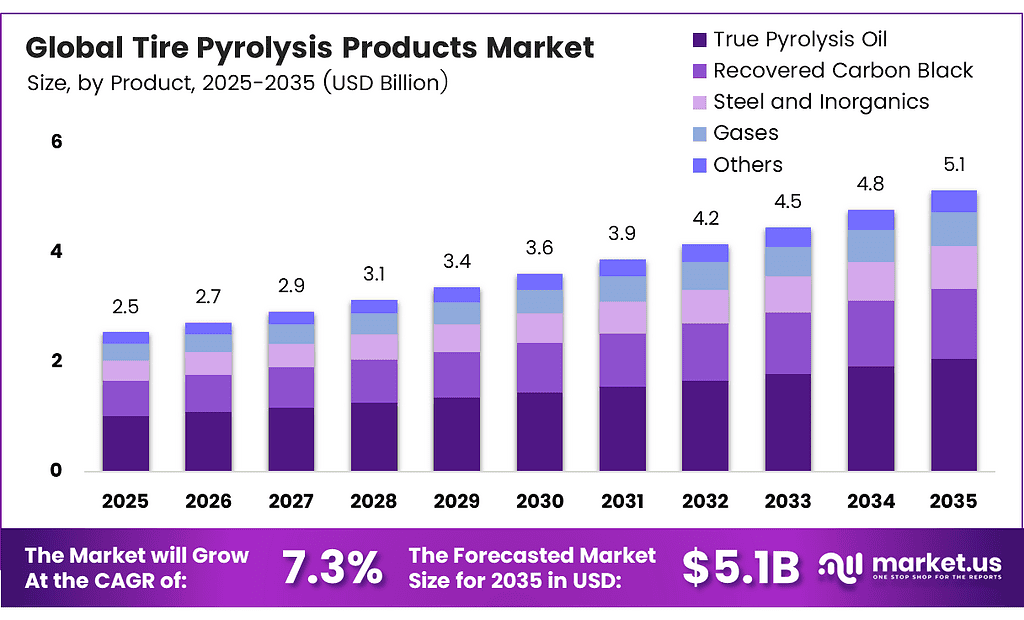
The Global Tire Pyrolysis Products Market size is expected to be worth around USD 5.1 billion by 2035 from USD 2.5 billion in 2025, growing at a CAGR of 7.3% during the forecast period 2026 to 2035.
The tire pyrolysis products market covers the commercial conversion of end-of-life tires into valuable outputs. These outputs include pyrolysis oil, recovered carbon black, steel, and combustible gases. Industries across energy, chemicals, and manufacturing use these recovered materials to replace conventional petroleum-derived inputs.
Optimized waste tire fast pyrolysis yields 46.3% tire pyrolysis oil, 39.6% carbon black, and 14.1% pyrolysis gas by mass. This product distribution highlights the commercial diversity of tire pyrolysis outputs and their potential across multiple downstream applications.
Recovered carbon black produced via thermal pyrolysis generates five times fewer carbon emissions than conventional virgin carbon black production. This significant environmental advantage drives adoption among tire manufacturers and chemical companies seeking to reduce their carbon footprint under sustainability commitments.
Demand from the automotive, construction, and chemical manufacturing sectors continues to accelerate market expansion. End users increasingly seek sustainable material inputs that reduce dependence on virgin petrochemical sources. Additionally, the rising volume of discarded tires globally creates a stable and growing feedstock base for pyrolysis operators.
Key Takeaways
- The Global Tire Pyrolysis Products Market is projected to reach USD 5.1 billion by 2035, up from USD 2.5 billion in 2025, and grow at a CAGR of 7.3% during the forecast period 2026 to 2035.
- True Pyrolysis Oil (TPO) dominates with a 39.6% market share in 2025.
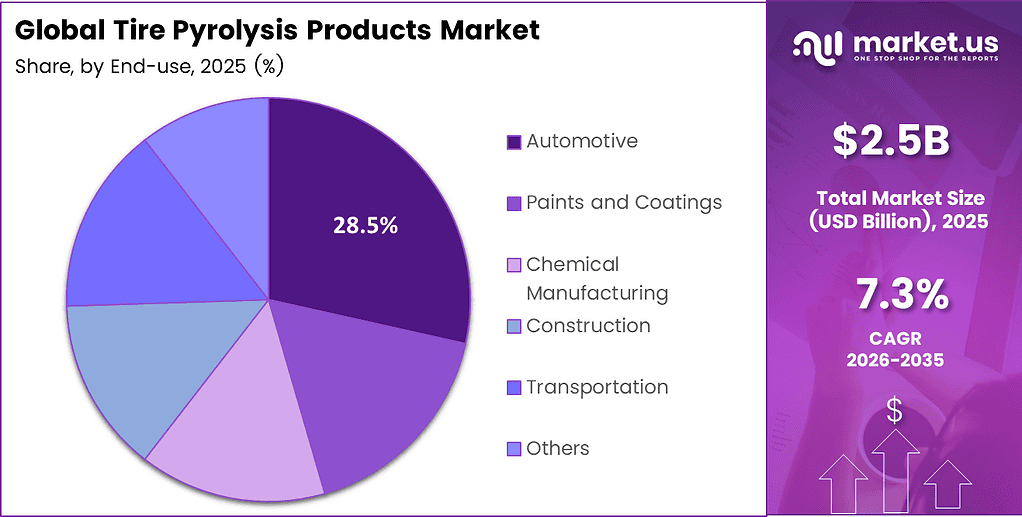
- The Automotive segment leads with a 28.5% share in 2025.
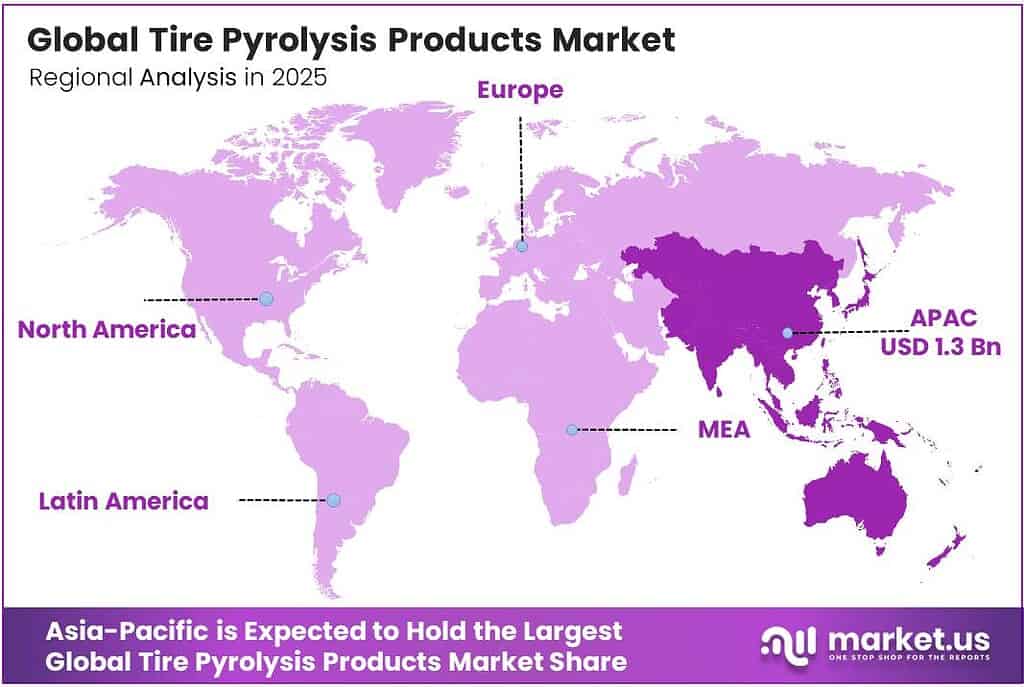
- Asia-Pacific Dominates the Tire Pyrolysis Products Market with a Share of 52.8%, Valued at USD 1.3 billion
By Product Analysis
True Pyrolysis Oil (TPO) dominates with 39.6% due to its direct use as a fuel and chemical feedstock substitute.
In 2025, True Pyrolysis Oil (TPO) held a dominant market position in the By Product segment of the Tire Pyrolysis Products Market, with a 39.6% share. TPO serves as a direct substitute for conventional fuel oil across industrial heating and power generation applications. Its compatibility with existing combustion equipment drives consistent demand from energy-intensive industries.
Recovered Carbon Black (rCB) represents a high-value co-product of the tire pyrolysis process. Manufacturers use rCB as a reinforcing agent in rubber compounds, paints, and coatings. Moreover, its lower carbon footprint compared to virgin carbon black strengthens demand from sustainability-focused producers in the automotive and industrial sectors.
Steel and Inorganics recovered from tire pyrolysis provide a recyclable metallic fraction. Steel wire extracted during the process enters scrap metal markets directly. Additionally, inorganic residues find use in construction materials, supporting waste valorization goals across multiple downstream industries.
By End Use Analysis
Automotive dominates with 28.5% due to high demand for recovered carbon black and pyrolysis oil in tire and rubber manufacturing.
In 2025, the Automotive sector held a dominant market position in the By End Use segment of the Tire Pyrolysis Products Market, with a 28.5% share. Automakers and tire producers use recovered carbon black as a cost-effective reinforcing material. Additionally, pyrolysis oil supports energy operations within manufacturing facilities, making automotive the leading consumer segment.
Paints and Coatings manufacturers incorporate recovered carbon black as a pigment and reinforcing filler. rCB offers consistent performance at competitive pricing compared to virgin alternatives. Therefore, formulators in the coatings industry increasingly source pyrolysis-derived carbon black to meet both cost and sustainability targets.
Chemical Manufacturing companies use tire pyrolysis oil as a feedstock for refinery blending and specialty chemical synthesis. TPO’s hydrocarbon composition makes it a versatile raw material. Moreover, integration into chemical supply chains supports circular economy objectives across petrochemical processing operations globally.
Construction applications include the use of carbon black and inorganic residues in modified asphalt, sealants, and roofing compounds. These materials enhance durability and performance properties. Consequently, infrastructure development programs in emerging economies offer a growing demand for pyrolysis-derived construction inputs.
Key Market Segments
By Product
- True Pyrolysis Oil (TPO)
- Recovered Carbon Black (rCB)
- Steel and Inorganics
- Gases
- Others
By End Use
- Automotive
- Paints and Coatings
- Chemical Manufacturing
- Construction
- Transportation
- Others
Emerging Trends
Modular Plant Designs and Decentralized Pyrolysis Operations Gain Traction
Tire pyrolysis operators increasingly adopt modular and portable plant configurations to reduce infrastructure costs. These compact systems enable decentralized processing closer to scrap tire sources. Moreover, according to the NITI Aayog 2026 report on waste tyres in India, advanced pyrolysis and recovered carbon black serve as critical technologies for strengthening the circular economy of waste tyres under India’s EPR framework.
Catalytic Pyrolysis and Energy Company Investment Reshape Market Dynamics
Advanced catalytic pyrolysis techniques improve product yield quality and output consistency across commercial facilities. Energy companies now actively invest in tire-derived alternative fuel programs as part of their diversification strategies. Additionally, strategic partnerships between waste management firms and energy producers accelerate the commercialization of high-performance pyrolysis products globally.
Drivers
Rising Scrap Tire Volumes and Circular Economy Policies Drive Market Expansion
Global scrap tire volumes continue to grow as vehicle ownership rises across emerging economies. Governments and industry associations actively promote circular economy models within the petrochemical and rubber sectors. The large-scale fast tire pyrolysis system consumes 102.9 kWh of energy per functional unit across all processing stages, underscoring the operational viability of industrial-scale pyrolysis solutions.
Fuel Oil Demand and Government Incentives Accelerate Pyrolysis Adoption
Emerging economies with rising industrial energy needs increasingly turn to tire pyrolysis oil as an affordable fuel alternative. Government incentive programs and waste-to-energy infrastructure policies reduce entry barriers for pyrolysis operators. Consequently, favorable regulatory environments in Asia, Europe, and Latin America continue to unlock new market opportunities for pyrolysis product manufacturers.
Restraints
High Capital Costs Limit Small-Scale Market Entry and Capacity Expansion
Tire pyrolysis facilities require substantial upfront investment in reactors, pretreatment systems, and emission controls. Small and mid-sized operators often struggle to secure financing for full-scale commercial plants. Consequently, high capital barriers restrict market participation to well-funded entities, slowing overall industry growth and geographic expansion.
Stringent Emission Regulations Create Compliance Challenges for Pyrolysis Operators
Environmental authorities impose strict emission standards on pyrolysis facilities processing waste tires at scale. Meeting these requirements demands continuous investment in monitoring equipment and pollution control systems. Therefore, regulatory compliance costs add a significant operational burden, particularly for facilities operating in markets with tightening environmental enforcement frameworks.
Growth Factors
Recovered Carbon Black Applications and Technological Improvements Fuel Market Growth
Demand for recovered carbon black in high-performance manufacturing continues to expand across rubber, coatings, and specialty chemical sectors. The company aims to use 100% sustainable materials in its tire products, with recovered carbon black from pyrolysis playing a key role in that transition. This commitment signals strong long-term demand from major industry players.
Developing Region Potential and Refinery Integration Open New Revenue Streams
Developing regions with limited tire recycling infrastructure represent significant untapped market potential for pyrolysis operators. Integration of tire pyrolysis oil into refinery and chemical feedstock supply chains further expands addressable end markets. Moreover, technological advancements continue to enhance yield efficiency, making pyrolysis economically competitive with conventional material production methods.
Regional Analysis
Asia-Pacific Dominates the Tire Pyrolysis Products Market with a Market Share of 52.8%, Valued at USD 1.3 Billion
Asia-Pacific leads the global tire pyrolysis products market with a commanding 52.8% share, valued at approximately USD 1.3 billion in 2025. The region benefits from massive scrap tire generation, supportive government waste management policies, and strong downstream demand from automotive and chemical manufacturing industries. China, India, and Southeast Asian nations drive the majority of regional activity.
North America represents a mature market for tire pyrolysis products, supported by strong environmental regulations and established waste management infrastructure. The United States actively promotes waste-to-energy conversion as part of its sustainability agenda. Moreover, growing demand for recovered carbon black from domestic tire and rubber manufacturers sustains steady market growth across the region.
Europe drives innovation in tire pyrolysis technology through strict circular economy legislation and extended producer responsibility frameworks. Countries including Germany, France, and the UK lead regional adoption of recovered carbon black in automotive manufacturing. Additionally, the European Union’s sustainability directives continue to accelerate investment in advanced tire recycling and pyrolysis infrastructure.
Latin America shows growing interest in tire pyrolysis as governments seek cost-effective waste management solutions for rising scrap tire volumes. Brazil and Mexico represent the primary growth markets in the region. However, limited regulatory enforcement and infrastructure gaps continue to slow commercial-scale pyrolysis deployment across most Latin American countries.
Key Regions and Countries
North America
- US
- Canada
Europe
- Germany
- France
- The UK
- Spain
- Italy
- Rest of Europe
Asia Pacific
- China
- Japan
- South Korea
- India
- Australia
- Rest of APAC
Latin America
- Brazil
- Mexico
- Rest of Latin America
Middle East & Africa
- GCC
- South Africa
- Rest of MEA
Key Players Analysis
Bolder Industries is a US-based pioneer in recovered carbon black production from end-of-life tires. The company operates commercial-scale pyrolysis facilities and supplies rCB to rubber and specialty chemical manufacturers. Bolder Industries positions itself at the forefront of circular material supply, targeting performance-grade applications in industrial and automotive markets.
Klean Industries delivers integrated waste-to-energy and pyrolysis solutions across North America and Asia. The company offers full-facility design, engineering, and operational services for tire pyrolysis projects. Klean Industries collaborates with municipal governments and industrial operators to establish compliant, high-output pyrolysis plants that convert scrap tires into commercially valuable fuel and material products.
Bridgestone actively integrates tire pyrolysis and recovered carbon black into its sustainable materials strategy. The company invests in circular supply chain development to reduce dependence on virgin petrochemical inputs. Bridgestone’s engagement in pyrolysis-derived material adoption reflects the broader commitment of global tire manufacturers to achieving long-term sustainability and carbon neutrality targets.
Metso provides advanced thermal processing and pyrolysis technology solutions for industrial waste management applications. The company’s equipment and process engineering capabilities support large-scale tire pyrolysis facilities across global markets. Metso’s technology expertise positions it as a key enabler for operators seeking to improve plant yield, energy efficiency, and product quality at commercial scale.
Top Key Players in the Market
- Bolder Industries
- Pryolyx
- Klean Industries
- Bridgestone
- Metso
- Bioenergy AE Cote-Nord
- Green Fuel Nordic Oy
- New Hope Energy
- Marubeni Corporation
- Contec S.A.
- Neste
- Revolve Carbon Materials
Recent Developments
- In 2025, Bolder is moving ahead with its N2TR (NextGen Thermal Tire Re-use) project in Antwerp, Belgium. The facility will use its proprietary tire-pyrolysis process to make recovered carbon black, pyrolysis oil, and gas, recover 98% of tire material, process about 6 million tires per year, create 50+ direct jobs, and target 85% lower carbon footprint than virgin carbon black.
- In 2025, Klean announced that it signed a Heads of Terms Agreement with KBR to jointly design, license, and deliver global end-of-life tire recycling projects focused on tire pyrolysis oil (TPO) and recovered carbon black (rCB). The parties said their first project effort would be in Victoria, Australia.









